

Top 50 Most Asked Penetration Testing Interview Questions for Experienced Professionals
When going for a job interview for the position of penetration tester, the candidate must understand that, apart from technical knowledge, other factors can work for or against him/her.
This calls for knowledge of the relevant ideas, approaches, and resources in the field. Here is a list of the 50 most frequently asked penetration testing interview questions for Experienced Professionals that will assist you in facing your next interview confidently.
List of Top 50 Most Asked Penetration Testing Interview Questions for Experienced

So, finally, let’s begin with the List of Top 50 Most Asked Penetration Testing Interview Questions for Experienced. To help curate this list of questions and answers we wanna thank you security professionals who shared their expert insights into the hiring process for Penetration Testing Post.
1. What are the differences between Windows and Linux from a security perspective?
Answer: Windows and Linux have different architectures, kernel designs, and security models. Windows is more vulnerable to malware and exploits due to its larger user base and complexity, while Linux is generally more secure due to its open-source nature and smaller attack surface.
2. How do you exploit a buffer overflow vulnerability in Windows?
Answer: To exploit a buffer overflow vulnerability in Windows, you would typically use a tool like Metasploit to create a payload, then use an exploit script to overwrite the return address on the stack, redirecting the program’s flow to the payload.
3. What is ASLR, and how does it affect exploitation?
Answer: Address Space Layout Randomization (ASLR) is a security feature that randomizes the location of executables, libraries, and other code in memory. This makes it harder for attackers to predict the location of vulnerable code and exploit it.
4. How do you perform a privilege escalation attack on Linux?
Answer: You would typically use a vulnerability in a setuid or setgid binary, or exploit a weakness in the Linux kernel to gain elevated privileges.
5. What is the concept of a kernel exploit, and how does it work?
Answer: A kernel exploit is a type of exploit that targets vulnerabilities in the operating system kernel. By exploiting these vulnerabilities, an attacker can gain elevated privileges, bypass security controls, and gain access to sensitive data.
6. What is the OWASP Top 10, and how do you address these vulnerabilities?
Answer: The OWASP Top 10 is a list of the most critical web application security risks. To address these vulnerabilities, you would use security best practices such as input validation, secure coding, and secure configuration, as well as testing and vulnerability scanning.
7. How do you perform an SQL injection attack, and what tools do you use?
Answer: To perform an SQL injection attack, you would inject malicious SQL code into a web application’s database queries. You can use tools like SQLmap, Burp Suite, or ZAP to identify and exploit SQL injection vulnerabilities.
8. What is cross-site scripting (XSS), and how do you exploit it?
Answer: XSS is a type of attack where an attacker injects malicious JavaScript code into a web page. To exploit XSS, you would typically use a tool like Burp Suite or ZAP to identify vulnerabilities, then craft a malicious payload to steal user data or take control of the user’s session.
9. What is cross-site request forgery (CSRF), and how do you prevent it?
Answer: CSRF is a type of attack where an attacker tricks a user into performing an unintended action on a web application. To prevent CSRF, you would use security measures such as token-based authentication, secure headers, and input validation.
10. How do you test for insecure direct object reference (IDOR) vulnerabilities?
Answer: To test for IDOR vulnerabilities, you would typically use a tool like Burp Suite or ZAP to identify and manipulate object references, then verify if the application properly enforces access controls.
11. What is the OWASP Top 10, and how do you address these vulnerabilities?
Answer: The OWASP Top 10 is a list of the most critical web application security risks. To address these vulnerabilities, you would use security best practices such as input validation, secure coding, and secure configuration, as well as testing and vulnerability scanning.
12. How do you perform an SQL injection attack, and what tools do you use?
Answer: To perform an SQL injection attack, you would inject malicious SQL code into a web application’s database queries. You can use tools like SQLmap, Burp Suite, or ZAP to identify and exploit SQL injection vulnerabilities.
13. What is cross-site scripting (XSS), and how do you exploit it?
Answer: XSS is a type of attack where an attacker injects malicious JavaScript code into a web page. To exploit XSS, you would typically use a tool like Burp Suite or ZAP to identify vulnerabilities, then craft a malicious payload to steal user data or take control of the user’s session.
14. What is cross-site request forgery (CSRF), and how do you prevent it?
Answer: CSRF is a type of attack where an attacker tricks a user into performing an unintended action on a web application. To prevent CSRF, you would use security measures such as token-based authentication, secure headers, and input validation.
15. How do you test for insecure direct object reference (IDOR) vulnerabilities?
Answer: To test for IDOR vulnerabilities, you would typically use a tool like Burp Suite or ZAP to identify and manipulate object references, then verify if the application properly enforces access controls.
16. What is the difference between symmetric and asymmetric encryption?
Answer: Symmetric encryption uses the same key for encryption and decryption, while asymmetric encryption uses a pair of keys (public and private) for encryption and decryption.
17. How do you crack an encrypted password using a dictionary attack?
Answer: To crack an encrypted password using a dictionary attack, you would use a tool like John the Ripper or Aircrack-ng to try a list of common passwords and variations against the encrypted hash.
18. What is the concept of a man-in-the-middle (MITM) attack, and how does it work?
Answer: An MITM attack is a type of attack where an attacker intercepts and alters communication between two parties. This can be used to steal sensitive data, inject malware, or disrupt communication.
19. How do you perform a cryptoanalysis attack on an encrypted message?
Answer: To perform a cryptoanalysis attack, you would use techniques such as frequency analysis, differential analysis, or side-channel attacks to recover the encryption key or plaintext.
20. What is the difference between a digital signature and a digital certificate?
Answer: A digital signature is a cryptographic mechanism used to authenticate the sender of a message, while a digital certificate is a digital document that verifies the identity of an entity or a public key.
21. What are the PTES Technical Guidelines, and how do you use them?
Answer: The PTES Technical Guidelines is a framework for penetration testing that provides guidelines for conducting penetration tests, including scoping, reconnaissance, exploitation, and reporting.
22. How do you plan and execute a penetration test, and what are the key stages?
Answer: The key stages of a penetration test include reconnaissance, scanning, exploitation, post-exploitation, and reporting. You would plan and execute a penetration test by following a methodology such as the PTES Technical Guidelines.
23. What is the importance of scope, rules of engagement, and threat modelling in a penetration test?
Answer: Scope defines the boundaries of the test, rules of engagement define the constraints, and threat modelling helps identify potential attack vectors and prioritize testing efforts.
24. How do you prioritize vulnerabilities and create a remediation plan?
Answer: You would prioritize vulnerabilities based on their severity, impact, and likelihood of exploitation, then create a remediation plan that includes recommendations for patching, configuration changes, and additional security measures.
25. What is the concept of a “get out of jail free” card in penetration testing?
Answer: A “get out of jail free” card is a utility or technique that allows a penetration tester to regain access to a system or network after being locked out or detected.
Tools and Technologies
26. What is Nmap, and how do you use it for network reconnaissance?
Answer: Nmap is a network scanning tool used for reconnaissance, host discovery, and port scanning. You would use Nmap to identify open ports, services, and operating systems on a network.
27. How do you use Nessus, OpenVAS, or ZAP for vulnerability scanning?
Answer: You would use these tools to scan for vulnerabilities in networks, systems, and applications, and then prioritize and remediate the identified vulnerabilities.
28 What is Metasploit, and how do you use it for exploitation?
Answer: Metasploit is a penetration testing framework that provides a large collection of exploits, payloads, and post-exploitation tools. You would use Metasploit to exploit identified vulnerabilities and gain access to systems or networks.
29. How do you use Burp Suite for web application scanning?
Answer: Burp Suite is a web application security testing tool that provides features such as scanning, crawling, and exploiting vulnerabilities. You would use Burp Suite to identify and exploit vulnerabilities in web applications.
30. What is Kali Linux, and how do you use it for penetration testing?
Answer: Kali Linux is a Linux distribution designed for penetration testing and digital forensics. You would use Kali Linux as a platform for penetration testing, exploitation, and post-exploitation activities.
31. How do you exploit a vulnerability using a zero-day exploit?
Answer: A zero-day exploit is a previously unknown vulnerability that has not been patched. You would exploit a zero-day vulnerability using a custom exploit or a tool like Metasploit.
32. What is the concept of a payload, and how do you use it in exploitation?
Answer: A payload is a piece of code that is executed after a vulnerability is exploited. You would use a payload to gain access to a system, escalate privileges, or maintain persistence.
33. How do you perform a reverse shell attack, and what tools do you use?
Answer: A reverse shell attack involves connecting to a compromised system from a remote location. You would use tools like Netcat or Meterpreter to establish a reverse shell connection.
34. What is the concept of a zombie network, and how does it apply to penetration testing?
Answer: A zombie network is a collection of compromised systems that can be used to launch attacks or distribute malware. You would use a zombie network to amplify the effects of a penetration test or to simulate a real-world attack.
35. How do you use Meterpreter for post-exploitation activities?
Answer: Meterpreter is a powerful post-exploitation tool that provides features such as file system access, process management, and network pivoting. You would use Meterpreter to perform post-exploitation activities such as data exfiltration, privilege escalation, and persistence.
36. What is HIPAA, and how does it apply to penetration testing?
Answer: HIPAA (Health Insurance Portability and Accountability Act) is a regulation that governs the security and privacy of healthcare data. You would conduct penetration testing in compliance with HIPAA regulations to ensure the security of healthcare data.
37. How do you comply with PCI-DSS requirements for penetration testing?
Answer: PCI-DSS (Payment Card Industry Data Security Standard) requires regular penetration testing to ensure the security of payment card data. You would comply with PCI-DSS requirements by conducting penetration testing according to the standard’s guidelines.
38. What is NERC, and how does it relate to penetration testing in the energy industry?
Answer: NERC (North American Electric Reliability Corporation) is a regulation that governs the security of the energy sector. You would conduct penetration testing in compliance with NERC standards to ensure the security of energy infrastructure.
39. How do you perform a penetration test for a company in the finance industry?
Answer: You would conduct a penetration test in compliance with finance industry regulations such as PCI-DSS, Gramm-Leach-Bliley Act (GLBA), and Sarbanes-Oxley Act (SOX).
40. What is GDPR, and how does it affect penetration testing in the EU?
Answer: GDPR (General Data Protection Regulation) is a regulation that governs data privacy in the EU. You would conduct penetration testing in compliance with GDPR to ensure the security and privacy of personal data.
41. How would you perform a penetration test for a company with a cloud-based infrastructure?
Answer: You would conduct a penetration test using cloud-specific tools and techniques, such as cloud-based vulnerability scanning and exploitation.
42. What would you do if you discovered a vulnerability in a third-party library?
Answer: You would report the vulnerability to the library’s developers, and work with the client to prioritize and remediate the vulnerability.
43 How would you test for insider threats in an organization?
Answer: You would conduct a penetration test using insider threat scenarios, such as simulating a rogue employee or contractor.
44. What would you do if you were able to gain access to a sensitive database?
Answer: You would immediately stop the test and inform the client, then work with them to contain and remediate the breach.
45. How would you perform a social engineering attack on a company?
Answer: You would conduct a penetration test using social engineering techniques, such as phishing, pretexting, and baiting.
46. What is the difference between a white-hat, grey-hat, and black-hat hacker?
Answer: A white-hat hacker is a security professional who conducts penetration testing to identify vulnerabilities, a grey-hat hacker is a security professional who may use questionable tactics, and a black-hat hacker is a malicious attacker.
47. How do you stay organized and manage your time during a penetration test?
Answer: You would use project management tools, such as Trello or Asana, to stay organized and manage your time effectively.
48. What is the importance of communication and reporting in penetration testing?
Answer: Communication and reporting are critical in penetration testing to ensure that clients understand the risks and remediation steps.
49. How do you handle multiple projects and tasks as a penetration tester?
Answer: You would use project management tools and prioritize tasks based on urgency and importance.
50. What is the concept of continuous learning, and how does it apply to penetration testing?
Answer: Continuous learning is the process of staying up-to-date with the latest security trends, tools, and techniques. You would apply continuous learning to stay current with the latest threats and improve your skills as a penetration tester.
Why these questions are useful?
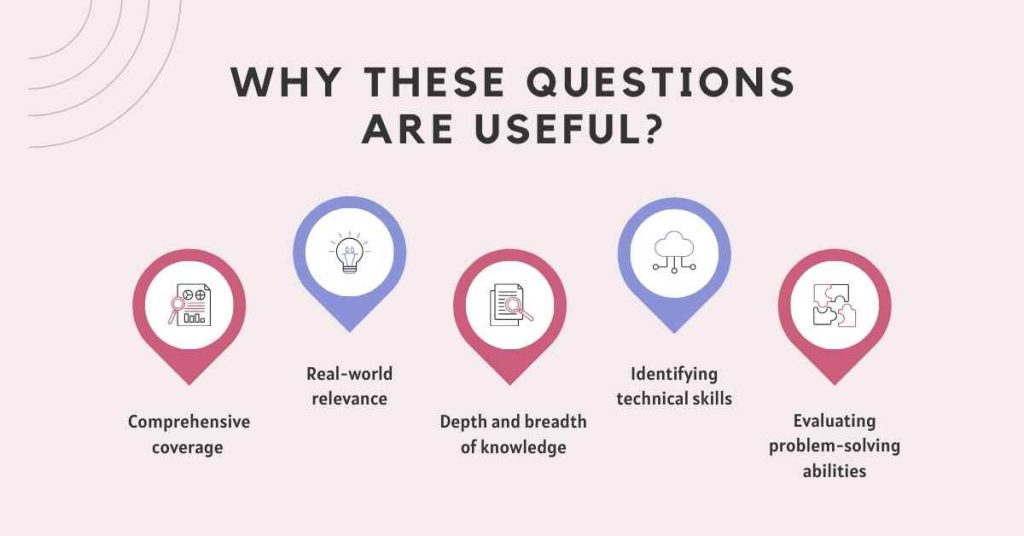
Knowing why you are learning something is as important as learning that topic. That’s why we have tried to also answer the question as to why the above questions are important for you.
1. Comprehensive coverage
These cover a broad category of penetration testing and includes networking, operating systems, web applications, security frameworks compliance and many others. This assists in establishing the candidate’s general awareness and comprehension of the penetration testing subject.
2. Real-world relevance
Also, a majority of the questions have been developed from real-life penetration testing engagements, thus making them more practical. This is useful to assess the level of critical, analytical thinking of a candidate, as well as the ability to use the knowledge obtained in real-life situations.
3. Depth and breadth of knowledge
The questions enhance the candidate’s knowledge of the fundamentals of penetration testing as well as the advanced level. This assists in determining the candidates who demonstrate adequate knowledge in the field and also can reason and plan.
4. Identifying technical skills
Some of the questions are procedural like tools, languages, and protocols that are used in networking. This is useful in determining a candidate’s practical experience and their capacity to execute certain functions of penetration testing.
5. Evaluating problem-solving abilities
Some questions are in the form of cases or dilemmas that test the candidate’s analytical skills and their ability to propose original solutions. This is useful in assessing the candidate’s problem-solving abilities, which are critical in penetration testing.
Summary: Top 50 Most Asked Penetration Testing Interview Questions for Experienced
Here is the summary of the “Top 50 Most Asked Penetration Testing Interview Questions for Experienced” article.
- What are the differences between Windows and Linux from a security perspective?
- How do you exploit a buffer overflow vulnerability in Windows?
- What is ASLR, and how does it affect exploitation?
- How do you perform a privilege escalation attack on Linux?
- What is the concept of a kernel exploit, and how does it work?
- What is the OWASP Top 10, and how do you address these vulnerabilities?
- How do you perform an SQL injection attack, and what tools do you use?
- What is cross-site scripting (XSS), and how do you exploit it?
- What is cross-site request forgery (CSRF), and how do you prevent it?
- How do you test for insecure direct object reference (IDOR) vulnerabilities?
- What is the difference between symmetric and asymmetric encryption?
- How do you crack an encrypted password using a dictionary attack?
- What is the concept of a man-in-the-middle (MITM) attack, and how does it work?
- How do you perform a cryptoanalysis attack on an encrypted message?
- What is the difference between a digital signature and a digital certificate?
- What are the PTES Technical Guidelines, and how do you use them?
- How do you plan and execute a penetration test, and what are the key stages?
- What is the importance of scope, rules of engagement, and threat modelling in a penetration test?
- How do you prioritize vulnerabilities and create a remediation plan?
- What is the concept of a “get out of jail free” card in penetration testing?
- What is Nmap, and how do you use it for network reconnaissance?
- How do you use Nessus, OpenVAS, or ZAP for vulnerability scanning?
- What is Metasploit, and how do you use it for exploitation?
- How do you use Burp Suite for web application scanning?
- What is Kali Linux, and how do you use it for penetration testing?
- How do you exploit a vulnerability using a zero-day exploit?
- What is the concept of a payload, and how do you use it in exploitation?
- How do you perform a reverse shell attack, and what tools do you use?
- What is the concept of a zombie network, and how does it apply to penetration testing?
- How do you use Meterpreter for post-exploitation activities?
- What is HIPAA, and how does it apply to penetration testing?
- How do you comply with PCI-DSS requirements for penetration testing?
- What is NERC, and how does it relate to penetration testing in the energy industry?
- How do you perform a penetration test for a company in the finance industry?
- What is GDPR, and how does it affect penetration testing in the EU?
- How would you perform a penetration test for a company with a cloud-based infrastructure?
- What would you do if you discovered a vulnerability in a third-party library?
- How would you test for insider threats in an organization?
- What would you do if you were able to gain access to a sensitive database?
- How would you perform a social engineering attack on a company?
- What is the difference between a white-hat, grey-hat, and black-hat hacker?
- How do you stay organized and manage your time during a penetration test?
- What is the importance of communication and reporting in penetration testing?
- How do you handle multiple projects and tasks as a penetration tester?
- What is the concept of continuous learning, and how does it apply to penetration testing?
- What is a hash function, and how is it used in cryptography?
- What is the OSSTMM (Open Source Security Testing Methodology Manual)?
- What is ZAP (Zed Attack Proxy), and how is it used in web application scanning?
- What is the Windows Registry, and how is it used in Windows security?
- Can you provide an example of a challenging penetration test you’ve conducted in the past?
Conclusion
This comprehensive guide of 50 penetration testing interview questions provides a valuable resource for organizations to identify and hire top talent.
Covering a wide range of topics, these questions assess a candidate’s technical expertise, problem-solving abilities, and soft skills. By incorporating these questions into their hiring process, organizations can confidently select the right candidate to conduct effective penetration testing and improve their overall cybersecurity posture.
FAQs
1. What should I do to prepare for a penetration testing interview?
Ans: Review the fundamentals of penetration testing, including networking, operating systems, and web applications. Practice with tools like Nmap, Metasploit, and Burp Suite. Brush up on relevant certifications like OSCP, CEH, or CISSP.
2. How can I demonstrate my skills and experience in penetration testing?
Ans: Share your projects, bug bounty experiences, or contributions to open-source security tools. Highlight your skills in reconnaissance, vulnerability identification, exploitation, and reporting.
3. What are the key soft skills required for a penetration tester?
Ans: Effective communication, teamwork, and problem-solving skills are essential. Be prepared to explain complex technical concepts to non-technical stakeholders and work collaboratively with development teams.
4. How can I stay up-to-date with the latest trends and techniques in penetration testing?
Ans: Follow industry leaders, blogs, and news outlets. Participate in online forums like Reddit’s Netsec community, Stack Overflow, and GitHub. Attend conferences, workshops, and webinars to stay current with the latest tools and methodologies.
5. What are the most common mistakes to avoid in a penetration testing interview?
Ans: Lack of preparation, poor communication skills, and inability to think critically under pressure. Be honest about your limitations and avoid exaggerating your experience or skills.
