

Top 15 Reasons Why Cloud VAPT is Important for Businesses in UAE
In the current environment in the United Arab Emirates (UAE), more and more organizations are adopting cloud-based computing for their information storage, data management, and data processing needs.
Although cloud computing brings many advantages, which are scalability, flexibility and reasonable price, at the same time it exposes organizations to new security threats.
Certain risks can be involved in cloud services, and Cloud Vulnerability Assessment and Penetration Testing (VAPT) is the way through which businesses can tackle them.
In this article let’s discuss the List of Top 15 Reasons Why Cloud VAPT is Important for Businesses in the UAE.
List of Top 15 Reasons Why Cloud VAPT is Important for Businesses in UAE

Here is the list of the Top 15 Reasons Why Cloud VAPT is Important for Businesses in the UAE:
1. Protection of Sensitive Data
Cloud VAPT also assists a company in guarding the company’s confidential information from theft, holding, and breaches.
Such steps make it possible for businesses to prevent cyber-attacks on the cloud infrastructure by identifying areas of weakness.
2. Compliance with Regulations
The UAE remains committed to protecting data and has put strict measures and laws regarding data protection and cybersecurity.
Cloud VAPT assists in these compliance needs, at the instance of the business, the UAE Cybercrime Law, and the Dubai Data Protection Law.
Thus, compliance with the rules of VAPT enables businesses to prove the company’s data security and avoid paying fines for non-compliance.

3. Prevention of Financial Losses
Businesses tend to suffer a huge loss as a result of cyber attacks. Cloud VAPT is useful in providing an organization with the means to know the various weaknesses that can cause financial loss and how to avoid them.
Thus, Cloud VAPT can prove cost-effective in saving millions of dirhams that may be lost if vulnerable points are exploited.
4. Protection of Reputation
The cyber threat could also prove detrimental to a business’s credibility and indeed customers’ confidence in a business. Cloud VAPT ensures that a company’s reputation is safeguarded as well as pre-empting any cyber attack that may be likely to occur on the business.
In turn, this concern ensures that customer’s trust and loyalty are achieved so that businesses may work diligently to protect their data.
5. Identification of Vulnerabilities
Cloud VAPT assists organisations in detecting the risks, which may include misconfiguration of cloud settings, the use of common and easily guessable passwords, and the deployment of outdated software on the cloud networks.
If these areas are identified, business firms can begin exercising preventive measures that would help in eliminating cyber threats.
6. Improvement of Incident Response
Cloud VAPT assists organizations in increasing their reaction to the targeted security threats by pointing out the existing potential weak points in their systems and identifying ways to counteract cyberattacks.
If a business has a good framework of incident response then the damage of the cyber-attack will be mitigated and the amount of time lost will be cut down.
7. Compliance with International Standards
Cloud VAPT assists in compliance of companies with global standards mainly ISo 27001 and PCI-DSS.
Consequently, frequent VAPT helps organizations present the necessary credentials and proof of compliance with best practices and standard requirements.
8. Protection of Intellectual Property
Cloud VAPT also ensures that so many company’s IP’s are not vulnerable to theft and unauthorized access.
From this, a business person can conduct an assessment of areas of weakness within the cloud infrastructure as a way of protecting their IP and Software against cyber perpetrators.
9. Improvement of Cloud Security Posture
Cloud VAPT involves the assessment of the cloud security risk and planning the best way of addressing any issues that are identified.
With good cloud security, the chances of cyber-attacks can be prevented hence safeguarding the data of any business.
10. Reduction of Risk
Cloud VAPT assists organizations to be secure from cyber threats and prevent exploitation by evaluating the potential of cybersecurity risks and rectifying the issues.
In today’s world, the ability to offset a cyber-attack is critical, as this will allow for minimizing its consequences and the length of time needed to deal with it.
11. Improvement of Compliance with Cloud Service Providers
Cloud VAPT assists organisations in enhancing their compliance with CSPs including AWS and Microsoft Azure.
As a result, regular VAPT can prove that a business entity is dedicated to data protection and compliance with CSP regulations.
12. Protection of Customer Data
Cloud VAPT ensures through different ways that the clients’ details are secure and cannot be hacked, stolen or breached.
Businesses can know weaknesses in cloud infrastructure and safeguard customers’ data from attackers’ attacks.
13. Improvement of Business Continuity
Cloud VAPT assists the continuity of an organisation by spotting risks and planning on how to deal with cyber threats.
In essence, businesses should enact a good business continuity plan to reduce the effects of cyber-attacks and to reduce the period of disruption.
14. Reduction of Downtime
Cloud VAPT also enables organisations to prevent businesses from being closed down for a long time by fixing the holes that had been identified.
If the downtime is reduced, the consumption of the customers’ confidence will also be reduced, and the business functioning will continue calmly in the event of a cyber-attack.
15. Improvement of Return on Investment (ROI)
Cloud VAPT helps businesses improve their ROI by identifying vulnerabilities and taking proactive measures to remediate them.
By reducing the risk of cyber-attacks, businesses can minimize the impact of a breach and reduce downtime, resulting in improved ROI.
Top 6 Best Practices for Cloud VAPT
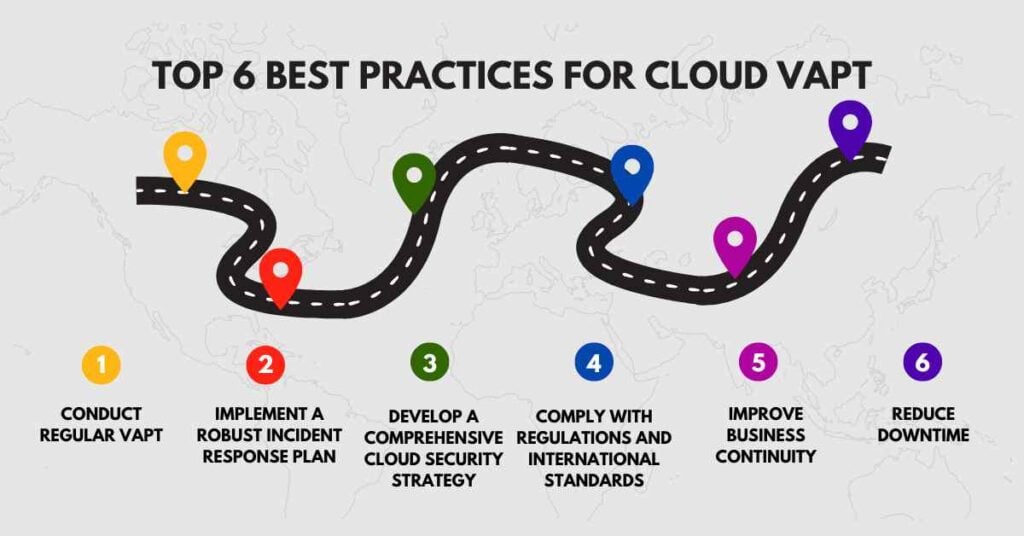
Cloud Vulnerability Assessment and Penetration Testing (VAPT) is a critical process that helps businesses identify and mitigate security risks in their cloud infrastructure. To get the most out of Cloud VAPT, businesses should follow best practices, including:
1. Conduct Regular VAPT
It ensures that there are regular VAPTs to check for weaknesses and take appropriate action on the same.
To effectively support the growing cloud structures, VAPT should be done at least once every three months, or when there have been any changes done to the cloud system.
2. Implement a Robust Incident Response Plan
Cybersecurity has emergency requirements to address any potential cyber-attacks; thus, formulate a sound incident response plan.
Any organisation should have a clear documented procedure of how to identify, isolate, and eradicate security incidences and should form part of every business.
3. Develop a Comprehensive Cloud Security Strategy
Cloud security is a critical issue that requires the formulation of adequate strategies and measures.
Organizations should ensure that they come up with strategies that address the following issues on cloud security; This involves setting up policies, processes and technologies for use in the cloud environment.
4. Comply with Regulations and International Standards
There is a need to meet regulatory and international standards to effectively provide secure and reliable cloud infrastructures.
Many countries including the UAE have legislation such as the UAE Cybercrime Law and the Dubai Data Protection Law in place and the Board of International Organizations enshrined international standards such as ISO 27001 and PCI-DSS.
5. Improve Business Continuity
Business continuity should therefore be enhanced in a bid to reduce the effects of a cyber-attack.
Organizations need to have a business continuity plan because it is helpful in the protection of organizations from cyber-attacks and reduction of downtime.
6. Reduce Downtime
Reducing the duration of a system shutdown is quite important to reduce the effects of a cyber-attack.
Enterprises should create a contingency plan as to minimize schedule loss and outline the methods of recognizing and eradicating risks and vulnerability, and the particular course of action to follow in case of an attack.
Summary
Here is the summary of this blog titled “Top 15 Reasons Why Cloud VAPT is Important for Businesses in UAE“
- Protection of Sensitive Data
- Compliance with Regulations
- Prevention of Financial Losses
- Protection of Reputation
- Identification of Vulnerabilities
- Improvement of Incident Response
- Compliance with International Standards
- Protection of Intellectual Property
- Improvement of Cloud Security Posture
- Reduction of Risk
- Improvement of Compliance with Cloud Service Providers
- Protection of Customer Data
- Improvement of Business Continuity
- Reduction of Downtime
- Improvement of Return on Investment (ROI)
Conclusion
Cloud VAPT is a critical process that helps businesses in the UAE protect their sensitive data, comply with regulations, and prevent financial losses.
By conducting regular VAPT, businesses can identify vulnerabilities, improve their incident response capabilities, and reduce the risk of cyber-attacks. And can demonstrate their commitment to data security and maintain customer trust and loyalty. By following best practices, companies can ensure the security and integrity of their cloud infrastructure and protect their sensitive data from cyber-attacks.
FAQs: Top 15 Reasons Why Cloud VAPT is Important for Businesses in UAE
1. What is Cloud VAPT?
Ans: Cloud VAPT (Vulnerability Assessment and Penetration Testing) is a process of identifying and mitigating security risks in cloud infrastructure and applications. It involves a combination of vulnerability scanning, penetration testing, and exploitation to identify vulnerabilities and weaknesses in the cloud infrastructure.
2. Why is Cloud VAPT important?
Ans: Cloud VAPT is important because it helps businesses identify and mitigate security risks in their cloud infrastructure and applications. This is critical to protect sensitive data and intellectual property from cyber-attacks and data breaches.
3. What are the benefits of Cloud VAPT?
Ans: The benefits of Cloud VAPT include improved security posture, reduced risk of cyber-attacks, improved compliance with regulations and international standards, and protection of sensitive data and intellectual property.
4. How often should I conduct Cloud VAPT?
Ans: It is recommended to conduct Cloud VAPT at least quarterly, or whenever there are significant changes to the cloud infrastructure or applications.
5. What are the different types of Cloud VAPT?
Ans: There are two types of Cloud VAPT: Vulnerability Assessment and Penetration Testing. Vulnerability Assessment involves identifying vulnerabilities in the cloud infrastructure and applications, while Penetration Testing involves simulating cyber-attacks to identify weaknesses and vulnerabilities.
6. What are the tools used for Cloud VAPT?
Ans: Some common tools used for Cloud VAPT include cloud security gateways, cloud access security brokers, cloud workload protection platforms, penetration testing tools, and vulnerability scanning tools.
7. How long does a Cloud VAPT take?
Ans: The duration of a Cloud VAPT depends on the scope and complexity of the cloud infrastructure and applications. Typically, a Cloud VAPT can take anywhere from a few days to several weeks.
8. What is the cost of Cloud VAPT?
Ans: The cost of Cloud VAPT depends on the scope and complexity of the cloud infrastructure and applications, as well as the type of testing required. Typically, the cost of Cloud VAPT can range from a few thousand dollars to tens of thousands of dollars.
9. Can I conduct Cloud VAPT myself?
Ans: While it is possible to conduct Cloud VAPT yourself, it is recommended to hire a professional Cloud VAPT service provider who has the necessary expertise and experience to conduct the testing.
10. What are the common Cloud VAPT methodologies?
Ans: Some common Cloud VAPT methodologies include the NIST Cybersecurity Framework, the OWASP Web Security Testing Guide, and the PTES (Penetration Testing Execution Standard).
