

Key Challenges in Cybersecurity for Enterprises and How SOCs Solve Them
In the fast-paced world of business, technology isn’t just a support function—it’s the backbone of operations, innovation, and customer engagement. But this reliance on technology comes with a significant downside: enterprises are now prime targets for cyberattacks. The stakes are high.
A single cyber incident can result in financial losses, operational disruptions, and irreversible damage to an organization’s reputation. For enterprises juggling complex infrastructures, growing data volumes, and stringent compliance requirements, cybersecurity can feel like a never-ending battle.
Enter the Security Operations Center (SOC)—a proactive solution designed to tackle cybersecurity challenges head-on. This blog explores the most pressing pain points enterprises face in cybersecurity and how SOCs address them, making the case for tailored SOC services.
Understanding the Cybersecurity Landscape for Enterprises
The threats facing enterprises today are diverse, relentless, and constantly evolving. Cybercriminals aren’t just targeting systems—they’re targeting the very lifeblood of organizations: their data, intellectual property, and customer trust.
A Few Sobering Stats:
- The average cost of a data breach in 2023 was $4.45 million, according to IBM.
- Ransomware attacks increased by over 13% last year, with enterprises being the most affected.
- Nearly 60% of small and medium-sized enterprises (SMEs) that experience a cyberattack close their doors within six months.
Key Cybersecurity Challenges for Enterprises

1. Complex IT Environments
Enterprises often operate with sprawling IT infrastructures, encompassing on-premise systems, cloud platforms, hybrid environments, and a growing array of connected devices. This complexity creates numerous entry points for attackers.
Pain Point: Visibility is a nightmare. IT teams struggle to monitor and secure such vast, fragmented environments effectively.
2. Growing Sophistication of Cyber Threats
Gone are the days of simple viruses or spam emails. Modern threats like Advanced Persistent Threats (APTs), ransomware, and supply chain attacks are designed to evade traditional defenses.
Pain Point: Legacy tools and reactive measures are no match for today’s dynamic and stealthy attack vectors.
3. Talent Shortage in Cybersecurity
The global cybersecurity talent gap exceeds 3.4 million professionals, according to (ISC)². For enterprises, finding and retaining skilled cybersecurity talent is a constant struggle.
Pain Point: Without the right expertise, identifying, analyzing, and responding to threats becomes nearly impossible.
4. Alert Fatigue
Security tools generate countless alerts daily. While most are false positives, a few may indicate real threats. Sorting through this noise overwhelms IT teams, leading to missed critical threats.
Pain Point: Overburdened teams may fail to act on genuine risks, leaving the organization exposed.
5. Compliance and Regulatory Pressure
Enterprises must navigate a maze of regulatory requirements, from GDPR and HIPAA to PCI DSS and CCPA. Non-compliance can result in severe penalties and loss of business opportunities.
Pain Point: Meeting these standards while ensuring operational continuity can feel like walking a tightrope.
6. Budget Constraints and ROI
Despite the critical need for cybersecurity, many enterprises operate under constrained budgets. Demonstrating the ROI of security investments is often challenging.
Pain Point: Balancing robust security with budgetary limitations is a constant challenge.
How SOCs Address These Challenges?
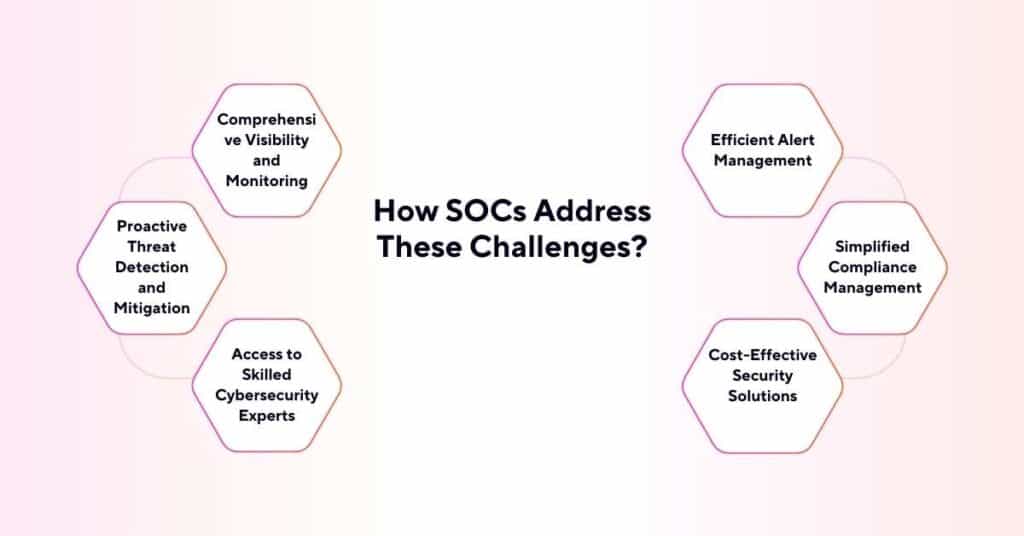
A Security Operations Center isn’t just a service it’s a strategic solution. Here’s how SOCs tackle these pain points:
1. Comprehensive Visibility and Monitoring
SOCs provide 24/7 monitoring across all parts of your infrastructure—cloud, on-premise, and hybrid environments. Using advanced tools like SIEM (Security Information and Event Management) and XDR (Extended Detection and Response), SOCs offer a unified view of your entire security landscape.
The Difference: You gain real-time insights and situational awareness, ensuring that no threat goes unnoticed.
2. Proactive Threat Detection and Mitigation
SOCs are equipped with advanced threat intelligence capabilities, enabling them to detect anomalies, identify potential threats, and respond swiftly.
The Difference: Instead of reacting to incidents, SOCs work proactively to neutralize risks before they cause harm.
3. Access to Skilled Cybersecurity Experts
When you partner with a SOC, you tap into a team of experienced professionals, including analysts, incident responders, and threat hunters.
The Difference: You get enterprise-grade expertise without the cost and hassle of building an in-house team.
4. Efficient Alert Management
Using automation and machine learning, SOCs filter out false positives and prioritize genuine threats, ensuring swift and accurate responses.
The Difference: Your team isn’t bogged down by alert fatigue, and critical issues are addressed without delay.
5. Simplified Compliance Management
SOCs maintain detailed logs, reports, and audit trails to simplify compliance with industry regulations. They also help identify gaps and implement measures to ensure your enterprise meets all requirements.
The Difference: You stay compliant without diverting internal resources or risking penalties.
6. Cost-Effective Security Solutions
With a SOC, enterprises can scale their cybersecurity capabilities without massive upfront investments. Managed SOC services, in particular, offer tailored solutions that align with your budget and needs.
The Difference: You achieve robust security at a fraction of the cost of building an in-house equivalent.
Tailored SOC Services: Why One Size Doesn’t Fit All
Every enterprise is unique, with distinct risks, goals, and infrastructures. Tailored SOC services take these factors into account, offering solutions designed to meet your specific needs.
For example:
- A retail enterprise may prioritize PCI DSS compliance and protection against point-of-sale malware.
- A healthcare provider may focus on safeguarding patient data and meeting HIPAA requirements.
- A technology company may emphasize intellectual property protection and defense against APTs.
Tailored SOC services ensure that you get precisely what you need no more, no less.
The Human Element of SOCs
Beyond the tools and technologies, a SOC is powered by people—people who genuinely care about keeping your business safe. These experts don’t just stop threats; they build trust, allowing you to focus on growth and innovation with confidence.
Conclusion
The cybersecurity challenges facing enterprises today aren’t going away. In fact, they’re only becoming more complex. A SOC isn’t just a nice-to-have it’s an essential part of any modern enterprise’s security strategy.
By addressing pain points like visibility, talent shortages, and compliance, SOCs offer not just protection but peace of mind. Tailored SOC services ensure that your enterprise gets the precise solutions it needs, enabling you to thrive in an increasingly digital world.
Ready to make cybersecurity a business enabler, not a headache? Let’s talk about how a SOC can transform your security strategy
