

The Business Case for AWS Pentesting: ROI and Risk Mitigation
Imagine this scenario: You’re running a successful business, leveraging AWS for cloud hosting, data storage, and application deployment. Everything is running smoothly—until one day, a critical misconfiguration in your AWS environment exposes sensitive customer data.
Before you can react, a malicious actor gains access to your S3 buckets, exfiltrates confidential files, and sells them on the dark web. Your customers lose trust, regulators slap you with compliance fines, and your company’s reputation takes a massive hit.
Sound extreme? Unfortunately, this isn’t fiction. Real-world breaches, such as the Capital One AWS breach (2019) and Accenture’s AWS misconfiguration exposure (2021), prove that cloud security is not just an IT concern—it’s a business imperative. Here in this article we are going to discuss about The Business Case for AWS Pentesting: ROI and Risk Mitigation
So, what can enterprises do to avoid this fate? AWS Penetration Testing (pentesting).
This blog will cover:
- The AWS security landscape & why pentesting is crucial
- Common AWS misconfigurations that put businesses at risk
- How AWS pentesting helps mitigate risk and strengthen security?
- The ROI of AWS pentesting and why it saves businesses millions
AWS Security Landscape: Understanding the Risks

1️. The Shared Responsibility Model – Who Secures What?
AWS operates on a Shared Responsibility Model, meaning that while AWS secures the cloud infrastructure, customers are responsible for securing their own applications, data, and configurations.
2️. What Makes AWS a Prime Target for Cyberattacks?
AWS is used by some of the world’s largest organizations, making it an attractive target for hackers. The most common AWS security risks include:
🔹 Misconfigured AWS Services
- S3 Buckets Left Publicly Accessible → Data leaks and ransomware risks.
- Overly Permissive IAM Policies → Attackers can escalate privileges.
- Unrestricted Security Groups → Open ports expose infrastructure to attacks.
- Unpatched EC2 Instances → Vulnerable to remote exploits.
🔹 Stolen AWS Access Keys & Credentials
- Hardcoded credentials in code repositories (e.g., GitHub leaks).
- Phishing attacks targeting AWS IAM users.
- Lack of Multi-Factor Authentication (MFA) for privileged accounts.
🔹 Insufficient Cloud Monitoring
- CloudTrail logging disabled, making forensic investigations impossible.
- No automated alerting for suspicious IAM activity.
- Lack of real-time security monitoring tools like GuardDuty.
With these risks in mind, how can businesses proactively identify and eliminate vulnerabilities before attackers exploit them?
Why AWS Pentesting is Crucial for Enterprises?

1️ . What is AWS Pentesting?
AWS penetration testing simulates real-world cyberattacks against your AWS infrastructure to uncover security weaknesses before hackers find them. It goes beyond automated vulnerability scans, helping businesses:
✔ Detect weak configurations in IAM, S3, EC2, and more.
✔ Identify privilege escalation risks within AWS roles.
✔ Assess network security by testing security groups and VPCs.
✔ Simulate real-world attacks to evaluate incident response.
AWS pentesting validates your cloud security posture by mimicking an attacker’s approach, exposing hidden security flaws that could lead to data breaches, financial losses, and compliance violations.
2️ AWS Pentesting Rules and Scope
AWS has specific guidelines and policies for conducting penetration testing. The good news? AWS allows security testing for certain services without prior approval, including:
- Amazon EC2 Instances
- Amazon RDS (Relational Database Service)
- Amazon CloudFront
- Amazon API Gateway
- AWS Lambda Functions
However, AWS prohibits testing that could impact other AWS customers, such as:
- DDoS attacks
- Disruptive tests on AWS infrastructure
- Targeting AWS management services (IAM, Route 53, etc.)
Proper pentesting ensures compliance with AWS policies while thoroughly evaluating security weaknesses.
Step-by-Step AWS Pentesting Methodology
AWS pentesting follows a structured attack simulation methodology:
1️ Reconnaissance & Enumeration
- Identify AWS services in use (EC2, RDS, S3, IAM, etc.).
- Detect exposed endpoints and public resources.
- Extract IAM user information and policies.
2️ Vulnerability Assessment
- Scan for open ports and unrestricted security groups.
- Check for exposed S3 buckets and leaked credentials.
- Identify privilege escalation paths in IAM roles.
3️ Exploitation & Privilege Escalation
- Exploit misconfigurations to gain unauthorized access.
- Use stolen IAM keys to escalate privileges.
- Extract sensitive data from exposed cloud storage.
4️ Reporting & Remediation
- Provide detailed risk assessments for stakeholders.
- Suggest mitigation strategies for each identified vulnerability.
- Ensure AWS compliance and strengthen security controls.
The ROI of AWS Pentesting: Cost vs. Risk
How Much Does a Data Breach Cost?
- Average cost of a cloud data breach (2023): $4.45 million (IBM Report).
- Cost of AWS Pentesting: A fraction of that, depending on scope.
Why AWS Pentesting is a Smart Business Investment?
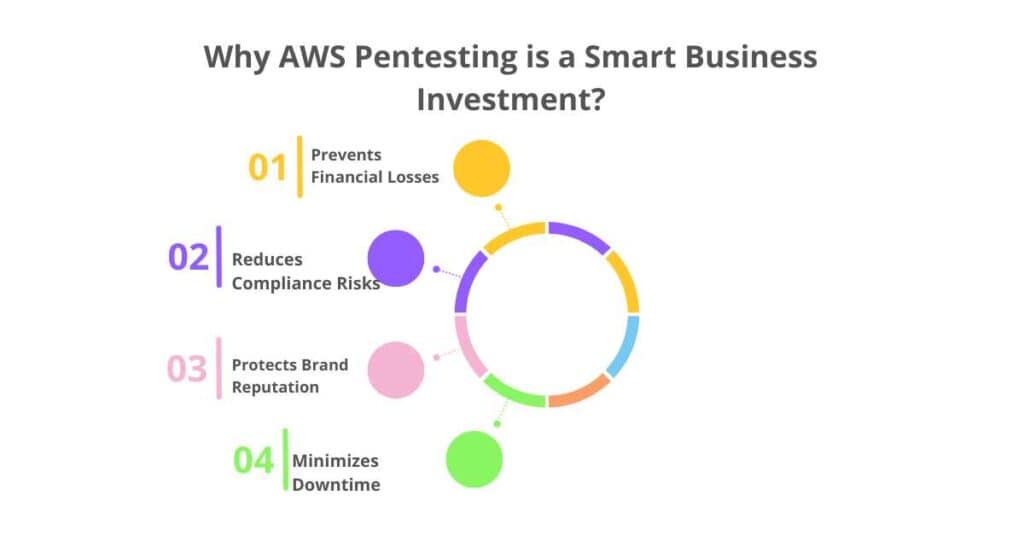
1. Prevents Financial Losses
Avoids legal penalties, lawsuits, and ransomware costs.
2. Reduces Compliance Risks
Ensures GDPR, HIPAA, SOC 2 adherence.
3. Protects Brand Reputation
A breach can permanently damage customer trust.
4. Minimizes Downtime
Security incidents can disrupt operations and cost revenue.
A single misconfiguration in AWS can expose millions of records, leading to hefty fines, lost customers, and reputational damage. Investing in AWS pentesting proactively eliminates risks, making it a high-ROI security measure.
Final Thoughts: The Business Case for AWS Pentesting: ROI and Risk Mitigation
AWS security is complex, and even small misconfigurations can have devastating consequences. Organizations must take a proactive approach by conducting regular AWS pentesting to:
- Identify security gaps before attackers do.
- Mitigate financial, reputational, and compliance risks.
- Strengthen AWS security posture and incident response.
