

How AWS Pentesting Helps Reduce Risks, Meet Compliance, and Protect Data?
Imagine your company is running a high-growth SaaS business, hosting critical customer data on AWS. One morning, you wake up to a nightmare—your AWS environment has been breached. Sensitive customer data is exposed, regulators are knocking on your door, and your brand reputation is in shambles.
This is not just a hypothetical scenario. Many enterprises, including Capital One, Accenture, and Facebook, have suffered massive breaches due to AWS misconfigurations, weak IAM policies, and exposed credentials. Here in this article lets discuss about the How AWS Pentesting Helps Reduce Risks, Meet Compliance, and Protect Data
The reality is misconfigurations are the leading cause of cloud security incidents, and they often go unnoticed until it’s too late. That’s where AWS penetration testing (pentesting) becomes critical.
- Detect and fix vulnerabilities before attackers exploit them
- Meet compliance requirements (ISO 27001, SOC 2, PCI DSS, GDPR, HIPAA, etc.)
- Protect sensitive business and customer data
- Improve overall cloud security posture and reduce financial risks
In this blog, we’ll break down:
- How AWS pentesting helps reduce risks and improve security.
- Why it’s essential for meeting compliance standards.
- The ROI of investing in proactive security testing.
By the end, you’ll understand why AWS pentesting is a business necessity, not just an IT practice.
Why AWS Pentesting is Critical for Risk Reduction?

AWS is powerful, flexible, and scalable—but it’s not inherently secure out-of-the-box. The AWS Shared Responsibility Model places the burden of securing applications, configurations, and identity management on businesses.
Here’s how pentesting helps mitigate risks:
1️ . Identifies and Fixes AWS Misconfigurations
Misconfigurations account for 80% of cloud security breaches. AWS pentesting helps:
- Identify publicly accessible S3 buckets leaking sensitive data.
- Detect overly permissive IAM roles that allow privilege escalation.
- Scan for exposed EC2 instances with weak security groups.
- Ensure encryption is properly enabled for RDS, EBS, and S3 storage.
2️ Protects Against Credential Theft and Privilege Escalation
Stolen AWS credentials can lead to full account compromise. Attackers often:
- Find hardcoded AWS keys in GitHub repositories.
- Exploit unprotected EC2 metadata APIs to steal temporary credentials.
- Abuse overly permissive IAM roles to escalate privileges and gain root access.
AWS pentesting simulates real-world attacks to ensure your IAM policies, access controls, and logging mechanisms can detect and prevent unauthorized access.
3️ Strengthens AWS Network Security and API Protections
Attackers frequently target open ports, unprotected APIs, and misconfigured VPCs.
- Are your security groups too permissive? (e.g., open SSH ports 22/0.0.0.0)
- Do your API Gateways have proper authentication and rate-limiting?
- Are your AWS Lambda functions exposed to unauthorized execution?
Pentesting helps secure AWS networking and API layers against common threats.
Meeting Compliance Standards with AWS Pentesting
Every industry has strict regulatory requirements for protecting customer data. If your AWS environment is handling sensitive information, you’re likely required to meet compliance standards such as:
| Compliance Framework | AWS Pentesting Role |
|---|---|
| ISO 27001 | Validates risk management processes. |
| SOC 2 Type II | Ensures security, availability, and data integrity. |
| PCI DSS (for payment data) | Detects vulnerabilities in AWS environments handling cardholder data. |
| GDPR (for EU businesses) | Ensures personal data is securely stored and processed. |
| HIPAA (for healthcare) | Validates encryption and access controls for ePHI data. |
How AWS Pentesting Helps with Compliance
- Identifies security gaps before auditors do.
- Provides documented evidence of security testing for audits.
- Reduces the risk of fines and non-compliance penalties.
- Strengthens AWS security controls to meet regulatory requirements.
Companies that ignore pentesting often face hefty fines and reputational damage due to non-compliance.
The ROI of AWS Pentesting: Why It’s a Smart Business Investment
- The average cost of a cloud data breach (2023): $4.45 million (IBM Report).
- Financial penalties for non-compliance: PCI DSS fines can reach up to $500,000 per incident.
- Cost of AWS Pentesting: A fraction of the cost of a breach.
Why Pentesting Saves More Than It Costs?
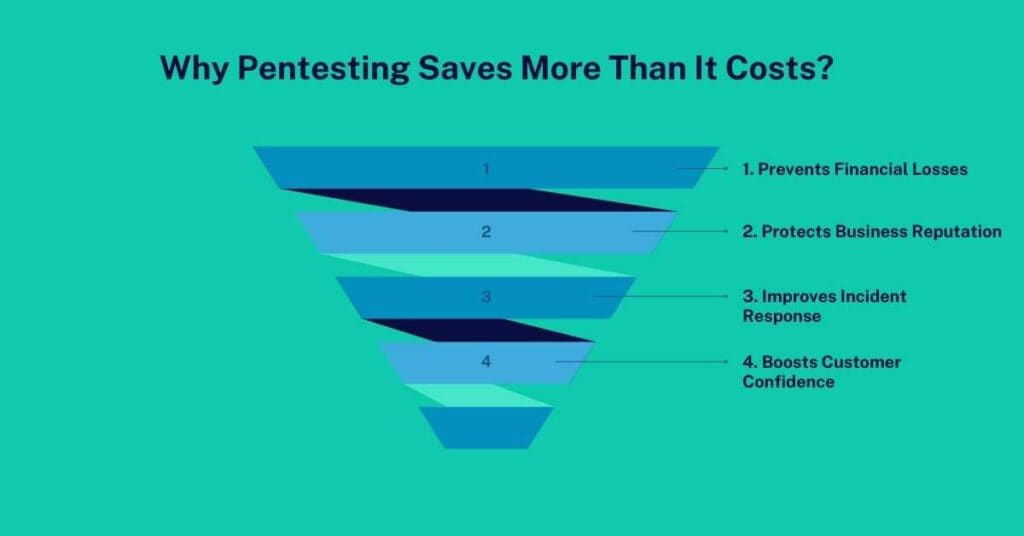
1. Prevents Financial Losses
Avoids ransomware, legal fees, and regulatory fines.
2. Protects Business Reputation
A breach leads to customer churn and lost trust.
3. Improves Incident Response
Helps your security team detect and respond faster.
4. Boosts Customer Confidence
Security-conscious customers prefer vendors with strong cloud security.
For B2B enterprises, a single AWS misconfiguration can result in millions of dollars in lost revenue. Investing in pentesting mitigates this risk while ensuring long-term security.
Final Thoughts: How AWS Pentesting Helps Reduce Risks, Meet Compliance, and Protect Data
AWS pentesting is not just a security best practice it’s a business enabler. Organizations that proactively test their cloud security posture:
Reduce financial and operational risks.
Ensure compliance with industry standards.
Safeguard customer data and maintain brand trust.
Gain a competitive edge by demonstrating strong security posture.
