
Difference Between Phishing and Anti Phishing Tools?
In today’s interconnected world, phishing remains one of the most common and damaging cyber-attacks. From fake emails mimicking banks to deceptive text messages, phishing scams trick unsuspecting users into handing over sensitive data. To fight back, organisations deploy anti-phishing tools—automated solutions that detect, block and remediate these threats before they reach end users. Understanding the difference between phishing and anti phishing tools is crucial for anyone looking to bolster their cyber-defence.
What Is Phishing?
Think of phishing as the digital version of someone dressing up in a convincing disguise—perhaps a bank officer or dear friend—to steal your secrets. In cyber-land, these crooks send out bait—emails, texts or calls—laced with malicious hooks to swipe your passwords or bank details.
Common Phishing Techniques: A Thief’s Toolkit
- Email Phishing: Bulk messages promising urgent action (“Your account will close!”) that hide poisonous links.
- Spear Phishing: Laser-focused darts aimed at specific folks—think CEO scams.
- Whaling: The big fish get targeted—top executives receive bespoke cons.
- Smishing & Vishing: Texts (smishing) and calls (vishing) that impersonate your mobile provider or tech support.
“If it sounds too good to be true, it probably is.”
Impact of Phishing Attacks
Phishing isn’t just a nuisance; it’s a burglar kicking down your door:
- Financial loss: Direct theft or bogus transactions.
- Data breaches: Customer or internal information spilling out.
- Reputation hit: Once trust is broken, it’s hard to rebuild.
- Malware infections: Gates left wide open for ransomware and spyware.
What Are Anti-Phishing Tools?
Picture an elite squad of cyber-dogs, sniffing out each suspicious sniff and snarling at any phishing attempt. Anti-phishing tools are those vigilant guards—software and services that automatically detect, block and remediate phishing attacks before they reach your inbox or browser.
Categories of Anti-Phishing Solutions: Your Digital Defence Arsenal
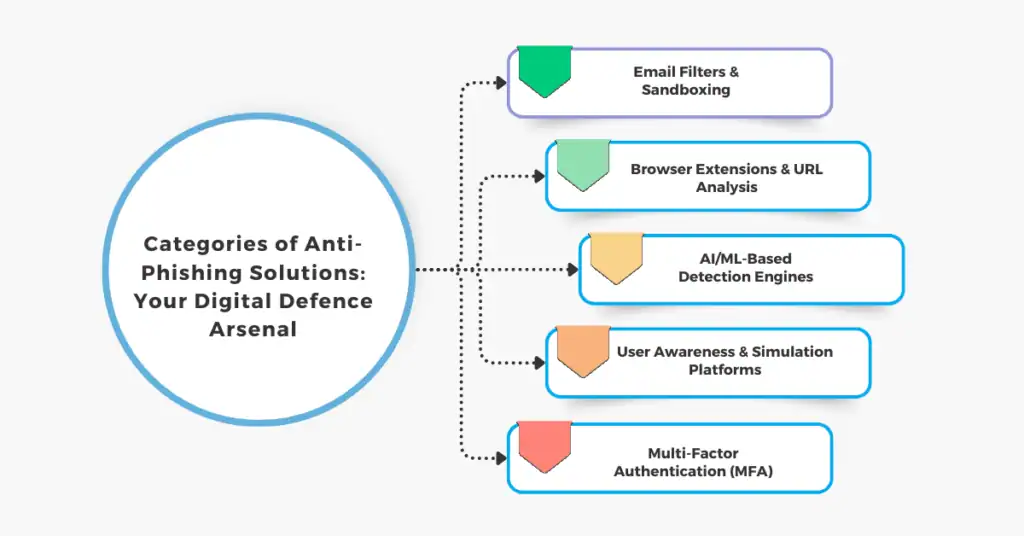
- Email Filters & Sandboxing
- Browser Extensions & URL Analysis
- AI/ML-Based Detection Engines
- User Awareness & Simulation Platforms
- Multi-Factor Authentication (MFA)
| Category | Primary Function | Example |
|---|---|---|
| Email Filters & Sandboxing | Block malicious emails; open attachments safely | Exchange Online Protection |
| Browser Extensions & URL Analysis | Warn about or block phishing sites | CyberSapiens Browser Guard |
| AI/ML-Based Detection | Analyse patterns in real time | CyberSapiens Threat AI |
| Awareness & Simulation | Train employees via controlled phishing simulations | PhishAware by CyberSapiens |
| Multi-Factor Authentication | Add second-factor verification to logins | Microsoft Authenticator |
Key Differences Between Phishing and Anti-Phishing Tools
- Offence vs Defence: Phishing is the crook’s play; anti-phishing tools are the alarm system.
- Human vs Technical: Phishing preys on emotions; tools rely on algorithms, policies and AI.
- Proactive vs Reactive: Attackers innovate new scams; defences must adapt and learn.
Just as you wouldn’t chase the pickpocket alone, you need both savvy users and robust tools to stay safe.
Comparing Types: Phishing Techniques vs Anti-Phishing Tools
1. Email-Based Attacks vs Email Security Solutions
- Phishing: Malicious links or attachments hidden in innocent-looking emails.
- Counter: Filters strip out fishy URLs, sandbox attachments and enforce DMARC checks.
2. Malicious Websites vs Browser Defences
- Phishing: Fake login portals that look just like the real deal.
- Counter: Real-time URL reputation checks, certificate validation and warning banners.
3. Credential Harvesting vs Authentication Controls
- Phishing: Harvests usernames and passwords like picking fruit.
- Counter: MFA adds a second lock, making stolen credentials useless without the second key.
How Anti-Phishing Tools Detect & Prevent Attacks
- Heuristic & Signature Detection: Known patterns trigger instant blocks.
- Machine Learning & AI: Learns new tricks faster than a cat learns new habits.
- URL Analysis & Sandboxing: Links and files get “quarantined” in a virtual lab.
- Real-Time Alerts & Warnings: Pop-ups shout “Stop! This site is dangerous!”
Anecdote: When a finance manager clicked a fake invoice link, CyberSapiens Threat AI flagged it mid-download, quarantined the payload and sent an alert before any files executed. Crisis averted.
Limitations of Anti-Phishing Tools
- False Positives: Legit messages get blocked, causing head-scratching in IT.
- False Negatives: Sneaky new scams slip past the net.
- Evasion: Attackers mimic homograph domains (e.g. “раypal.com”).
- Deployment Hurdles: Complex integration, user alert fatigue.
Best Practices for Organisations
- Layered Defence: Stack email filters, AI engines and MFA with user training.
- Incident Response: Have a hotline—”See something phishy? Report it!”
- Regular Drills: Simulate attacks with CyberSapiens PhishAware to keep everyone on their toes.
- Policy Reviews: Quarterly check-ups to ensure rules and tools stay razor-sharp.
Conclusion
In a nutshell, the difference between phishing and anti-phishing tools is a tale of attacker versus defender. Phishing weaves cunning traps; anti-phishing tools cut through deception with AI, sandboxing and trained staff. By combining CyberSapiens’ comprehensive suite with savvy users, organisations can turn the tide and keep those pesky cyber-pickpockets at bay.
FAQs
1. What is the main difference between phishing and anti-phishing tools?
Phishing is the scam itself; anti-phishing tools are the shields that detect and block those scams.
2. Can anti-phishing tools catch every phishing email?
While highly effective, no solution is perfect; savvy user training remains essential.
3. Which solution suits small businesses best?
A combo of cloud-based email filtering plus CyberSapiens Browser Guard offers strong, budget-friendly protection.
4. How often should defences be updated?
Ideally, in real time—but at minimum, daily updates for signatures and AI models.
5. What role does AI play in anti-phishing?
AI spots new, never-seen-before phishing patterns by learning from vast datasets.
