
Which pillar defines the purpose of the security operations team to the business and how it will be managed?
The Security Operations Team (SecOps) plays a vital role in safeguarding an enterprise’s information assets, ensuring operational continuity, and protecting the organization’s reputation.
But what defines the core purpose of a security operations team to the business? Among the fundamental pillars of cyber security, the pillar that distinctly shapes this purpose—and dictates how the team will be managed—is the Risk Management pillar. This article explores Which pillar defines the purpose of the security operations team to the business and how it will be managed?
The Pillars of Cyber Security and Their Relation to SecOps

Before delving into why Risk Management is central, it is crucial to understand the broader pillars commonly recognized in cyber security frameworks. Typically, these pillars include:
1. Confidentiality
Ensuring that sensitive information is accessed only by authorized parties.
2. Integrity
Protecting data from being altered by unauthorized users.
3. Availability
Keeping systems and information accessible when needed.
4. Risk Management
Identifying, assessing, and mitigating risks to an acceptable level.
Why Risk Management Defines the Purpose of SecOps?
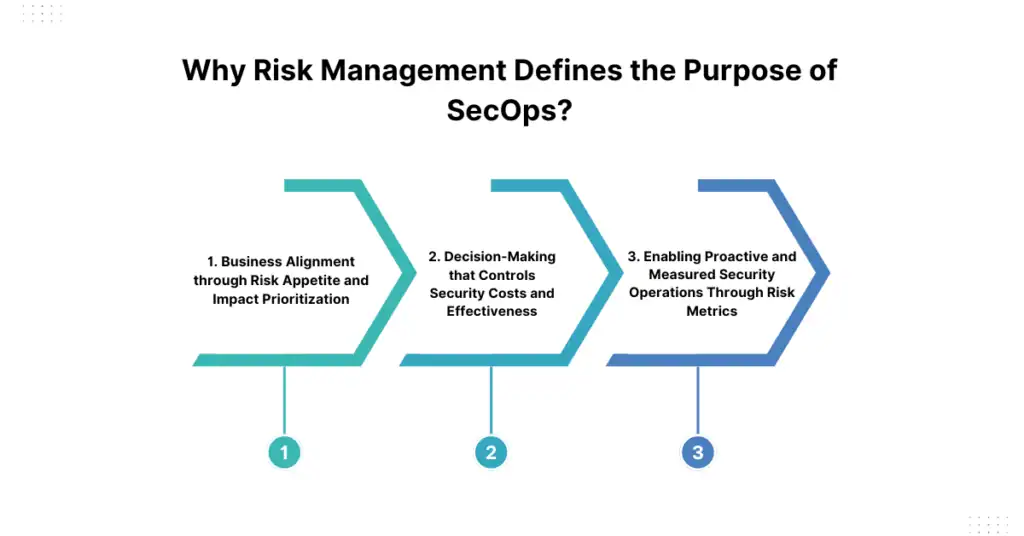
1. Business Alignment through Risk Appetite and Impact Prioritization
Every organization has a distinct risk appetite — the level of risk it is willing to accept in pursuit of its objectives. The security operations team’s role transcends mere technical defense; it must function as a strategic partner that understands and reflects this risk appetite in its daily operations.
Risk Management is about understanding which assets and processes are most critical to the business and what threats could disrupt them. SecOps uses this understanding to prioritize events, allocate resources efficiently, and respond proportionately to incidents that could jeopardize business outcomes. For instance, protecting customer data in a financial services firm requires a different priority scale compared to securing intellectual property in a manufacturing firm.
Therefore, Risk Management defines SecOps’s purpose by bridging cyber security activities with business risks and making the security team a custodian of business continuity.
2. Decision-Making that Controls Security Costs and Effectiveness
Resources—whether human, technological, or financial—are limited. Risk Management empowers SecOps to make data-driven decisions on where to invest in defenses, detection, and response capabilities by objectively assessing threats and vulnerabilities.
Without this risk-oriented focus, SecOps might be reactive, over-utilizing resources on less critical issues or under-preparing for high-impact threats. Risk Management provides a framework to balance security investments against potential business impacts, ensuring budget and effort contribute to meaningful risk reduction.
This prioritization supports the business by safeguarding its most valuable assets efficiently and justifies the security team’s existence as a driver of value rather than cost.
3. Enabling Proactive and Measured Security Operations Through Risk Metrics
The purpose of SecOps is not just to respond to incidents but also to minimize incident occurrence through early detection and threat hunting. Risk Management provides the framework for continuous assessment of the threat landscape and emerging risks.
By establishing clear risk metrics—for example, risk exposure levels, vulnerability rates, or mean-time-to-detect—security operations can be continuously tuned and its effectiveness measured quantitatively. These metrics offer leadership visibility into risk trends, facilitating proactive management of security posture aligned with business priorities.
This approach ensures SecOps is seen as a proactive guardian of business resilience, not just a reactive incident handler.
How Risk Management Guides the Management of Security Operations?
Understanding that Risk Management is pivotal to defining purpose naturally influences how the security operations team should be managed.
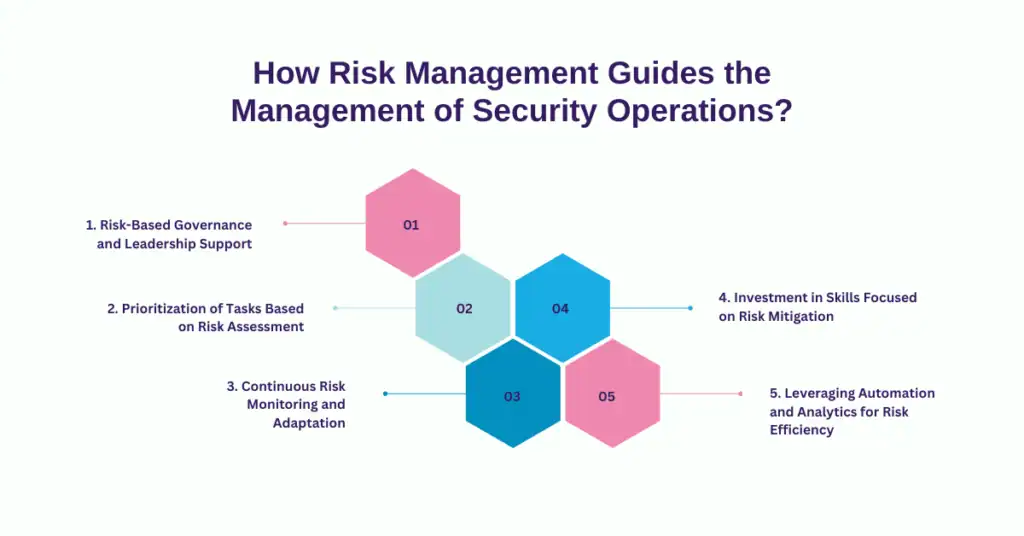
1. Risk-Based Governance and Leadership Support
Effective security operations management begins with governance structures that embed risk perspectives. This means:
- Implementing policies that reflect the accepted risk appetite and compliance requirements.
- Ensuring that leadership commits to supporting SecOps initiatives prioritized by risk.
- Establishing communication channels between business leaders and the security team to discuss risk impacts and mitigation strategies.
Such governance ensures the security team’s objectives are business-relevant and supported at the highest levels.
2. Prioritization of Tasks Based on Risk Assessment
Management must enforce a risk-centric approach in day-to-day SecOps tasks such as alert handling, incident response, patching, and penetration testing.
For example, alerts relating to high-risk assets or activities that could lead to significant business loss are escalated and handled immediately. Lower-risk alerts might be scheduled for routine handling or reviewed less frequently.
This prioritization avoids burnout among security analysts and ensures resources focus on activities that protect the business’s most critical requirements.
3. Continuous Risk Monitoring and Adaptation
Managing a security operations team requires continuous evaluation of the risk environment. This entails:
- Regularly updating risk assessments based on new intelligence and business changes.
- Integrating threat intelligence feeds into operational workflows.
- Adjusting monitoring tools and incident response playbooks according to identified risks.
Through this dynamic management, SecOps remains aligned with the evolving risk landscape rather than static security controls.
4. Investment in Skills Focused on Risk Mitigation
Training and upskilling within SecOps should be steered by the organization’s key risk areas. If a company faces advanced persistent threats targeting financial transactions, the team must focus on those attack vectors.
Management must also foster awareness of business processes so analysts comprehend the impact scope of incidents, improving decision-making during incident response.
5. Leveraging Automation and Analytics for Risk Efficiency
Risk Management encourages a strategic embrace of automation where it reduces exposure and improves reaction times—for example, automated threat detection on high-risk endpoints or automated containment of confirmed incidents.
Management oversight should ensure automation aligns with risk priorities and that analytics platforms deliver actionable risk insights, helping the team focus on critical threats and vulnerabilities.
The Business Value of Risk-Driven Security Operations
By basing the security operations team’s purpose and management on the Risk Management pillar, businesses realize several tangible benefits:
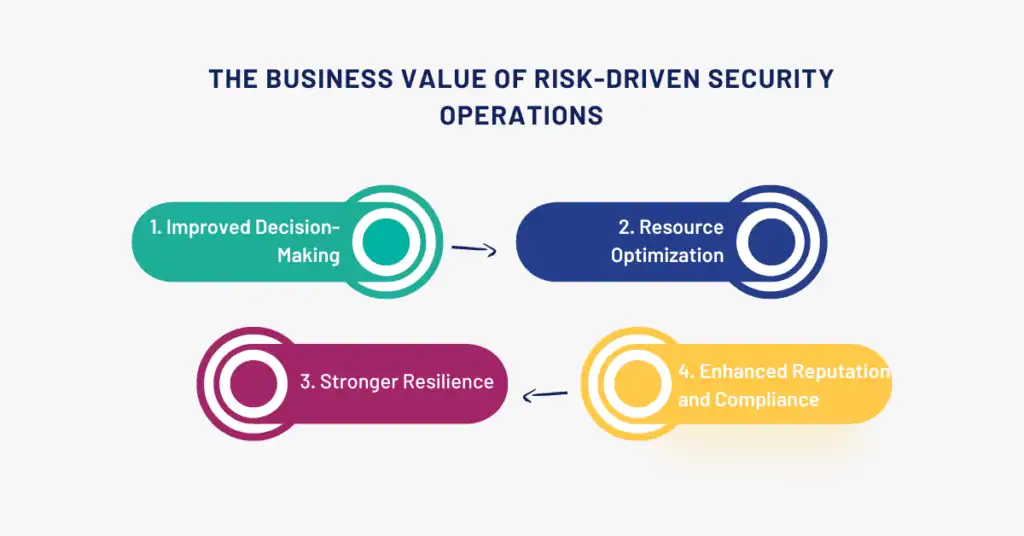
1. Improved Decision-Making
Security initiatives and responses are linked to business outcomes, facilitating executive buy-in and budget approval.
2. Resource Optimization
Efforts and costs align with risk priorities, reducing waste and maximizing protection where it matters.
3. Stronger Resilience
Proactive risk assessment leads to enhanced detection, quicker response, and minimized damage from incidents.
4. Enhanced Reputation and Compliance
Managing risks effectively supports compliance and safeguards customer trust.
Conclusion
While all cyber security pillars contribute vitally to a robust security posture, Risk Management stands out as the pillar that defines the security operations team’s purpose to the business and guides its management. It ensures that security activities are not just technical necessities but strategic imperatives tied directly to the company’s objectives, risk appetite, and operational priorities.
By managing SecOps through a risk lens, organizations can protect their most valuable assets more effectively, justify investments, and position their security teams as essential partners in business success. Ultimately, this alignment not only strengthens cyber security but also drives business resilience, trust, and growth in an increasingly complex digital environment.
FAQs
1. What is the primary purpose of the security operations team in an organization?
The primary purpose of a security operations team is to protect the organization’s information systems by continuously monitoring, detecting, responding to, and mitigating cyber security threats to ensure business continuity and safeguard critical assets.
2. Which cyber security pillar most influences the security operations team’s objectives?
The Risk Management pillar most influences the security operations team’s objectives because it aligns security efforts with the organization’s risk appetite and the business impact of threats, ensuring that resources target the most critical risks.
3. How does Risk Management help prioritize security operations activities?
Risk Management helps prioritize activities by assessing which assets and vulnerabilities pose the greatest risk to the organization, allowing the security team to focus on threats that could cause the most significant business impact.
4. Why is it important for security operations management to integrate with business leadership?
Integration ensures that security priorities reflect business goals and risks, enabling better support, resource allocation, and alignment of security measures with organizational objectives and compliance requirements.
5. What role do risk metrics play in managing a security operations team?
Risk metrics provide measurable indicators of the organization’s exposure to threats, helping managers track the effectiveness of security controls, identify trends, and make informed decisions to improve security posture.
