

Explained APT Advanced Persistent Threat in Cyber Security Terms
In the constantly evolving landscape of cyber security, threats are becoming more sophisticated, targeted, and prolonged. Among these threats, the Advanced Persistent Threat (APT) stands out as one of the most dangerous and complex forms of cyber attack. Understanding what an APT is, how it operates, and why it poses such a serious risk is essential for businesses, governments, and individuals concerned about protecting their digital assets.
Here in this article we are going to discuss about Explained APT Advanced Persistent Threat in Cyber Security Terms.
What is an Advanced Persistent Threat (APT)?
An Advanced Persistent Threat (APT) refers to a prolonged and targeted cyber attack in which an adversary gains unauthorized access to a network and remains undetected for an extended period. The goal of an APT is not to cause immediate damage or disruption but to stealthily steal data, spy on operations, or sabotage over time.
To break down the term:
- Advanced: The attackers use sophisticated techniques and tools, often custom-built, that go beyond common malware or generic hacking.
- Persistent: The attackers maintain long-term access, adapting their tactics to avoid detection and maintain control.
- Threat: It refers to a highly skilled, motivated, and organized adversary usually backed by countries, criminal organizations, or hacktivists.
In essence, an APT is a well-funded and organized cyber espionage or cyber warfare campaign targeting specific high-value organizations such as government agencies, critical infrastructure, technology firms, and defense contractors.
Characteristics of APTs
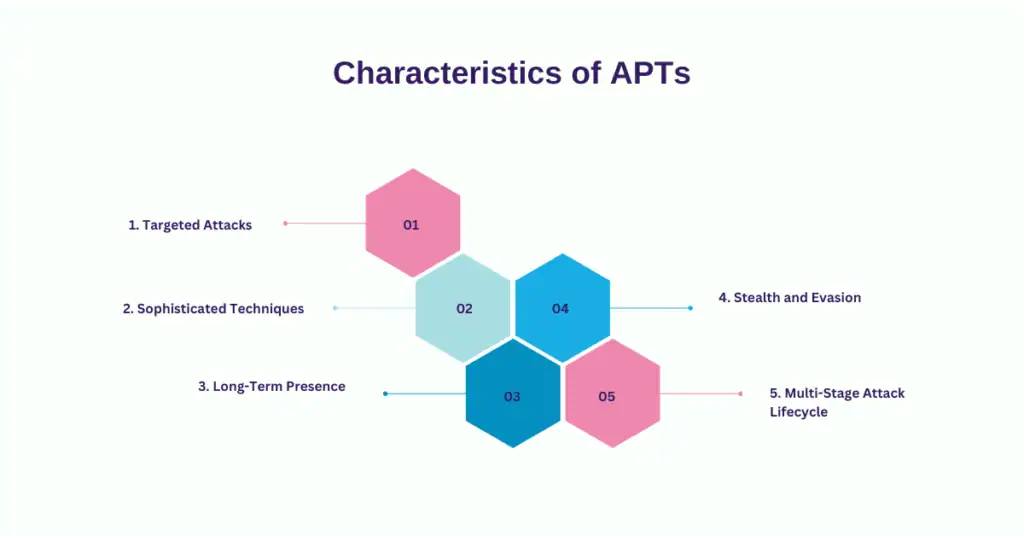
Understanding the defining features of APTs helps distinguish them from regular cyber attacks:
1. Targeted Attacks
Unlike opportunistic cyber attacks that seek random victims, APTs focus on specific targets, often selected for strategic reasons such as political, economic, or military intelligence.
2. Sophisticated Techniques
APT actors use a mix of advanced malware, zero-day vulnerabilities (previously unknown vulnerabilities), social engineering, spear-phishing, and custom exploits.
3. Long-Term Presence
Persistence is key. The attacker aims to maintain continuous access, sometimes for months or even years, to gather intelligence or compromise systems.
4. Stealth and Evasion
APT attackers employ techniques to avoid detection by traditional antivirus, intrusion detection systems, and monitoring tools. This can include encryption, obfuscation, and using legitimate credentials to move laterally.
5. Multi-Stage Attack Lifecycle
APTs usually unfold in stages: initial reconnaissance, infiltration, establishing a foothold, lateral movement inside the network, data exfiltration, and ultimately, covering tracks.
How Do APTs Work? The Attack Lifecycle?
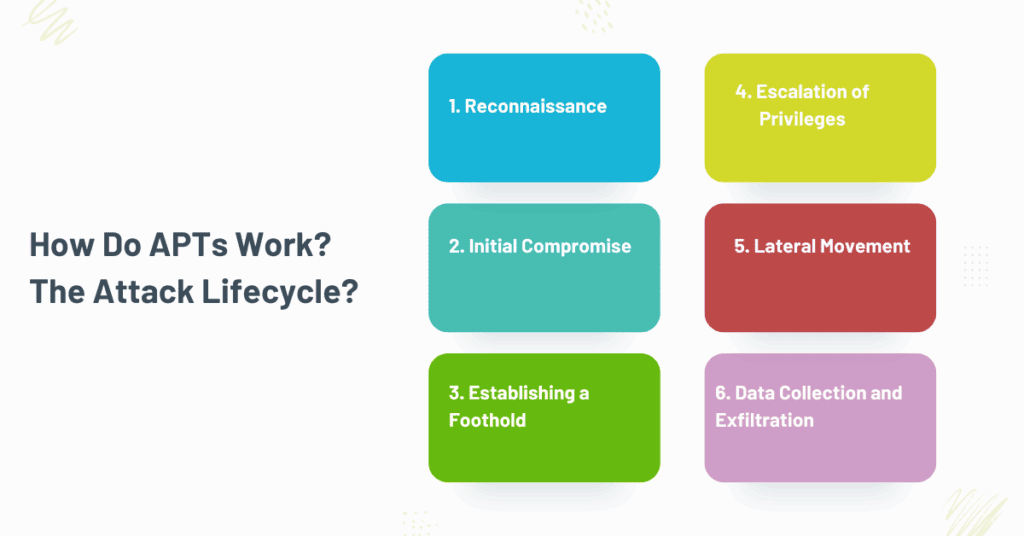
The methodology behind an APT attack can be roughly outlined in several phases:
1. Reconnaissance
Before launching an attack, the adversary gathers intelligence about the organization: employee names, network infrastructure, software in use, and security posture. This phase may involve open-source intelligence (OSINT) gathering and social media analysis.
2. Initial Compromise
The attacker seeks to breach the target’s perimeter using techniques like spear-phishing emails with malicious attachments or links, exploiting vulnerabilities in external-facing systems, or exploiting zero-day vulnerabilities.
3. Establishing a Foothold
Once inside, the attacker installs malware designed to maintain persistence, such as backdoors or remote access Trojans (RATs). This allows ongoing control over compromised machines.
4. Escalation of Privileges
Attackers work to gain higher system privileges to access sensitive data. They might exploit software flaws or use stolen credentials to move from a limited user account to administrator or root access.
5. Lateral Movement
With elevated privileges, attackers explore the network to identify valuable assets and expand access. They leverage legitimate credentials or exploit network vulnerabilities to move through systems stealthily.
6. Data Collection and Exfiltration
Once the attacker identifies the desired data (e.g., intellectual property, financial records, confidential communications), they collect it and transfer it outside the victim’s network using covert channels, often encrypted to avoid detection.
Examples of Notable APT Groups and Incidents
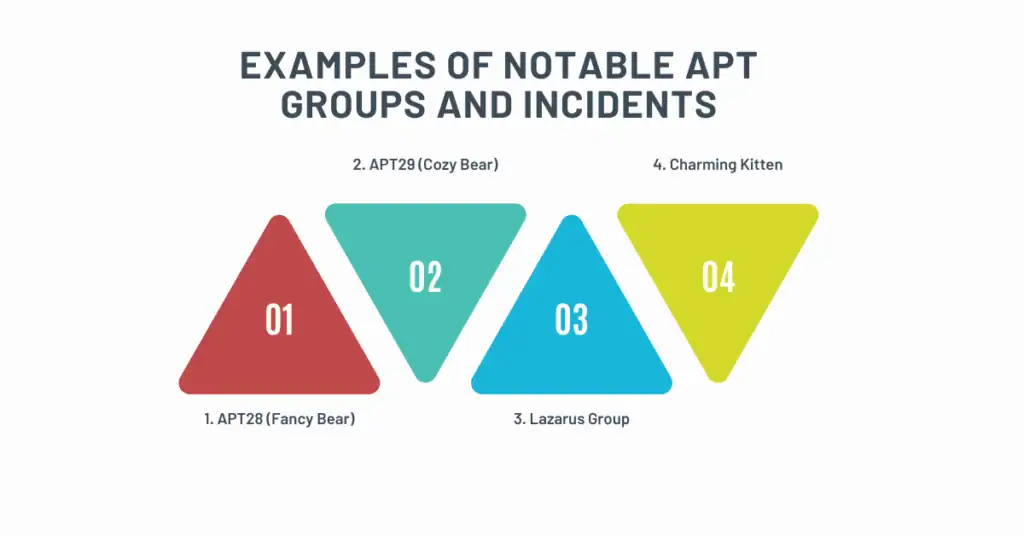
Several well-known nation-state sponsored groups have executed APT attacks globally:
1. APT28 (Fancy Bear)
Associated with Russian military intelligence, known for cyber espionage targeting government agencies and political organizations.
2. APT29 (Cozy Bear)
Another Russian-linked group, noted for stealthy and long-term espionage campaigns.
3. Lazarus Group
Linked to North Korea, involved in cyber espionage, financial theft, and destructive attacks like the WannaCry ransomware incident.
4. Charming Kitten
An Iranian group targeting journalists, academics, and activists primarily through phishing campaigns.
One landmark example is the 2010 Operation Aurora attack, where Chinese APT hackers infiltrated Google and dozens of other companies to steal intellectual property and gain access to Gmail accounts of human rights activists.
Defending Against APTs: Strategies and Best Practices
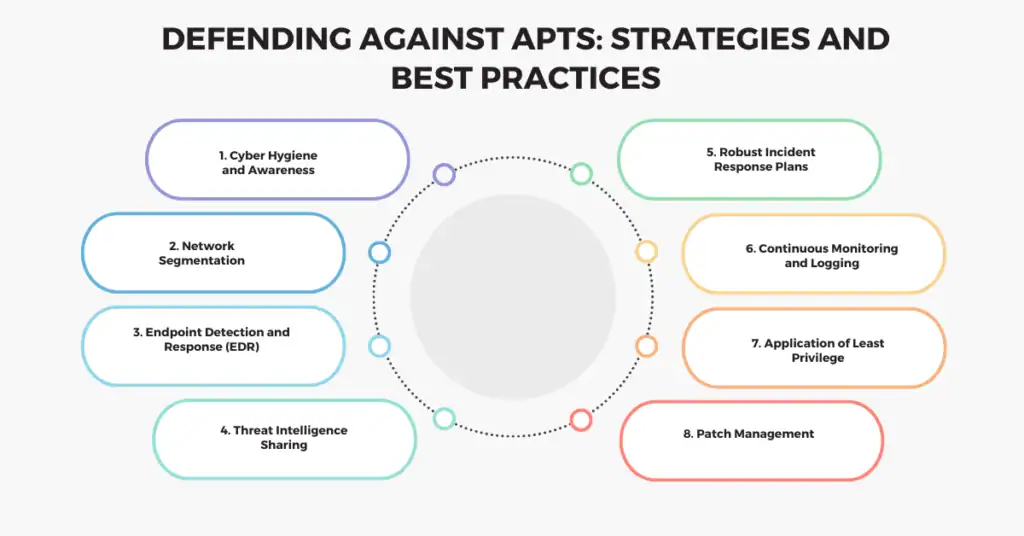
While defending against an APT is challenging, organizations can adopt multi-layered security strategies:
1. Cyber Hygiene and Awareness
Regular employee training on phishing awareness and implementing strong password policies help reduce the risk of initial compromise.
2. Network Segmentation
Dividing the network into isolated segments limits lateral movement, preventing attackers from easily accessing critical systems.
3. Endpoint Detection and Response (EDR)
Advanced endpoint security tools can detect suspicious behaviors and unusual activity patterns that may indicate APT presence.
4. Threat Intelligence Sharing
Collaboration between organizations and governments to share indicators of compromise (IOCs) and tactics used by APT groups helps improve preparedness.
5. Robust Incident Response Plans
Preparedness to detect, analyze, contain, and recover from APT incidents minimizes damage and downtime.
6. Continuous Monitoring and Logging
Constant network traffic analysis, log monitoring, and anomaly detection can help identify suspicious activity early.
7. Application of Least Privilege
Limiting users’ access rights to only what they need reduces the risk attackers gain administrator-level control.
8. Patch Management
Keeping software and systems updated closes vulnerabilities that APT attackers could exploit.
Conclusion
Advanced Persistent Threats represent one of the most formidable challenges in cyber security today. Their combination of sophistication, targeted intent, and long-term focus means that organizations cannot afford to be complacent.
Understanding how APTs operate, recognizing the signs of an attack, and adopting robust security practices can significantly reduce risk. As cyber threats continue to evolve, ongoing vigilance, collaboration, and innovation are vital to defending against these persistent digital adversaries.
FAQs
1. What does APT stand for in cybersecurity?
Answer: APT stands for Advanced Persistent Threat, which refers to a highly skilled, targeted, and long-term cyber attack aimed at stealing data or spying on specific organizations.
2. How is an APT different from regular cyber attacks?
Answer: Unlike typical cyber attacks that may be opportunistic and short-lived, APTs are deliberate, targeted, use sophisticated methods, and maintain prolonged access to the victim’s network.
3. Who are the typical perpetrators behind APT attacks?
Answer: APT attacks are often carried out by nation-state actors, well-funded cybercriminal groups, or hacktivists with specific political, economic, or strategic goals.
4. What kind of organizations are usually targeted by APTs?
Answer: High-value targets such as government agencies, defense contractors, financial institutions, critical infrastructure, and large corporations are common victims of APTs.
5. How do attackers gain initial access in an APT attack?
Answer: Attackers commonly use spear-phishing emails, malware, exploiting zero-day vulnerabilities, or compromised third-party vendors to infiltrate the target network.
