

AI Agents vs Compliance Auditors – Is Automation the Future of Governance & Risk?
Governance and risk management underpin the integrity of every organisation. Historically, compliance auditors have shouldered the responsibility of ensuring policies are followed and risks are identified. Today, AI agents, software-driven entities powered by machine learning and natural language processing, are reshaping this process.
As organisations seek speed and accuracy, the debate over AI Agents vs Compliance Auditors – Is Automation the Future of Governance & Risk? becomes ever more critical. This article examines both sides, explores the benefits and drawbacks, and assesses whether automation will dominate future oversight.
What Are AI Agents?
AI agents are software entities that perform tasks autonomously, often learning and adapting over time. Key types include:
- Rule‑based Agents: Execute predefined workflows (“if‑this‑then‑that”).
- Machine‑Learning Agents: Analyse data patterns to make predictions.
- Cognitive Agents: Use NLP to interpret policies, regulations and human language.
Core Capabilities of AI‑Driven Compliance Tools
- Continuous Monitoring & Anomaly Detection
- Policy Analysis via Natural‑Language Processing
- Automated Risk Scoring
- Real‑Time Reporting and Alerts
Key Use Cases in Risk Management
- Transaction Auditing: Matching transactions to policy rules instantly.
- Document Review: Scanning regulations, flagging non‑compliant clauses.
- Fraud Detection: Spotting unusual patterns across large datasets.
Who Are Compliance Auditors?
Compliance auditors are professionals with certifications such as CISA, CIA or industry‑specific qualifications. They interpret complex regulations, conduct interviews, gather evidence and compile audit reports.
Typical Audit Workflow
- Planning: Define scope and objectives.
- Evidence Gathering: Interviews, document requests, sampling.
- Testing: Validate controls and procedures.
- Reporting: Draft findings and recommendations.
Challenges Faced by Traditional Auditors
- Resource Constraints: Limited hours vs vast data volumes.
- Manual Error Risk: Human fatigue leads to oversights.
- Timeliness: Periodic audits may miss emerging issues.
AI Agents vs Compliance Auditors: Head‑to‑Head Comparison
| Aspect | AI Agents | Human Auditors |
| Speed & Scalability | 24/7 monitoring of millions of transactions | Limited by work hours and team size |
| Accuracy & Consistency | Consistent rule execution; minimal fatigue | Subject to human judgement and variability |
| Cost‑Efficiency | Lower marginal cost after implementation | High ongoing labour costs |
| Adaptability | Requires retraining for new regulations | Can interpret novel or ambiguous scenarios |
Benefits of Automation in Governance & Risk
- Real‑Time Compliance Monitoring: Immediate identification of breaches.
- Predictive Analytics: Forecast risk trends using historical data.
- Reduced Human Error: Automated processes follow exact rules.
- Enhanced Documentation: Automated logs create robust audit trails.
Fact: Organisations that implement automated compliance solutions report 50–70% faster issue resolution times.
Limitations & Risks of Relying Solely on AI Agents
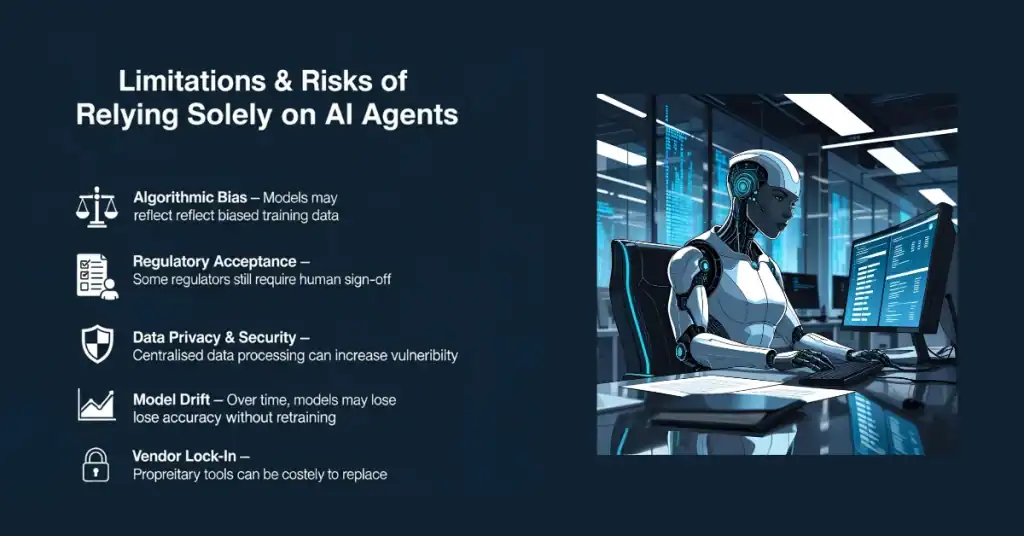
- Algorithmic Bias: Models may reflect biased training data.
- Regulatory Acceptance: Some regulators still require human sign‑off.
- Data Privacy & Security: Centralised data processing can increase vulnerability.
- Model Drift: Over time, models may lose accuracy without retraining.
- Vendor Lock‑In: Proprietary tools can be costly to replace.
Hybrid Models: Combining AI Agents with Human Auditors
1. Collaborative Governance Framework
A hybrid model leverages AI for routine tasks and humans for complex judgments:
- AI Agents: Continuous data scanning, flagging anomalies.
- Human Auditors: Investigating flagged items, strategic decision‑making.
2. Roles & Responsibilities
- AI handles data analysis at scale.
- Auditors validate findings and interpret nuanced contexts.
3. Training & Upskilling
- Technical Training: Familiarity with AI dashboards and model limitations.
- Analytical Skills: Interpreting AI outputs and translating results into actionable insights.
Case Studies: Automation Success Stories
1. Financial Services: AI‑Driven Transaction Audits
A major bank deployed an AI agent that processes over 100 million transactions daily, reducing false positives by 40% and saving AU$2 million annually on manual reviews.
2. Healthcare: Automated HIPAA Compliance Checks
A healthcare provider used AI to scan patient‑access logs, identifying potential privacy breaches in real time, reducing incident response times from days to hours.
3. Manufacturing: Real‑Time Safety Audits
An auto manufacturer integrated AI to monitor equipment sensor data, flagging safety risks before they occur and reducing workplace incidents by 30%.
The Future of Governance & Risk: Automation Trends
- Robotic Process Automation (RPA): Automating repetitive control tests.
- Generative AI: Drafting compliance reports and recommendations.
- Blockchain: Immutable audit trails for transparent governance.
Predictions:
- 2026–2028: Hybrid teams will become the norm.
- 2030: Fully autonomous audit pilots in low‑risk environments.
Conclusion – Is Automation the Future of Governance & Risk?
The debate around AI Agents vs Compliance Auditors reveals that neither side offers a silver bullet. Automation excels at scale, consistency and cost‑efficiency, while humans bring context, ethics and strategic oversight. The optimal path lies in hybrid models that harness the strengths of both. Organisations ready to embrace this approach will gain a competitive edge in governance and risk management.
FAQs
1. What is the main difference between AI agents and compliance auditors?
Ans: AI agents automate data analysis and monitoring; auditors apply professional judgement and interpret complex scenarios.
2. Can AI agents fully replace human compliance auditors?
Ans: Not entirely—AI excels at routine tasks, but human expertise remains crucial for nuanced decision‑making.
3. Which compliance tasks are best suited for AI automation?
Ans: High‑volume, rule‑based processes such as transaction screening and document review.
4. How do organisations mitigate bias in AI‑driven audits?
Ans: By using diverse training data, regular model audits and human oversight of flagged outcomes.
5. Are there regulatory standards for AI in governance and risk?
Ans: Emerging guidelines exist (e.g., EU’s AI Act), but many jurisdictions still require human sign‑off.
