
PCI DSS Compliance and Audit Service Providers in Australia
As digital payments continue to dominate Australia’s retail, e-commerce, and financial landscape, protecting cardholder data has never been more critical. PCI DSS (Payment Card Industry Data Security Standard) provides a structured framework to help businesses secure payment environments, reduce fraud risks, and maintain customer trust. For organisations that store, process, or transmit card data, achieving and maintaining PCI DSS compliance isn’t just a regulatory expectation; it’s a commitment to safeguarding sensitive financial information in an increasingly targeted threat landscape.
Choosing the right PCI DSS compliance and audit service provider in Australia can make this journey smoother, ensuring businesses understand their security gaps, implement the required controls, and achieve certification efficiently. This blog explores what PCI DSS means for Australian organisations and how specialised providers can support them through compliance, assessment, and continuous security improvement.
What is PCI DSS Compliance?
PCI DSS Compliance refers to meeting the Payment Card Industry Data Security Standard, a global set of security requirements designed to protect cardholder data and reduce payment fraud. Any business that stores, processes, or transmits credit or debit card information must follow these standards to ensure that sensitive payment data is handled securely.
In simple terms, PCI DSS Compliance means implementing the necessary security controls like encryption, access restrictions, network monitoring, vulnerability management, and regular audits to prevent unauthorized access or data breaches involving cardholder information. It helps organisations build customer trust, avoid financial penalties, and maintain secure payment operations.
Understanding PCI DSS Requirements
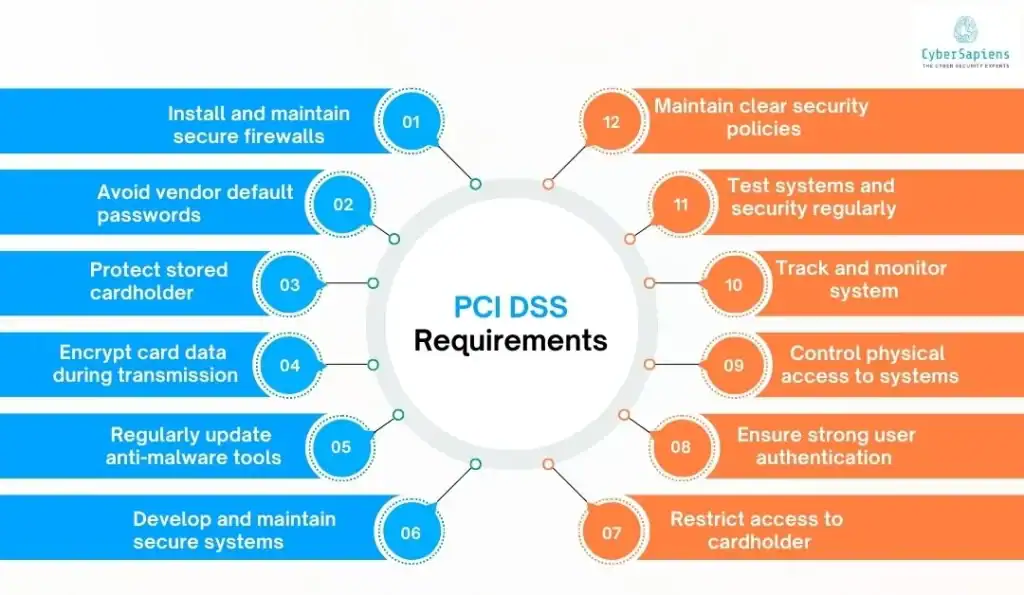
PCI DSS is built around 12 core security requirements that help organisations protect cardholder data throughout its lifecycle. These requirements cover everything from securing networks and systems to monitoring access and responding to potential threats. Together, they create a structured approach to reducing the risk of data breaches and payment fraud.
The 12 PCI DSS Requirements:
- Install and maintain secure firewalls to protect cardholder environments: Firewalls act as the first line of defense by filtering incoming and outgoing traffic based on approved security rules. Organisations must design, configure, and maintain firewalls that isolate the cardholder data environment (CDE) from external networks to prevent unauthorized access.
- Avoid vendor default passwords and security settings that attackers can easily exploit: Many cyberattacks exploit unchanged factory settings such as default usernames, passwords, and configurations. PCI DSS requires businesses to replace these defaults with strong, unique credentials and hardened configurations to reduce the risk of compromise.
- Protect stored cardholder data using methods like encryption, hashing, and truncation: If cardholder data needs to be stored, it must be protected with strong cryptography. Techniques like tokenization, hashing, and truncation ensure sensitive data cannot be accessed in plain text, reducing the impact even if systems are breached.
- Encrypt card data during transmission across open or public networks: Data transmitted over the internet, wireless networks, or other public channels must be encrypted using industry-accepted protocols (e.g., TLS) to prevent attackers from intercepting and reading cardholder information in transit.
- Use and regularly update anti-malware tools to defend against malicious software: Anti-malware systems must be deployed, actively monitored, and frequently updated to detect and block viruses, ransomware, and other malicious software targeting systems that store, process, or access cardholder data.
- Develop and maintain secure systems and applications through patching and secure coding: Organisations must apply security patches promptly to fix known vulnerabilities, while developers should follow secure coding practices to prevent issues such as SQL injection and cross-site scripting, thereby reducing exploitable weaknesses in applications.
- Restrict access to cardholder data based on job roles and business need-to-know: Access to cardholder data should only be granted to employees whose roles require it. Role-based access control ensures that the exposure of sensitive information is limited and helps prevent insider threats or accidental misuse.
- Ensure strong user authentication with unique IDs and secure access controls: Every user accessing systems that handle cardholder data must have a unique user ID to track activity. Strong authentication mechanisms, such as multi-factor authentication (MFA), help prevent unauthorized access and identity misuse.
- Control physical access to systems storing or handling cardholder data: Servers, workstations, storage devices, and paper records must be protected against physical tampering or theft. This includes access badges, surveillance, locked rooms, and visitor logs to ensure only authorized personnel can access sensitive areas.
- Track and monitor system activity to quickly detect suspicious or unauthorized actions: Logging and monitoring capabilities should capture system access, changes, and unusual activities. Centralized log management and security monitoring tools enable organisations to detect breaches early and respond effectively.
- Test systems and security regularly, including vulnerability scans and penetration tests: Continuous testing helps validate that security measures are working as intended. Regular internal and external vulnerability scans, combined with penetration testing, identify weaknesses before attackers can exploit them.
- Maintain clear security policies that guide staff on responsibilities and secure behavior: Well-defined security policies ensure employees understand their roles in protecting cardholder data. Policies should include training, acceptable-use guidelines, incident response processes, and regular updates as security needs evolve.
Understanding these requirements helps businesses map their current security posture, identify gaps, and plan their journey toward full PCI DSS compliance.
Why Businesses in Australia Need PCI DSS Compliance?
With digital payments becoming the norm across Australia, protecting cardholder information is essential for maintaining trust and avoiding costly breaches. PCI DSS provides the security framework businesses need to keep payment data safe and operations compliant.
- Protects cardholder data from theft, fraud, and unauthorized access.
- Strengthens customer trust by showing commitment to secure payment handling.
- Reduces financial and reputational risk associated with data breaches.
- Supports regulatory and industry expectations, especially when handling payment card data.
- Prevents penalties and fines from banks, card brands, and payment processors for non-compliance.
- Ensures smoother relationships with payment service providers, who often require PCI DSS validation.
- Helps businesses stay resilient against cyber threats, as digital payments continue to grow in Australia.
- Critical for industries like retail, e-commerce, fintech, hospitality, and banking, where payment processing is core to operations.
Benefits of Partnering With the Right Audit Service Provider
Choosing the right PCI DSS Compliance and Audit Service Providers in Australia can make the compliance journey faster, smoother, and more effective. A strong partner not only validates compliance but also helps strengthen your overall security posture, ensuring your organisation meets industry expectations while maintaining customer trust.
- Expert guidance for faster compliance: Reduces time spent interpreting requirements and avoids costly delays.
- Accurate gap identification: Pinpoints weaknesses that could lead to non-compliance or security risks.
- Efficient remediation support: Helps prioritise and fix issues in alignment with PCI DSS controls.
- Reduced operational burden: Audit partners streamline documentation, assessment, and reporting processes.
- Improved readiness for future audits: Builds internal understanding and creates repeatable compliance practices.
- Enhanced security beyond compliance: Recommendations often strengthen systems and processes beyond the minimum required standards.
- Lower risk of penalties and breaches: Proactive assessments reduce the chances of data exposure and associated financial losses.
- Continuous monitoring & support options: Some providers offer ongoing guidance to maintain compliance as environments change.
Top 5 PCI DSS Compliance and Audit Service Providers in Australia

1. Cybersapiens
Offers end-to-end PCI DSS consulting, readiness assessments, remediation support, and compliance services tailored to Australian organisations handling payment card data.
Cybersapiens Process for PCI DSS Compliance and Audit
Cybersapiens follows a structured and practical approach to help organisations achieve PCI DSS Compliance and Audit Service Providers in Australia standards, ensuring cardholder data environments are secure and auditable. Their process is designed to guide businesses from readiness through assessment and ongoing compliance support, making compliance less complex and more effective.
1. Initial Scoping & Gap Analysis
Cybersapiens begins by defining the scope of your cardholder data environment (CDE) to understand where cardholder data is stored, processed, or transmitted. They then perform a gap analysis to evaluate your current security posture against PCI DSS requirements. This helps identify areas requiring remediation before formal assessment.
2. Compliance Roadmap & Planning
Based on the gap analysis, Cybersapiens develops a compliance roadmap that outlines what needs to be addressed, from technical controls to policies and processes. This phase ensures your organisation prioritises high-impact changes and prepares the documentation required for audit validation.
3. Implementation Support
Their team provides hands-on support and guidance during control implementation. This includes strengthening network defenses, configuring secure systems, enforcing access controls, and establishing logging and monitoring, all aligned with PCI DSS requirements.
4. Internal Testing & Validation
Before the formal audit, Cybersapiens conducts internal assessments and scans to validate that controls are functioning as intended. This typically involves vulnerability scanning, configuration review, and preparing evidence for assessment.
5. Audit & Reporting
They assist with compiling the documentation and evidence needed for your PCI DSS assessment, helping organisations interact with auditors effectively and submit compliant reports. Their support ensures that your audit submission is thorough and accurate.
6. Post-Assessment Support & Continuous Compliance
After audit completion, Cybersapiens continues to help organisations maintain compliance by recommending ongoing monitoring strategies, updates to controls as environments change, and readiness for future PCI DSS validation cycles.
Clients Served by CyberSapiens






2. Stratica
Independent advisory practice and Qualified Security Assessor (QSA) specialising in PCI DSS consulting, compliance validation, forensic investigation, and risk management across the Asia-Pacific region.
3. PCI Consulting Australia
Australian-owned firm focused on pragmatic PCI DSS compliance support, scope reduction, and assessment services, led by experienced QSAs.
4. CyberCX
Large Australian cybersecurity provider with dedicated PCI DSS expertise to guide organisations through assessment, control testing, and compliance attainment.
5. Vectra
Provides PCI DSS consulting and compliance services across major Australian cities, including assessments, penetration testing, and alignment with PCI requirements.
Building Resilience Through PCI DSS
Achieving and maintaining PCI DSS compliance is essential for Australian businesses that handle cardholder data, helping them safeguard payment transactions, reduce the risk of cyberattacks, and build lasting customer trust. With growing digital payment adoption and more sophisticated threats, partnering with the right PCI DSS Compliance and Audit Service Providers in Australia ensures organisations not only meet regulatory expectations but also strengthen their overall security posture.
By following a structured approach like the one adopted by Cybersapiens, businesses can move confidently from assessment to certification and ongoing compliance, turning what may feel like a complex process into a sustainable security advantage.
FAQs
1. Who needs PCI DSS compliance in Australia?
Answer: Any business that stores, processes, or transmits credit or debit card information — including retailers, e-commerce platforms, fintech companies, hospitality businesses, and payment service providers.
2. How often should PCI DSS assessments be conducted?
Answer: PCI DSS requires annual assessments and quarterly vulnerability scans to ensure ongoing compliance and security.
3. What happens if a business is not PCI DSS compliant?
Answer: Non-compliance can lead to financial penalties, loss of payment processing privileges, legal liabilities, and reputational damage after a data breach.
4. How long does it take to become PCI DSS compliant?
Answer: The timeline varies depending on your environment’s complexity and security maturity; it can range from a few weeks to several months, especially when remediation is required.
5. Is penetration testing required for PCI DSS compliance?
Answer: Yes, penetration testing and vulnerability scanning are mandatory to identify exploitable weaknesses in systems handling cardholder data.
