
PCI DSS Compliance and Audit Service Providers in Pune
Pune has rapidly emerged as one of India’s leading technology, IT services, and manufacturing hubs, with a growing ecosystem of fintech companies, retail brands, SaaS platforms, and global service centers. As digital payments and online transactions expand across the city, protecting cardholder data has become essential for maintaining customer trust and meeting industry expectations. PCI DSS (Payment Card Industry Data Security Standard) offers a globally recognized framework that strengthens payment security, reduces fraud risks, and helps organizations maintain secure and compliant payment operations.
For Pune-based organizations that store, process, or transmit cardholder data, PCI DSS compliance is not just a regulatory necessity; it is a strategic step toward safeguarding sensitive financial information in a rapidly evolving digital landscape. Selecting the right PCI DSS Compliance and Audit Service Provider in Pune helps organizations identify security gaps, build resilient controls, and achieve certification efficiently while enhancing their security posture.
What is PCI DSS Compliance?
PCI DSS Compliance refers to meeting the Payment Card Industry Data Security Standard, a global set of security requirements designed to protect cardholder data and prevent payment fraud. Any organization in Pune that handles credit or debit card transactions must comply with PCI DSS to ensure secure processing and protect financial information from misuse.
In simple terms, PCI DSS compliance requires implementing essential measures such as encryption, controlled access, secure configurations, vulnerability management, and continuous monitoring. Meeting these standards strengthens customer confidence, protects business reputation, and prevents penalties from payment service providers.
Understanding PCI DSS Requirements
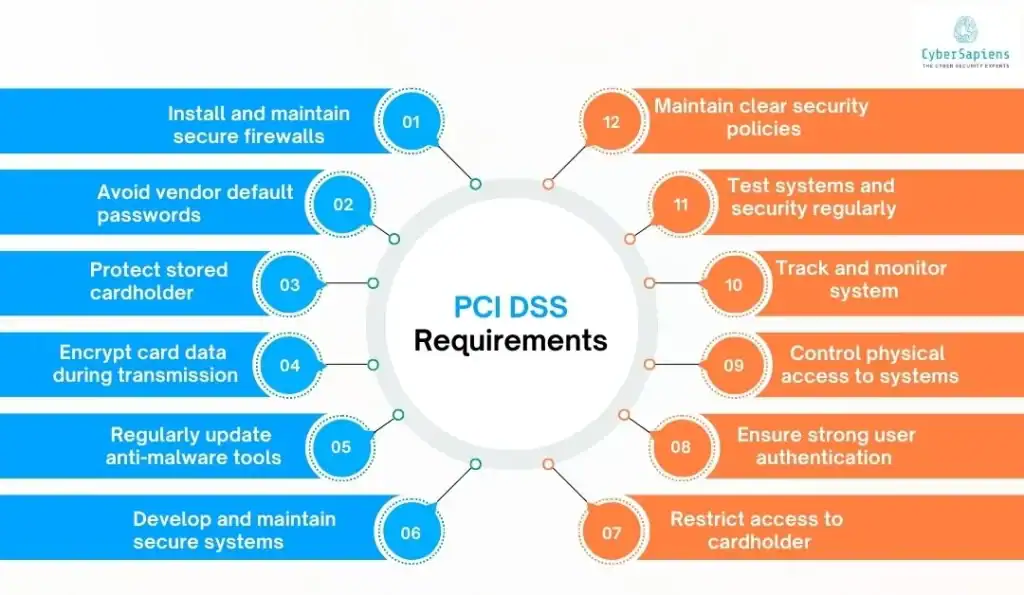
PCI DSS consists of 12 core requirements that ensure cardholder data is protected throughout its lifecycle. These requirements guide businesses in securing systems, monitoring activity, and continuously testing defenses.
The 12 PCI DSS Requirements
- Install and maintain secure firewalls to protect cardholder environments: Configure firewalls to isolate the cardholder data environment (CDE) and control network access.
- Avoid vendor default passwords and security settings: Replace default credentials and harden configurations to prevent easy exploitation.
- Protect stored cardholder data using strong cryptography: Encrypt or tokenize sensitive data to keep it unreadable even if accessed.
- Encrypt card data during transmission over open networks: Use secure protocols such as TLS to prevent interception of cardholder information.
- Use and regularly update anti-malware protections: Deploy and update anti-malware tools to defend against malicious software targeting payment systems.
- Develop and maintain secure systems and applications: Apply patches and follow secure development practices to prevent vulnerabilities.
- Restrict access to cardholder data based on job responsibilities: Limit data access to authorized individuals to reduce internal exposure risks.
- Ensure strong authentication and identity controls: Implement MFA, unique IDs, and secure authentication methods to verify user identities.
- Control physical access to systems storing cardholder data: Secure facilities and devices to prevent unauthorized physical access and data theft.
- Monitor and log system activity to detect suspicious actions: Capture and review logs to identify anomalies, intrusions, and unauthorized access.
- Test systems regularly through scans and penetration testing: Conduct recurring assessments to identify weaknesses before attackers do.
- Maintain clear security policies and employee training: Establish policies and educate employees to foster a culture of security awareness.
These requirements help Pune-based organizations understand their security obligations and structure their compliance journey effectively.
Why Businesses in Pune Need PCI DSS Compliance
Pune is home to IT parks, global delivery centers, BFSI institutions, e-commerce brands, retail chains, and fintech startups, all of which manage payment data. With cyberattacks and digital fraud on the rise, PCI DSS provides a strong foundation for securing payment environments.
Key benefits of PCI DSS compliance for Pune organizations:
- Protects cardholder information from theft and fraud.
- Builds customer trust in digital payments and transactions.
- Reduces financial, legal, and reputational risks.
- Avoids penalties and processing restrictions due to non-compliance.
- Strengthens cybersecurity posture beyond baseline requirements.
- Required by payment processors, banks, and card brands.
- Essential for sectors such as retail, fintech, manufacturing, BFSI, hospitality, and IT.
For organizations looking to grow securely, PCI DSS is a critical enabler of trusted digital operations.
Benefits of Partnering With the Right Audit Service Provider
Partnering with experienced PCI DSS Compliance and Audit Service Providers in Pune helps make compliance structured, repeatable, and efficient.
- Expert guidance for faster compliance: simplifies complex requirements.
- Accurate gap identification: exposes vulnerabilities and critical weaknesses.
- Efficient remediation support: prioritizes fixes aligned with PCI DSS controls.
- Reduced operational burden: streamlines documentation and audit preparation
- Improved readiness for recurring audits: builds long-term compliance maturity.
- Enhanced security beyond minimum standards: strengthens overall resilience.
- Lower risk of penalties and breaches: prevents costly data exposure incidents.
- Continuous monitoring & support: maintains compliance throughout system changes.
Top PCI DSS Compliance and Audit Service Providers in Pune
1. Cybersapiens
Provides end-to-end PCI DSS consulting, readiness assessments, remediation guidance, implementation support, audit preparation, and continuous compliance services tailored to Pune-based businesses handling cardholder data.
Cybersapiens PCI DSS Compliance Process
1. Initial Scoping & Gap Analysis
This stage involves identifying every system, application, and business process that stores, processes, or transmits cardholder data to define the boundaries of the Cardholder Data Environment (CDE). Once data flows are mapped, existing security controls are reviewed against PCI DSS requirements to uncover configuration weaknesses, missing controls, or outdated practices that could impact compliance.
2. Compliance Roadmap & Planning
Based on the results of the gap analysis, a structured and prioritized plan is created to guide the compliance journey. This roadmap outlines the necessary technical changes, security control implementation, process updates, and documentation requirements in a phased manner.
3. Implementation Support
During this stage, experts support internal teams in applying and configuring PCI DSS-mandated controls across the environment. This may include segmenting the CDE to isolate sensitive data, enabling encryption to secure stored and transmitted cardholder information, enforcing strict access controls through least-privilege principles, and activating monitoring mechanisms for continuous oversight.
5. Internal Testing & Validation
Before the formal assessment, validation activities are conducted to confirm that the deployed controls are functioning effectively and consistently. This includes performing internal and external vulnerability scans, penetration testing, configuration reviews, access verification, and log checks.
6. Audit & Reporting
In preparation for the official PCI DSS audit, all required documentation—such as policies, network diagrams, scan results, control evidence, and configuration records is compiled and organized for submission. Coordination with Qualified Security Assessors (QSAs) ensures that evidence is presented clearly, requirements are interpreted correctly, and queries are addressed promptly throughout the assessment process.
7. Post-Assessment Support & Continuous Compliance
Once compliance is achieved, ongoing activities ensure alignment with PCI DSS requirements over time. This includes periodic control reviews, regular vulnerability scans, policy revisions, monitoring configuration changes, and maintaining supporting evidence for future assessments.
Clients Served by CyberSapiens






2. SISA Information Security
Offers PCI DSS audits, compliance advisory, forensic investigation, and data protection services with strong experience across payment environments.
3. ControlCase
Delivers PCI DSS validation, managed compliance solutions, and continuous monitoring for enterprises with complex environments.
4. Panacea Infosec
Provides PCI DSS readiness, penetration testing, compliance consulting, and secure architecture support for organizations in regulated industries.
5. Payatu
Specializes in security validation through advanced penetration testing and vulnerability assessments to support PCI DSS readiness and remediation.
Strengthening Payment Security Through PCI DSS in Pune
Achieving and maintaining PCI DSS compliance is essential for Pune-based businesses managing cardholder data, enabling them to secure payment operations, reduce cyber risks, and maintain customer trust.
As payment channels diversify and threats evolve, partnering with the right PCI DSS Compliance and Audit Service Providers in Pune ensures organizations not only meet certification standards but also build lasting security resilience.
By following a structured approach from scoping and remediation to audit and continuous compliance, businesses can confidently progress from assessment to certification and ongoing readiness, turning PCI DSS into a strategic security advantage.
FAQs
1. Who needs PCI DSS compliance in Pune?
Answer: Retailers, SaaS providers, fintech companies, IT service firms, manufacturing units with payment systems, hospitality businesses, and any entity handling cardholder data.
2. How often are PCI DSS assessments required?
Answer: Annual assessments and quarterly vulnerability scans are mandatory to maintain ongoing compliance.
3. What risks arise from non-compliance?
Answer: Organizations may face penalties, increased processing charges, regulatory scrutiny, and reputational damage following a breach.
4. How long does it take to achieve PCI DSS compliance?
Answer: Timelines vary depending on complexity, ranging from weeks to several months if remediation and system updates are required.
5. Is penetration testing required under PCI DSS?
Answer: Yes, both vulnerability scanning and penetration testing are mandatory to validate system security and identify weaknesses.
