

API Security vs App Security: A Complete Comparison
Modern applications are no longer standalone systems. They are built using distributed architectures, cloud services, microservices, and third-party integrations, all of which rely heavily on APIs to exchange data and functionality. As a result, security has expanded beyond traditional application boundaries, making both application security and API security critical components of an organization’s overall security strategy.
While application security focuses on protecting user-facing applications from common threats, API security addresses risks introduced by machine-to-machine communication, data exposure, and authorization flaws. Although these two areas are closely related, they differ significantly in attack surface, threat models, and security controls. Understanding the difference between API security and application security is essential for organizations aiming to protect sensitive data, maintain compliance, and prevent modern cyber attacks in today’s API-driven environments.
What Is Application Security?
Application security refers to the practices, tools, and processes used to protect software applications from security threats throughout their lifecycle. It focuses on identifying and mitigating vulnerabilities in web, mobile, and desktop applications that could be exploited by attackers to gain unauthorized access, manipulate data, or disrupt services.
Application security typically addresses issues such as input validation, authentication, session management, and access control. Common application-layer threats include SQL injection, cross-site scripting (XSS), cross-site request forgery (CSRF), and insecure authentication mechanisms. By implementing secure coding practices, regular testing, and continuous monitoring, application security helps ensure that applications remain resilient against attacks while protecting user data and maintaining business continuity.
What Is API Security?
API security focuses on protecting application programming interfaces (APIs) from unauthorized access, abuse, and data exposure. APIs enable communication between applications, services, and third-party systems, often handling sensitive data and critical business logic without direct human interaction, which makes them a high-value target for attackers.
Unlike traditional applications, APIs rely heavily on token-based authentication, object-level authorization, and rate limiting. Common API-specific risks include broken object-level authorization (BOLA), excessive data exposure, improper authentication, and lack of rate limiting. Effective API security ensures that only authorized users and systems can access the correct data, prevents misuse at scale, and provides visibility into API traffic to detect and respond to malicious activity.
API Security vs App Security: A Complete Comparison
API security and application security differ across several key dimensions, despite both aiming to protect applications and data.
| Aspect | Application Security | API Security |
| Primary Focus | Protects user-facing applications such as web, mobile, and desktop apps | Protects machine-to-machine communication and backend services |
| Interaction Type | Human-driven interaction through browsers and User Interfaces (UI) | Automated or system-driven interaction between services and integrations |
| Authentication Method | Session-based authentication and cookies | Token-based authentication using Open Authorization (OAuth), JSON Web Tokens (JWT), and Application Programming Interface (API) keys |
| Authorization Model | Role-based and page-level access control | Object-level and function-level authorization |
| Attack Surface | Forms, URLs, sessions, and client-side input | Endpoints, parameters, payloads, and data objects |
| Common Threats | Structured Query Language (SQL) injection, Cross-Site Scripting (XSS), Cross-Site Request Forgery (CSRF), and session hijacking | Broken Object Level Authorization (BOLA), excessive data exposure, API abuse, and token misuse |
| Data Exposure | Usually limited to what is displayed through the UI | Often exposes large volumes of structured data directly through endpoints |
| Rate Limiting Importance | Less critical due to human interaction speed | Critical to prevent automated abuse and data scraping |
| Monitoring Focus | User behavior, session activity, and UI interactions | Request patterns, data access behavior, and usage anomalies |
| Security Testing Methods | Static Application Security Testing (SAST), Dynamic Application Security Testing (DAST), and manual testing | API-specific testing, schema validation, and authorization testing |
This comparison highlights why API security requires dedicated controls and visibility beyond traditional application security approaches, especially in modern, API-driven architectures.
Common Threats in Application Security and API Security
Modern applications and APIs face different threat patterns due to how they are designed and used. Understanding these threats helps organizations apply the right security controls at each layer.
Common Threats in Application Security
Application security threats usually target user-facing components and exploit how applications handle input, sessions, and authentication.
- Injection attacks: Attackers inject malicious input (such as SQL queries) to manipulate backend databases or application logic.
- Cross-Site Scripting (XSS): Malicious scripts are injected into web pages and executed in a user’s browser.
- Cross-Site Request Forgery (CSRF): An attacker tricks a logged-in user into performing unintended actions.
- Broken authentication and session management: Weak login mechanisms or poor session handling can lead to account compromise.
- Insecure access control: Users gain access to functions or data they should not be allowed to view or modify.
Common Threats in API Security
API security threats focus on data access, authorization, and automation, often at a much larger scale than traditional applications.
- Broken Object Level Authorization (BOLA): Attackers access or modify objects they are not authorized to use.
- Excessive data exposure: APIs return more data than necessary, increasing the risk of data leakage.
- Broken authentication: Weak or improperly implemented token-based authentication allows unauthorized access.
- Lack of rate limiting: APIs are abused through automated requests, leading to data scraping or denial-of-service conditions.
- Token and API key leakage: Exposed credentials are reused to gain persistent unauthorized access.
Application security threats are often interaction-driven, while API security threats are data- and automation-driven. Addressing both requires tailored security controls, testing approaches, and continuous monitoring to protect modern, API-driven environments.
Essential Best Practices for Securing Applications and APIs
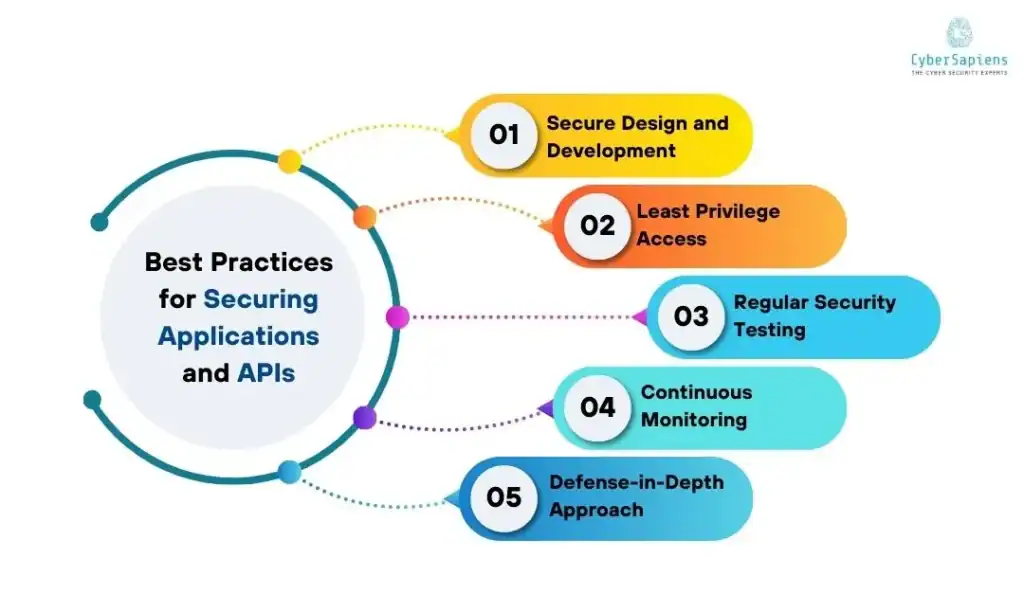
Securing modern digital systems requires more than a single control or tool. As applications increasingly rely on APIs and distributed architectures, organizations must adopt structured best practices that protect both user-facing components and backend services. The following essential best practices outline a practical, layered approach to securing applications and APIs against evolving threats while ensuring reliability, compliance, and long-term resilience.
1. Secure Design and Development
- Build security into the application and API architecture from the start.
- Implement strong authentication and authorization mechanisms.
- Follow secure coding standards to reduce common vulnerabilities.
2. Least Privilege Access
- Grant users, services, and APIs only the permissions they require.
- Regularly review and remove unnecessary access rights.
- Use role-based and object-level authorization where appropriate.
3. Regular Security Testing
- Perform application security testing to identify common vulnerabilities.
- Conduct API-specific testing for authorization, data exposure, and abuse risks.
- Validate fixes through retesting to ensure issues are properly resolved.
4. Continuous Monitoring and Logging
- Enable detailed logging for applications and APIs.
- Monitor for abnormal behavior, misuse, and automated attacks.
- Use logs to support incident detection and investigation.
5. Defense-in-Depth Approach
- Implement multiple security controls across different layers.
- Combine application security, API security, network security, and monitoring.
- Ensure fallback protections are in place if one control fails.
Why You Need Both Application Security and API Security?
Modern applications rely on both user-facing interfaces and backend APIs to function. While application security protects what users see and interact with, API security protects how data and services are accessed behind the scenes. Relying on only one leaves critical gaps that attackers can exploit.
Application security helps prevent common web and mobile threats such as injection attacks, session hijacking, and insecure authentication. However, even a well-secured application can expose sensitive data if its APIs lack proper authorization, rate limiting, or data controls. APIs often operate without user interaction, making them attractive targets for automated attacks and large-scale data abuse.
By implementing both application security and API security, organizations gain complete coverage across the entire application stack. This combined approach ensures secure user interactions, protected data access, and resilience against modern attack techniques, ultimately reducing risk, improving compliance, and strengthening overall security posture.
Securing Applications and APIs Together
Application security and API security are not interchangeable; they are complementary. As modern architectures increasingly rely on APIs to power web, mobile, and cloud-based services, securing only the user-facing layer is no longer sufficient. Organizations must address risks at both the application and API levels to prevent data exposure, unauthorized access, and large-scale automated attacks.
By combining strong application security practices with dedicated API security controls, businesses can achieve end-to-end protection across their digital ecosystem. This unified approach not only reduces the overall attack surface but also improves visibility, resilience, and compliance in today’s API-driven environments.
FAQs
1. Is API security part of application security?
Answer: API security is related to application security but addresses a different attack surface. While application security focuses on user-facing components, API security specifically protects backend services and data access, which require dedicated controls.
2. Can traditional web application firewalls (WAFs) fully protect APIs?
Answer: Traditional WAFs can provide basic protection, but they are not sufficient on their own. APIs require additional controls such as object-level authorization checks, rate limiting, and API-specific monitoring.
3. Are APIs more vulnerable than applications?
Answer: APIs are not inherently more vulnerable, but they are more exposed to automated abuse and data access issues if not secured properly. Their direct access to data makes misconfigurations more impactful.
4. How often should application and API security testing be performed?
Answer: Security testing should be performed regularly, ideally during development and after major changes. Continuous testing and monitoring are recommended for production environments.
