
Top 10 Internal Team Phishing Training Platform 2026
Phishing continues to be one of the most effective cyber attack techniques, and in 2026, it remains the leading cause of data breaches and account compromises. Despite advances in email security and threat detection, attackers increasingly focus on exploiting human behavior, making employees the most targeted and often the most vulnerable entry point into organizations.
This growing risk has made internal team phishing training platforms a critical part of modern cybersecurity strategies. The right platform can help organizations simulate real-world attacks, educate employees, measure human risk, and reduce successful phishing incidents over time. In this article, we explore the Top 10 Internal Team Phishing Training Platforms for 2026, evaluating their capabilities, strengths, and limitations, with PhishCare leading the list as the most effective solution for building a strong human layer of defense.
What Is an Internal Team Phishing Training Program?
An internal team phishing training program is a planned security initiative that helps employees learn how to identify, prevent, and report phishing attempts. Rather than depending only on classroom-style or theoretical training, these programs use realistic phishing simulations that mimic actual attack scenarios, allowing organizations to safely evaluate how employees respond.
When an employee engages with a simulated phishing message, they are provided with immediate, focused training that highlights missed warning signs and explains how to spot similar threats in the future. Over time, this approach strengthens secure habits, increases overall awareness, and transforms employees into an effective first line of defense against phishing attacks.
How to Choose the Right Phishing Training Platform?
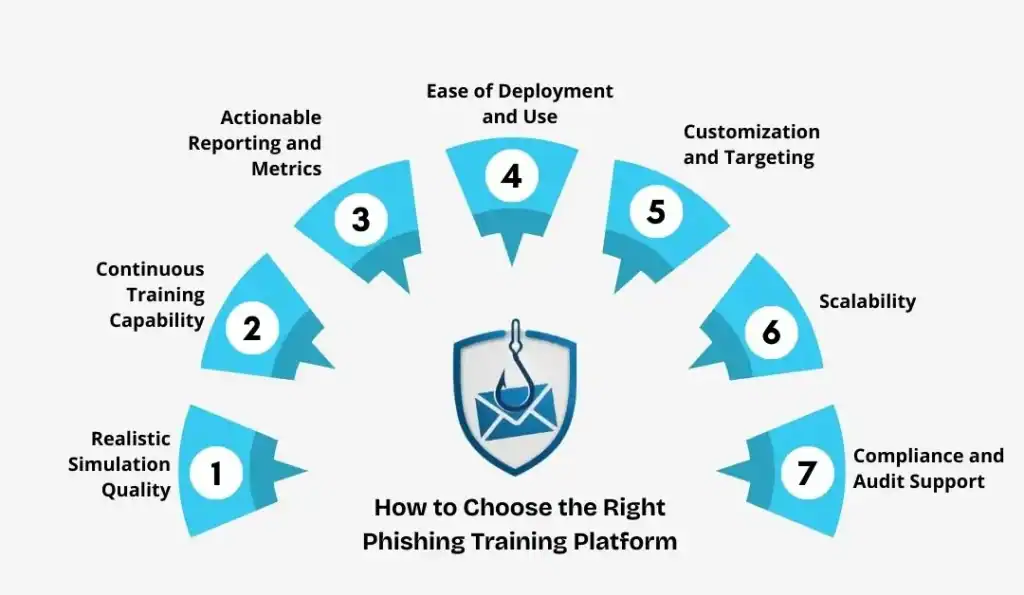
Selecting the right phishing training platform is critical for strengthening your organization’s human layer of defense. With many options available in 2026, here are key factors to consider to ensure you invest in a solution that delivers measurable security improvements and aligns with your business needs:
- Realistic Simulation Quality: Choose a platform that provides highly realistic phishing simulations that mimic real-world attack tactics. The closer the simulation is to real phishing emails, the better prepared employees will be for actual threats.
- Continuous Training Capability: Look for platforms that support ongoing and automated training rather than one-time sessions. Continuous simulations and refresher training help reinforce secure behavior over time.
- Actionable Reporting and Metrics: A strong reporting dashboard should provide clear metrics such as click rates, reporting rates, user risk scores, and trend analysis. This visibility allows security teams to track progress and focus efforts where they are most needed.
- Ease of Deployment and Use: Opt for a solution that is easy to deploy across your organization and user-friendly for both administrators and employees. Platforms that require minimal configuration reduce operational overhead.
- Customization and Targeting: Good training platforms allow you to tailor simulations and learning paths based on roles, departments, and risk profiles, making training more relevant and effective.
- Scalability: Ensure the platform can grow with your organization and support increased users, evolving threats, and more advanced training needs as your organization matures.
- Compliance and Audit Support: If your organization has regulatory requirements, consider platforms that offer compliance reporting and documentation support to demonstrate ongoing training efforts.
By evaluating phishing training platforms against these criteria, organizations can choose a solution that not only educates employees but also reduces phishing risk, improves reporting culture, and supports long-term security outcomes.
Top 10 Internal Team Phishing Training Platform 2026
Here’s a curated list of the leading phishing training platforms organizations rely on to strengthen their human layer of defense in 2026. These platforms are evaluated based on simulation realism, continuous training capability, reporting insights, ease of use, and overall impact on security culture.
1. PhishCare: Top-Rated Phishing Training Platform For Internal Teams
PhishCare is a next-generation phishing training and awareness platform built for the evolving threat landscape of 2026. Designed to help organizations reduce human risk, PhishCare combines realistic attack simulations with continuous learning and powerful analytics to strengthen the human layer of defense. Its intuitive interface, adaptive training paths, and enterprise-grade reporting make it a preferred choice for security teams of all sizes.
Phishcare Services:
1. Realistic, real-world phishing simulations
PhishCare delivers highly believable phishing campaigns that mirror the tactics, visuals, and social engineering strategies used by real attackers. These simulations go beyond basic templates by incorporating current threat intelligence, targeted messaging, and industry-specific themes, helping employees learn to recognize threats they will actually encounter.
2. Continuous and automated training approach
Unlike one-time or annual training sessions, PhishCare supports ongoing and automated training that keeps security awareness top of mind. Simulations and learning modules are scheduled strategically over time, adapting to user performance so training remains relevant, fresh, and effective.
3. Risk scoring and actionable reporting
PhishCare provides detailed metrics and dashboards that offer real insights into organizational risk. Security teams can track key indicators such as phishing click rates, reporting rates, user risk scores, and department-level trends. These actionable insights help prioritize where training or remediation is most needed and demonstrate measurable risk reduction.
4. Positive learning model
PhishCare emphasizes learning and improvement. When users interact with a phishing simulation, they receive immediate feedback and targeted education designed to reinforce good habits. This positive approach fosters engagement, reduces fear or stigma, and encourages employees to participate actively in strengthening security.
PhishCare stands out in 2026 due to its combination of realistic simulations, ongoing adaptive training, clear risk visibility, and employee-centric design. It strikes the right balance between automation and customization, enabling security teams to run effective programs at scale without overwhelming users. With robust reporting, ease of deployment, and measurable outcomes, PhishCare delivers both security impact and business value, making it the best overall phishing training platform available today.
2. KnowBe4
KnowBe4 is one of the most widely adopted phishing training platforms, offering a vast library of phishing templates and awareness content suitable for organizations of all sizes. It combines simulated attacks with engaging training modules and customizable campaigns, making it especially effective for compliance-driven environments. Its robust reporting capabilities help security teams track progress and identify high-risk users over time.
3. Proofpoint Security Awareness Training
Proofpoint integrates phishing simulations with real-time threat intelligence, enabling organizations to simulate attacks based on the latest threat trends. This makes it particularly valuable for security teams that want to test user responses against real-world campaigns observed in the wild. The platform’s analytics help pinpoint risk patterns and guide targeted awareness efforts.
4. Cofense PhishMe
Cofense PhishMe focuses on targeted phishing campaigns and detailed analytics to assess how users respond to specific attack vectors. It pairs simulation with actionable insights for security operations and incident response teams, helping close the gap between detection and remediation. The platform is well-suited for mature security teams looking for deep visibility into human risk behavior.
5. Hoxhunt
Hoxhunt uses adaptive learning and gamification to engage employees in their own security training, making educational experiences more interactive and less repetitive. The platform adjusts simulation difficulty based on user performance, ensuring that training challenges grow with employee skill levels. Its data-driven insights help organizations spot trends and reinforce security culture.
6. Mimecast Awareness Training
Mimecast Awareness Training is tightly integrated with Mimecast’s email security stack, allowing security teams to coordinate phishing simulations with advanced email defense tools. It includes customizable campaigns and training modules that educate users on recognizing and reporting suspicious emails. The platform is especially useful for organizations already using Mimecast’s broader security suite.
7. Infosec IQ
Infosec IQ offers a comprehensive security awareness and training suite that includes phishing simulations, interactive learning paths, and published training content. The platform emphasizes long-term learning and measurable behavior change, with dashboards that show improvements across different user groups. It is a solid choice for teams that want a combined awareness and phishing simulation program.
8. Curricula
Curricula provides a flexible training program that allows organizations to tailor phishing simulations and awareness modules based on roles, departments, or industry-specific threats. Its focus on continuous learning and adaptive campaigns helps keep training relevant and engaging. Curricula also offer robust reporting to help track risk reduction over time.
9. CybSafe
CybSafe goes beyond basic phishing simulations by incorporating behavior analytics and risk scoring to give security teams deeper context into how human risk influences broader security posture. It offers personalized feedback and suggestions for improvement, helping employees understand their own risk levels. The platform’s insights help prioritize training where it’s most needed.
10. Terranova Security
Terranova Security combines localized, culturally relevant training content with phishing simulations, making it a strong choice for global organizations with diverse teams. Its training library includes multi-language options and awareness resources that meet varying compliance requirements. The platform’s emphasis on engagement and accessibility helps improve overall employee participation.
Choosing the Right Phishing Training Platform for 2026
As phishing attacks continue to evolve, organizations can no longer rely on awareness alone; effective, continuous training is essential to reduce human risk. The right phishing training platform should combine realistic simulations, ongoing education, and clear metrics to drive measurable behavior change.
Among the top platforms in 2026, PhishCare stands out as the best overall solution by delivering real-world simulations, automated training, actionable risk insights, and a positive learning experience. By investing in the right platform, organizations can transform employees into a strong human firewall and significantly strengthen their overall cybersecurity posture.
FAQs
1. Are phishing training platforms suitable for small teams?
Answer: Yes. Most phishing training platforms, including PhishCare, are scalable and designed to support organizations of all sizes, from small teams to large enterprises.
2. How long does it take to see results from phishing training?
Answer: Many organizations begin to see measurable improvements, such as reduced click rates and increased reporting, within the first few simulation cycles.
3. Is phishing training required for compliance?
Answer: While requirements vary by regulation, many security frameworks recommend or require ongoing security awareness training. Phishing training platforms help demonstrate compliance and due diligence.
4. What makes PhishCare different from other phishing training platforms?
Answer: PhishCare focuses on realistic simulations, continuous automated training, actionable risk insights, and a positive learning model that drives real behavior change rather than checkbox compliance.
