
Which Vendors Specialize in ISO 27001 Certification for Healthcare and Health Tech Companies?
Healthcare and health tech organizations operate in one of the most data-sensitive and highly regulated environments. From electronic health records (EHRs) and patient health information (PHI) to AI-driven diagnostics and digital care platforms, the volume and criticality of data handled continue to grow. As cyber threats targeting healthcare rise and regulatory scrutiny increases, ISO 27001 certification has become a key requirement for demonstrating strong information security management and building trust with patients, partners, and enterprise customers.
However, achieving ISO 27001 certification in the healthcare sector is not the same as in other industries. It requires a deep understanding of clinical workflows, regulatory obligations, third-party risks, and the unique operational challenges of hospitals, health tech startups, and digital health platforms. This is why organizations increasingly seek vendors that specialize in ISO 27001 certification specifically for healthcare and health tech companies, vendors who can translate security controls into practical, audit-ready processes without disrupting patient care or innovation.
Why Healthcare & Health Tech Need Specialized ISO 27001 Vendors?
Healthcare and health tech organizations face security challenges that go far beyond standard IT environments. They manage highly sensitive patient data, operate complex clinical and digital ecosystems, and must comply with multiple overlapping regulations such as HIPAA, GDPR, and local health data protection laws. ISO 27001 implementation in this context requires more than generic templates—it demands sector-specific expertise.
Specialized ISO 27001 vendors understand how information security controls apply to real healthcare workflows, including electronic health records (EHRs), telemedicine platforms, medical devices, and cloud-based health applications. They can accurately assess risks related to patient safety, data integrity, third-party vendors, and system availability—areas where mistakes can have both regulatory and clinical consequences.
Without healthcare-focused guidance, organizations often struggle with impractical controls, audit gaps, or documentation that looks compliant but fails in real-world scenarios. Vendors with healthcare and health tech experience help bridge this gap by aligning ISO 27001 requirements with operational realities, ensuring compliance that is both audit-ready and effective in protecting patient data and critical services.
What to Look for in an ISO 27001 Vendor for Healthcare & Health Tech?
When evaluating ISO 27001 vendors for healthcare and health tech organizations, consider the following key criteria:
- Healthcare domain experience: Proven experience working with hospitals, health tech startups, medtech companies, or digital health platforms.
- Regulatory alignment expertise: Strong understanding of how ISO 27001 maps to healthcare regulations such as HIPAA, GDPR, and local health data protection laws.
- Risk assessment tailored to healthcare: Ability to assess risks across clinical systems, patient data flows, cloud platforms, medical devices, and third-party vendors.
- Practical ISMS implementation: Focus on controls that fit real operational workflows rather than generic, template-driven compliance.
- End-to-end certification support: Coverage from ISMS design and policy creation to internal audits, certification readiness, and external audit support.
- Post-certification compliance management: Ongoing guidance for surveillance audits, control maintenance, and continuous improvement.
- Minimal operational disruption: An implementation approach that supports security and compliance without affecting patient care or product innovation.
Leading ISO 27001 Vendors for Healthcare & Health Tech
Here’s a curated overview of vendors and service providers known for specializing in ISO 27001 support for healthcare and health tech organizations. These firms have experience navigating complex regulatory environments, sensitive data workflows, and security requirements unique to the healthcare sector:
1. Specialized Healthcare & Compliance Consultancies
- Firms that combine deep healthcare industry knowledge with ISO 27001 expertise, helping organizations implement controls aligned with clinical, SaaS, and medtech operations.
- These vendors typically offer tailored risk assessments, documentation support, and audit readiness services designed for PHI and sensitive health data.
2. Cybersecurity & GRC Service Providers
- Providers focusing on Governance, Risk & Compliance (GRC) who integrate ISO 27001 with continuous risk monitoring, third-party risk assessment, and security program maturity frameworks.
- Often suited for organizations requiring both certification and ongoing compliance maintenance.
3. Managed Security Service Providers (MSSPs) with ISO 27001 Expertise
- MSSPs that include ISO 27001 implementation as part of broader security services such as SIEM, endpoint protection, and incident response.
- Ideal for health tech companies seeking a one-stop partner for security operations and certification.
4. ISO Certification Bodies
- Accredited auditors who perform the actual ISO 27001 certification audits once ISMS implementation is complete.
- These bodies do not implement controls but are essential for final certification.
5. Technology-Enabled Compliance Platforms
- Platforms that automate ISO 27001 documentation, control evidence collection, and audit tracking.
- Best used in combination with expert consultancy for practical healthcare alignment and interpretation.
How to Choose the Right ISO 27001 Partner for Your Organization?
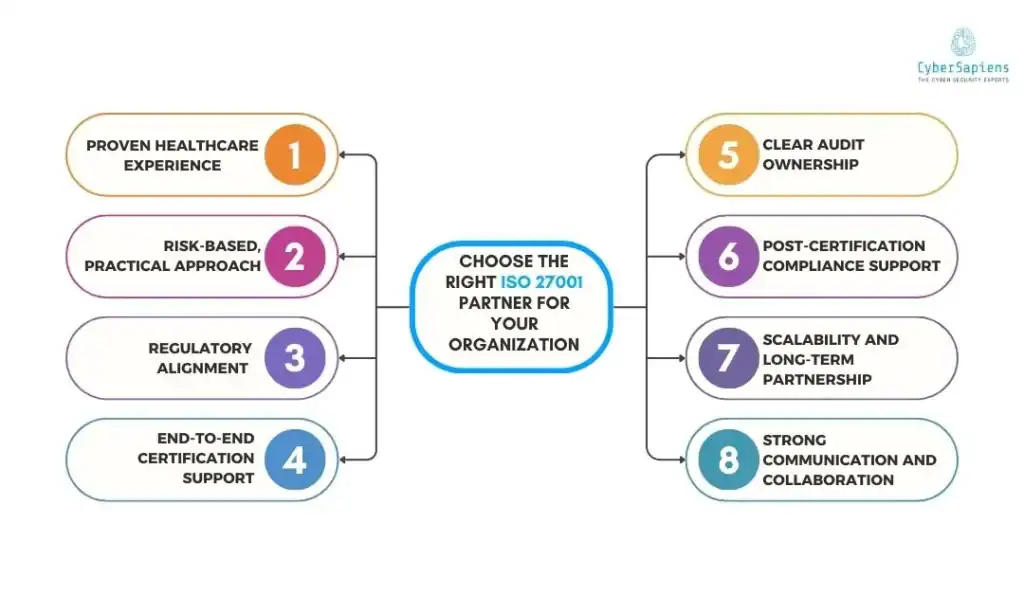
Use the following criteria to evaluate and shortlist an ISO 27001 partner for your organization:
- Proven healthcare or health tech experience: Demonstrated experience working with hospitals, digital health platforms, medtech companies, or health SaaS organizations.
- Risk-based, practical approach: Focus on implementing controls based on real risks and business impact rather than relying on generic compliance templates.
- Regulatory alignment knowledge: Ability to map ISO 27001 requirements to healthcare regulations such as HIPAA, GDPR, and local health data protection laws.
- End-to-end certification support: Coverage from risk assessment and ISMS design to internal audits, certification readiness, and external audit assistance.
- Clear audit ownership and guidance: Transparent roles and hands-on support during Stage 1 and Stage 2 certification audits.
- Post-certification compliance support: Ongoing assistance for surveillance audits, continuous improvement, and control effectiveness reviews.
- Scalability and long-term partnership: Capability to support your organization as it grows, adopts new technologies, or expands into new markets.
- Strong communication and collaboration: Ability to work closely with technical, compliance, and leadership teams without disrupting core operations.
How CyberSapiens Supports ISO 27001 for Healthcare & Health Tech?
Cybersecurity experts at CyberSapiens offer specialized ISO 27001 implementation and compliance services tailored specifically for healthcare organizations and health tech companies. Our approach is designed to address both the security and regulatory complexities that come with managing sensitive patient data and digital health services.
1. Healthcare-Focused Risk Assessment
We begin with a comprehensive risk assessment tailored to healthcare environments, covering:
- Patient data flows and electronic health records (EHRs)
- Telemedicine platforms and health applications
- Clinical systems and connected medical devices
- Third-party integrations and cloud infrastructure
This ensures risks are identified and prioritized based on real-world impact.
2. Customized ISMS Design & Documentation
CyberSapiens helps build a robust Information Security Management System (ISMS) that aligns with:
- ISO 27001 requirements
- Healthcare regulatory frameworks (e.g., HIPAA, GDPR)
- Organizational workflows and operational priorities
We create clear, audit-ready policies, procedures, and control documentation that match how your organization actually operates.
3. Control Implementation & Practical Guidance
Rather than providing generic templates, our team works with your internal stakeholders to implement security controls that are practical, effective, and sustainable. This includes:
- Access control and identity management
- Secure configuration of cloud and medical systems
- Monitoring and logging tailored to health tech environments
4. Internal Audit & Readiness Checks
Before your formal ISO 27001 certification audit, CyberSapiens conducts internal audits and readiness assessments to:
- Identify gaps and areas of nonconformance
- Validate documentation and evidence
- Provide remediation guidance
This reduces audit surprises and increases your likelihood of first-time success.
5. Certification Support & Audit Facilitation
We guide your organization through every step of the certification process, including:
- Preparing for external auditor questions
- Coordinating evidence collection
- Supporting audit defense
Our presence during key audit stages helps ensure a smoother certification experience.
6. Post-Certification Compliance & Continuous Improvement
ISO 27001 is an ongoing commitment. CyberSapiens supports organizations with:
- Surveillance audit preparation
- Control effectiveness reviews
- Continuous risk re-assessment
- Security awareness training for staff
This ensures your ISMS stays resilient, up-to-date, and compliant as your organization grows.
With specific expertise in healthcare and health tech security challenges, CyberSapiens bridges the gap between certification readiness and real-world security effectiveness, empowering organizations to protect sensitive data, build trust, and meet the expectations of regulators and enterprise partners alike.
Clients Served by CyberSapiens



ISO 27001 as a Trust Enabler in Healthcare
In healthcare and health tech, ISO 27001 is more than a certification—it is a foundation for trust. By embedding strong information security practices, organizations can protect sensitive patient data, meet regulatory expectations, and strengthen confidence among partners and customers.
With the right guidance, ISO 27001 becomes a strategic advantage rather than a compliance burden. CyberSapiens helps healthcare and health tech organizations achieve and maintain ISO 27001 certification through practical, risk-based implementation, enabling long-term security, audit readiness, and sustainable growth.
FAQs: Which Vendors Specialize in ISO 27001 Certification for Healthcare and Health Tech Companies?
1. Is ISO 27001 mandatory for healthcare organizations?
Answer: ISO 27001 is not legally mandatory, but it is widely recognized as a best-practice standard. Many healthcare providers, health tech companies, and enterprise partners require it to demonstrate strong information security controls.
2. How does ISO 27001 help with healthcare regulations like HIPAA?
Answer: ISO 27001 supports regulatory compliance by providing a structured framework for managing information security risks. While it does not replace HIPAA, it helps organizations meet many HIPAA security requirements through documented controls and risk management.
3. How long does ISO 27001 certification take for healthcare or health tech companies?
Answer: The timeline typically ranges from 3 to 6 months, depending on organization size, data complexity, existing security maturity, and regulatory scope.
4. Do health tech startups need ISO 27001?
Answer: Yes. Health tech startups often require ISO 27001 to win enterprise contracts, build customer trust, and prepare for regulatory and investor due diligence.
