
How to Conduct an ISO 27001 Internal Audit Before Your Final Certification?
An ISO 27001 internal audit is one of the most critical steps before your final certification audit. It acts as a rehearsal that helps organizations identify gaps, verify control effectiveness, and correct issues before an external auditor evaluates the Information Security Management System (ISMS). When conducted properly, an internal audit significantly reduces the risk of major non-conformities during certification
Many organizations underestimate the importance of the internal audit or treat it as a documentation review. In reality, ISO 27001 internal audits must assess whether policies, processes, and technical controls are not only defined but also implemented and operating effectively. Auditors expect evidence, consistency, and alignment between documentation and real-world practices.
Conducting a thorough internal audit before certification allows organizations to uncover weaknesses early, strengthen their security posture, and demonstrate continual improvement.
Understanding ISO 27001 Internal Audit Requirements
ISO 27001 requires organizations to conduct internal audits at planned intervals to determine whether the Information Security Management System (ISMS) conforms to both the standard and the organization’s own policies. These audits are a mandatory requirement and play a key role in demonstrating the effectiveness of the ISMS before certification.
Internal audits must be objective and independent, meaning auditors should not audit their own work. The audit process should cover the ISMS scope, applicable clauses of ISO 27001, and relevant Annex A controls. Auditors are expected to evaluate not just documentation, but also evidence of implementation, such as logs, access reviews, incident records, risk assessments, and corrective actions.
Certification auditors often review internal audit records to assess ISMS maturity. They look for clear audit plans, defined criteria, documented findings, and evidence that identified issues were addressed. A weak or incomplete internal audit can raise concerns about governance and readiness for certification.
When Should You Conduct the ISO 27001 Internal Audit?
Timing plays a critical role in the effectiveness of an ISO 27001 internal audit. Conducting the audit too early can result in incomplete findings, while conducting it too late leaves little time to fix issues before certification.
Ideally, the internal audit should be performed after the ISMS has been fully implemented and is operating for a reasonable period. This allows auditors to evaluate whether controls are working in practice and whether records and evidence are being consistently maintained.
For organizations preparing for certification, the internal audit should be completed before the Stage 2 certification audit. Many certification bodies also review internal audit results during the Stage 1 audit, making early completion even more beneficial.
Preparing for an ISO 27001 Internal Audit
Effective preparation is essential for a successful ISO 27001 internal audit. Proper planning ensures the audit is structured, objective, and focused on identifying real gaps rather than last-minute documentation issues.
Before starting the audit, organizations should clearly define the audit scope and criteria. This includes identifying the ISMS scope, applicable ISO 27001 clauses, and relevant Annex A controls to be assessed.
Key preparation activities include:
- Reviewing ISMS Documentation: Ensure policies, procedures, risk assessments, risk treatment plans, and Statements of Applicability are complete, approved, and up to date.
- Identifying Key Processes and Stakeholders: Determine which teams, systems, and process owners will be audited and schedule interviews accordingly.
- Collecting Preliminary Evidence: Gather logs, access reviews, incident records, training records, and change management evidence in advance.
- Creating an Audit Plan and Checklist: Develop a structured audit plan outlining audit objectives, scope, schedule, and methods.
Step-by-Step: How to Conduct an ISO 27001 Internal Audit?
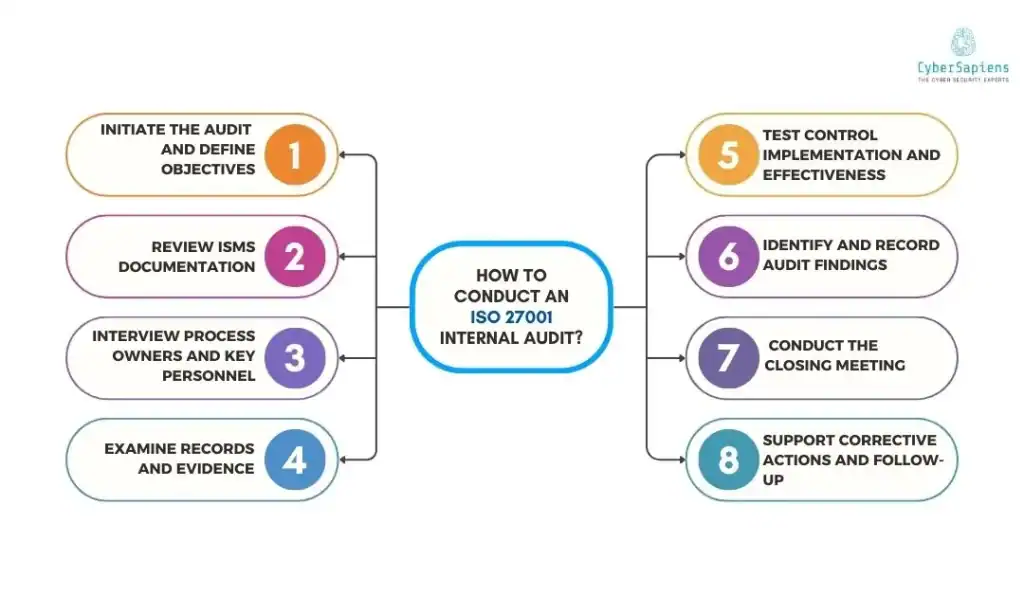
Conducting an ISO 27001 internal audit requires a structured, evidence-based approach. The goal is not just to identify gaps, but to evaluate whether the ISMS is effectively implemented and operating as intended.
Step 1: Initiate the Audit and Define Objectives
Begin with a formal audit initiation. Clearly define the audit objectives, scope, criteria (ISO 27001 clauses and Annex A controls), and audit schedule. Conduct an opening meeting to communicate expectations with stakeholders.
Step 2: Review ISMS Documentation
Examine key ISMS documents such as policies, procedures, risk assessments, risk treatment plans, and the Statement of Applicability. Verify that documents are approved, current, and aligned with the defined ISMS scope.
Step 3: Interview Process Owners and Key Personnel
Interview employees responsible for ISMS processes, security controls, and operations. Confirm whether staff understand their roles and whether documented procedures are followed in practice.
Step 4: Examine Records and Evidence
Review objective evidence such as access reviews, system logs, incident records, training attendance, change management records, and previous audit findings. Evidence must demonstrate consistent implementation—not a one-time activity.
Step 5: Test Control Implementation and Effectiveness
Validate whether technical and operational controls are functioning as intended. This may include reviewing monitoring mechanisms, access restrictions, incident response actions, and vulnerability management activities.
Step 6: Identify and Record Audit Findings
Document audit findings clearly and objectively. Classify them as:
- Major non-conformities
- Minor non-conformities
- Observations or opportunities for improvement
Each finding should reference the relevant ISO 27001 clause or Annex A control.
Step 7: Conduct the Closing Meeting
Present audit findings to management and process owners. Ensure findings are clearly understood, agreed upon, and formally acknowledged.
Step 8: Support Corrective Actions and Follow-Up
Ensure corrective actions are assigned, root causes are identified, and remediation timelines are defined. Follow up to verify that actions are implemented and effective before the certification audit.
How CyberSapiens Helps with ISO 27001 Internal Audits?
Conducting an effective ISO 27001 internal audit requires independence, deep standard knowledge, and the ability to evaluate both governance and technical controls. Cybersecurity experts at CyberSapiens support organizations at every stage of the internal audit process, ensuring audits are objective, thorough, and aligned with certification expectations.
An effective ISO 27001 internal audit requires more than checking documents—it demands independence, technical validation, and a deep understanding of how auditors assess ISMS maturity. CyberSapiens supports organizations throughout the internal audit lifecycle, helping them identify gaps early, strengthen controls, and confidently prepare for final certification.
Comprehensive Support from CyberSapiens for ISO 27001 Internal Audits
1. Independent and Objective Internal Audits
CyberSapiens conducts fully independent ISO 27001 internal audits, ensuring compliance with the standard’s requirement for auditor objectivity. This independence provides unbiased insights into ISMS effectiveness and highlights risks that internal teams may overlook.
2. Audit Planning and Scope Alignment
A structured audit plan is developed based on the defined ISMS scope, business context, applicable ISO 27001 clauses, and Annex A controls. This ensures the audit is focused, comprehensive, and aligned with certification expectations.
3. Detailed Audit Checklists and Evidence Mapping
CyberSapiens uses ISO 27001–aligned checklists to systematically evaluate governance, operational, and technical controls. Evidence such as logs, access reviews, incident records, and training data is mapped directly to audit criteria, ensuring traceability and clarity.
4. Validation of Technical and Operational Controls
Beyond documentation, CyberSapiens evaluates whether controls such as access management, logging, monitoring, backup, and incident response are implemented and operating effectively in real-world conditions.
5. VAPT-Driven Control Effectiveness Assessment
Where required, vulnerability assessments and penetration testing are used to validate the effectiveness of technical controls. This provides strong, objective evidence that security measures can withstand real attack scenarios.
6. Clear, Actionable Audit Reporting
Audit findings are clearly documented and classified as major non-conformities, minor non-conformities, or observations. Each finding includes root cause analysis and practical recommendations to support timely remediation.
7. Corrective Action and Follow-Up Support
CyberSapiens assists organizations in developing corrective action plans, assigning ownership, and tracking remediation progress. Follow-up reviews confirm that issues are effectively closed before certification audits.
8. Management Review and Certification Readiness
Support is provided to prepare management review inputs, summarize audit results, and demonstrate leadership involvement. This ensures organizations are fully prepared for Stage 1 and Stage 2 certification audits.
With its hands-on, audit-focused approach, CyberSapiens helps organizations turn internal audits into a powerful readiness tool, reducing certification risk and strengthening long-term ISMS effectiveness.
Clients Served by CyberSapiens






Using Internal Audits to Pass ISO 27001 with Confidence
An ISO 27001 internal audit is more than a compliance requirement—it is a critical confidence check before your final certification audit. When conducted thoroughly, internal audits help organizations validate control effectiveness, identify gaps early, and ensure the Information Security Management System (ISMS) is operating as intended.
By approaching internal audits as a practical assessment rather than a formality, organizations can reduce certification risk, strengthen governance, and demonstrate continual improvement. Reviewing real evidence, testing controls, and closing findings in advance creates a strong foundation for a successful certification outcome.
With its independent internal audit expertise, technical validation, and certification readiness support, CyberSapiens enables organizations to turn internal audits into a strategic advantage. By identifying and resolving issues before external review, CyberSapiens helps organizations approach ISO 27001 certification with clarity, confidence, and control.
FAQs: How to Conduct an ISO 27001 Internal Audit Before Your Final Certification?
1. Is an internal audit mandatory for ISO 27001 certification?
Answer: Yes. ISO 27001 requires organizations to conduct internal audits at planned intervals. Certification auditors will review internal audit records during Stage 1 and Stage 2 audits.
2. When should the internal audit be conducted before certification?
Answer: The internal audit should be conducted after the ISMS is fully implemented and before the Stage 2 certification audit, allowing sufficient time to address findings.
3. Who can perform an ISO 27001 internal audit?
Answer: The audit must be conducted by competent and independent auditors. This can include trained internal staff not responsible for the audited areas or an external audit provider.
4. What evidence is reviewed during an internal audit?
Answer: Auditors review policies, risk assessments, logs, access reviews, incident records, training records, audit reports, and corrective action evidence.
