
How Organizations Track Employee Phishing Awareness Progress Over Time?
Phishing attacks continue to evolve in sophistication, but employee awareness is not something that improves overnight or stays effective without reinforcement. Many organizations invest in security awareness training, yet struggle to answer a critical question: Is employee behavior actually improving over time?
Tracking phishing awareness progress is essential to understanding how employees recognize, respond to, and report threats in real-world scenarios. Without ongoing measurement, security teams are left relying on assumptions rather than evidence. By continuously monitoring awareness metrics and behavioral trends, organizations gain clear visibility into human cyber risk, enabling them to strengthen defenses, reduce incidents, and build a resilient security culture over time.
Why Tracking Employee Phishing Awareness Progress Matters?
Phishing is not a one-time threat, and employee awareness is not a one-time achievement. Attackers constantly change tactics, making it essential for organizations to continuously assess how well employees can recognize and respond to evolving phishing attempts.
Without tracking awareness over time, organizations may assume training is effective while risky behaviors persist unnoticed. Monitoring progress allows security teams to identify trends, measure improvement, and pinpoint areas where additional training is needed. It also helps shift security awareness from a compliance checkbox to a measurable risk-reduction strategy.
By tracking employee phishing awareness progress, organizations gain data-driven insight into human risk, improve incident detection through faster reporting, and ensure security awareness programs deliver lasting behavioral change rather than temporary improvements.
What Does “Employee Phishing Awareness Progress” Mean?
Employee phishing awareness progress goes beyond simply completing training or passing a single test. It reflects measurable changes in behavior, such as how consistently employees identify, avoid, and report phishing attempts over time.
True awareness progress is seen when employees pause before clicking, recognize subtle phishing indicators, and report suspicious emails quickly and confidently. It also includes a reduction in repeat mistakes and an improvement in response time as employees become more familiar with attacker techniques.
By focusing on behavioral trends rather than isolated results, organizations can accurately assess whether security awareness efforts are working and where targeted improvements are needed to reduce human-related cyber risk.
Key Metrics Organizations Use to Track Phishing Awareness Progress
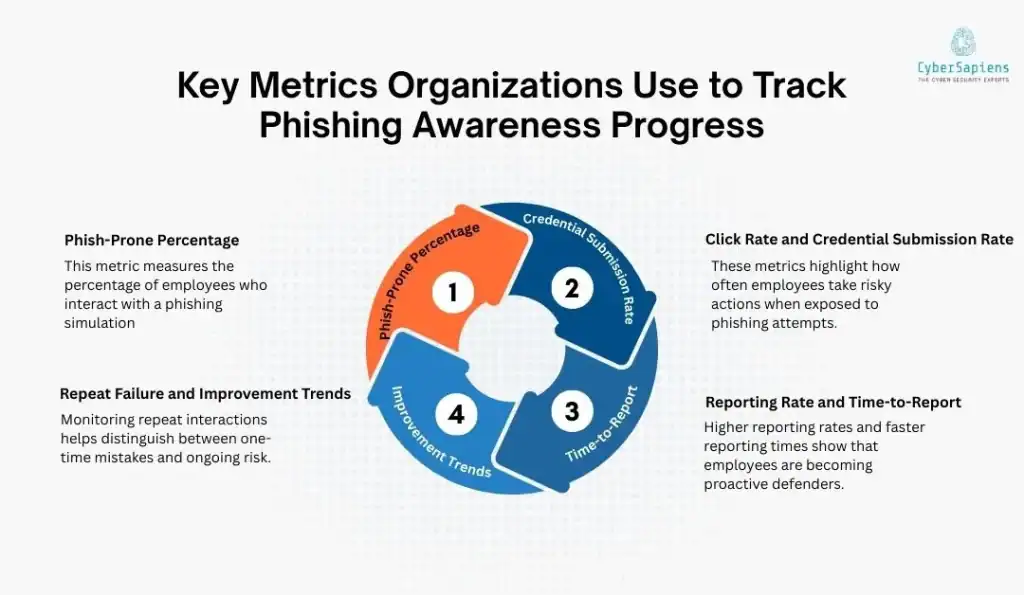
To measure employee phishing awareness effectively, organizations rely on clear, behavior-based metrics that show how actions change over time, not just one-time results.
- Phish-Prone Percentage: This metric measures the percentage of employees who interact with a phishing simulation (clicking links or submitting credentials). A consistent decline over time indicates improving awareness and reduced human risk.
- Click Rate and Credential Submission Rate: These metrics highlight how often employees take risky actions when exposed to phishing attempts. Tracking trends helps identify high-risk users, departments, or attack types.
- Reporting Rate and Time-to-Report: Higher reporting rates and faster reporting times show that employees are becoming proactive defenders. Early reporting enables faster containment and reduces potential impact.
- Repeat Failure and Improvement Trends: Monitoring repeat interactions helps distinguish between one-time mistakes and ongoing risk. Improvement trends reveal whether training and simulations are driving lasting behavior change.
By tracking these metrics over time, organizations gain actionable insight into employee awareness maturity and can adjust training strategies to strengthen their human defense layer.
How Continuous Phishing Simulations Enable Long-Term Tracking?
Continuous phishing simulations make it possible to measure employee phishing awareness consistently and accurately over time. Key ways they support long-term tracking include:
- Establishing a Clear Baseline: Initial simulations create a starting point for measuring employee risk and awareness levels.
- Tracking Behavioral Trends Over Time: Ongoing simulations reveal patterns such as reduced click rates, faster reporting, and improved recognition of phishing attempts.
- Measuring Improvement Across Roles and Departments: Regular testing highlights differences in risk levels, enabling targeted training for specific teams.
- Adapting to Evolving Phishing Tactics: Simulations change alongside real-world attack techniques, ensuring progress is measured against current threats.
- Linking Training to Real Behavior: Continuous data helps confirm whether awareness training is driving genuine, lasting behavior change.
By using continuous phishing simulations, organizations gain long-term visibility into employee awareness progress and can adjust security strategies based on measurable outcomes rather than assumptions.
Business Benefits of Tracking Phishing Awareness Over Time
Tracking employee phishing awareness over time delivers clear business value by turning human behavior into a measurable and manageable security factor. Key business benefits include:
- Reduced Risk of Phishing-Related Breaches: Continuous visibility into employee behavior helps prevent credential theft, ransomware, and data breaches before they occur.
- Lower Incident Response and Recovery Costs: Early detection and faster reporting reduce downtime, investigation effort, and financial losses.
- Improved Compliance and Audit Readiness: Ongoing tracking provides documented evidence of security awareness efforts required by standards such as ISO 27001 and SOC 2.
- Data-Driven Security Investments: Behavioral metrics help organizations focus resources on high-risk users, departments, or attack types, improving ROI.
- Stronger Organizational Security Culture: Employees become active participants in security, fostering shared responsibility and accountability.
- Protection of Brand Reputation and Business Continuity: By minimizing human-driven incidents, organizations safeguard customer trust, operational stability, and long-term growth.
How PhishCare Helps Organizations Track Phishing Awareness Progress?
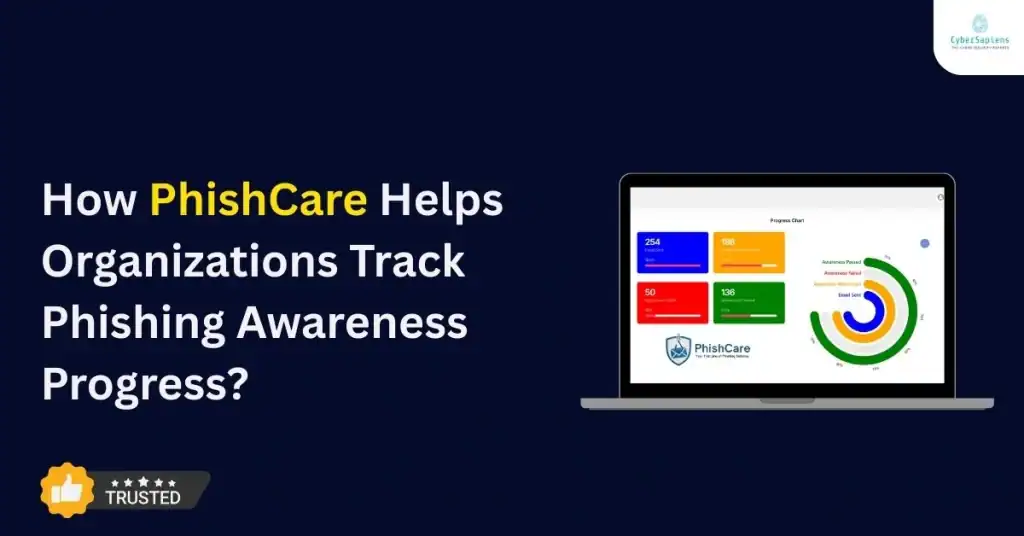
PhishCare is built to help organizations move beyond isolated phishing tests and gain continuous, measurable visibility into employee security behavior. By combining realistic phishing simulations with behavior-driven analytics, PhishCare enables security teams and leadership to clearly understand how awareness evolves over time and where risk still exists.
Instead of relying on assumptions or one-off results, PhishCare provides long-term insight into human cyber risk by tracking trends, improvements, and recurring weaknesses across the organization.
How PhishCare Enables Continuous Tracking?
1. Centralized Dashboards With Historical Trends
PhishCare maintains a complete history of phishing simulation results, allowing organizations to track awareness improvement over weeks, months, and years. Trends such as declining click rates and increasing report rates provide clear evidence of behavioral progress.
2. Behavior-Based Risk Scoring
Employee actions are translated into risk scores, helping organizations quantify human risk at individual, team, and organizational levels. This makes it easier to prioritize high-risk users and focus training efforts where they deliver the greatest impact.
3. Role-Based and Department-Level Visibility
Different roles face different phishing risks. PhishCare highlights department-wise and role-specific trends, enabling targeted simulations and customized awareness strategies rather than one-size-fits-all training.
4. Automated, Just-in-Time Training
When an employee interacts with a simulated phishing email, PhishCare automatically delivers contextual training at the moment of error. This immediate feedback accelerates learning and reinforces correct behavior.
5. Audit-Ready and Executive Reporting
PhishCare generates clear, audit-ready reports aligned with compliance frameworks such as ISO 27001 and SOC 2. Leadership teams gain easy-to-understand metrics that demonstrate ongoing awareness efforts and measurable risk reduction.
By turning phishing simulations into continuous intelligence, PhishCare helps organizations prove improvement over time, reduce human-related incidents, and build a resilient security culture.
PhishCare Pricing Plans
PhishCare pricing is designed to scale with your organization’s size, security maturity, and risk profile. Whether you’re starting with foundational awareness or looking for advanced, continuous behavior tracking, PhishCare offers flexible plans that deliver measurable value.
| Quantity Range | Yearly | Bi-Annually | Quarterly | Monthly |
| 1-50 | $15.00 | $14.00 | $13.00 | $12.00 |
| 51-150 | $14.50 | $13.75 | $12.80 | $11.70 |
| 151-350 | $14.15 | $13.20 | $12.45 | $11.50 |
| 351-800 | $13.90 | $12.70 | $12.00 | $11.00 |
| 801-1500 | $13.30 | $12.00 | $11.65 | $10.60 |
| 1501-3000 | $13.00 | $11.75 | $11.30 | $10.20 |
| 3001-5000 | $12.60 | $11.40 | $11.00 | $9.80 |
| 5001-10000 | $12.30 | $11.00 | $10.60 | $9.50 |
Measuring Awareness to Reduce Human Risk
Tracking employee phishing awareness over time is no longer optional; it is essential for reducing human-driven cyber risk. One-time training and isolated tests provide only a snapshot, while continuous measurement reveals whether security behaviors are truly improving and keeping pace with evolving threats.
By monitoring key metrics such as click rates, reporting behavior, and time-to-report, organizations gain clear, data-driven insight into their human security posture. Solutions like PhishCare enable this visibility by transforming phishing simulations into long-term intelligence, helping security teams focus on the right risks, strengthen awareness programs, and demonstrate measurable improvement.
Ultimately, organizations that consistently track phishing awareness progress don’t just train employees; they empower them to become an active line of defense, protecting business operations, reputation, and long-term growth in an increasingly threat-driven digital landscape.
FAQs: How Organizations Track Employee Phishing Awareness Progress Over Time
1. How often should phishing awareness progress be reviewed?
Answer: Progress should be reviewed regularly—monthly or quarterly is ideal. Continuous monitoring helps organizations detect trends early and adjust training or simulations as needed.
2. Can phishing awareness tracking support compliance requirements?
Answer: Yes. Continuous tracking provides documented evidence of security awareness and training, supporting compliance with standards such as ISO 27001 and SOC 2.
3. How do continuous phishing simulations help measure long-term progress?
Answer: They create a consistent baseline and ongoing data points, allowing organizations to track behavioral trends, improvement, and risk reduction across departments and roles.
4. Is phishing awareness tracking suitable for small and growing organizations?
Answer: Absolutely. Phishing attacks target organizations of all sizes, and scalable platforms like PhishCare make it easy for small and growing teams to track awareness effectively.
