
Phishing Simulation for IT Teams: Automating Employee Security Training
Phishing attacks continue to be the easiest and most effective way for cybercriminals to breach organizations, often bypassing advanced security tools by targeting the weakest link: people. For IT teams, this creates an ongoing challenge: how to continuously train employees to recognize and respond to phishing threats without adding manual workload or disrupting daily operations. Traditional awareness sessions and annual training programs simply aren’t enough to keep pace with evolving attack techniques.
This is where phishing simulation becomes a game-changer. By automating real-world phishing scenarios and tying them directly to employee security training, IT teams can proactively reduce human risk, measure security awareness, and build a resilient security culture. Modern platforms like PhishCare enable organizations to turn phishing training into a continuous, automated process, helping employees learn through experience while giving IT teams clear visibility into risk and progress.
What Is Phishing Simulation?
Phishing simulation is a controlled security training approach that helps organizations test and strengthen their employees’ ability to recognize phishing attacks. Instead of relying only on theory-based awareness sessions, IT teams send simulated phishing emails that closely mimic real-world attacks, such as fake login pages, malicious links, or suspicious attachments, to employees in a safe environment.
These simulations allow IT and security teams to observe how users actually behave when faced with a potential phishing threat. The platform tracks actions like email opens, link clicks, and credential submissions, turning employee behavior into measurable security data. Employees who fall for a simulated attack are automatically guided to short, targeted training modules, reinforcing correct behavior at the moment it matters most.
Phishing simulation transforms security awareness from a one-time exercise into a continuous, automated learning process. By regularly running simulations and linking them to adaptive training, organizations can reduce human risk, improve incident response readiness, and build a stronger, more resilient security culture across the workforce.
Why Phishing Simulation Is Essential for IT Teams?

Phishing attacks continue to evolve in speed, sophistication, and scale, making them one of the most persistent threats IT teams face today. Relying solely on technical defenses or occasional awareness training leaves organizations exposed to human error. Phishing simulation fills this gap by enabling IT teams to continuously test, measure, and improve employee readiness in a controlled and automated way.
- Addresses the human risk factor: Even with strong technical controls in place, phishing attacks exploit human behavior. Phishing simulations help IT teams reduce this risk by training employees to identify real-world threats.
- Provides measurable security insights: IT teams gain clear visibility into employee behavior, who clicks, who reports, and who needs additional training, turning awareness into actionable data.
- Enables continuous, automated training: Automated phishing campaigns run on a schedule without manual effort, ensuring employees are regularly tested and trained without increasing IT workload.
- Helps prioritize remediation efforts: By identifying high-risk users and departments, IT teams can focus security efforts where they are needed most instead of applying one-size-fits-all training.
- Strengthens overall security posture: Regular simulations reduce successful phishing incidents over time, lowering the chances of breaches, ransomware, and credential theft.
- Supports compliance and audit requirements: Phishing simulations help demonstrate ongoing security awareness training for standards such as ISO 27001, SOC 2, and other regulatory frameworks.
- Shifts security from reactive to proactive: Instead of responding after an attack occurs, IT teams can continuously test and improve employee readiness against evolving phishing techniques.
Business Benefits of Automating Phishing Simulation and Employee Training
Automating phishing simulation and security awareness training delivers clear, measurable value beyond technical security improvements. For businesses, it reduces operational risk, lowers costs, and strengthens overall resilience against cyber threats.
- Reduced phishing-related incidents: Continuous simulations and targeted training significantly lower the likelihood of employees falling for real phishing attacks, reducing breaches and downtime.
- Lower IT and security workload: Automation removes the need for manual campaign management and repetitive training tasks, allowing IT teams to focus on strategic initiatives.
- Measurable improvement in employee behavior: Organizations can track declining click rates, improved reporting behavior, and reduced repeat failures over time.
- Improved business continuity and resilience: Fewer successful phishing attacks mean less disruption to operations, data access, and customer trust.
- Cost-effective risk reduction: Automated training provides a high return on investment by preventing incidents that could lead to financial loss or regulatory penalties.
- Stronger compliance posture: Demonstrates ongoing security awareness efforts required by standards such as ISO 27001, SOC 2, and similar frameworks.
- Better executive visibility and decision-making: Clear reports help leadership understand human risk and justify security investments with data-driven insights.
This makes automated phishing simulation not just a security initiative, but a strategic business enabler that supports long-term growth and operational stability.
How PhishCare Helps IT Teams Automate Security Training?
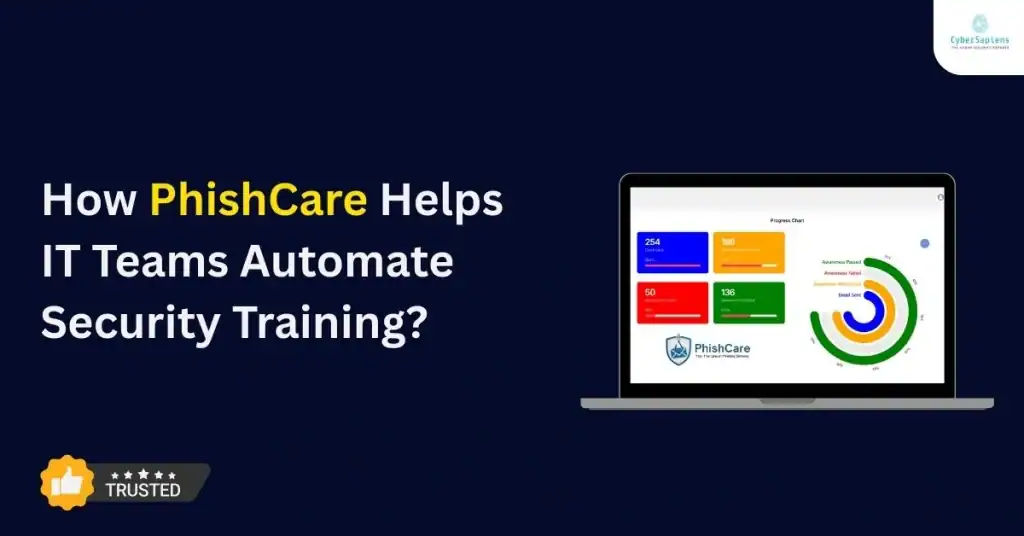
PhishCare is built to simplify phishing simulation and employee training for IT teams without adding operational complexity. By combining automation, behavioral insights, and easy deployment, it enables organizations to run effective security awareness programs at scale.
1. Fully automated phishing simulations
PhishCare enables IT teams to run realistic phishing campaigns without manual configuration or constant oversight. Simulations are designed to mirror real-world attack techniques such as credential harvesting, malicious links, and spoofed emails, helping employees experience threats in a safe and controlled environment.
2. Behavior-triggered employee training
Instead of assigning generic training to everyone, PhishCare automatically delivers short, targeted training modules when employees interact with a simulated phishing email. This just-in-time learning approach reinforces correct behavior immediately, making training more effective and less disruptive.
3. Actionable dashboards for IT and security teams
PhishCare provides centralized dashboards that translate employee actions into clear, actionable insights. IT teams can track click rates, reporting behavior, repeat offenders, and overall improvement trends, enabling data-driven decisions rather than assumptions.
4. Designed for startups, SMBs, and enterprise IT environments
Whether supporting a small IT team or a large security operation, PhishCare scales easily across organizations of all sizes. Its flexible architecture allows teams to start small and expand phishing simulations and training as the organization grows.
5. Quick deployment without complex integrations
PhishCare is built for rapid onboarding, allowing IT teams to launch phishing simulations quickly without lengthy setup processes or heavy system integrations. This minimizes disruption and accelerates time-to-value.
6. Automated phishing simulation campaigns
Campaigns can be scheduled to run on a recurring basis, ensuring continuous testing of employee awareness. Automation removes the burden of manual planning while keeping phishing readiness consistent throughout the year.
7. Role-based employee awareness training
Training modules are tailored to employee roles and risk exposure, making content more relevant and improving retention. This ensures employees receive guidance that aligns with their daily responsibilities.
8. User risk assessment and prioritization
PhishCare evaluates employee behavior across multiple campaigns to identify high-risk users and departments. IT teams can use this insight to focus remediation efforts where the risk is highest.
9. Compliance and audit support
PhishCare helps organizations demonstrate ongoing security awareness efforts required by standards such as ISO 27001 and SOC 2. Automated reports simplify audit preparation and evidence collection.
10. Executive-ready reporting and analytics
Clear, easy-to-understand reports help IT teams communicate security posture and progress to leadership, highlighting measurable reductions in phishing risk and improved employee behavior over time.
PhishCare Pricing Plans Overview
Choosing a phishing simulation platform isn’t just about features; it’s about finding a solution that delivers measurable risk reduction without straining IT budgets. PhishCare offers flexible, cost-effective pricing plans designed to support organizations at every stage, from growing startups to large enterprises.
| Quantity Range | Yearly | Bi-Annually | Quarterly | Monthly |
| 1-50 | $15.00 | $14.00 | $13.00 | $12.00 |
| 51-150 | $14.50 | $13.75 | $12.80 | $11.70 |
| 151-350 | $14.15 | $13.20 | $12.45 | $11.50 |
| 351-800 | $13.90 | $12.70 | $12.00 | $11.00 |
| 801-1500 | $13.30 | $12.00 | $11.65 | $10.60 |
| 1501-3000 | $13.00 | $11.75 | $11.30 | $10.20 |
| 3001-5000 | $12.60 | $11.40 | $11.00 | $9.80 |
| 5001-10000 | $12.30 | $11.00 | $10.60 | $9.50 |
Building a Scalable Phishing Awareness Program for IT Teams
Phishing attacks continue to be one of the most effective and damaging cyber threats facing organizations today, largely because they exploit human behavior rather than technical vulnerabilities. For IT teams, relying on occasional awareness training or reactive incident response is no longer sufficient. What’s needed is a continuous, automated approach that turns employees into an active layer of defense.
Phishing simulation combined with automated employee security training enables organizations to proactively reduce human risk, measure awareness in real time, and strengthen their overall security posture. Platforms like PhishCare make this process scalable and practical by automating simulations, delivering behavior-based training, and providing clear, actionable insights for IT and security teams.
By investing in automated phishing simulation, organizations not only reduce the likelihood of successful attacks but also build a lasting security-aware culture. For businesses of any size, this approach transforms security training from a one-time obligation into a continuous, measurable, and business-critical capability.
FAQs: Phishing Simulation for IT Teams: Automating Employee Security Training
1. How often should phishing simulations be conducted?
Answer: Most organizations run phishing simulations monthly or quarterly. Regular testing ensures employees stay alert to evolving phishing tactics and helps reinforce secure behavior over time.
2. Do phishing simulations disrupt employee productivity?
Answer: No. Phishing simulations are designed to run in the background with minimal disruption. Training modules are short, focused, and only triggered when an employee interacts with a simulated phishing email.
3. How does automated training improve security awareness?
Answer: Automated training delivers learning at the moment of risk. When employees make a mistake, they immediately receive targeted guidance, which is far more effective than generic, scheduled training sessions.
4. Can phishing simulation help with compliance requirements?
Answer: Yes. Phishing simulations support ongoing security awareness requirements for standards such as ISO 27001, SOC 2, and similar frameworks by providing documented training and measurable results.
