
Australia’s Top Web Application Security Testing Firms (2026)
Web applications have become the backbone of Australia’s digital economy. From fintech platforms and SaaS startups to healthcare systems and government portals, businesses increasingly rely on web-based applications to deliver services and manage sensitive data. However, this rapid digital expansion has also made web applications a primary target for cybercriminals.
In 2026, threats such as SQL injection, cross-site scripting (XSS), broken authentication, API vulnerabilities, and business logic flaws continue to impact organizations across Australia. Attackers are becoming more sophisticated, exploiting both technical vulnerabilities and insecure development practices. As a result, proactive Web Application Security Testing is no longer optional; it is a business necessity.
Regulatory expectations, client security questionnaires, and compliance frameworks such as ISO/IEC 27001 and OWASP Top 10 further reinforce the need for structured penetration testing and secure development validation. Companies are now prioritizing manual testing, secure code reviews, and DevSecOps integration to reduce risk before deployment.
Choosing the right web application security testing partner can significantly impact your organization’s risk posture, compliance readiness, and overall cybersecurity maturity. In this guide, we highlight Australia’s Top Web Application Security Testing Firms (2026) to help you identify the right security partner for your business needs.
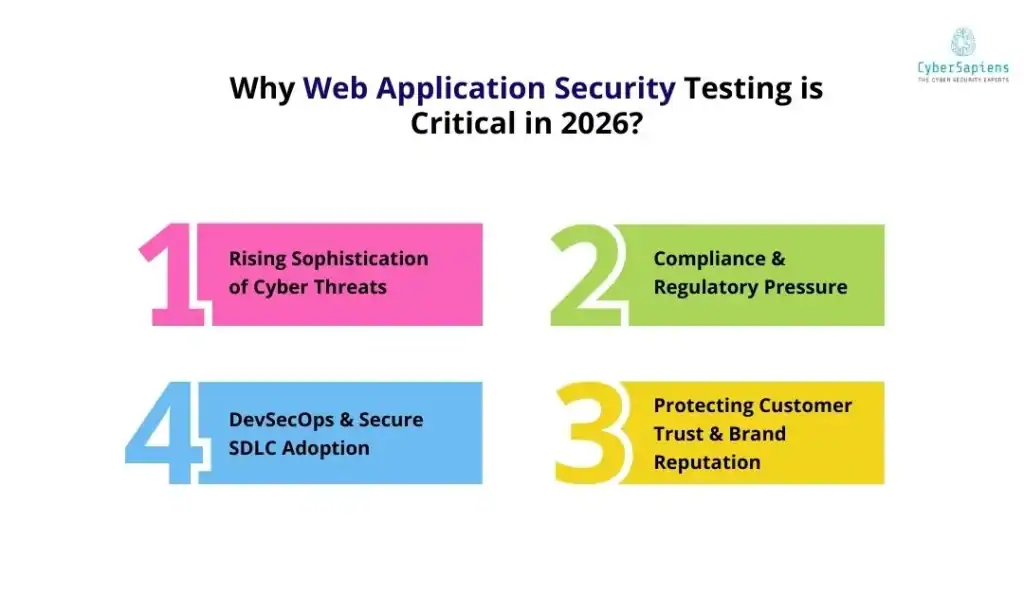
Why Web Application Security Testing is Critical in 2026?
As Australian businesses continue accelerating digital transformation, web applications have become increasingly complex—integrating APIs, cloud infrastructure, third-party services, and mobile frontends. This expanded attack surface has made structured web application security testing more important than ever.
- Rising Sophistication of Cyber Threats: Attackers are no longer relying solely on automated scans. Modern threats involve logic-based attacks, API abuse, authentication bypass techniques, and chained exploits that target multiple vulnerabilities simultaneously. Many of these risks are highlighted in the OWASP Top 10, which remains a global benchmark for application security testing. Without proper testing, even a minor vulnerability can lead to data breaches, financial loss, or reputational damage.
- Compliance & Regulatory Pressure: Australian organizations working with global clients must meet international standards such as ISO/IEC 27001 and may also need to demonstrate SOC 2 readiness or PCI DSS compliance. Regular web application penetration testing is often a requirement during audits and vendor security assessments. Security testing is no longer just about protection—it’s about meeting contractual and regulatory obligations.
- Protecting Customer Trust & Brand Reputation: A web application breach can quickly become public, leading to loss of customer confidence and long-term brand damage. Proactive testing identifies weaknesses before attackers exploit them, helping businesses maintain trust and demonstrate due diligence.
- DevSecOps & Secure SDLC Adoption: In 2026, more Australian companies are embedding security directly into the Software Development Life Cycle (SDLC). Web application testing now includes secure code review, API security testing, and continuous vulnerability assessments aligned with DevSecOps practices. Organizations that test early and test often significantly reduce remediation costs and operational disruption.
Australia’s Top 5 Web Application Security Testing Firms (2026)

Here are the leading firms in Australia that provide comprehensive web application security testing services, including penetration testing, secure code review, vulnerability assessment, compliance support, and strategic risk guidance.
1. Cybersapiens
Cybersapiens is a rapidly growing cybersecurity firm known for its practical and developer-friendly approach to web application security testing. The company blends manual penetration testing with structured secure code review services to uncover vulnerabilities that automated tools often miss.
Strengths of Cybersapiens – Web Application Security Testing
1. In-Depth Web Application Penetration Testing
Cybersapiens performs comprehensive web application penetration testing aligned with the OWASP Top 10, ensuring coverage of the most critical and commonly exploited vulnerabilities. However, their approach goes beyond checklist-based testing.
They simulate real-world attack scenarios to identify complex issues such as multi-step exploitation paths, privilege escalation chains, API abuse, and business logic flaws. This real attacker mindset helps uncover vulnerabilities that automated scanners often fail to detect. The focus is not just on identifying vulnerabilities, but on validating exploitability and assessing real business impact.
2. Secure Source Code Review (Development & Production Environments)
In addition to penetration testing, Cybersapiens provides structured secure source code review services for applications both in development and live production environments. This includes reviewing authentication flows, input validation mechanisms, access control logic, encryption usage, session handling, and error management. By analyzing the code directly, they can detect root-cause vulnerabilities early in the SDLC, reducing remediation costs and preventing recurring security flaws. Secure code review also supports organizations adopting DevSecOps practices by embedding security into development workflows rather than treating it as a post-deployment activity.
3. Remediation Guidance & Developer-Centric Reporting
One of Cybersapiens’ strongest differentiators is its reporting style. Instead of delivering highly technical documents that are difficult for development teams to interpret, they provide clear, structured, and actionable reports.
Each vulnerability is categorized by severity (Critical, High, Medium, Low) and includes:
- Proof-of-concept evidence.
- Clear reproduction steps.
- Technical explanation of root cause.
- Practical remediation recommendations.
- Business risk impact analysis.
This developer-friendly approach ensures faster issue resolution and better collaboration between security and engineering teams.
4. Compliance Support & Secure SDLC Integration
Cybersapiens’ services are aligned with compliance frameworks such as ISO/IEC 27001, helping organizations meet audit requirements and security control validation needs. Their testing reports can be used during compliance audits, vendor security assessments, and enterprise onboarding processes. Additionally, by integrating testing within Secure SDLC practices, they help organizations establish repeatable security validation processes rather than one-time assessments.
This alignment ensures that security testing not only reduces technical risk but also strengthens governance, risk management, and compliance posture. By combining real-world attack simulation, secure code analysis, remediation-focused reporting, and compliance alignment, Cybersapiens delivers a holistic web application security testing approach that supports both technical security goals and business-level risk management.
2. Tesserent
Tesserent is one of Australia’s most established cybersecurity firms with broad security testing and consulting offerings. Their web application testing services are delivered by experienced security consultants using a blend of manual testing, automated tools, and threat modelling.
3. Sekuro
Sekuro focuses on cyber resilience and tailored security testing solutions, including advanced web application assessments. Their approach combines threat intelligence, red teaming, and secure code review techniques.
4. CyberCX
CyberCX is a leading Australian managed security and consulting firm with extensive penetration testing capabilities, including applications, networks, and APIs. They serve both government and commercial clients with a strong focus on risk reduction.
5. NCC Group Australia
NCC Group is a global cybersecurity consultancy with a strong presence in Australia. They provide robust web application security testing services backed by research-driven methodologies.
Securing Your Web Applications for 2026 and Beyond
As cyber threats continue to evolve, web application security testing is no longer a periodic checkbox activity; it is a continuous business necessity. Australian organizations must proactively identify vulnerabilities, validate exploitability, and strengthen secure development practices to protect customer data, maintain regulatory compliance, and preserve brand trust.
Choosing the right security partner makes a measurable difference. Firms that combine manual penetration testing, secure code review, remediation guidance, and compliance alignment deliver far greater value than automated scanning alone. Providers like Cybersapiens stand out by offering risk-focused testing, developer-friendly reporting, and structured remediation support aligned with standards such as OWASP Top 10 and ISO/IEC 27001.
In 2026, organizations that embed security into their development lifecycle, adopt proactive testing strategies, and work with experienced security specialists will be better positioned to withstand emerging threats. Investing in high-quality web application security testing today is an investment in long-term resilience and digital trust.
FAQs: Australia’s Top Web Application Security Testing Firms (2026)
1. How often should a web application be tested?
Answer: Web applications should be tested at least annually, and additionally after major updates, feature releases, infrastructure changes, or integration of new APIs. Organizations adopting Secure SDLC often perform testing continuously throughout development cycles.
2. What is the difference between Vulnerability Assessment and Penetration Testing (VAPT)?
Answer: Vulnerability Assessment focuses on identifying potential weaknesses, often using automated tools. Penetration Testing goes further by manually validating and exploiting vulnerabilities to assess real-world impact. A combined VAPT approach provides comprehensive risk evaluation.
3. How does web application testing help with compliance?
Answer: Security testing supports compliance with standards such as ISO/IEC 27001, SOC 2, and PCI DSS by demonstrating that vulnerabilities are identified, assessed, and remediated. Many audits require evidence of regular security testing.
4. What should I look for when choosing a security testing firm in Australia?
Answer: Key factors include manual testing capability, expertise in OWASP-based assessments, developer-friendly reporting, remediation support, compliance alignment, and experience with your industry sector.
