
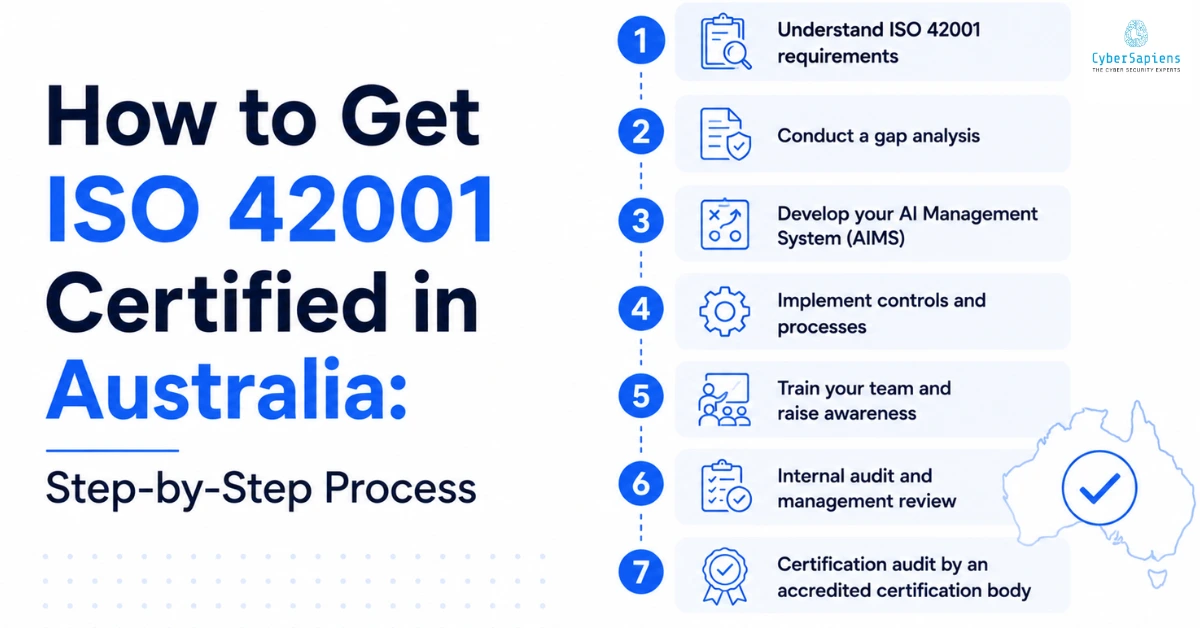
How to Get ISO 42001 Certified in Australia: Step-by-Step Process
Getting ISO 42001 certified in Australia involves establishing an Artificial Intelligence Management System (AIMS), implementing the standard’s requirements, conducting internal audits, and successfully completing certification audits by an accredited certification body. While the process varies based on an organisation’s size and AI maturity, a structured approach can significantly improve the chances of successful certification.
As more Australian organisations adopt artificial intelligence, ISO 42001 certification is becoming an important way to demonstrate responsible AI governance. CyberSapiens works with organisations across Australia to help assess readiness, implement controls, and prepare for certification against AS ISO/IEC 42001:2023.
Step 1: Define the Scope of Your AI Management System
The first step towards ISO 42001 certification is determining exactly which parts of the organisation will be covered by the Artificial Intelligence Management System (AIMS). A clearly defined scope helps establish boundaries, responsibilities, and governance requirements from the outset.
Organisations should identify all AI systems, AI-enabled business processes, stakeholders, and compliance obligations that fall within the certification programme. Well-defined scope statements reduce implementation challenges and simplify certification audits.
Identify AI Systems
Document all AI systems currently in use across the organisation, including internally developed solutions, third-party platforms, machine learning models, and AI-enabled software tools.
Define Business Processes
Determine which business functions rely on AI outputs and whether those processes should be included within the management system scope.
Identify Stakeholders
Consider internal teams, customers, regulators, suppliers, and other interested parties affected by AI-related decisions and operations.
Review Regulatory Obligations
Assess applicable legal, regulatory, contractual, and industry-specific requirements that influence AI governance and risk management activities.
Questions to Ask During Scoping
Which AI systems are currently deployed?
Which departments use AI technologies?
Are third-party AI platforms included?
Which business processes rely on AI outputs?
What compliance obligations apply?
Step 2: Conduct an ISO 42001 Gap Analysis
Once the scope has been defined, the next step is conducting a gap analysis against ISO 42001 requirements. A gap analysis evaluates existing governance, risk management, and AI oversight practices to determine how closely they align with the standard.
The objective is to identify strengths, weaknesses, and implementation priorities before beginning certification activities. This provides a clear roadmap for closing compliance gaps and allocating resources effectively.
What Does an ISO 42001 Gap Analysis Assess?
Governance Structures
Evaluates accountability frameworks, leadership involvement, and decision-making responsibilities.
Risk Management Processes
Reviews how AI risks are identified, analysed, monitored, and treated across the organisation.
AI Policies
Assesses whether formal policies exist to support responsible AI use and governance.
Accountability Frameworks
Examines ownership, reporting lines, and oversight responsibilities for AI systems.
Documentation
Reviews procedures, records, evidence, and supporting documentation required for certification.
AI Lifecycle Controls
Evaluates development, deployment, monitoring, maintenance, and retirement processes.
Benefits of a Gap Analysis
- Identifies compliance gaps early.
- Reduces implementation delays.
- Prioritises remediation activities.
- Improves audit preparedness.
- Provides a structured implementation roadmap.
CyberSapiens Insight
Many organisations discover that governance structures already exist through ISO 27001, ISO 9001, or risk management programmes. A targeted gap assessment helps leverage these existing controls rather than building an AI governance framework from scratch, significantly reducing implementation effort and certification timelines.
Step 3: Establish AI Governance Policies
ISO 42001 requires organisations to establish governance frameworks that support the responsible development, deployment, and use of artificial intelligence. Governance policies provide the foundation for accountability, decision-making, and ongoing oversight throughout the AI lifecycle.
These policies should be approved by leadership, communicated throughout the organisation, and regularly reviewed to ensure they remain aligned with business objectives, regulatory requirements, and emerging AI risks.
AI Governance Objectives
Define the organisation’s goals for responsible AI adoption, oversight, and continual improvement.
Accountability Structures
Establish ownership, responsibilities, escalation paths, and governance committees for AI oversight.
Ethical AI Principles
Define expectations around fairness, transparency, explainability, privacy, and responsible AI usage.
Oversight Mechanisms
Create governance processes for monitoring AI performance, incidents, risks, and compliance obligations.
Why Governance Policies Matter
Certification auditors expect organisations to demonstrate that AI governance is embedded into business operations rather than existing solely as documentation. Effective policies help create consistency across teams while ensuring AI decisions remain aligned with organisational objectives and stakeholder expectations.
Step 4: Perform AI Risk and Impact Assessments
Risk assessment is one of the most important components of ISO 42001. Organisations must identify, evaluate, and manage risks associated with AI systems while considering their broader impact on individuals, customers, employees, and stakeholders.
Comprehensive risk and impact assessments demonstrate governance maturity and provide evidence that potential harms are being proactively identified and addressed throughout the AI lifecycle.
Biased Outcomes
AI systems may unintentionally produce unfair or discriminatory outcomes that impact individuals or groups.
Lack of Explainability
Complex AI models can make decisions that are difficult for users and stakeholders to understand.
Privacy Concerns
AI systems often rely on large volumes of data, creating privacy and data protection obligations.
Security Vulnerabilities
Threat actors may exploit AI models, training data, or supporting infrastructure.
Inaccurate Outputs
AI-generated recommendations or decisions may produce errors that affect operations and stakeholders.
Regulatory Non-Compliance
Failure to meet legal or industry obligations can create financial and reputational risks.
AI Impact Assessments
Beyond technical risks, organisations should assess the broader social, ethical, operational, and business impacts of AI systems. Documented impact assessments provide valuable evidence during certification audits and demonstrate a proactive approach to responsible AI governance.
Step 5: Implement the ISO 42001 Controls
After governance structures and risk assessments have been established, organisations must implement the operational controls required by ISO 42001. These controls provide a structured framework for managing AI systems responsibly while ensuring risks are continuously monitored and mitigated.
ISO 42001 contains 38 controls grouped across nine control objectives. The controls selected should align with the organisation’s AI environment, risk profile, regulatory obligations, and business objectives.
| Control Objective | Purpose |
|---|---|
| AI Policies | Provides governance direction and strategic oversight. |
| Internal Organisation | Defines roles, responsibilities, and accountability. |
| AI Resources | Ensures appropriate resources and capabilities are available. |
| AI Impact Assessment | Evaluates risks and impacts associated with AI systems. |
| AI System Lifecycle | Manages AI development, deployment, monitoring, and retirement. |
| Data Management | Supports data quality, integrity, and governance controls. |
| Information for Interested Parties | Supports transparency and stakeholder communication. |
| Use of AI Systems | Establishes operational governance requirements. |
| Third-Party Relationships | Manages supplier and external AI service risks. |
Align Existing Controls
Organisations already certified against ISO 27001 or SOC 2 can often leverage existing governance, risk management, and compliance controls during implementation.
Prioritise High-Risk Areas
Focus implementation efforts on AI systems that process sensitive information, influence business decisions, or impact customers and stakeholders directly.
Integrate Security Controls
AI governance should complement broader security frameworks such as ACSC Essential Eight, security awareness programmes, and enterprise risk management initiatives.
CyberSapiens Implementation Perspective
Successful ISO 42001 implementations rarely require building every process from scratch. Most organisations already operate governance, compliance, privacy, or information security frameworks that can be adapted to support AI governance. Mapping existing controls to ISO 42001 requirements significantly accelerates implementation and reduces audit preparation effort.
Step 6: Create Required Documentation
Documentation plays a critical role in ISO 42001 certification. Auditors require evidence that governance processes are formally established, consistently followed, and regularly reviewed. Well-maintained documentation demonstrates compliance while supporting ongoing operational effectiveness.
Documentation should accurately reflect how AI governance activities are performed in practice. Organisations should focus on creating meaningful records that support decision-making rather than producing documents solely for audit purposes.
AI Policies
Governance policies defining AI objectives, responsibilities, and oversight mechanisms.
Risk Assessments
Records demonstrating how AI risks have been identified, evaluated, and treated.
Impact Assessments
Documentation showing ethical, operational, privacy, and stakeholder impact evaluations.
Procedures & Workflows
Operational guidance supporting governance, monitoring, reporting, and incident management.
Governance Records
Meeting minutes, decisions, approvals, and evidence of management oversight activities.
Audit Evidence
Internal audit findings, corrective actions, and continual improvement activities.
Organisations already maintaining frameworks such as ISO 27001 Certification & Implementation, HIPAA Compliance, or PCI DSS Compliance can often reuse existing document management and governance structures to support ISO 42001 implementation.
Step 7: Train Employees and Stakeholders
Technology alone cannot achieve ISO 42001 compliance. Employees, management teams, and stakeholders must understand their responsibilities within the Artificial Intelligence Management System. Effective training ensures governance policies are consistently applied across the organisation.
Training programmes should be tailored to job roles, risk exposure, and governance responsibilities. This helps employees recognise AI-related risks, report issues promptly, and support responsible AI decision-making.
AI Governance Policies
Employees should understand organisational policies governing AI development, deployment, and use.
Risk Management Procedures
Teams should know how to identify, assess, escalate, and manage AI-related risks and incidents.
Ethical AI Responsibilities
Training should reinforce fairness, transparency, privacy protection, and accountability expectations.
Reporting & Escalation
Staff should know how to report governance concerns, incidents, and policy violations effectively.
Build a Strong Security Culture
AI governance is most effective when combined with broader security awareness initiatives. Programmes such as Employee Awareness Training and Phishing Simulation Exercises help reinforce responsible technology usage and strengthen organisational resilience.
Step 8: Conduct Internal Audits
Before pursuing certification, organisations should conduct internal audits to evaluate whether the Artificial Intelligence Management System is operating as intended. Internal audits provide an opportunity to identify weaknesses, verify compliance, and address issues before external auditors become involved.
A structured internal audit programme helps organisations measure implementation effectiveness while demonstrating continual improvement and governance maturity.
Verify Policy Compliance
Confirm that governance policies, procedures, and operational controls are being consistently followed.
Review Risk Controls
Evaluate whether AI risks are being effectively identified, monitored, and managed.
Assess Documentation
Ensure required records, assessments, approvals, and evidence are complete and current.
Identify Improvement Opportunities
Highlight non-conformities, process gaps, and corrective actions before certification audits.
Internal Audit Checklist
- Are governance policies being followed consistently?
- Are AI risks being assessed and treated appropriately?
- Are required records complete and accessible?
- Have corrective actions been implemented effectively?
- Can the organisation demonstrate continual improvement?
Step 9: Hold a Management Review
Leadership involvement is a core requirement of ISO 42001. Senior management must periodically review the performance of the Artificial Intelligence Management System to ensure it remains effective, aligned with organisational objectives, and capable of managing evolving AI risks.
Management reviews demonstrate accountability and provide evidence that AI governance receives appropriate executive oversight. Auditors frequently review management review records during certification assessments.
Audit Findings
Review internal audit results, non-conformities, and corrective action progress.
AI Risk Trends
Assess emerging risks, changing threat landscapes, and ongoing mitigation effectiveness.
Performance Objectives
Evaluate whether governance goals and AI management objectives are being achieved.
Resource Requirements
Determine whether sufficient people, budget, skills, and technology resources are available.
Leadership Commitment Drives Certification Success
One of the most common reasons organisations struggle during certification audits is limited executive involvement. ISO 42001 expects leadership teams to actively participate in governance decisions, risk management activities, resource allocation, and continual improvement initiatives. Strong executive sponsorship often accelerates implementation and improves long-term compliance outcomes.
Step 10: Select an Accredited Certification Body
Once implementation activities have been completed, organisations can engage an accredited certification body to independently assess their Artificial Intelligence Management System. Selecting the right certification partner is important because audit quality, industry expertise, and certification experience can significantly influence the certification journey.
Organisations should evaluate multiple certification bodies before making a decision and ensure they have experience assessing management systems within technology-driven environments.
Accreditation Status
Verify that the certification body holds appropriate accreditation and recognition.
Industry Experience
Choose auditors who understand AI governance, compliance, and technology environments.
Audit Methodology
Understand how audits are conducted and how evidence will be evaluated.
Geographic Coverage
Ensure the certification body can support your operational footprint and audit scope.
Step 11: Complete the Stage 1 Audit
The Stage 1 Audit is primarily a documentation and readiness assessment. Auditors review whether the Artificial Intelligence Management System has been adequately designed and whether the organisation is prepared to proceed to the implementation assessment stage.
Any major gaps identified during Stage 1 should be addressed before moving to the Stage 2 Audit.
Scope Definition
Auditors verify the boundaries and applicability of the management system.
Policies & Procedures
Governance documentation is reviewed for completeness and alignment with ISO 42001 requirements.
Governance Framework
Accountability structures and oversight processes are assessed.
Audit Readiness
The organisation’s preparedness for the implementation audit is evaluated.
Step 12: Complete the Stage 2 Audit
The Stage 2 Audit evaluates whether the Artificial Intelligence Management System is operating effectively in practice. Unlike Stage 1, which focuses on documentation, Stage 2 examines real-world implementation, governance activities, and operational evidence.
Successful completion of this audit results in ISO 42001 certification, demonstrating that the organisation has implemented a recognised framework for responsible AI governance.
Governance Practices
Auditors assess how governance processes operate across the organisation.
Risk Management Activities
Evidence is reviewed to verify that risks are actively managed and monitored.
AI Lifecycle Management
Controls governing development, deployment, monitoring, and retirement are evaluated.
Continual Improvement
Auditors verify that the management system is reviewed and improved over time.
Certification Outcome
Organisations that successfully demonstrate compliance with ISO 42001 requirements receive certification and enter an ongoing surveillance cycle. Certification provides assurance to customers, regulators, investors, and stakeholders that AI systems are governed responsibly using internationally recognised best practices.
What Happens After Certification?
Achieving ISO 42001 certification is a significant milestone, but it is not the end of the governance journey. Organisations must continue operating, monitoring, and improving their Artificial Intelligence Management System to maintain certification and adapt to evolving AI risks, technologies, and regulatory expectations.
ISO 42001 follows the continual improvement model used across modern management system standards, ensuring governance practices remain effective as AI adoption grows.
Annual Surveillance Audits
Certification bodies conduct surveillance audits each year to verify ongoing compliance and governance effectiveness.
Recertification Audits
Most organisations undergo a full recertification assessment every three years to maintain certification status.
Continual Improvement
Governance controls, risk assessments, policies, and oversight mechanisms should be reviewed regularly and improved where necessary.
The PDCA Approach
ISO 42001 follows the Plan-Do-Check-Act (PDCA) methodology, encouraging organisations to continuously evaluate AI governance effectiveness, respond to emerging risks, and improve management system performance over time.
How Long Does ISO 42001 Certification Take?
There is no universal implementation timeline for ISO 42001 certification. The duration depends on organisational size, AI maturity, existing governance frameworks, available resources, and the complexity of AI systems within scope.
Organisations that already maintain compliance frameworks such as ISO 27001, SOC 2, or PCI DSS often complete implementation more efficiently because many management system principles and governance controls are already established.
| Factor | Impact on Timeline |
|---|---|
| Organisation Size | Larger organisations typically require more planning and coordination. |
| Number of AI Systems | More AI systems generally require additional governance and risk assessment effort. |
| Existing Governance Maturity | Mature governance frameworks can significantly accelerate implementation. |
| Regulatory Requirements | Additional obligations may require expanded controls and documentation. |
| Available Resources | Dedicated teams and executive support often reduce project timelines. |
Common Mistakes to Avoid
Many organisations encounter avoidable challenges during ISO 42001 implementation. Understanding these common pitfalls can improve audit readiness and reduce delays during certification.
Treating Certification as a Documentation Exercise
ISO 42001 requires operational governance and real-world implementation, not simply a collection of policies and documents.
Ignoring AI Risk Assessments
Risk and impact assessments are foundational requirements and should be performed early in the implementation process.
Lack of Leadership Involvement
Executive sponsorship is essential for governance, resource allocation, and continual improvement activities.
Poor Scope Definition
An unclear certification scope can create implementation challenges, audit confusion, and governance gaps.
Delaying Internal Audits
Internal audits help uncover issues before certification assessments and should not be postponed until the final stages.
Frequently Asked Questions
How do I get ISO 42001 certified?
Organisations must implement an Artificial Intelligence Management System (AIMS), perform risk and impact assessments, conduct internal audits, complete management reviews, and successfully pass certification audits conducted by an accredited certification body.
How long does ISO 42001 certification take?
Certification timelines vary based on organisation size, AI maturity, scope complexity, and existing governance frameworks. Organisations with established compliance programmes often achieve certification more efficiently.
Is ISO 42001 mandatory in Australia?
No. ISO 42001 is currently a voluntary certification standard. However, it is rapidly becoming an important benchmark for organisations seeking to demonstrate responsible AI governance and risk management.
What is the first step in ISO 42001 implementation?
The first step is defining the scope of the Artificial Intelligence Management System, including the AI systems, business processes, stakeholders, and regulatory obligations that will be covered by certification.
Can organisations with ISO 27001 implement ISO 42001 more easily?
Yes. Organisations already operating ISO 27001 management systems can often leverage existing governance structures, risk management processes, documentation frameworks, and audit practices.

Shabari Shankar
Shabari Shankar is a Senior Content Writer with 10+ years of experience creating impactful cybersecurity content. Specialising in cyber threats, compliance, cloud security, and emerging technologies, Shabari delivers informative and engaging content tailored for modern digital audiences.
Connect on LinkedInStart Your ISO 42001 Certification Journey
As AI adoption continues to grow, organisations need governance frameworks that help manage risks while supporting innovation. CyberSapiens helps Australian organisations assess readiness, conduct gap analyses, implement controls, and prepare for ISO 42001 certification audits.
Schedule a Compliance Assessment