
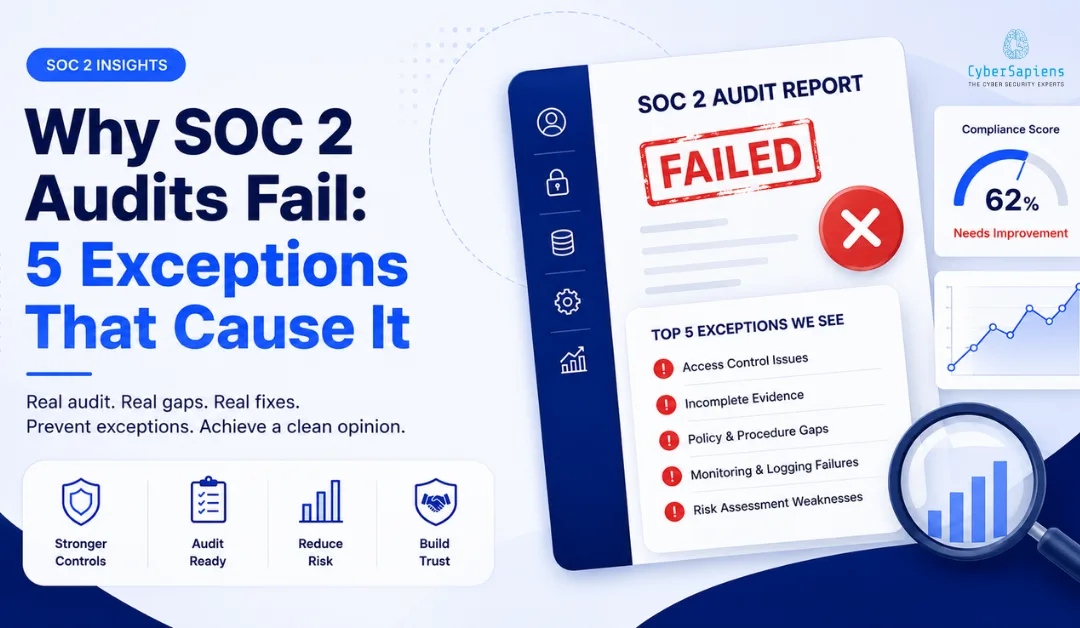
Why SOC 2 Audit Failure Happens: 5 Exceptions That Cause It
A SOC 2 audit rarely “fails” outright, true adverse opinions are uncommon. What organizations encounter far more often is a qualified opinion, where auditors identify one or more control exceptions significant enough to be documented in the final report. The five most common causes include weak access controls, missing evidence following operational changes, inadequate vendor oversight, undocumented policy exceptions, and skipping the readiness assessment. The good news? Every one of these issues is preventable with the right preparation.
This guide explores each exception, explains why it occurs, and shares practical ways to prevent it before your audit begins. If you’re preparing for your first or next audit, our SOC 2 compliance services can help identify and remediate gaps before they become audit findings.
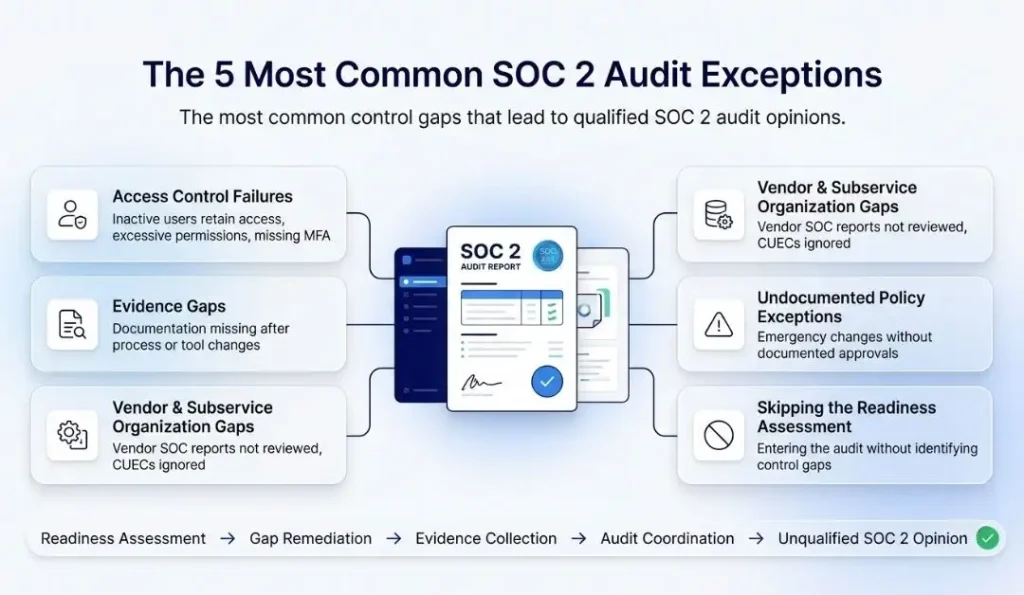
The Five Most Common Exceptions
Access Control Failures
Inactive users, excessive permissions, and missing MFA.
Evidence Gaps
Documentation missing after tools or processes change.
Vendor Oversight
Unreviewed SOC reports and overlooked CUECs.
Policy Exceptions
Emergency changes without proper approval records.
No Readiness Assessment
Entering the audit without validating controls first.
What “Failing” a SOC 2 Audit Actually Means
Before looking at the most common audit exceptions, it’s important to understand one common misconception. A SOC 2 audit is not graded as a simple pass or fail. Instead, an independent CPA auditor issues an opinion based on whether your controls satisfy the applicable AICPA Trust Services Criteria. While many organizations refer to a qualified opinion as a “failed audit,” the reality is more nuanced.
Unqualified
Clean Opinion
All applicable Trust Services Criteria were met. Minor observations may exist but they do not affect the overall opinion.
Qualified
Most Common Outcome
One or more material control exceptions prevented a completely clean opinion. This is what many organizations mistakenly call a failed audit.
Adverse
Rare
Multiple significant control failures indicate that the control environment is ineffective across one or more Trust Services Criteria.
Disclaimer
Insufficient Evidence
The auditor could not obtain enough appropriate evidence to issue an opinion on the controls.
When businesses say they “failed” a SOC 2 audit, they usually mean they received a Qualified Opinion rather than an Unqualified (Clean) Opinion. The goal of this guide is to help you avoid the five most common control exceptions that typically lead to that outcome.
Access Control Failures
Access control failures are consistently the most common SOC 2 audit exception. Former employees retaining access, excessive user permissions, shared credentials, or missing multi-factor authentication (MFA) often result in findings under the AICPA Common Criteria CC6. Over the course of a Type 2 observation period, even small access management gaps can become material audit exceptions.
What It Is
A user—typically a former employee, contractor, or someone whose role has changed—still has access they should no longer possess. In other cases, employees retain permissions beyond what their responsibilities require, increasing security and compliance risks.
Why It Happens
- Manual employee offboarding processes
- Delayed communication between HR and IT
- Role changes without permission reviews
- Inactive contractor accounts
- Missing or inconsistent MFA enforcement
Recommended Fix
Automate user provisioning and deprovisioning using your HR system as the single source of truth. Every employee exit or role change should immediately trigger access updates across all business systems.
Conduct quarterly access reviews instead of annual reviews to identify inactive accounts and excessive permissions before your auditor discovers them.
Learn more about SOC 2 access control requirements →Best Practice
Organizations with automated identity lifecycle management and regular access reviews significantly reduce the likelihood of receiving qualified opinions related to logical access controls.
2. Evidence Gaps from Mid-Window Changes
Even when controls are well designed at the beginning of an audit period, changes made during the observation window can create evidence gaps. New tools, updated processes, or organizational changes often leave documentation incomplete, making it difficult for auditors to verify that controls operated effectively throughout the audit period.
What It Is
A control operated effectively at the beginning of the audit period, but changes introduced later—such as a new platform, process update, or team restructuring—were not reflected in the supporting evidence. As a result, the evidence no longer matches the documented control activities.
Why It Happens
SOC 2 Type 2 audits evaluate controls over time, not just at a single point. Organizations often prepare thoroughly before the audit window begins, but operational changes during the following months are not consistently documented. By the end of the observation period, the evidence collected may no longer support how the control is actually being performed.
Recommended Remediation
Assign a dedicated owner to every control who is responsible for monitoring changes throughout the observation period. Whenever a new tool, process, or organizational change occurs, the control documentation and supporting evidence should be updated immediately rather than waiting until the audit begins.
Maintaining accurate evidence throughout the audit window is significantly easier than trying to reconstruct missing documentation during the audit. Ongoing ownership helps ensure every control remains aligned with day-to-day operations.
3. Vendor & Subservice Organization Gaps
Many organizations rely on third-party providers for critical business functions, but vendor oversight is often overlooked during SOC 2 audits. Assuming that a vendor’s SOC 2 report automatically satisfies your compliance obligations can lead to material control exceptions if your responsibilities are not documented and reviewed.
What It Is
A vendor or subservice organization performs part of a control on your behalf—such as cloud hosting, payroll processing, or managed security services—but your organization has not verified whether that control is operating as expected.
Why It Happens
Organizations often assume that because a vendor has its own SOC 2 report, all compliance responsibilities are covered. However, most reports include Complementary User Entity Controls (CUECs), meaning your organization is still responsible for implementing and documenting specific controls on your side.
Recommended Remediation
Maintain an up-to-date vendor register covering every subservice organization within your audit scope. Request each vendor’s SOC 2 report annually, review the Complementary User Entity Controls (CUECs), and document how your organization satisfies its own responsibilities rather than simply retaining the report for audit purposes.
Vendor compliance is a shared responsibility. A vendor’s SOC 2 report strengthens your compliance posture only when your organization also demonstrates that its complementary controls are operating effectively.
4. Undocumented Policy Exceptions
Having well-documented policies is only part of SOC 2 compliance. Auditors also evaluate whether those policies are consistently followed in practice. When emergency changes or exceptions occur without proper documentation, they can become audit findings even if the control itself is well designed.
What It Is
A documented control exists—for example, requiring peer review before production deployment—but an exception occurs during day-to-day operations. An urgent hotfix or operational change bypasses the documented process, and no approval or justification is recorded.
Why It Happens
Business priorities sometimes require emergency changes. The issue isn’t that exceptions happen; it’s that they are not documented. Without an audit trail explaining who approved the deviation and why, auditors cannot determine whether it was a controlled exception or a breakdown in the process.
Recommended Remediation
Establish a formal break-glass process for emergency situations. Every policy exception should capture who approved it, why it was necessary, and when it occurred. Maintaining this documentation provides auditors with evidence that the exception was managed through an approved process rather than representing a control failure.
Well-documented and approved policy exceptions are generally viewed far more favorably than undocumented deviations. In many cases, a complete approval trail can be the difference between a minor observation and a reportable finding.
5. Skipping the Pre-Audit Readiness Assessment
One of the most preventable causes of a qualified SOC 2 opinion is entering the formal audit without first conducting a readiness assessment. A pre-audit review helps identify control gaps, documentation issues, and evidence deficiencies while there is still time to resolve them.
What It Is
A readiness assessment is a practice audit performed before the formal SOC 2 engagement. It evaluates your controls, supporting evidence, and documentation using the same level of scrutiny an independent auditor would apply, allowing issues to be identified before the official audit begins.
Why It Happens
Organizations under pressure to meet compliance deadlines often skip the readiness assessment to save time or reduce upfront costs. However, this usually increases the risk of unexpected findings during the formal audit, leading to additional remediation work and delays.
Recommended Remediation
Schedule a readiness assessment 60–90 days before your formal audit begins. Treat it like the real audit by validating every control, reviewing supporting evidence, and identifying documentation gaps early. Addressing issues before fieldwork starts significantly reduces the likelihood of receiving a qualified opinion.
A readiness assessment gives your team time to resolve issues before the auditor reviews your controls, turning unexpected audit findings into planned remediation activities.
Why Type 2 Audits Are Riskier Than Type 1
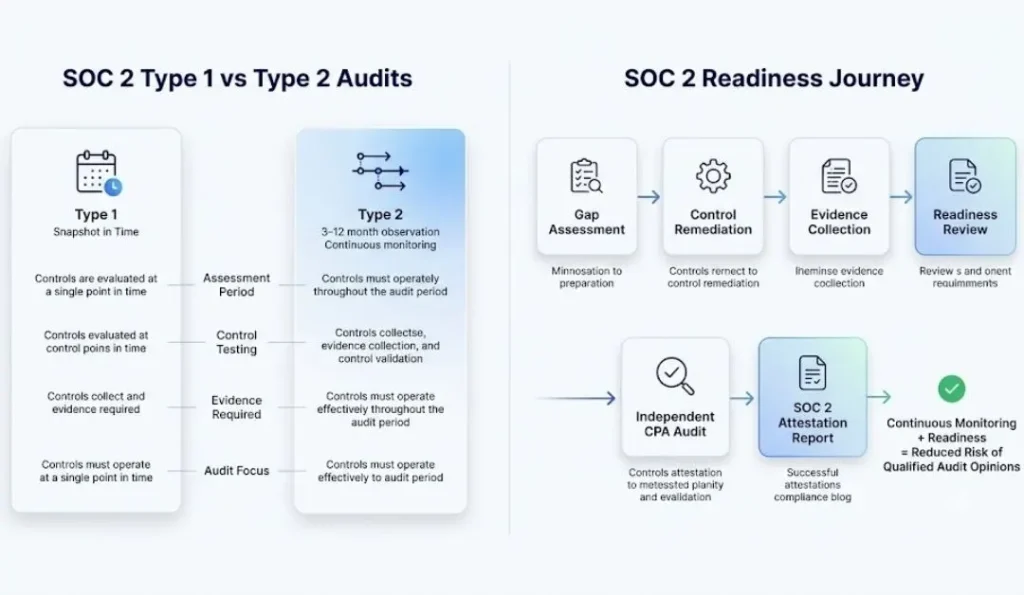
While both SOC 2 audit types evaluate your security controls, the biggest difference lies in time. A Type 1 audit validates whether controls are properly designed at a specific point in time, whereas a Type 2 audit assesses whether those controls operate consistently over an extended observation period. This makes continuous monitoring, documentation, and evidence collection essential for a successful Type 2 audit.
Type 1 Audit
Snapshot Assessment
- Evaluates controls on a single date.
- Confirms controls are appropriately designed.
- Ideal for organizations beginning their SOC 2 journey.
- Lower operational risk because no observation period is involved.
Type 2 Audit
Continuous Assessment
- Evaluates controls over 3–12 months.
- Tests whether controls operate consistently.
- Requires continuous evidence collection.
- Higher risk of exceptions if controls are not monitored.
Why Continuous Monitoring Matters
Many SOC 2 exceptions are not caused by poorly designed controls—they occur because well-designed controls are not followed consistently throughout the audit period. Access reviews, documentation updates, vendor oversight, and policy compliance must be maintained continuously, not just before the audit begins.
Learn more about SOC 2 Type 1 vs Type 2 (and what each costs) .
Quick Self-Assessment Before Your Next Audit
Use this checklist to determine whether your organization is prepared for a successful SOC 2 audit. If you answer “No” to any of the questions below, that area deserves attention before your formal assessment begins.
Are all privileged access reviews documented and performed on schedule?
Does every control have complete and up-to-date supporting evidence throughout the audit period?
Have you reviewed vendor SOC 2 reports and documented your Complementary User Entity Controls (CUECs)?
Are policy exceptions formally approved and recorded through a documented process?
Have you completed a readiness assessment before scheduling your formal SOC 2 audit?
If You Answered “No” to Any Question…
Each unchecked area represents a potential audit exception that can delay certification or result in a qualified opinion. Addressing these gaps before the audit begins is significantly more efficient than resolving findings during fieldwork.
Schedule a SOC 2 Readiness Assessment →Frequently Asked Questions
Still have questions about SOC 2 audits? Here are answers to some of the most common questions organizations ask before starting or completing a SOC 2 assessment.
Does a “failed” SOC 2 audit mean I don’t get a report at all?
No. Even with significant exceptions, you almost always still receive a report—it’s simply qualified rather than unqualified (clean). The report is issued either way; the opinion type is what changes.
Can I fix an exception after the audit period has closed?
Not for that report. The exception reflects what actually occurred during the tested period. You can remediate the underlying control for future audit periods, but you cannot retroactively change evidence from the completed observation window.
How many exceptions are “normal” to expect?
It varies by company size and maturity, but even well-run organizations often have a small number of minor exceptions in a first Type 2 report. The goal isn’t zero exceptions—it’s avoiding material ones that could contribute to a qualified opinion.
Does one exception automatically mean a qualified opinion?
No. It depends on materiality, which is the auditor’s professional judgment regarding whether an exception is significant enough to undermine confidence in that trust service criterion. A single, well-documented minor exception is generally treated very differently from repeated or undocumented control failures.
Should we do a readiness assessment even for our second or third SOC 2 audit?
Yes. While it may be lighter than a first-time assessment, controls, technology, vendors, and teams evolve over time. An annual readiness review helps identify new risks before the formal audit begins.
Is a SOC 2 report the same as a certification?
No. SOC 2 is an attestation report—not a certification—and there is no pass/fail badge issued by AICPA’s SOC 2 framework.
Content Reviewed By

Robin Dsouza
Founder and Lead Cyber Security Expert
Cyber Forensic Advisor, Karnataka State Police
200K+
Trained
200+
Clients
500+
Seminars
10+
Yrs Exp
Robin is the founder of CyberSapiens and one of Australia’s leading cybersecurity experts. With over 10 years of experience, he has trained more than 200,000 individuals, consulted over 200 organisations, and conducted 500+ seminars. Previously at Infosys, KPMG Global Services, and iPRIMED Education Solutions.
