
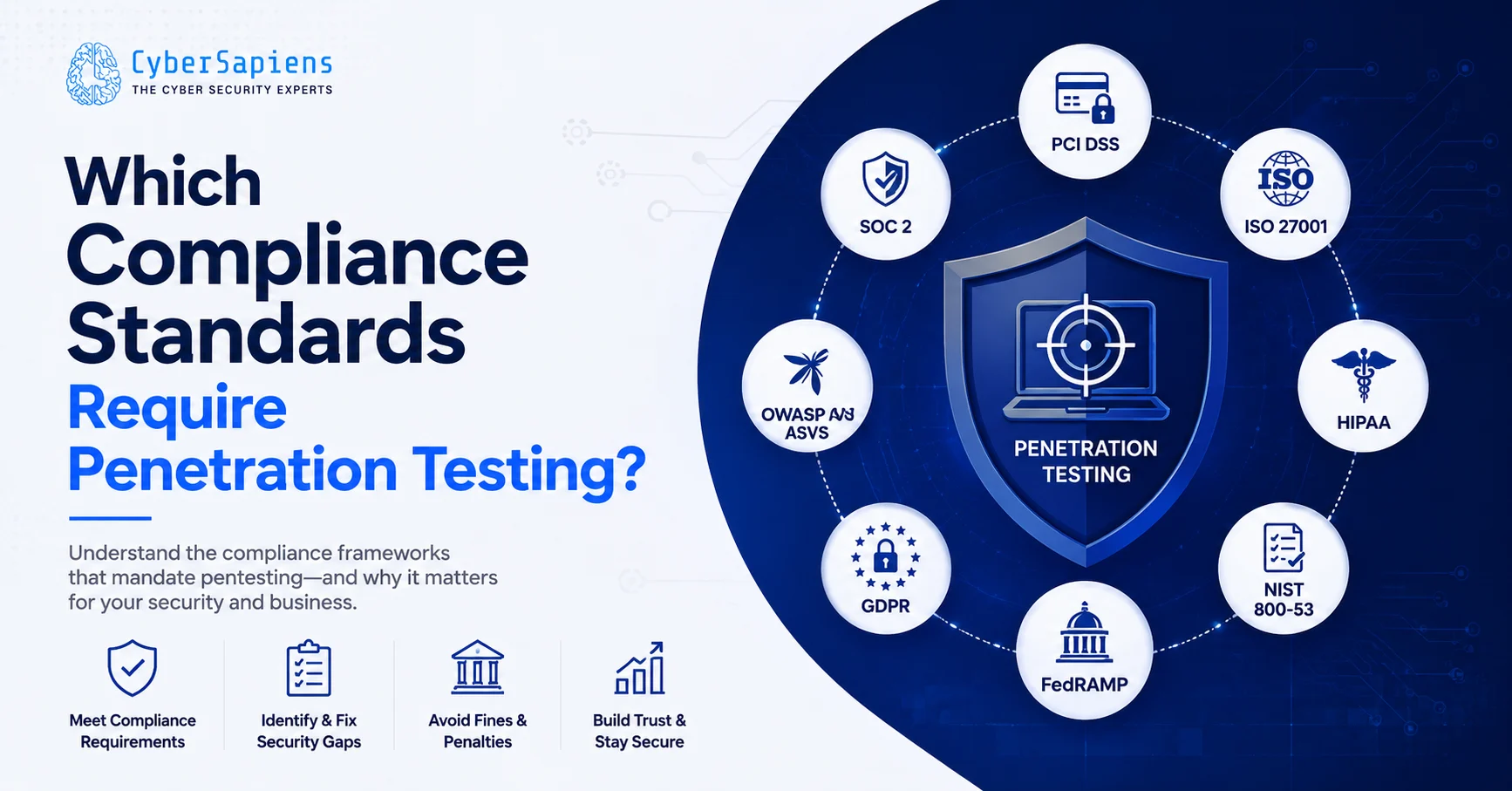
Which Compliance Standards Require Penetration Testing?
Not every compliance framework treats penetration testing the same way. Some name it explicitly and set a strict schedule. Others imply it through a broader control requirement and leave the frequency to your auditor’s judgement.
Knowing which is which before you scope an engagement saves you from either under-testing and failing an audit, or over-testing and spending on evidence nobody asked for.
This guide covers penetration testing requirements across six frameworks: PCI DSS, SOC 2, ISO 27001, Essential 8, HIPAA and CPS 234. Because CyberSapiens delivers penetration testing services across all of these frameworks rather than specialising in just one, this is a comparison a single-framework provider cannot credibly write.
Penetration Testing Requirements by Framework
Six frameworks, side by side: what each one requires, how often, and what evidence auditors actually accept.
| Framework | Pentest requirement | Typical frequency | Evidence auditors accept |
|---|---|---|---|
| PCI DSS 4.0 | Explicit and mandatory (Requirement 11.4) | Internal and external annually, plus after significant changes. Segmentation testing every 6 months for service providers | Documented methodology, CVSS-rated findings, remediation and retest evidence |
| SOC 2 | Not named explicitly, but commonly expected as evidence for Common Criteria CC7.1 | Annual is standard practice for Type 2 audits | Pentest report plus evidence of remediation tracking |
| ISO 27001 | Not named explicitly, but expected as evidence for Annex A control A.8.8 | Annual or after major infrastructure changes is typical auditor expectation | Pentest report referenced in your risk treatment plan and internal audit records |
| Essential 8 | Not formally mandated by ACSC at every maturity level, but independent testing is increasingly required in specific contexts | Varies by context, government supplier and insurer requirements typically drive the need | Independent assessment report, maturity scorecard |
| HIPAA | Not named explicitly, but routinely expected as part of the mandated Security Risk Analysis | Annual or after major system changes is common guidance | Risk analysis documentation referencing technical testing performed |
| CPS 234 (APRA) | Explicit, names a testing program that includes penetration testing by independent specialists | Regular, risk-based cadence defined by the entity’s own testing program | Test program documentation and independent specialist attestation |
PCI DSS: The Most Explicit Requirement
Of every framework in this guide, PCI DSS is the clearest. PCI DSS Requirement 11.4 states plainly that external and internal penetration testing must be regularly performed, and it does not leave “regularly” open to interpretation. Internal and external testing is required at least annually and after any significant infrastructure or application change.
If your organisation relies on network segmentation to reduce the scope of your cardholder data environment, that segmentation must also be validated by penetration testing, and service providers must do this every six months rather than annually.
This is also the framework where Qualified Security Assessors are strictest about what counts as a genuine penetration test. Requirement 11.4 explicitly distinguishes a real penetration test from automated vulnerability scanning: a scan finds known issues, while a proper test demonstrates that a vulnerability is actually exploitable and confirms the fix works through retesting. Organisations preparing for an assessment often bring in PCI DSS compliance services specifically to close this gap between scanning and genuine testing.
SOC 2: Implied But Expected
SOC 2’s Trust Services Criteria do not contain a line that says perform a penetration test. Instead, the requirement is implied through CC7.1, which covers detecting and monitoring for vulnerabilities. In practice, most SOC 2 Type 2 auditors expect to see a recent penetration test as part of the evidence supporting this criterion, particularly for companies handling customer data at scale.
The practical takeaway: you can technically pass a SOC 2 audit without a formal pentest if your auditor accepts alternative vulnerability-detection evidence, but going into a Type 2 audit without one increases the risk of a qualified opinion on CC7.1. Annual testing aligned to your audit window is the safest default, and organisations preparing for certification typically build this into their SOC 2 compliance services engagement from the outset.
ISO 27001: Part of Technical Vulnerability Management
ISO 27001’s Annex A control A.8.8 covers technical vulnerability management, and penetration testing is the standard way organisations demonstrate they are actively identifying and addressing vulnerabilities rather than just tracking patch levels. Like SOC 2, there is no fixed clause number that says penetration test annually. Your certification body will expect to see testing evidence proportionate to your risk profile, referenced in your risk treatment plan and covered in your internal audit programme.
For most organisations pursuing or maintaining certification, annual testing, or testing after major infrastructure changes, satisfies this expectation. This is a standard part of what CyberSapiens builds into every ISO 27001 certification and implementation engagement.
Essential 8: Context-Dependent
Essential 8 is the framework where “does this require a pentest” has the least straightforward answer. The ACSC Essential Eight Maturity Model does not mandate independent penetration testing at every maturity level for every organisation. However, independent testing is increasingly required in specific contexts, most notably, NSW Government’s Cyber Security Policy mandates an annual independent assessment for suppliers at certain maturity requirements.
If your organisation is pursuing Essential 8 maturity purely as a baseline security uplift, independent testing may not be strictly required. If you are supplying to government, or your contract or insurer specifically requires independent verification, it likely is. This is worth clarifying with whoever is setting your maturity target before you scope anything through ACSC Essential Eight compliance services.
HIPAA and CPS 234
HIPAA: The Security Rule does not name penetration testing as a line-item requirement. What it does mandate is a Security Risk Analysis under 45 CFR §164.308(a)(1), and in practice, a thorough risk analysis is expected to include technical vulnerability testing. Most healthcare organisations and their business associates treat annual penetration testing as the practical way to satisfy this expectation, even though the regulation itself does not use that specific term, which is why HIPAA compliance services typically build testing in as standard.
CPS 234: APRA’s CPS 234 is the most explicit of the frameworks in this section. It requires regulated entities to maintain a testing program that includes penetration testing performed by appropriately skilled, functionally independent specialists. Unlike PCI DSS, CPS 234 does not set a fixed annually requirement in the standard itself. Instead, entities define their own risk-based testing cadence, which APRA then expects to see justified and followed.
One Test, Many Frameworks
If your organisation is pursuing more than one of these frameworks at once, which is common for SaaS companies chasing both ISO 27001 and SOC 2, or Australian companies balancing Essential 8 alongside CPS 234, you do not need a separate penetration test for each one.
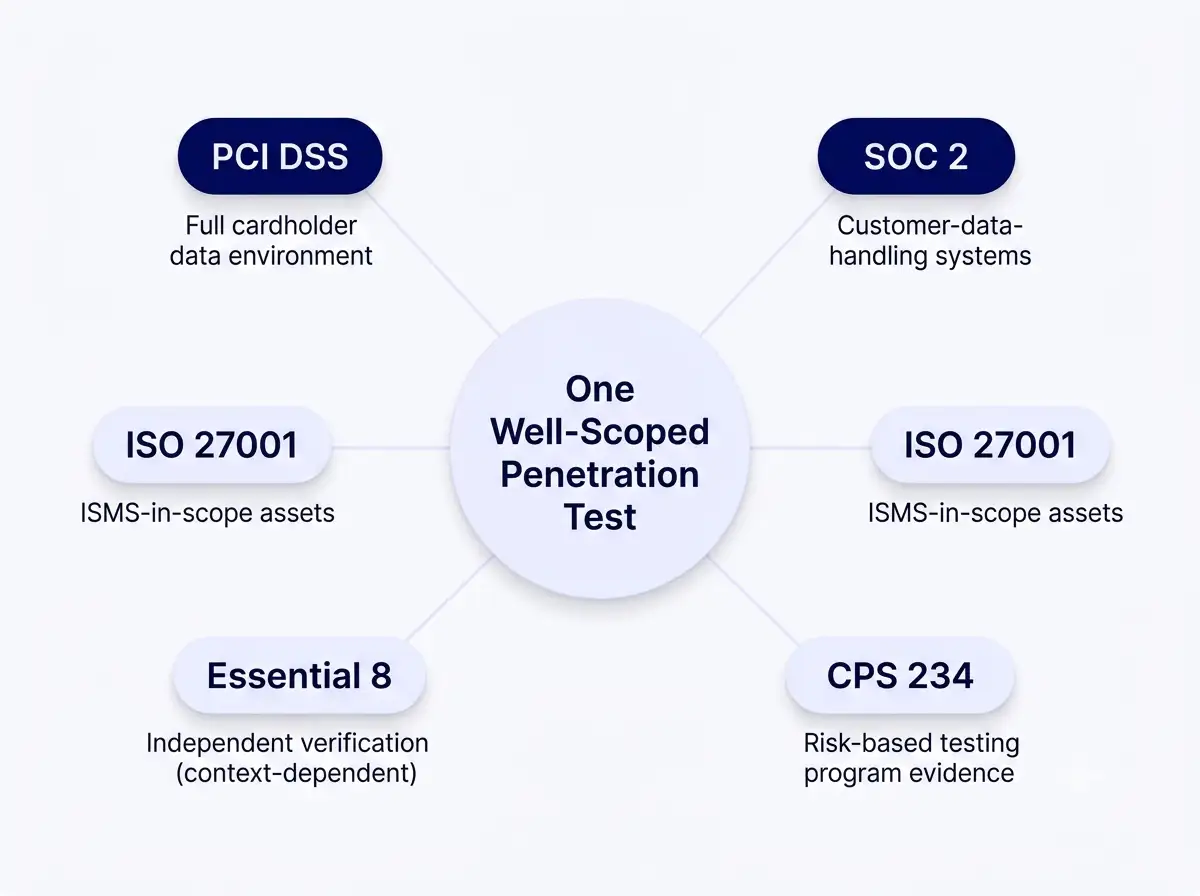
A single, well-scoped engagement can produce evidence multiple auditors will accept, provided the scope covers everything each framework cares about, the full cardholder data environment for PCI DSS, customer-data-handling systems for SOC 2, your ISMS-in-scope assets for ISO 27001, and so on, and the report is structured so each piece of evidence maps clearly back to the relevant framework’s requirement. This is exactly the kind of scoping decision covered in more depth when managing multiple compliance frameworks at once.
FAQs
Which compliance framework has the strictest penetration testing requirement?
PCI DSS. Requirement 11.4 is the most explicit and prescriptive of any framework covered here, with a fixed annual cadence, defined methodology expectations, and mandatory retesting.
Can I use the same penetration test for multiple certifications?
Often yes, if the engagement is scoped to cover what each framework requires. See the section above on scoping one test for multiple frameworks for how this works in practice.
Does SOC 2 require a penetration test?
Not by explicit name, but it is commonly expected as evidence supporting Common Criteria CC7.1, and most auditors treat annual testing as the practical standard for Type 2 audits.
Is Essential 8 the same as a penetration testing requirement?
No. Essential 8 is a maturity-based framework, and independent testing requirements depend on context, such as government supplier obligations, rather than being mandated at every maturity level universally.
How often should a penetration test be repeated?
It depends on the framework, but annually plus after any significant infrastructure or application change is the common baseline across PCI DSS, SOC 2, ISO 27001 and HIPAA guidance.
What happens if I skip a required penetration test?
For frameworks with explicit requirements like PCI DSS or CPS 234, this can result in a failed audit or compliance gap. For frameworks with implied requirements like SOC 2 or ISO 27001, it increases the risk of an auditor flagging insufficient evidence for the relevant control.

Content Reviewed By
Abdul Rameez
Senior Security Analyst
VAPT | Web VAPT | Mobile VAPT | Ethical Hacker | Security Consultant
Abdul Rameez is a Senior Security Analyst at CyberSapiens with 4 years of experience specialising in web and mobile application penetration testing. He holds the Certified AppSec Practitioner (CAP) and Certified Mobile Application Penetration Tester credentials, and mentors other security researchers alongside his testing work.
Scope a compliance pentest
Tell us which frameworks you are working toward, and we will scope one engagement that satisfies all of them. Explore our penetration testing services to see how we approach multi-framework scoping.
Scope a Compliance PentestCall Us
1300 507 668Email Us
[email protected]Our Office
Lvl 1, 206 Lorimer St, Port Melbourne, Australia
