
Achieve ISO 27001 and SOC2 Compliance Together: A Unified Approach to Compliance
Organizations face rising expectations to prove that their data protection measures are both strong and trustworthy. Clients, partners, and regulators demand transparency in how businesses secure sensitive information, and that’s where compliance with globally recognized frameworks like ISO 27001 and SOC 2 becomes essential.
While each framework focuses on different aspects of information security and assurance, achieving both can help organizations build a comprehensive, risk-based security posture that meets international standards. ISO 27001 ensures a structured approach to implementing and maintaining an Information Security Management System (ISMS), whereas SOC 2 demonstrates ongoing operational effectiveness of controls related to data privacy and trust principles.
However, managing both compliance journeys separately can be time-consuming, complex, and resource-intensive, especially for startups and growing enterprises. That’s where CyberSapiens, a trusted global cybersecurity and compliance partner, simplifies the process. Expert team in CyberSapiens helps organizations integrate ISO 27001 and SOC 2 compliance into a single, unified roadmap, reducing duplication of effort, minimizing audit fatigue, and ensuring end-to-end alignment with international data security expectations.
What is ISO 27001?
ISO 27001 is an international standard developed by the International Organization for Standardization (ISO) that specifies the requirements for establishing, implementing, maintaining, and continually improving an Information Security Management System (ISMS).
It is built around a risk-based framework that enables organizations to systematically identify security risks, implement relevant controls, and ensure the protection of data across people, processes, and technology.
Key highlights of ISO 27001 include:
- Establishing a structured ISMS aligned with business objectives.
- Conducting periodic risk assessments and applying relevant controls from Annex A.
- Continuous improvement through monitoring, auditing, and management reviews.
- Applicability across industries from IT and finance to healthcare and manufacturing.
ISO 27001 provides a comprehensive governance framework for managing information security on a global scale.
What is SOC2 Compliance?
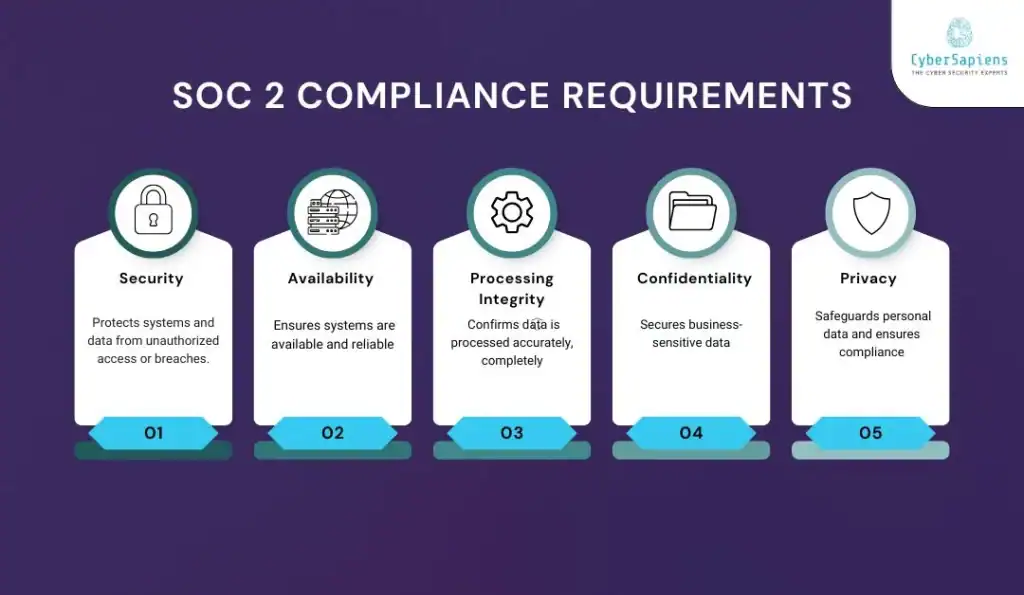
SOC2 (System and Organization Controls 2) is an attestation standard developed by the American Institute of Certified Public Accountants (AICPA). It evaluates whether a service organization’s internal controls effectively protect client data based on the Trust Services Criteria (TSC):
- Security: Ensures that systems are protected against unauthorized access, data breaches, and other potential threats through robust controls and monitoring.
- Availability: Focuses on the system’s reliability and uptime, ensuring that services are accessible and operational as agreed upon in service commitments.
- Processing Integrity: Verifies that system processing is complete, valid, accurate, and timely, ensuring data is handled correctly and consistently.
- Confidentiality: Protects sensitive business and client information from unauthorized disclosure through encryption, access controls, and secure data handling practices.
- Privacy: Ensures that personal information is collected, used, stored, and disclosed in accordance with the organization’s privacy policy and applicable data protection laws.
SOC 2 reports are of two types:
- Type 1: Evaluates the design of controls at a specific point in time.
- Type 2: Assesses the operating effectiveness of those controls over a defined period (usually 6–12 months).
For service-based businesses, especially SaaS providers, IT companies, and cloud platforms, SOC2 compliance serves as proof of reliability, accountability, and customer trust.
Key Benefits of Combining ISO 27001 and SOC2 Compliance
As cybersecurity expectations continue to rise globally, organizations are realizing that meeting just one framework isn’t enough to build full stakeholder confidence. Many clients, especially those in regulated industries like finance, SaaS, and healthcare, expect their vendors to be compliant with both ISO 27001:2022 and SOC2. The benefits of combining ISO 27001 and SOC2 compliance include:
1. Reduced Duplication of Effort: Both ISO 27001 and SOC2 share common control areas—such as access control, incident management, asset protection, and data encryption. By implementing shared controls, businesses can avoid redundant work and optimize audit preparation.
2. Cost and Time Efficiency: Running both compliance journeys together saves time and financial resources. Organizations can streamline documentation, evidence gathering, and internal audits while reducing consulting and auditor engagement costs.
3. Comprehensive Security and Trust Assurance: ISO 27001 provides a strong management framework for information security, while SOC2 emphasizes the ongoing operational effectiveness of security controls. Together, they offer end-to-end assurance—from governance to real-world performance.
4. Strengthened Market Credibility: Dual compliance signals a higher level of maturity and trustworthiness to clients and partners worldwide. It demonstrates that your organization is not only compliant with global standards but also serious about maintaining data integrity and privacy.
5. Faster and More Scalable Compliance Journey: A unified compliance roadmap enables faster certification timelines and makes it easier to expand into other frameworks like HIPAA, GDPR, or PCI DSS. It lays a solid foundation for long-term regulatory readiness.
By combining ISO 27001 and SOC2, organizations transform compliance from a one-time checklist into a strategic business advantage, enhancing brand reputation, operational efficiency, and customer confidence.
Steps to Achieving ISO 27001 and SOC2 Compliance Together
Achieving ISO 27001 and SOC2 compliance simultaneously may seem complex at first, but with the right approach, organizations can integrate both frameworks into a single, well-structured journey. This unified roadmap minimizes redundancy, aligns documentation, and creates a stronger security foundation that supports ongoing compliance and growth.
Below is a step-by-step guide to streamline your dual compliance process:
Step 1: Conduct an Initial Assessment and Gap Analysis
Start by evaluating your organization’s current security posture against both ISO 27001 and SOC2 requirements. A comprehensive gap analysis helps identify overlapping controls, areas for improvement, and missing documentation. This step sets the foundation for an efficient compliance roadmap by showing exactly where your current practices align—or fall short—of both frameworks.
Step 2: Perform Risk Assessment and Control Mapping
Next, conduct a joint risk assessment to determine which threats and vulnerabilities pose the greatest impact to your business. Map each ISO 27001 Annex A control to the relevant SOC2 Trust Services Criteria (TSC). This ensures your security measures address both risk management and operational effectiveness without duplicating work.
Step 3: Develop and Implement Security Controls
Design and implement unified security policies, controls, and procedures that satisfy both ISO 27001 and SOC2 requirements.
Examples include:
- Access control and identity management policies
- Data encryption and backup procedures
- Incident detection and response plans
- Vendor risk management practices
A well-implemented control framework strengthens your organization’s overall security while keeping compliance manageable.
Step 4: Document Policies and Gather Evidence
Documentation plays a key role in both ISO 27001 and SOC2 compliance. Maintain unified records for policies, risk assessments, standard operating procedures (SOPs), and monitoring logs. Leverage compliance automation tools to collect and store evidence efficiently for future audits.
Step 5: Conduct Internal Audit and Readiness Review
Before moving to external audits, perform a combined internal audit for both frameworks. This helps identify gaps in control effectiveness, validate documentation accuracy, and ensure that remediation plans are in place. A readiness review ensures that your team is fully prepared for certification and attestation.
Step 6: Engage in External Audit and Certification
Finally, work with accredited auditors to complete the certification process.
- ISO 27001: Obtain certification from an ISO-accredited certification body.
- SOC2: Receive a Type 1 or Type 2 attestation report from a licensed CPA firm.
By aligning both audit processes, organizations can reuse evidence and minimize audit fatigue, achieving dual compliance with minimal disruption to daily operations.
How CyberSapiens Simplifies ISO 27001 and SOC2 Compliance Together?
Achieving and maintaining ISO 27001 and SOC2 compliance can be complex, but with the right partner, it becomes a strategic advantage. CyberSapiens bridges the gap between compliance theory and real-world implementation by offering an integrated, expert-led approach that saves time, reduces costs, and ensures lasting compliance success.
CyberSapiens’ unified compliance methodology is designed to guide businesses through every stage of their security and certification journey:
1. Comprehensive Gap Analysis and Control Mapping: CyberSapiens starts with a detailed assessment to identify where your current controls align with both ISO 27001 and SOC2. By mapping the overlap between ISO 27001 Annex A and the SOC2 Trust Services Criteria, CyberSapiens ensures that your compliance roadmap is efficient and non-redundant.
2. Custom Compliance Roadmap Development: Every organization is unique, so CyberSapiens designs a tailored compliance strategy that aligns with your business size, risk profile, and industry requirements. This includes defining milestones, timelines, and documentation plans for both certifications.
3. Hands-on Implementation and Documentation Support: CyberSapiens doesn’t just advise; they work alongside your internal teams to implement unified policies, configure security controls, and create audit-ready documentation. This hands-on guidance simplifies the operational side of compliance.
4. Readiness Review and Continuous Monitoring: Before the official audits, CyberSapiens conducts readiness assessments to ensure all controls are functioning as intended. Post-certification, they provide continuous monitoring services to maintain compliance and manage recurring audits effortlessly.
5. End-to-End Audit Coordination: From liaising with ISO-accredited certification bodies to coordinating with SOC2 auditors, CyberSapiens manages the entire process to ensure smooth and timely audit completion with minimal internal disruption.
6. Long-Term Compliance Partnership: CyberSapiens believes in building sustainable compliance programs — not just achieving a one-time certification. Through regular reviews, tool-based monitoring, and ongoing advisory, they help clients maintain compliance maturity as their business grows.
CyberSapiens transforms compliance from a complex requirement into a competitive advantage. By unifying ISO 27001 and SOC2 compliance journeys, organizations can focus on what truly matters: scaling their business securely and earning the trust of global clients.
Clients Served by CyberSapiens




From Compliance to Competitive Advantage
Achieving ISO 27001 and SOC2 compliance together positions your organization as one that prioritizes security, privacy, and accountability at every level. It reflects a mature commitment to protecting stakeholder data while aligning with international standards of governance.
A unified compliance approach doesn’t just simplify the certification process,it helps organizations embed security into their culture. The result is a business that can confidently meet client expectations, expand into new markets, and respond swiftly to evolving cyber risks.
With CyberSapiens as your compliance partner, achieving and maintaining ISO 27001 and SOC2 compliance becomes a seamless, guided journey. From initial gap analysis to certification and continuous monitoring, CyberSapiens ensures your business remains audit-ready, risk-aware, and globally trusted.
FAQs
1. Why should a company aim for both ISO 27001 and SOC2 compliance?
Answer: Dual compliance enhances global credibility by meeting both international and U.S. standards. It reassures clients that your organization follows robust security governance practices while maintaining operational excellence in protecting sensitive data.
2. Can the same set of ISO 27001 and SOC2 controls be used for both audits?
Answer: Yes. Many controls, such as encryption, user access management, and incident response, apply to both ISO 27001 and SOC2. CyberSapiens helps organizations map these shared controls efficiently to reduce redundancy.
3. How long does it take to achieve both ISO 27001 and SOC2 compliance?
Answer: The timeline varies depending on an organization’s size, current security posture, and readiness. On average, it takes 4–6 months to achieve both, but with expert guidance from CyberSapiens, the process can be streamlined through unified documentation and control mapping.
4. Is it more expensive to pursue ISO 27001 and SOC2 compliance together?
Answer: Surprisingly, no. When managed together, ISO 27001 and SOC2 compliance share many overlapping activities, reducing costs for documentation, audits, and assessments. Working with a unified compliance partner like CyberSapiens can make the journey significantly more cost-effective.
5. How often do organizations need to renew their compliance?
Answer: ISO 27001 certification is valid for three years, with annual surveillance audits. SOC2 reports are typically renewed annually. Regular internal audits and monitoring ensure continuous compliance between certification cycles.
