
Application Security and Code Review Course for Job Preparation
As cyberattacks increasingly target web and mobile applications, organizations are prioritizing application security more than ever before. Vulnerabilities in source code, insecure development practices, and overlooked logic flaws often become entry points for attackers. This has created a strong demand for professionals who can identify security weaknesses early in the development lifecycle through secure code review and application security testing.
Today, companies are not just hiring developers; they are actively seeking Application Security Engineers, Secure Code Reviewers, and DevSecOps professionals who understand how to build and assess secure applications. For job seekers in cybersecurity and software development, gaining structured training in application security and code review can significantly improve employability and interview performance.
What is Application Security?
Application Security (AppSec) refers to the practice of protecting software applications from security threats by identifying, fixing, and preventing vulnerabilities throughout the development lifecycle. Instead of addressing security only after deployment, AppSec integrates security controls into the design, coding, testing, and maintenance phases of software development.
Modern applications, whether web, mobile, or cloud-based, handle sensitive data such as personal information, financial records, and business-critical assets. Without proper security measures, these applications can become targets for attacks like SQL injection, cross-site scripting (XSS), authentication bypass, and insecure direct object references.
Application security involves:
- Secure coding practices
- Threat modeling
- Static Application Security Testing (SAST)
- Dynamic Application Security Testing (DAST)
- Vulnerability management
- Secure design principles
By learning application security, professionals gain the ability to proactively identify weaknesses before attackers exploit them, making this skill highly valuable in today’s job market.
What is Secure Code Review?
Secure Code Review is a structured process of analyzing application source code to identify security flaws, logic errors, and insecure coding practices. Unlike functional code review, which focuses on performance and correctness, secure code review specifically evaluates security risks within the codebase.
It involves examining:
- Input validation mechanisms
- Authentication and authorization logic
- Data handling and encryption usage
- Error handling and logging practices
- Third-party dependencies
Secure code review helps organizations detect vulnerabilities early in the development lifecycle, reducing remediation costs and improving overall software quality.
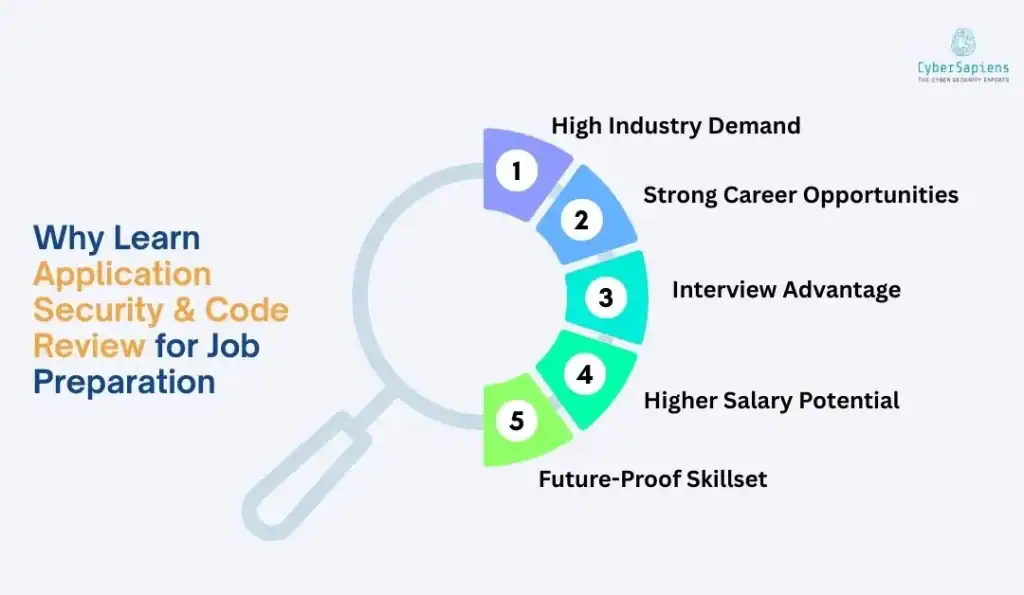
Why Learn Application Security & Code Review for Job Preparation?
Application security is no longer a “nice-to-have” skill; it is becoming a core requirement in modern development and cybersecurity roles. Organizations are integrating security into DevOps pipelines and shifting toward DevSecOps models, which means security professionals must understand how applications are built and where vulnerabilities typically occur.
- High Industry Demand: Companies building SaaS platforms, fintech applications, healthcare systems, and e-commerce platforms require professionals who can secure their codebase. Knowledge of secure coding practices and the OWASP Top 10 is often expected during technical interviews.
- Strong Career Opportunities: Learning application security and secure code review can open doors to roles such as Application Security Engineer, Secure Code Reviewer, DevSecOps Engineer, Security Consultant, and Product Security Analyst. These roles are in demand across startups, enterprises, and global tech firms.
- Interview Advantage: Many technical interviews now include scenario-based questions on vulnerabilities, secure design, and code analysis. Candidates who understand how to identify injection flaws, broken authentication, insecure deserialization, and access control issues stand out from traditional developers.
- Higher Salary Potential: Application security professionals typically earn more than general developers because they bring both development and security expertise. The ability to reduce security risks directly impacts business value, making this skill highly compensated.
- Future-Proof Skillset: As organizations adopt secure SDLC practices and regulatory requirements become stricter, secure coding and code review skills will remain relevant. Application security is a long-term, sustainable career path in cybersecurity.
5 Top-Rated Application Security and Code Review Courses in India
1. Cybersapiens: Secure Source Code Review & Application Security Program
The Secure Source Code Review & Application Security course by Cybersapiens is designed specifically for learners who want practical, job-ready skills in application security. The program focuses on helping students understand how vulnerabilities actually exist in source code and how to identify them systematically.
Course Focus
The training emphasizes real-world secure code review techniques rather than just theoretical vulnerability explanations. Learners are guided through identifying security flaws in application logic, authentication mechanisms, session management, and data handling practices.
The curriculum aligns with widely recognized standards such as the OWASP Top 10, ensuring that students understand the most critical and frequently exploited web vulnerabilities.
Key Learning Areas
The course covers practical concepts, including:
- Secure coding principles.
- Identifying injection flaws and XSS vulnerabilities.
- Authentication and authorization weaknesses.
- Business logic vulnerabilities.
- Manual secure code review methodology.
- Introduction to application security testing approaches
Instead of relying purely on automated tools, the program teaches learners how to think critically and manually analyze code, a highly valued skill during interviews.
What the Program Offers?
- Live Learning: Learners attend live sessions led by experienced educators, allowing real-time interaction, doubt clarification, and engagement with instructors and peers.
- Structured Curriculum: The course content is carefully designed by industry experts to ensure a clear progression from fundamentals to advanced application security concepts.
- Community & Networking: Participants gain access to exclusive chat groups where they can connect, discuss concepts, and network with like-minded cybersecurity aspirants and professionals.
- Learn with the Best: Students can discuss challenges directly with instructors and peers through built-in chat groups, encouraging collaborative problem-solving.
- Practice Tests: Regular quizzes and live tests help reinforce learning, measure progress, and simulate interview-style assessments.
- Certification: Upon completion, learners receive a course certificate that can be showcased on professional platforms like LinkedIn, adding credibility to their profile.
Overall, the program combines practical application security skills with structured learning support, making it a strong option for candidates preparing for Application Security and Secure Code Review roles.
2. SANS Institute: Secure Coding & Code Review Courses
SANS Institute is widely recognized for delivering deep, technical cybersecurity training, including specialized courses in secure coding and secure code review. These programs focus on identifying vulnerabilities at the code level, understanding exploitation techniques, and implementing secure development methodologies across software lifecycles. SANS courses are best suited for experienced professionals who want advanced, industry-recognized certifications and hands-on expertise.
3. ISACA: Application Security & Secure Coding Programs
ISACA offers programs that integrate application security with enterprise governance and risk management frameworks. Their training focuses on secure development practices aligned with organizational compliance requirements and IT governance models. These programs are ideal for IT and security professionals who want to combine secure coding knowledge with governance, audit, and compliance expertise.
4. Udemy & Coursera: Application Security Courses
Udemy and Coursera provide a wide range of application security courses, from beginner-friendly introductions to intermediate-level modules. These platforms are ideal for developers and students who are just starting their journey in application security. Courses typically cover topics like common web vulnerabilities, secure coding basics, and an introduction to frameworks such as the OWASP Top 10.
5. EC-Council: Certified Secure Programmer & Application Security Courses
EC-Council offers secure programming and application security certifications designed to strengthen secure coding practices across multiple programming languages. Their courses focus on vulnerability identification, threat modeling, and aligning development practices with security standards such as the OWASP Top 10. These programs are well-suited for developers seeking recognized certifications that demonstrate secure coding competency.
Preparing for a Future in Secure Development
Application security and secure code review have become essential skills in today’s software-driven world. As organizations prioritize secure development practices and integrate security into DevOps pipelines, professionals who understand vulnerability identification, secure coding standards, and structured code review methodologies are in high demand.
Choosing the right training program plays a critical role in job preparation. Courses that offer hands-on learning, real-world vulnerability analysis, and interview-focused preparation can significantly improve confidence and employability. Programs like Cybersapiens’ Secure Source Code Review & Application Security course help learners move beyond theory by building practical expertise aligned with industry expectations.
For aspiring Application Security Engineers, Secure Code Reviewers, and DevSecOps professionals, investing in structured, implementation-focused training can be the key differentiator in competitive job markets. In a field where secure development is no longer optional, building strong AppSec skills today prepares you for the cybersecurity challenges of tomorrow.
FAQs: Application Security and Code Review Course for Job Preparation
1. Is Application Security a good career option?
Answer: Yes. Application Security is a high-demand domain as companies increasingly adopt secure SDLC and DevSecOps practices. Roles like Application Security Engineer and Secure Code Reviewer offer strong salary growth and long-term career stability.
2. Do I need programming knowledge to learn AppSec?
Answer: Basic programming knowledge is highly recommended since secure code review involves analyzing source code. Familiarity with languages like Java, Python, JavaScript, or PHP can be helpful, but many courses start with foundational concepts.
3. How does the Cybersapiens course help in job preparation?
Answer: The Cybersapiens Secure Source Code Review & Application Security program focuses on practical vulnerability identification, structured code review techniques, interview-oriented preparation, live learning sessions, practice tests, and certification to strengthen job readiness.
4. What job roles can I apply for after completing an AppSec course?
Answer: After completing an Application Security course, you can apply for roles such as Application Security Engineer, Secure Code Reviewer, DevSecOps Engineer, Product Security Analyst, and Security Consultant.
