
Automated vs Manual Compliance: How to Decide Which Approach Fits Your Business
Automated vs Manual Compliance: How to Decide
Neither automated nor manual compliance is universally better. The right choice depends on your team size, framework complexity, timeline, and your auditor, and in 2026 most mature programmes blend both.
When teams compare automated vs manual compliance, they often expect a single clear answer. In practice, automated platforms and consultant led processes solve different problems, and the strongest results usually come from combining them.
An automated compliance tool behaves like accounting software. It connects to your systems, continuously gathers evidence, and tracks what is and is not in place. Manual compliance behaves more like a skilled accountant working through everything by hand, applying expert judgment at each step.
This guide breaks down how each approach works, where each one fits, and how a hybrid model performs across SOC 2, ISO 27001, and more specialised frameworks. The aim is to help you decide with clarity, not to declare a winner.
What Is Automated Compliance and What Is Manual Compliance?
Automated compliance uses software to gather evidence and monitor controls continuously, while manual compliance relies on people to collect evidence, design controls, and apply judgment. Both can achieve the same certification. They simply get there in different ways.
Compliance Automation Tools
Think of it like accounting software. The platform connects to your stack and keeps a live view of your compliance posture without constant human effort.
Consultant Led Compliance
Think of it like a skilled accountant working by hand. A practitioner designs controls, drafts policies, and applies judgment to grey areas a tool cannot interpret.
These are not opposites. As later sections show, many organisations combine the volume handling of a tool with the judgment of a consultant rather than choosing one alone.
What Should Decide Between Automated and Manual Compliance?
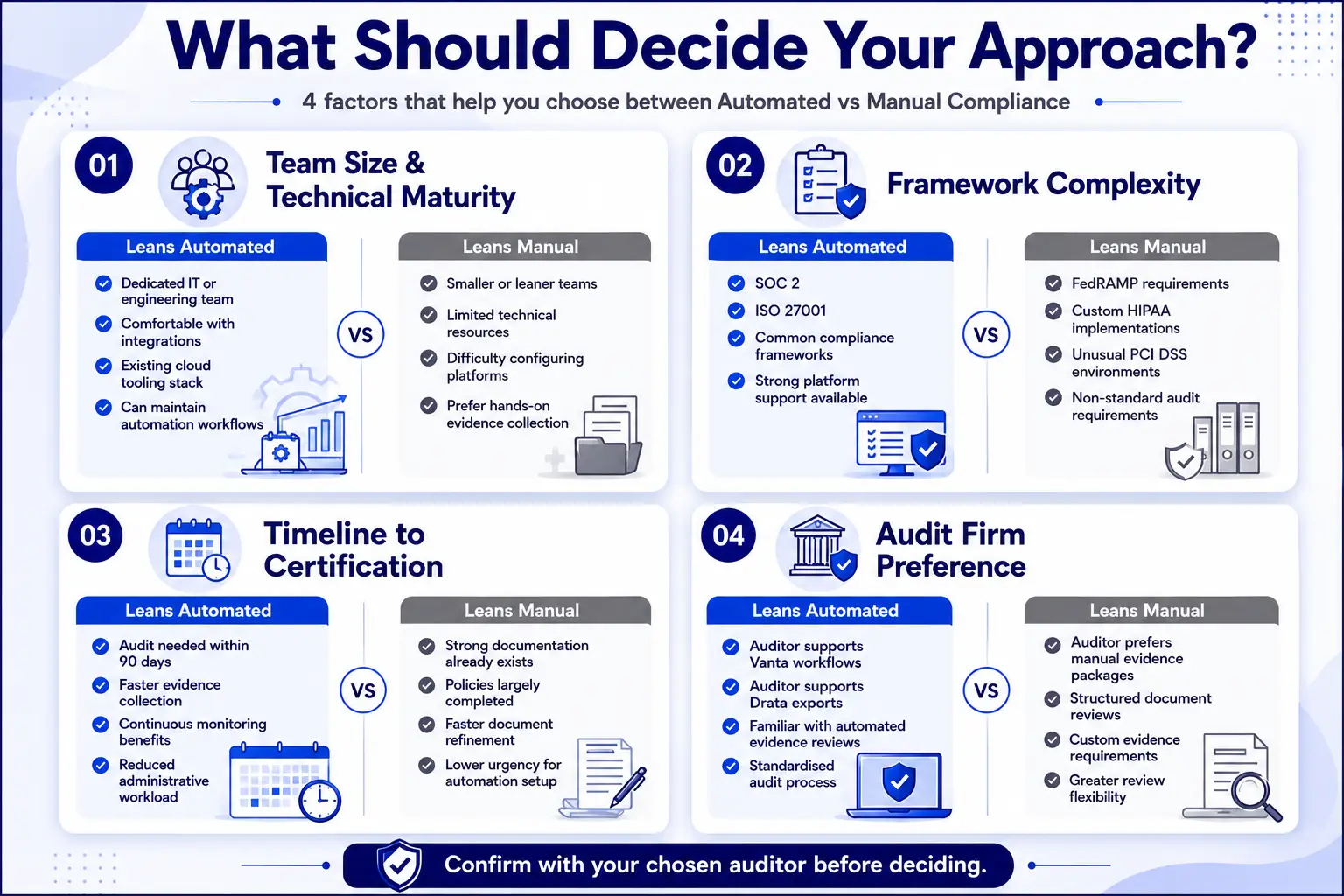
There is no default answer. From our client engagements, the decision comes down to four practical factors, and most teams sit somewhere on a spectrum rather than fully at one end.
1. Team Size and Technical Maturity
Teams with dedicated IT or engineering staff get more value from tools, because integrations do the heavy lifting. Leaner teams often struggle to configure and maintain them, where consultant led work fits better.
2. Framework Complexity
SOC 2 and ISO 27001 are well supported by major tools. Niche scope, such as custom HIPAA controls or unusual PCI DSS requirements, often needs a manual overlay. You can review the official ISO/IEC 27001 information security standard to understand its control expectations.
3. Timeline to Certification
If a team needs to be audit ready in around 90 days, a tool led approach collects evidence faster. Manual work can be faster for policy drafting when a strong documentation baseline already exists.
4. Auditor Preference
Some firms have efficient workflows built around tool exports. Others prefer structured manual evidence packages. Always confirm with your chosen auditor before committing to a path.
How CyberSapiens Frames the Decision
Across our engagements, we tend to recommend tools for tech forward teams targeting SOC 2 Type II with a long runway. We lean towards manual or hybrid for regulated industries, niche frameworks, pre IPO companies with complex control environments, or clients who have had poor tool experiences before.
Strengths of Automated and Manual Compliance
Each approach has genuine strengths, and they rarely overlap. The table below summarises where each one tends to perform well, so you can see which strengths matter most for your situation.
| Dimension | Automated Tools | Manual / Consultant Led |
|---|---|---|
| Evidence collection | Integrations pull evidence automatically, saving hours of export and upload | Evidence is reviewed before submission, reducing irrelevant or incorrect items |
| Monitoring | Continuous checks flag gaps in real time, not just at review cycles | Point in time, but interpreted with context by a practitioner |
| Policies | Template libraries get policies drafted quickly | Policies tailored to your actual operations, not a generic template |
| Edge cases | Binary pass or fail logic on each control | Human judgment interprets grey areas with nuance |
| Scalability | Scales as infrastructure grows without extra hours | Controls designed around how your business actually runs |
| Multi framework | One workspace can support several frameworks at once | Handles niche or jurisdiction specific requirements flexibly |
| Ownership | Evidence lives in the platform portal | All evidence and documentation stay fully owned by you, no vendor lock in |
| Auditor interaction | Live portal access can reduce evidence request cycles | Coaching prepares the team for walkthroughs and interviews |
Read across each row and the pattern is clear. Tools win on volume and speed, while consultants win on judgment and tailoring, which is why neither set of strengths fully replaces the other.
Drawbacks of Automated and Manual Compliance
Every approach carries trade-offs, and most of them only surface once a programme is running. Knowing these limitations in advance helps you plan around them rather than discover them mid audit.
Where Tools Fall Short
Integration with legacy or bespoke systems often takes far longer than vendors promise.
A green dashboard can create a false sense of security that an auditor will not share.
Auto generated policies read as boilerplate, and experienced auditors probe them quickly.
Standard control mapping can miss organisation specific or custom requirements.
Continuous monitoring produces alert volume, and teams without a compliance function fall behind on remediation.
Tools prepare evidence, but they do not prepare people for walkthroughs and interviews.
Where Manual Falls Short
Gathering logs, screenshots, and records across systems becomes a bottleneck at scale.
Processes are point in time, so a control can drift out of compliance unnoticed until the next cycle.
Knowledge depends on people, and it can leave when a key owner or consultant leaves.
Maintaining several frameworks at once without a platform is labour intensive.
Managing many documents by hand invites version confusion and outdated evidence.
Coordination gets complex as teams spread across time zones and jurisdictions.
Confusing Compliance Posture With Compliance Reality
A tool measures what it can measure, such as configurations, logs, and training completions. It cannot confirm whether controls are genuinely embedded in daily operations, or whether a control owner can explain their own process to an auditor. Treating the tool as the entire programme, rather than one component of it, is the most common reason audits go badly.
Not Sure Which Approach Fits Your Business?
CyberSapiens helps you design the right mix of automation and expert guidance across SOC 2, ISO 27001, and more specialised frameworks. Talk to our team and get a clear, neutral recommendation for your stage and scope.
Talk to a Compliance ExpertWhat Does a Hybrid Compliance Model Look Like?
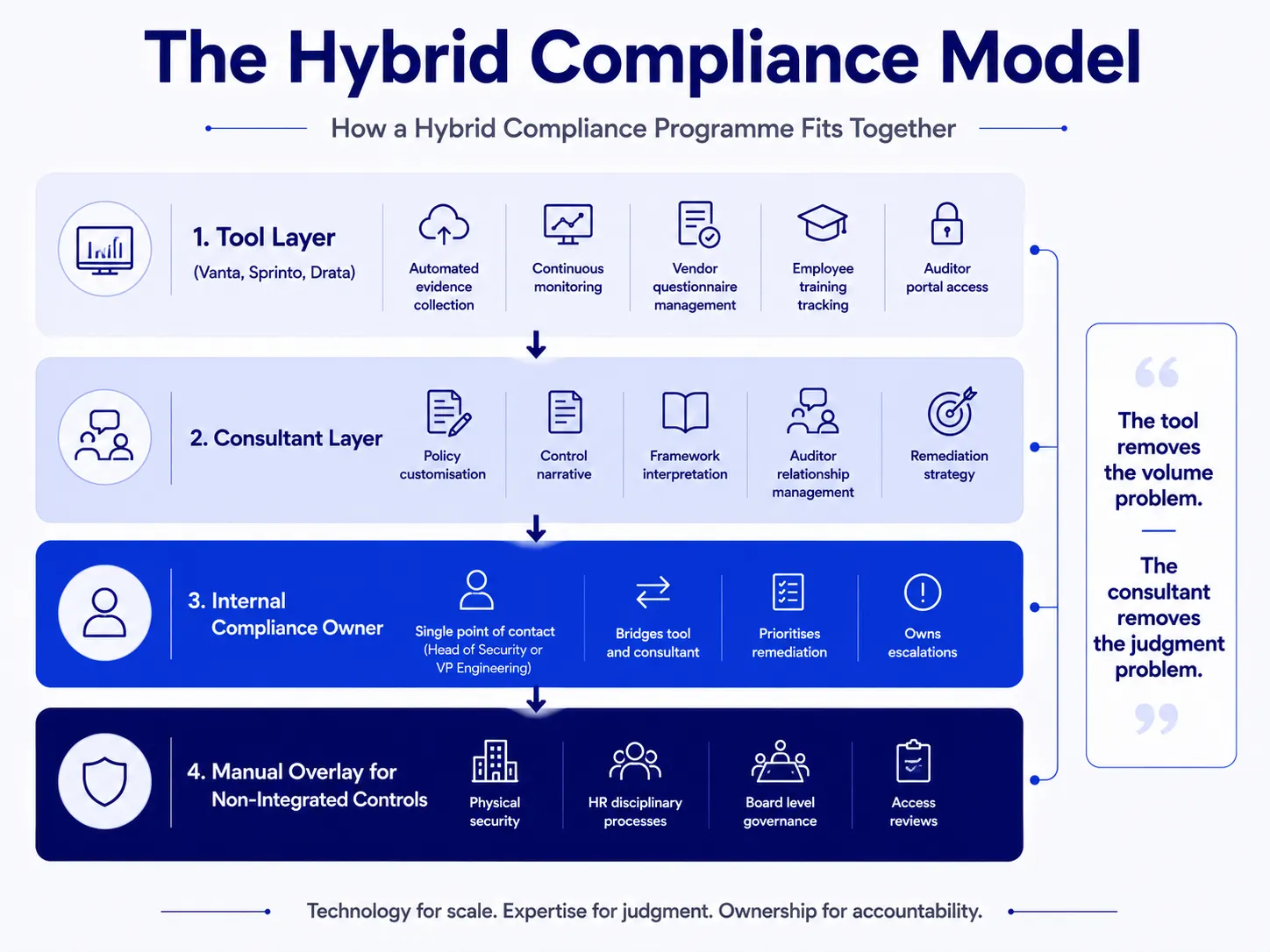
In practice, the most effective compliance programmes we have seen in 2025 and 2026 are hybrid. Automation handles volume and velocity, while a consultant handles judgment, strategy, and relationships.
Tool Layer
Platforms such as Vanta, Sprinto, or Drata handle automated evidence collection, continuous monitoring, vendor questionnaire management, training tracking, and auditor portal access.
Consultant Layer
A practitioner owns policy customisation, control narrative, framework interpretation, auditor relationship management, and remediation strategy for flagged items.
Internal Compliance Owner
A single internal contact, often a Head of Security or VP Engineering, bridges the tool and the consultant, prioritises remediation tasks, and owns escalations.
Manual Overlay for Non-Integrated Controls
Anything an integration cannot reach is handled by documentation and review, including physical security, HR processes, board level governance, and ISO 27001 Annex A access control reviews.
The overlay is where many tool only programmes quietly fail. Controls like least privilege enforcement across AWS, Azure, and GCP still need human verification, because an integration can confirm a setting exists without confirming it is operating as intended.
Continuous monitoring is increasingly the expectation rather than the exception. National bodies such as the Australian Cyber Security Centre publish ongoing guidance on maintaining security controls between assessments, which suits the always on nature of a tool layer.
Volume and Judgment, Handled Separately
Hybrid programmes consistently show shorter audit cycles, fewer auditor findings, and better internal adoption than either pure tool or pure manual programmes. The tool removes the volume problem. The consultant removes the judgment problem.
Which Approach Suits Which Type of Company?
The right fit shifts with your stage, team, and frameworks. The groupings below reflect what usually works, not a fixed rule, and many companies move between them as they grow.
Early Stage Startups
For most pre Series A and Series A teams, use a tool but do not use it alone. The tool handles evidence, and a consultant owns policy quality, auditor relationships, and the control narrative.
Small Teams of 5 to 10
A technically capable team with clear scope and a dedicated consultant can reach SOC 2 Type II without a full tool. Many pair manual evidence with a lightweight workspace for organisation.
Regulated and Enterprise
Complex control environments and bespoke customer requirements in finance, defence, and healthcare often exceed what a tool maps out of the box. Manual interpretation fills the gap.
Niche Framework Programmes
FedRAMP, TISAX, IRAP, and custom HIPAA scope have limited tool support. These are usually consultant dependent, with tool evidence used only to supplement.
One pattern cuts across all of these. As a company adds identity providers and cloud platforms, designing clean role based access control across AWS, Azure, Okta, and Google Workspace becomes harder to verify with a tool alone, which is often the point where human review earns its place.
How Long Does SOC 2 Type II Take?
A SOC 2 Type II from a standing start usually takes 7 to 10 months with a tool led approach, and 9 to 12 months when handled manually. The stage that fixes the floor for both is the observation window, which no tool or consultant can compress.
Infrastructure Assessment
Automated: 2 to 3 weeks. Manual: 3 to 5 weeks.
Policy Drafting
Automated: 3 to 4 weeks with templates and customisation. Manual: 4 to 6 weeks, fully custom.
Evidence Collection Period (Observation Window)
Automated: 90 to 180 days. Manual: 90 to 180 days. This window is identical on both paths.
Audit Preparation
Automated: 2 to 3 weeks. Manual: 3 to 4 weeks.
Audit Fieldwork
Automated: 4 to 6 weeks. Manual: 4 to 6 weeks.
Report Issuance
Automated: 2 to 4 weeks. Manual: 2 to 4 weeks.
The headline gap between the two paths sits in setup and preparation, not the audit itself. Because the 90 day minimum observation window applies equally, no approach can promise a genuinely fast Type II.
What Do Auditors Actually Care About?
From our conversations with senior auditors, the tool versus manual question matters far less than the quality and completeness of what is presented. Preferences differ by firm, but the things auditors reward and penalise are remarkably consistent.
Whatever the platform, evidence still has to map cleanly to the control framework. Standards such as the SOC 2 Trust Services Criteria maintained by the American Institute of Certified Public Accountants set the bar that evidence is judged against, regardless of how it was collected.
What Auditors Universally Dislike
Generic, boilerplate policies that read like a template.
Incomplete or undated evidence with gaps.
Control descriptions that do not match what actually happens.
Control owners who cannot explain their own process in a walkthrough.
What Auditors Universally Respect
Clients who clearly understand their own controls.
A clear risk rationale behind each control.
Evidence that is complete, dated, and clearly mapped to the framework.
Owners who can talk through exceptions and how they were remediated.
The Client Owns the Management Assertion
A compliance tool is not an auditor. If a tool marks a control as passing when it is not, the client is still responsible for reviewing that output before presenting it. The management assertion the auditor relies on is signed by the client, so every tool output should be checked by a qualified practitioner first.
Why Work With CyberSapiens on Your Compliance Programme
We are not tied to any single platform, so our recommendation starts with your stage and scope rather than a tool we are paid to sell. Across our engagements, we design programmes that pair the right automation with the judgment auditors expect.
Vendor Neutral Guidance
We assess tool, manual, and hybrid options against your needs, so you avoid paying for automation you cannot sustain or missing it where it would help.
Certified Practitioners
Our team includes ISO 27001 Lead Auditors and CISA certified specialists who own the judgment layer that tools cannot provide.
Hybrid by Design
We configure the tool layer, customise policies, and manage the auditor relationship, so your team carries the lightest possible load.
Frameworks we work across:
Frequently Asked Questions
Can a small team of 5 to 10 people get SOC 2 without a tool?
Yes, with conditions. A technically capable team with clear scope and a dedicated consultant can reach SOC 2 Type II without a commercial tool, though collecting evidence by hand is the most time consuming part.
Is manual compliance better for niche frameworks?
Often, yes, and significantly so. Frameworks such as FedRAMP, TISAX, and IRAP have limited tool support and are usually consultant dependent, with tool generated evidence used only to supplement the work.
What is the least stressful compliance approach?
A managed model that pairs a tool for evidence collection with a consultant for strategy and auditor management. This removes both the technical burden of configuration and the judgment burden of interpreting findings.
Why do some companies return to manual after using a tool?
Usually after audit findings traced to tool gaps, shrinking engineering bandwidth, expansion into frameworks the tool does not support, or a need for deeper strategic guidance. Tools show what is failing, not why it matters or how to remediate it strategically.
Does a compliance tool guarantee you are audit ready?
No. A green dashboard reflects what the tool can measure, not whether controls are embedded in daily operations or whether owners can explain them. Tool outputs should be reviewed by a qualified practitioner before any audit.
Content Reviewed By

Ketki is a certified ISO 27001 Lead Auditor specialised in Governance, Risk and Compliance, with experience consulting public, private, and government clients. She evaluates threats, risk impacts, and regulatory requirements across multiple industry frameworks.
Build a Compliance Programme That Holds Up Under Audit
Whether you lean automated, manual, or hybrid, the goal is the same: evidence that maps cleanly, policies that fit your operations, and owners who can explain their controls. Talk to CyberSapiens and we will help you get there with the right balance for your team.
Contact Us