
Best GRC Course for Interview Preparation
Governance, Risk, and Compliance (GRC) roles are becoming some of the most sought-after positions in cybersecurity and IT. As organizations face increasing regulatory pressure, third-party risk assessments, and enterprise security reviews, the demand for professionals who understand frameworks, controls, and risk management continues to grow.
But preparing for a GRC interview is different from simply studying for a certification. Recruiters don’t just test theoretical knowledge. They want to see whether you understand how frameworks like ISO 27001, SOC 2, NIST, or PCI DSS work in real-world environments. They assess whether you can identify risks, design controls, support audits, and explain compliance concepts clearly to business stakeholders.
That’s why choosing the right GRC course for interview preparation matters. The best course isn’t necessarily the most expensive or the most popular. It’s the one that helps you think practically, answer scenario-based questions confidently, and demonstrate how compliance connects to business operations.
What Recruiters Actually Look for in GRC Interviews?
GRC interviews are designed to test how you think, not just what you’ve memorized. Recruiters want professionals who understand how governance, risk, and compliance operate inside real organizations.
Here’s a deeper look at what they actually evaluate:
1. Practical Understanding of Frameworks
Recruiters don’t expect you to recite every clause of ISO 27001 or every Trust Services Criterion of SOC 2. Instead, they want to see whether you understand:
- The purpose of the framework.
- How it applies to business operations.
- How controls are mapped to risks.
- What implementation looks like in practice.
For example, instead of defining ISO 27001, you should be able to explain:
- It is a risk-based information security management system (ISMS).
- It requires identifying risks, selecting controls, and continuously improving security posture.
- It focuses on documented processes and ongoing monitoring.
They may also test comparison skills:
- How is SOC 2 different from ISO 27001?
- When would you recommend NIST over ISO?
- What type of organization needs PCI DSS?
This checks your contextual understanding, not memorization.
2. Strong Risk Assessment Knowledge
Risk is the heart of GRC. Recruiters often explore:
- How do you identify risks (assets, threats, vulnerabilities)?
- How do you assess likelihood and impact?
- How do you prioritize risks?
- How do you document them in a risk register?
- What mitigation strategies would you recommend?
You may be given scenario-based questions like:
“If a company stores customer data in a third-party SaaS platform, what risks would you identify?”
They are assessing:
- Logical thinking
- Business impact awareness
- Structured approach to analysis
Understanding inherent risk vs residual risk, risk acceptance, and risk treatment options (avoid, mitigate, transfer, accept) is very important.
3. Control Design and Implementation Clarity
Many candidates can define a control. Fewer can explain how to design one.
Recruiters want to know:
- How do you select controls based on identified risks?
- The difference between preventive, detective, and corrective controls?
- Manual vs automated controls?
- How do you test control effectiveness?
For example:
- How would you implement access control in a SaaS startup?
- How do you ensure periodic access reviews actually happen?
- What makes a control weak?
They are looking for operational thinking, not theoretical definitions.
4. Audit Readiness and Evidence Management
GRC professionals spend significant time supporting audits. Interviewers often assess:
- How do you prepare for an internal or external audit?
- What documentation is required?
- How is it collected and maintained?
- How do you handle audit observations or findings?
You should understand:
- Types of audit evidence (screenshots, logs, reports, policies).
- Importance of timestamps and traceability.
- Continuous evidence collection vs last-minute preparation.
If you can explain how you coordinated with IT, HR, or DevOps during audits, it demonstrates maturity.
5. Policy vs Operational Alignment
This is where many candidates struggle. Recruiters know that policies are easy to write, but difficult to enforce. They want to see if you understand:
- How do policies translate into procedures?
- How teams are trained on policies?
- How compliance is monitored?
- How deviations are handled?
Example question:
“What would you do if employees are not following the password policy?”
They are testing your ability to handle real-world compliance challenges.
6. Business and Stakeholder Communication
GRC roles sit between technical teams and leadership.
Recruiters evaluate whether you can:
- Explain risks to non-technical stakeholders.
- Present compliance status to management.
- Escalate issues appropriately.
- Work with cross-functional teams.
Strong candidates communicate clearly and confidently. They avoid overly technical jargon unless necessary.
7. Problem-Solving Through Scenarios
Many GRC interviews include scenario-based questions:
- A critical vulnerability is discovered. What steps do you take?
- A vendor fails a security review. How do you respond?
- An audit finding remains open for months. What would you do?
Here, recruiters assess:
- Structured thinking
- Practical judgment
- Risk prioritization
- Escalation decision-making
They want to see maturity and balanced decision-making, not panic or rigid answers.
Key Features of an Effective GRC Interview Preparation Course
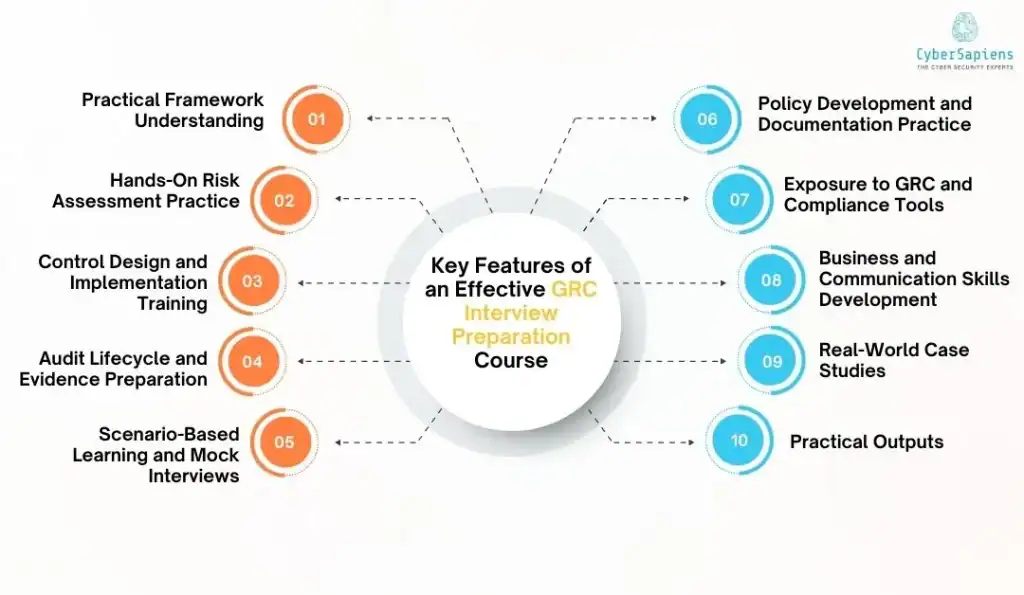
A strong GRC course for interview preparation should focus on practical application, real-world exposure, and structured thinking, not just theory. Here’s what it should involve:
- Practical Framework Understanding: The course should explain major frameworks like ISO 27001, SOC 2, NIST, and PCI DSS in a way that helps you understand their purpose, structure, and real-world implementation. It should show how controls are selected, mapped to risks, and applied within an organization instead of just listing clauses.
- Hands-On Risk Assessment Practice: A good course should teach you how to identify assets, threats, and vulnerabilities, evaluate likelihood and impact, calculate risk levels, and document findings in a structured risk register. It should include practical exercises that simulate real organizational risk scenarios.
- Control Design and Implementation Training: The course should demonstrate how to design effective controls based on identified risks. It should explain the difference between preventive, detective, and corrective controls, and show how organizations implement and monitor them in daily operations.
- Audit Lifecycle and Evidence Preparation: A strong interview-focused course should walk you through the complete audit process, from readiness assessment to final audit reporting. It should teach you how to collect, validate, and present evidence, and how to respond to audit findings professionally.
- Scenario-Based Learning and Mock Interviews: The course should include real GRC interview questions and case-based scenarios. It should guide you on how to structure answers, explain your thought process clearly, and handle practical problem-solving questions confidently.
- Policy Development and Documentation Practice: It should help you understand the difference between policies, procedures, and standards, and provide practical guidance on drafting documents that align with actual business operations rather than theoretical templates.
- Exposure to GRC and Compliance Tools: A good course should introduce you to commonly used GRC tools, risk tracking platforms, and evidence management systems. Even basic exposure helps you speak confidently about compliance operations during interviews.
- Business and Communication Skills Development: Since GRC roles involve working with leadership and cross-functional teams, the course should teach you how to communicate risks in business terms, prepare compliance reports, and collaborate with IT, HR, and management stakeholders.
- Real-World Case Studies: The course should include case studies based on real compliance challenges, such as access control failures, vendor risk issues, or audit observations. This helps you develop analytical thinking instead of memorizing answers.
- Practical Outputs You Can Reference in Interviews: Ideally, the course should help you create tangible outputs like a sample risk register, audit checklist, policy draft, or compliance roadmap that you can confidently discuss during interviews.
A GRC course becomes valuable for interviews when it prepares you to explain how governance, risk, and compliance work in real organizations, not just how they are defined in textbooks.
3 Best GRC Courses for Interview Preparation in India
Governance, Risk, and Compliance (GRC) has become one of the most sought-after skill areas in cybersecurity and risk management. Employers increasingly test candidates on real-world GRC concepts, risk assessment, compliance frameworks, and policy implementation during technical interviews. Below are three of the top-rated GRC courses in India that help learners prepare effectively for job interviews and real-world job requirements.
1. Cybersapiens: Information Security, Risk & Compliance (GRC) Mastery Program
This program offers a targeted curriculum for learners preparing for GRC-related roles such as GRC Analyst, Compliance Officer, IT Auditor, and Risk Consultant. It goes beyond theory by teaching practical GRC implementation, risk assessment frameworks, internal control design, ISO standards overview, and audit readiness, all crucial topics commonly evaluated in interviews.
What makes this course particularly effective for interview preparation is its emphasis on real-world scenarios and an application-oriented understanding of governance and compliance. Rather than memorizing frameworks, you learn how to apply them in organizational contexts, which aligns closely with interview expectations and hands-on job responsibilities.
The program also includes:
- Live interactive sessions with expert instructors
- Structured curriculum designed by industry practitioners
- Community networking and peer discussions
- Practice tests and real-world assessments
- Certificate upon completion to showcase in resumes and LinkedIn
This combination ensures that learners not only understand GRC concepts but can also articulate them clearly in interviews, giving them a strong advantage over others.
2. ISACA: COBIT & CRISC / GRC Foundation Programs
ISACA offers globally recognized certifications, such as COBIT Foundation and CRISC (Certified in Risk and Information Systems Control), that are extremely valuable for interview preparation in GRC roles. These programs dive deep into governance frameworks, risk identification methodologies, and compliance best practices.
3. Simplilearn: GRC & Risk Management Programs
Simplilearn’s GRC courses provide structured training on governance principles, risk management practices, and compliance assessment methodologies. These programs include lessons on ISO standards, policies, risk classification, and compliance controls, all essential elements tested in interviews.
Turning Knowledge into Interview Confidence
The right GRC course for interview preparation depends on your experience level, career goals, and the type of roles you are targeting. Certifications help build credibility and demonstrate structured knowledge of frameworks. Practical courses build confidence by teaching you how governance, risk, and compliance work in real-world scenarios.
GRC interviews are not about memorizing standards; they are about showing that you understand how to apply them. Choose a course that prepares you to think like a practitioner, not just pass an exam.
FAQs: Best GRC Course for Interview Preparation
1. How can I prepare for scenario-based GRC interview questions?
Answer: Practice explaining how you would handle real situations such as conducting a risk assessment, preparing for an audit, or responding to a control failure. Focus on structured thinking, business impact, and clear communication rather than textbook definitions.
2. How long does it take to prepare for a GRC interview?
Answer: Preparation time depends on your background. Beginners may need 2–3 months to build foundational knowledge, while professionals with experience may need 3–6 weeks of focused revision and mock interview practice.
3. What frameworks should I know for GRC interviews?
Answer: You should be familiar with commonly referenced frameworks such as ISO 27001, SOC 2, NIST, PCI DSS, and basic regulatory concepts like GDPR. Understanding their purpose and practical application is more important than memorizing clauses.
4. Can freshers get into GRC roles without prior experience?
Answer: Yes, freshers can enter GRC roles by building foundational knowledge, understanding risk assessment basics, and practicing documentation skills. Internships, practical projects, and structured training programs significantly improve chances.
