
Business Email Compromise (BEC): How SOCs Protect Against Financial Fraud
In the fast-paced world of enterprise communication, email remains both a lifeline and a liability. Among the most financially damaging cyber threats today is Business Email Compromise (BEC) — a sophisticated scam that blends social engineering with deception to trick employees into transferring funds, sharing sensitive data, or updating vendor payment details. Unlike traditional phishing attacks, BEC is often malware-free, making it harder to detect through traditional tools alone.
Here in this article we are going to discuss about the Business Email Compromise (BEC): How SOCs Protect Against Financial Fraud and outlines how Security Operations Centers (SOCs) play a critical role in detecting such incidents.
This blog explores the anatomy of a BEC attack, showcases the real-world impact, and outlines how Security Operations Centers (SOCs) play a critical role in detecting, responding to, and preventing such incidents.
What is Business Email Compromise (BEC)?
BEC is a form of spear-phishing where attackers impersonate trusted individuals—often C-level executives, vendors, or partners—to deceive employees into making unauthorized financial transactions or disclosing confidential information.
Key traits of BEC:
- No malicious attachments or links
- Highly personalized and well-timed messages
- Often executed using spoofed or compromised email accounts
- Targets specific individuals within the finance, HR, or procurement teams
Real-World Financial Impact
According to the FBI’s Internet Crime Complaint Center (IC3) 2023 report, BEC attacks have resulted in over $2.7 billion in losses globally. Many enterprises, including multinational corporations and healthcare providers, have suffered six- to seven-figure losses from a single well-executed BEC attempt.
Scenario: BEC Attack on a Healthcare Organization
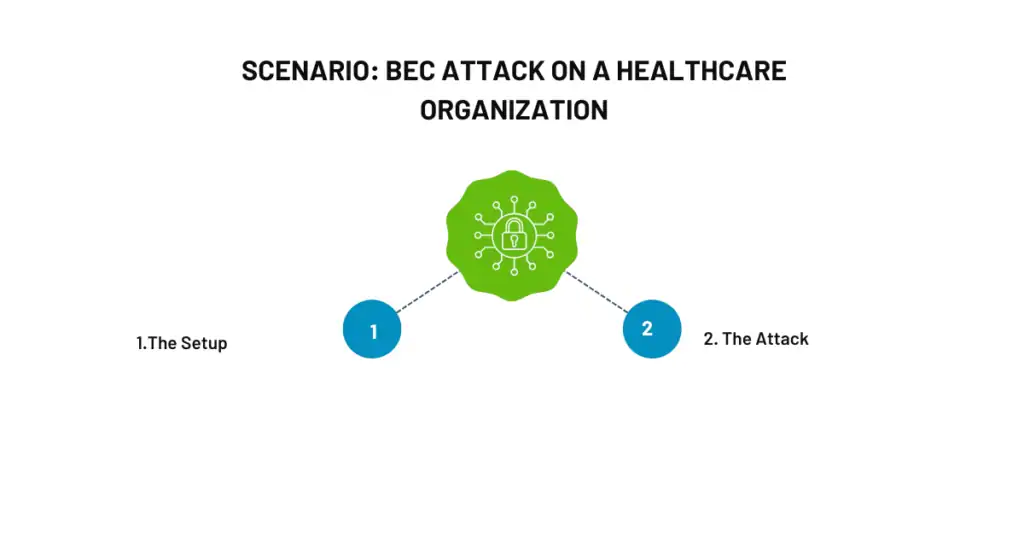
1. The Setup
An attacker gains access to a trusted medical equipment supplier’s email through previously leaked credentials. The adversary monitors ongoing invoice conversations and identifies a pending $150,000 payment.
2. The Attack
Using the supplier’s compromised account, the attacker sends an email to the hospital’s finance team:
- “Please use our new bank account for the upcoming payment due this Friday. We’ve moved to HSBC recently due to a merger. Kindly confirm.”
- Everything looks legitimate—correct branding, language, signatures, and context. The only difference? The bank account is fraudulent.
How the SOC Responds: Step-by-Step?
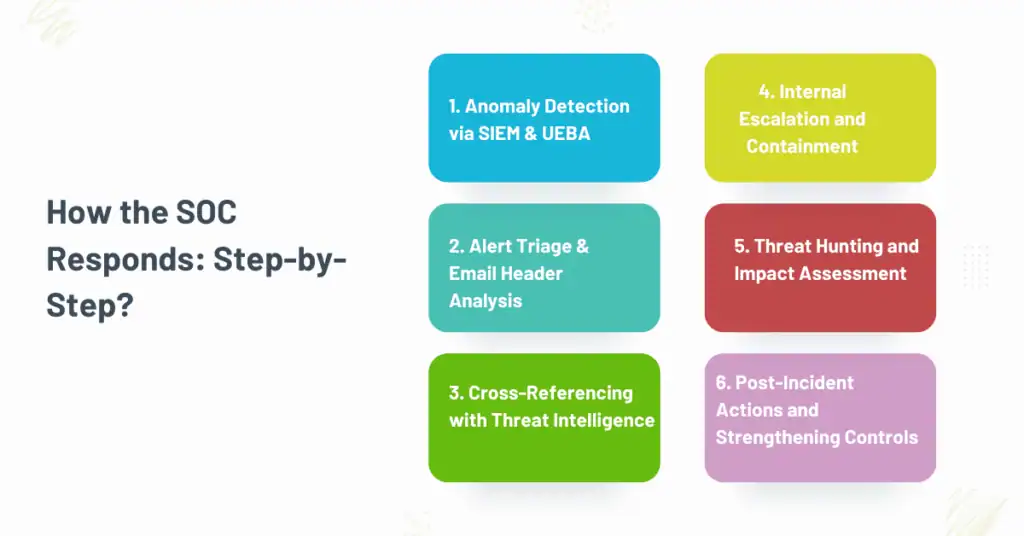
1. Anomaly Detection via SIEM & UEBA
- The SOC’s Security Information and Event Management (SIEM) system ingests email metadata, user logs, and behavioural indicators.
- User and Entity Behaviour Analytics (UEBA) detect anomalies such as:
- An unusual sender domain or email route
- A change in communication behaviour from the vendor
- A new bank account reference in an ongoing thread
Outcome: The SIEM generates a high-confidence alert flagging the transaction as suspicious.
2. Alert Triage & Email Header Analysis
- Level 1 SOC analysts review the alert:
- Inspect email headers, IP addresses, and SPF/DKIM/DMARC validation
- Confirm that SPF validation failed and the email passed through an unrecognized relay
Outcome: Suspicion is confirmed—this is likely a BEC attempt.
3. Cross-Referencing with Threat Intelligence
- The SOC integrates threat intelligence feeds (e.g., Virus Total, IBM X-Force) to check:
- Sender domain/IP reputation
- Known indicators of compromise (IOCs)
- History of financial fraud campaigns linked to similar signatures
Outcome: The attacker’s IP is tied to multiple global BEC campaigns.
4. Internal Escalation and Containment
- The SOC immediately:
- Notifies the finance team to pause the transaction
- Blocks the sender’s domain/IP on the email gateway
- Tags the email chain as malicious
- Locks down access to any accounts involved
Outcome: The wire transfer is halted in time, preventing financial loss.
5. Threat Hunting and Impact Assessment
- The SOC initiates a threat hunting exercise:
- Searches across logs for similar BEC patterns in past 90 days
- Checks for lateral movement from the attacker
- Validates access logs of the finance team and vendor accounts
Outcome: No evidence of broader compromise is found. Vendor is contacted for incident notification and account reset.
6. Post-Incident Actions and Strengthening Controls
The SOC, in coordination with IT and compliance, initiates:
| Action | Purpose |
|---|---|
| Email rule audit | Ensure no malicious forwarding rules exist |
| MFA enforcement on vendor accounts | Reduce compromise risks |
| Keyword-based DLP filters | Flag messages with “urgent payment,” “bank update” |
| Outbound transaction alerts | Alert SOC for high-value transfers |
| Mandatory call-back procedure | Validate any payment or account change |
SOCs Toolset Against BEC
| Tool/Service | Purpose |
|---|---|
| SIEM (e.g., Splunk, Qradar) | Email and log correlation for anomaly detection |
| EDR/XDR (e.g., CrowdStrike) | Monitor endpoint behaviour linked to compromised access |
| Email Gateway (Proofpoint, Mimecast) | Advanced threat protection, spoof prevention |
| DMARC/DKIM/SPF Enforcement | Prevent spoofing and unauthorized email relay |
| SOAR (e.g., Cortex XSOAR) | Automate alert triage and incident response |
| Threat Intelligence Feeds | Identify known BEC indicators and actors |
Conclusion
BEC is not just a technological problem—it’s a human and procedural challenge. Attackers exploit trust, familiarity, and urgency, often without needing malware or exploits. That’s what makes it dangerous.
However, with a mature, well-trained SOC in place—armed with real-time visibility, contextual analytics, and automated response—the damage from a BEC attack can be prevented before it even begins.
SOCs don’t just detect threats—they build a proactive shield against fraud and deception.
