
Difference Between SOC 1 And SOC 2 Audits: A Comprehensive Guide
Quick answer: SOC 1 vs SOC 2
SOC 1 audits test a service provider’s controls that affect clients’ financial reporting. SOC 2 audits test controls over security, availability, processing integrity, confidentiality and privacy, using the AICPA Trust Services Criteria. Choose SOC 1 if you process transactions feeding client financials; choose SOC 2 if you handle customer data or run cloud services.
As businesses continue to rely on cloud computing and outsourcing critical services, there has been a growing need for third-party assurance regarding the security and availability of these services.
Two common methods of providing this assurance are SOC1 and SOC2 audits.
Although these audits share similarities, they have different objectives and focus areas. This comprehensive guide will explore the difference between SOC 1 and SOC 2 audits, their scope and objectives, and the benefits they offer to businesses and their customers, helping organisations determine which report best aligns with their services, risk profile, and customer expectations.
By the end of this guide, you will clearly understand the key differences between SOC 1 and SOC 2 audits and how to determine which audit is most appropriate for your organization.
Understanding SOC 1 and SOC 2 audits
SOC 1 and SOC 2 are independent attestation reports issued by a licensed CPA firm after it examines a service organisation’s controls. They are not certifications, and each one answers a different question for your customers. Both are available as a SOC 1 or SOC 2 report, and each report can be Type 1 or Type 2.
SOC 1
Controls that affect financial reporting
What it covers: The controls a service provider runs that can affect its clients’ financial statements.
Standard: SSAE 18 (AT-C 320).
Best for: Payroll, billing, payment processing, fund administration and other outsourced finance services.
Read by: Client management and their financial auditors.
SOC 2
Controls that protect systems and data
What it covers: The controls a service provider uses to protect customer data and keep its services reliable.
Standard: AICPA 2017 Trust Services Criteria, with revised points of focus (2022).
Best for: SaaS, cloud, data centres, MSPs, and healthcare and fintech vendors.
Read by: Customers, security and procurement teams, and partners.
The five Trust Services Criteria behind SOC 2
Security is always in scope. You add the other four only when they are relevant to your service.
Every SOC report includes the auditor’s opinion, management’s description of the system, and the tested controls with their results. The Trust Services Criteria are published by the AICPA, and you can read more on the AICPA SOC suite page.
SOC 1 vs SOC 2: key differences at a glance
| Feature | SOC 1 | SOC 2 |
|---|---|---|
| Focus | Internal control over financial reporting (ICFR) | Security, availability, processing integrity, confidentiality, privacy |
| Who needs it | Payroll, billing, payment processors, fund administrators, outsourced finance providers | SaaS, cloud, data centres, MSPs, healthcare and fintech vendors |
| Who reads it | Client management and their financial auditors | Customers, security and procurement teams, partners |
| Framework | SSAE 18 (AT-C 320) | AICPA 2017 Trust Services Criteria (revised points of focus, 2022) |
| Control objectives | Defined by the service provider | Predefined criteria; you choose which categories are in scope |
| Report types | Type 1 and Type 2 | Type 1 and Type 2 |
| Distribution | Restricted use | Restricted use (SOC 3 is the public version) |
Type of Service: SOC 1 audits are typically performed for service organizations that provide financial transaction processing services, such as banks and payment processors. SOC 2 audits are typically performed for service organizations that store, process or transmit sensitive data, such as cloud service providers, SaaS companies, and healthcare providers.
Scope and focus of SOC 1 and SOC 2 audits
SOC 1 and SOC 2 audits have different scopes and focuses. Let’s take a closer look at each type of audit.
SOC 1 audit scope and focus
- Scope: Internal controls over the financial reporting of a service organization.
- Focus: Financial transactions and related controls that impact the financial statements of the service organization’s customers.
- Typically performed for: Service organizations that provide financial transaction processing services, such as banks, credit unions, and payment processors.
- What it evaluates: Whether the controls are designed and operating effectively to meet customers’ needs and comply with relevant regulations.
- The report: Gives an independent auditor’s opinion on the fairness of the service organization’s presentation of its controls over financial reporting.
- Customer benefit: Customers can use the report to gain confidence in the reliability of the service organization’s financial reporting.
SOC 2 audit scope and focus
- Scope: Controls related to security, availability, processing integrity, confidentiality, and privacy of a service organization’s systems and data.
- Focus: Controls the service organization has in place to protect its systems and data and meet the Trust Services Criteria established by the American Institute of Certified Public Accountants (AICPA).
- Typically performed for: Service organizations that store, process, or transmit sensitive data, such as cloud service providers, SaaS companies, and healthcare providers.
- What it evaluates: Whether the controls are designed and operating effectively to meet the Trust Services Criteria.
Looking for SOC 1 and SOC 2 Certificates!
We Can HELP…
Controls assessed in SOC 1 vs. SOC 2 audits
The controls assessed in SOC 1 and SOC 2 audits differ due to the varying scopes and focuses. Here’s a closer look at the controls assessed in each type of audit.
Controls assessed in a SOC 1 audit
- Controls assessed: Those related to financial reporting, including controls over the initiation, authorization, processing, recording, and reporting of financial transactions.
- Examples: Controls over accounts payable and receivable, payroll processing, financial statement preparation and review, and fraud prevention and detection.
- What is evaluated: The design and operating effectiveness of these financial reporting controls at a service organization.
- Auditor’s opinion: Whether the controls are suitably designed and operating effectively to meet the needs of the service organization’s customers.
Controls assessed in a SOC 2 audit
- Controls assessed: Those related to the Trust Services Criteria established by the AICPA: security, availability, processing integrity, confidentiality, and privacy.
- Examples: Access controls, encryption, backup and recovery procedures, change management, and incident response.
- What is evaluated: The design and operating effectiveness of these controls at a service organization.
- Auditor’s opinion: Whether the controls are suitably designed and operating effectively to meet the Trust Services Criteria.
How are SOC 1 and SOC 2 audit reports structured and presented?
The structure and presentation of the two SOC audit reports are similar in some ways, but there are also key differences.
SOC 1 audit report structure and presentation
- Structured around: The service organization’s description of its system and the controls in place over financial reporting.
- What the report includes: An introductory section, a description of the service organization’s system, a section on the controls in place, the auditor’s opinion, and any additional information required by the auditing standards.
- Auditor’s opinion: Typically presented as a separate section, with a statement on the fairness of presenting the controls over financial reporting in the service organization’s description of its system.
- Presentation: Prepared under the Statement on Standards for Attestation Engagements (SSAE) 18, which provides consistency and clarity for service organization customers and other stakeholders.
SOC 2 audit report structure and presentation
- Structured around: The Trust Services Criteria and the controls in place at the service organization to meet those criteria.
- What the report includes: An introductory section, a description of the service organization’s system, a section on the controls in place to meet the Trust Services Criteria, the auditor’s opinion, and any additional information required by the auditing standards.
- Auditor’s opinion: Typically presented as a separate section, with a statement on the effectiveness of the controls in place to meet the Trust Services Criteria.
- Presentation: Organised around the AICPA Trust Services Criteria, which provides consistency and clarity for service organization customers, partners, and other stakeholders.
Ensuring Ongoing SOC Compliance
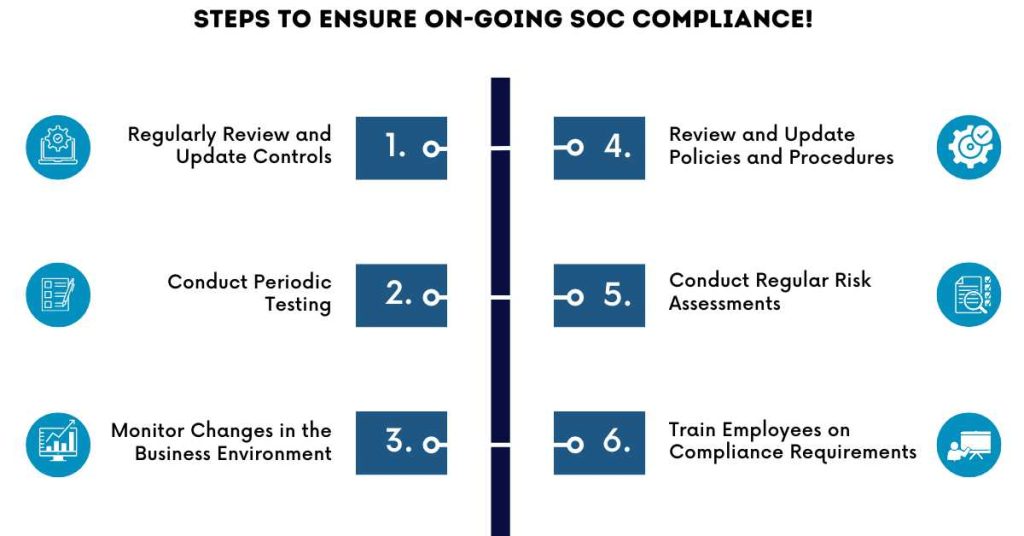
Ensuring ongoing SOC compliance is critical for service organizations to maintain their customers’ and stakeholders’ trust and confidence.
Here are some steps that service organizations can take to ensure ongoing SOC compliance:
1. Regularly Review and Update Controls
Service organizations should review and update their controls regularly to ensure that they remain effective and relevant. This includes assessing new risks and making changes to controls as needed.
2. Conduct Periodic Testing
Service organizations should periodically test their controls to ensure they operate effectively. This includes both testing of design effectiveness and testing of operating effectiveness.
3. Monitor Changes in the Business Environment
Service organizations should monitor changes in the business environment that may impact their controls. For example, changes in the regulatory environment or the technology landscape may require control changes.
4. Review and Update Policies and Procedures
Service organizations should regularly review and update their policies and procedures to reflect current best practices and meet regulatory requirements.
5. Conduct Regular Risk Assessments
Service organizations should conduct regular risk assessments to identify new risks and ensure that controls are in place to address them.
6. Train Employees on Compliance Requirements
Service organizations should train employees on compliance requirements and the importance of SOC compliance. This includes training on the policies and procedures in place and the roles and responsibilities of each employee in maintaining SOC compliance.
Conclusion
In conclusion, SOC 1 and SOC 2 audits are important for service organizations to demonstrate their commitment to security, availability, processing integrity, confidentiality, and privacy. While both audits involve the assessment of controls, there are key differences between SOC 1 and SOC 2 audits regarding their scope, focus, and the types of controls assessed.
SOC 1 audits focus on financial reporting controls, while SOC 2 audits assess controls related to the Trust Services Criteria. Understanding the difference between SOC1 and SOC2 audits is critical for service organizations to ensure they meet the compliance requirements of their customers and stakeholders.
By implementing the appropriate controls and processes and conducting regular audits, service organizations can maintain SOC compliance and their customers’ and stakeholders’ trust and confidence.

Content Reviewed By
Ketki Tidke
Cyber Security and GRC Lead Auditor — ISO 27001 Lead Auditor
Ketki is a certified ISO 27001 Lead Auditor specialised in Governance, Risk and Compliance, with experience consulting public, private, and government clients. She evaluates threats, risk impacts, and regulatory requirements across multiple industry frameworks.
