
Gap Analysis for SOC2: Identifying Your Security Weaknesses Before the Auditor Does
Many organizations begin their SOC2 journey confident that their security controls are in place, only to discover critical gaps during the audit itself. These gaps rarely stem from a lack of effort. More often, they arise because controls are inconsistently executed, evidence is incomplete, or security practices haven’t kept pace with business growth.
A SOC2 audit does not evaluate intentions or future plans. It evaluates what actually happened and what can be proven with evidence. When weaknesses are first identified by an auditor, organizations are left reacting under time pressure, facing audit exceptions, delayed reports, or costly remediation.
This is where a SOC2 gap analysis becomes essential. By identifying security weaknesses before the audit begins, organizations gain the opportunity to fix issues proactively, strengthen control execution, and build reliable evidence trails. A well-executed gap analysis turns SOC2 from a high-risk event into a controlled, predictable process.
What Is a SOC2 Gap Analysis?
A SOC2 gap analysis is a structured, pre-audit assessment that evaluates your current security controls, processes, and evidence against the SOC2 Trust Services Criteria (TSC). Its purpose is to identify gaps before the formal audit, when there is still time to fix them without audit pressure.
Unlike a SOC2 audit, a gap analysis is:
- Advisory, not judgmental
- Focused on improvement, not opinions
- Designed to prepare you for real auditor scrutiny
What a SOC2 Gap Analysis Covers
A comprehensive gap analysis assesses both control design and operating effectiveness, including:
- Control Design: Are controls appropriately defined to meet SOC2 requirements?
- Operational Execution: Are those controls actually followed in day-to-day operations?
- Evidence Readiness: Is there complete, dated, and traceable evidence for the audit period?
- Consistency Over Time: Would controls hold up over a 6–12 month Type II audit window?
Key Areas Reviewed During a SOC2 Gap Analysis
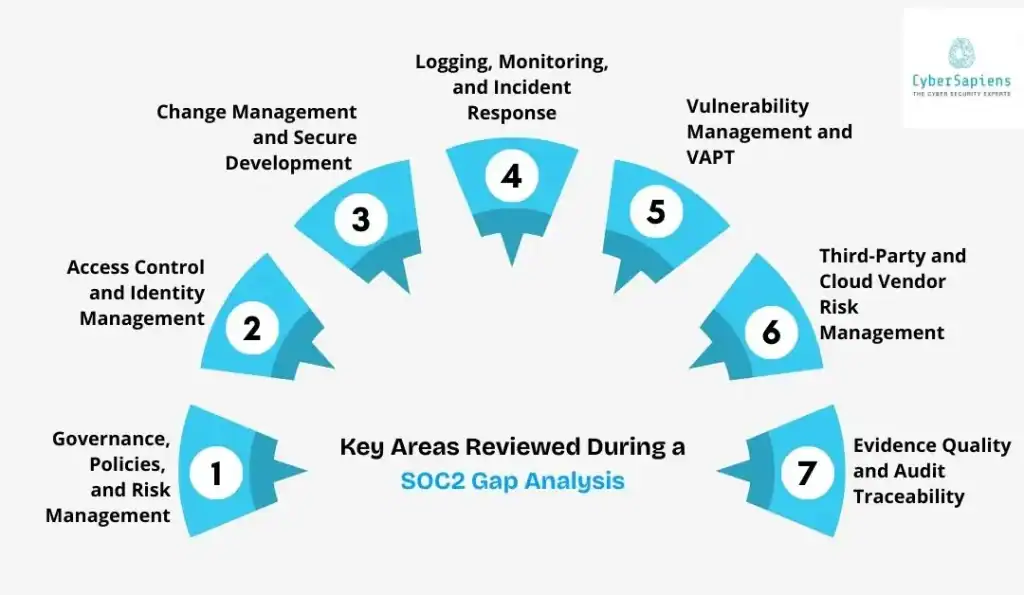
A SOC2 gap analysis examines whether your security controls are properly designed, consistently executed, and supported by audit-ready evidence. Auditors do not look at controls in isolation; they assess how well people, processes, and technology work together over time.
Below are the core areas reviewed during a SOC2 gap analysis and why each one matters for audit success.
1. Governance, Policies, and Risk Management
This area evaluates whether security is formally governed and aligned with business risk.
- Information security policies and procedures.
- Defined roles and responsibilities.
- Risk assessment and risk treatment processes.
- Management oversight and reviews.
Common gaps: outdated policies, unclear ownership, or risk assessments that are not reviewed regularly.
2. Access Control and Identity Management
Auditors closely scrutinize who has access to systems and data—and why.
- User provisioning and deprovisioning.
- Role-based access control.
- Privileged access management.
- Periodic access reviews.
Common gaps: excessive privileges, missing access reviews, or undocumented approvals.
3. Change Management and Secure Development
This area ensures system changes are authorized, tested, and traceable.
- Code changes and deployment approvals.
- CI/CD pipeline security controls.
- Testing and rollback procedures.
- Change logs and evidence.
Common gaps: untracked changes, missing approvals, or lack of testing evidence.
4. Logging, Monitoring, and Incident Response
Auditors expect organizations to detect, respond to, and learn from security incidents.
- Security logging and monitoring coverage.
- Incident detection and escalation processes.
- Incident response plans and testing.
- Incident records and post-incident reviews.
Common gaps: incident response plans not tested, or no evidence of monitoring effectiveness.
5. Vulnerability Management and VAPT
This area confirms that security weaknesses are identified and addressed proactively.
- Regular vulnerability scanning
- Penetration testing (VAPT)
- Remediation tracking
- Re-testing evidence
Common gaps: one-time testing, no remediation proof, or missing re-tests.
6. Third-Party and Cloud Vendor Risk Management
SOC2 requires visibility into risks introduced by vendors and cloud providers.
- Vendor onboarding risk assessments
- Cloud shared responsibility understanding
- Ongoing vendor monitoring
- Security assurances and contracts
Common gaps: assumed vendor security without documented assessments.
7. Evidence Quality and Audit Traceability
Even strong controls fail audits without proper evidence.
- Complete coverage across the audit period.
- Timestamps and version control.
- Clear ownership and approvals.
- Easy traceability to SOC2 requirements.
Common gaps: retroactive evidence collection or incomplete records.
Why SOC2 Auditors Commonly Identify Security Gaps?
SOC2 auditors rarely uncover gaps because organizations ignore security. In most cases, gaps appear due to operational disconnects between documented controls and real-world execution. As companies grow, scale infrastructure, and move fast, small inconsistencies quietly accumulate—until the auditor tests them.
Common Reasons Auditors Find SOC2 Gaps
- Controls Exist but Are Not Consistently Followed: Policies may define access reviews or incident response steps, but these activities are skipped, delayed, or performed inconsistently during the audit period.
- Evidence Is Incomplete or Missing: Auditors require dated, traceable evidence. Even if a control was performed, missing screenshots, logs, or approvals can result in a failed test.
- Manual Processes Break at Scale: As teams and systems grow, manual security processes fail to keep up, leading to missed reviews, untracked changes, or undocumented approvals.
- Incident Response Is Untested: Incident response plans often exist only on paper. Without simulations, drills, or real incident records, auditors cannot verify effectiveness.
- Vulnerability Management Is Ad Hoc: One-time scans or penetration tests are not enough. Auditors expect ongoing vulnerability identification, remediation, and re-testing.
- Third-Party Risks Are Overlooked: Cloud providers and vendors are assumed to be secure, but vendor risk assessments and ongoing monitoring are often missing.
- Security Is Treated as a One-Time Project: Preparing only right before the audit leads to retroactive evidence collection, something auditors quickly identify.
When Should You Conduct a SOC2 Gap Analysis?
Timing plays a critical role in how effective a SOC2 gap analysis will be. Conducted at the right moment, it can prevent months of remediation and significantly reduce audit risk. Conducted too late, it becomes a damage-control exercise.
- Before Starting a SOC2 Type II Audit Period: This is the most important time to conduct a gap analysis. Identifying and fixing gaps before the 6–12 month audit window begins ensures controls operate consistently throughout the period.
- When transitioning from SOC2 Type I to Type II: Controls that passed Type I design testing often fail Type II operating effectiveness testing. A gap analysis helps validate readiness for sustained execution.
- After Major System or Organizational Changes: Cloud migrations, new CI/CD pipelines, team growth, or new vendors can introduce unseen security gaps that need reassessment.
- Before Large Enterprise, EdTech, or University Deals: Many customers request SOC2 assurance early in the sales cycle. A gap analysis helps avoid delays or negative findings during security reviews.
- After a Previous Audit with Exceptions: If your last audit resulted in findings or exceptions, a gap analysis helps identify root causes and prevent repeat issues.
How CyberSapiens Performs SOC2 Gap Analysis?
A SOC2 gap analysis is only effective if it mirrors how auditors actually test controls. CyberSapiens follows an audit-aligned, evidence-driven approach that focuses on real operational execution—not just policy review, so organizations are fully prepared before the auditor engagement begins.
CyberSapiens’ SOC2 Gap Analysis Methodology
1. Trust Services Criteria (TSC) Scoping & Mapping
Cybersecurity expert at CyberSapiens begins by confirming the correct SOC2 scope and applicable Trust Services Criteria (Security, Availability, Confidentiality, etc.). Each requirement is mapped to your business processes, systems, and data flows to ensure nothing critical is missed.
2. Control Design Assessment
Existing controls are reviewed to determine whether they are appropriately designed to meet SOC2 requirements. This includes policies, procedures, and defined responsibilities across teams.
3. Operating Effectiveness Review
CyberSapiens evaluates whether controls are actually performed in day-to-day operations. This step focuses on consistency, verifying that controls would hold up across a full SOC2 Type II audit period.
4. Evidence Readiness & Quality Check
Evidence is examined for completeness, accuracy, timestamps, approvals, and traceability. Missing, weak, or retroactively created evidence is flagged early to prevent audit failures.
5. Technical Control Validation
Key technical areas such as access control, logging, monitoring, vulnerability management, and incident response are validated to ensure they are working as intended, not just documented.
6. Gap Identification & Risk Prioritization
Gaps are clearly documented and prioritized based on audit impact. This helps teams focus on high-risk findings first rather than spreading effort across low-impact issues.
7. Actionable Remediation Guidance
Instead of generic recommendations, CyberSapiens provides practical, step-by-step remediation guidance aligned with SOC2 expectations, making fixes achievable before the audit starts.
8. Type II Readiness Confirmation
For organizations preparing for SOC2 Type II, CyberSapiens confirms that controls and evidence processes are sustainable over time, not just ready for a one-time review.
By combining audit insight, technical security expertise, and operational realism, CyberSapiens ensures SOC2 gap analyses uncover real weaknesses early, so audits are predictable, efficient, and free of surprises.
Clients Served by CyberSapiens






Stay Ahead of the Auditor, Not Behind the Findings
SOC2 audits rarely fail because organizations lack security intent; they fail because gaps are discovered too late. Missing evidence, inconsistent control execution, and operational blind spots only become costly when they surface during an auditor’s review.
A well-executed SOC2 gap analysis gives organizations visibility, control, and time. By identifying weaknesses early, teams can remediate confidently, strengthen evidence collection, and ensure controls operate effectively throughout the audit period. This proactive approach transforms SOC2 from a high-pressure event into a predictable, well-managed process.
With its audit-aligned methodology, technical validation, and practical remediation guidance, CyberSapiens helps organizations find and fix SOC2 gaps before they become audit findings, protecting compliance outcomes, customer trust, and business growth.
FAQs: Gap Analysis for SOC2: Identifying Your Security Weaknesses Before the Auditor Does
1. How is a SOC2 gap analysis different from a SOC2 audit?
Answer: A gap analysis is advisory and improvement-focused, while a SOC2 audit is a formal, independent assessment that results in an official audit report.
2. When should organizations perform a SOC2 gap analysis?
Answer: Ideally, before starting a SOC2 Type II audit period, when transitioning from Type I to Type II, after major changes, or before large enterprise deals.
3. How long does a SOC2 gap analysis take?
Answer: Typically 2–4 weeks, depending on the size, complexity, and readiness of the organization.
4. Does a SOC2 gap analysis include technical testing?
Answer: Yes. A comprehensive gap analysis includes reviews of access controls, logging, monitoring, vulnerability management, and incident response readiness.
