
How Continuous Phishing Simulations Improve Employee Security Behavior?
Phishing attacks no longer rely on poor spelling or obvious red flags; they are targeted, convincing, and designed to exploit human behavior rather than technical vulnerabilities. Despite growing investments in security tools, a single click by an employee can still open the door to credential theft, ransomware, or data breaches.
Traditional security awareness training, often delivered once a year, fails to create lasting behavioral change. Employees forget lessons, attackers evolve tactics, and risky habits return over time. This is why organizations are shifting toward continuous phishing simulations, a practical, behavior-driven approach that trains employees in real-world conditions and reinforces secure decision-making every day.
What Are Continuous Phishing Simulations?
Continuous phishing simulations are an ongoing security awareness approach that safely mimics real-world phishing attacks within an organization. Instead of relying on one-time or annual training sessions, these simulations regularly expose employees to realistic phishing scenarios, such as credential harvesting emails, malicious links, or attachment-based attacks, in a controlled environment.
The goal isn’t to trick or penalize employees, but to train behavior through repetition. When users interact with a simulated phishing email, they receive immediate, contextual feedback that helps them recognize warning signs and respond correctly in the future.
Unlike traditional phishing tests, continuous simulations evolve alongside real attacker techniques. They adapt to current threat trends, target different departments and roles, and provide measurable insights into employee risk levels, making them a powerful tool for reducing human-related security incidents over time.
How Continuous Phishing Simulations Improve Employee Security Behavior?
Continuous phishing simulations drive real, measurable changes in how employees recognize and respond to cyber threats. By reinforcing secure behavior through repetition and real-world scenarios, organizations can significantly reduce human-related security risks.
Key Ways Continuous Phishing Simulations Improve Security Behavior
- Build Security Awareness Through Repetition: Regular exposure to realistic phishing scenarios helps employees stay alert and recognize common attack patterns such as spoofed senders, malicious links, and urgent messaging.
- Develop Safer Decision-Making Habits: Employees learn to pause, verify, and think critically before clicking links or sharing credentials, turning secure behavior into second nature.
- Improve Phishing Detection Accuracy: Ongoing simulations help employees identify subtle phishing indicators, even in sophisticated and targeted attacks.
- Encourage a Strong Reporting Culture: Employees become more confident in reporting suspicious emails instead of ignoring them, enabling faster response and threat containment.
- Reinforce Learning With Immediate Feedback: Just-in-time training after failed simulations helps employees understand mistakes instantly and apply lessons in future situations.
- Reduce Human-Driven Security Incidents: Over time, click rates drop, reporting rates improve, and employees transition from being a vulnerability to becoming an active security defense layer.
Business Benefits of Continuous Phishing Simulations
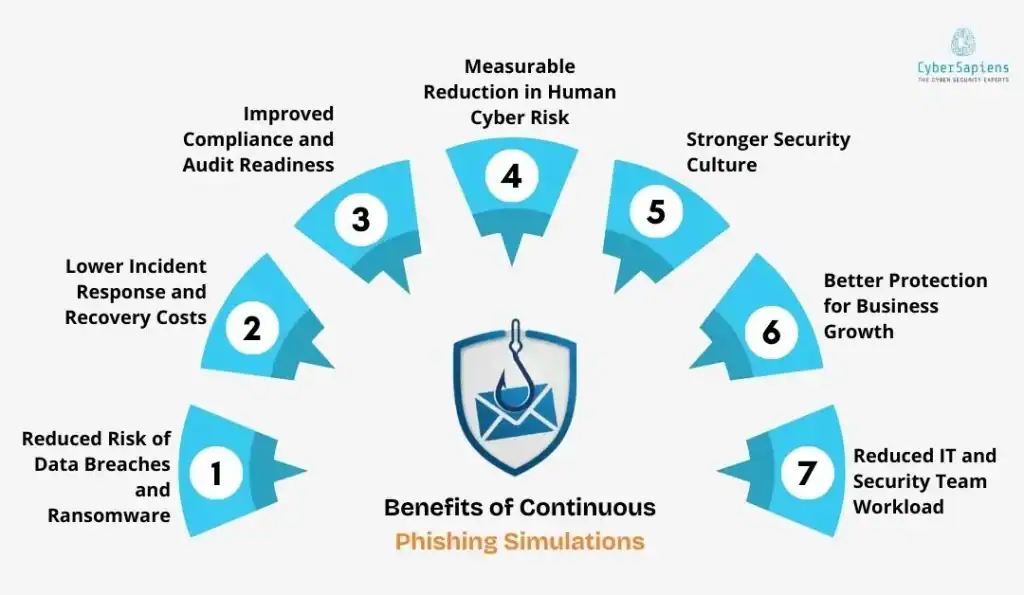
While phishing simulations improve individual behavior, their real value lies in the business outcomes they deliver. By continuously strengthening employee awareness, organizations reduce risk, improve resilience, and protect long-term growth.
Key Business Benefits
- Reduced Risk of Data Breaches and Ransomware: Fewer clicks on malicious links and faster reporting significantly lower the chances of credential theft, malware infections, and ransomware attacks.
- Lower Incident Response and Recovery Costs: Preventing phishing-related incidents reduces downtime, forensic costs, legal exposure, and business disruption.
- Improved Compliance and Audit Readiness: Continuous simulations support security awareness requirements under standards such as ISO 27001 and SOC 2, providing measurable proof of employee training and risk reduction.
- Measurable Reduction in Human Cyber Risk: Metrics like click rates, report rates, and time-to-report offer clear visibility into human risk trends and security maturity.
- Stronger Security Culture Across the Organization: Employees become active participants in security rather than passive users, creating shared responsibility and accountability.
- Better Protection for Business Growth and Reputation: By minimizing phishing-driven incidents, organizations safeguard customer trust, brand reputation, and digital transformation initiatives.
- Reduced IT and Security Team Workload: Automated phishing simulations and behavior-driven training minimize manual campaign management and repetitive awareness tasks, allowing IT and security teams to focus on strategic initiatives instead of constant incident handling.
Best Practices for Successful Phishing Simulation Programs
To achieve meaningful and lasting behavior change, phishing simulations must be implemented thoughtfully. The most successful programs focus on learning and improvement, not fear or punishment.
Key Best Practices
- Start Simple and Increase Difficulty Gradually: Begin with basic phishing scenarios and progressively introduce more sophisticated attacks as employee awareness improves.
- Avoid a Blame-Based Security Culture: Treat failed simulations as learning opportunities. A supportive approach encourages participation and long-term behavior change.
- Align Simulations With Real-World Threats: Use scenarios based on current phishing trends so employees are trained against realistic attacker techniques.
- Provide Immediate, Contextual Training: Deliver short, targeted training immediately after a failed simulation to reinforce learning at the right moment.
- Encourage and Reward Reporting: Make it easy for employees to report suspicious emails and recognize positive security behavior.
- Run Simulations Consistently: Continuous or regular simulations are far more effective than one-time or annual testing.
- Use Data to Drive Improvement: Track metrics such as click rates, report rates, and time-to-report to measure progress and refine the program.
By following these best practices, organizations can ensure phishing simulations lead to sustained behavior change and a stronger human defense layer.
How PhishCare Delivers Continuous Phishing Defense?
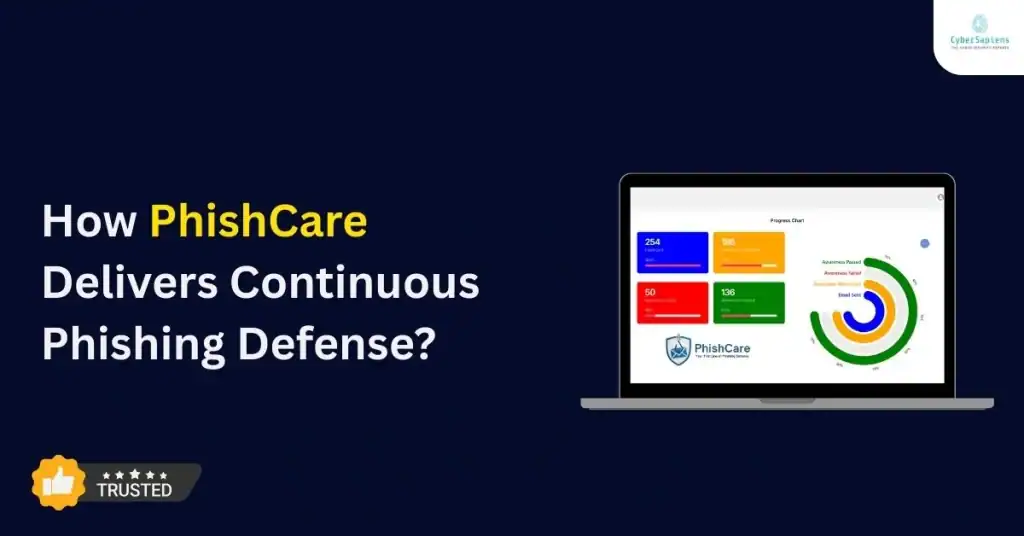
PhishCare is designed to help organizations move beyond one-time awareness training and build sustained, measurable security behavior across their workforce. By combining realistic phishing simulations with automated, behavior-driven training, PhishCare continuously reduces human cyber risk.
PhishCare aligns simulations with real-world attack trends, ensuring employees are trained against the same techniques attackers use today, not outdated examples. Integrated reporting and analytics provide security teams and leadership with clear visibility into risk levels and improvement over time.
Key PhishCare Capabilities
- Continuous, real-world phishing simulations tailored to evolving threats.
- Automated, just-in-time training based on employee actions.
- Risk-based scoring and behavioral analytics.
- Executive-ready dashboards and reports.
- Support for compliance requirements (ISO 27001, SOC 2, etc.).
- Optional integration with SOC and security operations.
PhishCare Pricing Plans
PhishCare pricing plans are designed to scale with your organization’s security maturity and workforce size. Whether you’re starting with basic phishing awareness or looking for advanced, continuous simulations with compliance and SOC integration, PhishCare offers flexible options that deliver measurable risk reduction and long-term value.
| Quantity Range | Yearly | Bi-Annually | Quarterly | Monthly |
| 1-50 | $15.00 | $14.00 | $13.00 | $12.00 |
| 51-150 | $14.50 | $13.75 | $12.80 | $11.70 |
| 151-350 | $14.15 | $13.20 | $12.45 | $11.50 |
| 351-800 | $13.90 | $12.70 | $12.00 | $11.00 |
| 801-1500 | $13.30 | $12.00 | $11.65 | $10.60 |
| 1501-3000 | $13.00 | $11.75 | $11.30 | $10.20 |
| 3001-5000 | $12.60 | $11.40 | $11.00 | $9.80 |
| 5001-10000 | $12.30 | $11.00 | $10.60 | $9.50 |
Turning Human Risk Into Human Defense
Phishing attacks continue to evolve, but so can your employees. Continuous phishing simulations move security awareness beyond check-the-box training and transform it into a living, measurable defense mechanism. By reinforcing secure behavior through real-world scenarios, organizations significantly reduce the likelihood of human-driven security incidents.
With the right approach and tools like PhishCare, employees become active participants in cybersecurity, detecting threats early, reporting suspicious activity, and strengthening the organization’s overall security posture. Turning human risk into human defense isn’t just a security improvement; it’s a strategic investment in resilience, trust, and sustainable business growth.
FAQs : How Continuous Phishing Simulations Improve Employee Security Behavior?
1. How often should phishing simulations be conducted?
Answer: For best results, phishing simulations should be conducted continuously or at least monthly. Regular testing reinforces learning and keeps employees prepared for evolving attack techniques.
2. Do phishing simulations impact employee trust or morale?
Answer: When implemented correctly, phishing simulations improve confidence rather than fear. A positive, learning-focused approach—without blame—helps employees feel empowered instead of targeted.
3. How do continuous phishing simulations improve security behavior?
Answer: They reinforce secure habits through repetition, real-world scenarios, and immediate feedback, leading to reduced click rates, faster reporting, and improved threat awareness.
4. Can phishing simulations help with compliance requirements?
Answer: Yes. Continuous phishing simulations support security awareness and training requirements under standards such as ISO 27001 and SOC 2 by providing measurable evidence of ongoing employee education.
