
How to Integrate VAPT Requirements into Your ISO 27001 Framework?
Implementing ISO 27001 is a major step toward building a robust information security program, but certification alone does not guarantee real-world protection. As cyber threats continue to evolve, organizations must go beyond policies and documentation to actively identify and test security weaknesses. This is where Vulnerability Assessment and Penetration Testing (VAPT) becomes essential.
ISO 27001 is built on a risk-based approach to information security, and VAPT plays a critical role in identifying, validating, and prioritizing those risks. Regular vulnerability assessments help uncover known weaknesses across networks, applications, APIs, and cloud infrastructure, while penetration testing simulates real-world attacks to evaluate how effectively security controls can withstand exploitation.
For organizations aiming to achieve or maintain ISO 27001 certification, integrating VAPT into the Information Security Management System (ISMS) is not just a best practice; it is increasingly expected by auditors, customers, and regulators.
Understanding the Relationship Between ISO 27001 and VAPT
ISO 27001 provides a structured framework for managing information security risks, while VAPT acts as a practical mechanism for identifying and validating those risks. Rather than being a standalone security activity, VAPT directly supports the core principles of ISO 27001 by supplying evidence-based insights into an organization’s actual security posture.
At the heart of ISO 27001 is continuous risk assessment and improvement. Vulnerability assessments help organizations systematically discover weaknesses such as misconfigurations, outdated software, and insecure access controls. Penetration testing goes a step further by simulating real-world attacks, showing how vulnerabilities could be exploited and what the potential business impact might be.
VAPT outputs feed directly into key ISO 27001 processes, including risk registers, risk treatment plans, and control selection under Annex A. This ensures that security decisions are based on real technical findings rather than assumptions. Auditors also rely on VAPT reports as objective evidence that controls are not only documented but also tested and effective.
By integrating VAPT into the ISMS lifecycle, organizations can move from a compliance-driven approach to a risk-driven security strategy.
Why VAPT Is Critical for ISO 27001 Compliance?
While ISO 27001 defines what controls should be in place, VAPT helps verify how well those controls actually protect the organization. By continuously testing systems and applications, VAPT ensures that the ISMS is based on real, measurable risks rather than assumptions.
How VAPT Strengthens Your ISO 27001 ISMS?
- Identifies Real-World Security Weaknesses: VAPT uncovers vulnerabilities across networks, applications, APIs, and cloud environments that may not be visible through documentation reviews alone.
- Validates the Effectiveness of Security Controls: Penetration testing confirms whether controls such as access management, network security, and secure development can withstand real attack scenarios.
- Supports Risk-Based Decision Making: VAPT findings provide accurate inputs for risk registers and risk treatment plans, enabling informed prioritization of remediation efforts.
- Provides Strong Audit Evidence: VAPT reports act as objective proof for ISO 27001 auditors that technical controls are tested and effective.
- Reduces the Likelihood of Security Incidents: Regular vulnerability assessments and penetration tests help prevent breaches by identifying and fixing weaknesses early.
- Demonstrates Continuous Improvement: Repeated VAPT cycles align with ISO 27001’s requirement for ongoing improvement of the ISMS.
Mapping VAPT to ISO 27001 Controls
To effectively integrate VAPT into an ISO 27001 framework, organizations must align technical testing activities with specific security controls. Mapping VAPT findings to ISO 27001 controls ensures that vulnerabilities are not treated in isolation but are systematically addressed through the ISMS.
How VAPT Aligns with ISO 27001 Controls?
- Risk Assessment & Risk Treatment (Clause 6): VAPT findings provide real-world inputs to risk assessments, helping organizations evaluate threats, vulnerabilities, and potential business impact more accurately.
- Access Control & Identity Management (Annex A): Penetration testing validates controls related to authentication, authorization, privilege management, and account misuse.
- Network & Infrastructure Security (Annex A): Network-based vulnerability assessments and penetration tests assess firewall configurations, segmentation, and exposure of critical services.
- Application, API & Cloud Security (Annex A): Application and API penetration testing evaluate secure coding practices, data validation, authentication mechanisms, and cloud misconfigurations.
- Logging, Monitoring & Incident Management (Annex A): VAPT helps verify whether security events are detected, logged, and escalated appropriately during simulated attack scenarios.
- Supplier & Third-Party Risk Management (Annex A): VAPT supports the assessment of risks introduced by third-party integrations, cloud service providers, and external dependencies.
By clearly linking VAPT activities to ISO 27001 controls, organizations can demonstrate to auditors that security testing is an integral part of their ISMS.
Step-by-Step: How to Integrate VAPT into Your ISO 27001 Framework?
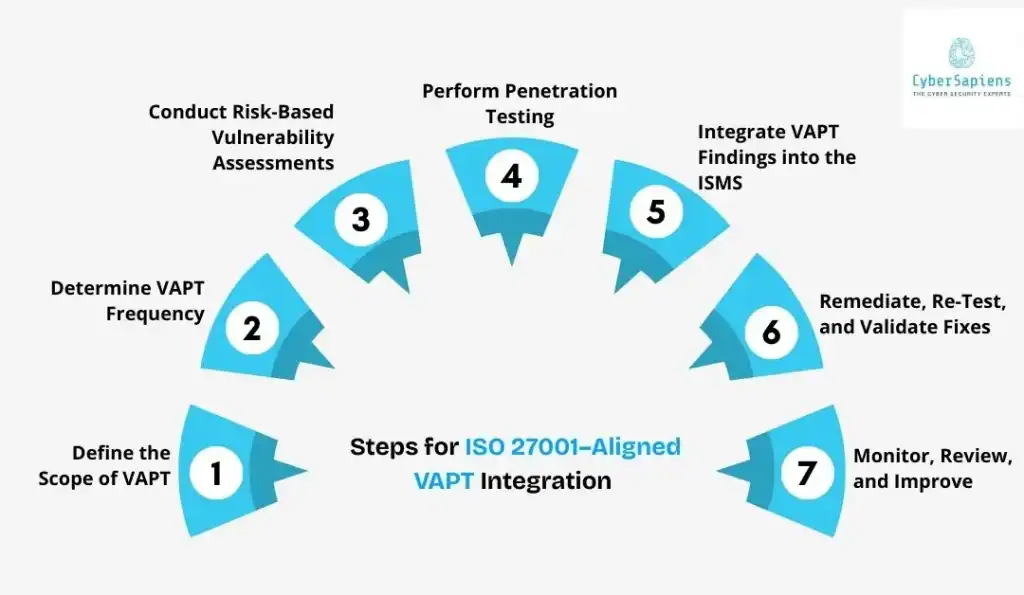
Integrating VAPT into ISO 27001 requires more than scheduling occasional tests; it involves embedding security testing into the ongoing ISMS lifecycle. The following steps help organizations align VAPT activities with ISO 27001 requirements in a structured and audit-ready manner.
Practical Steps for ISO 27001–Aligned VAPT Integration
- Define the Scope of VAPT Clearly: Identify which assets fall under the ISO 27001 scope, including networks, applications, APIs, cloud infrastructure, and third-party integrations.
- Determine VAPT Frequency Based on Risk: Schedule vulnerability assessments and penetration tests based on risk levels, regulatory expectations, system changes, and business criticality.
- Conduct Risk-Based Vulnerability Assessments: Perform regular vulnerability scans and manual assessments to identify weaknesses that directly impact confidentiality, integrity, and availability.
- Perform Penetration Testing on Critical Systems: Simulate real-world attack scenarios to validate whether high-risk vulnerabilities can be exploited and to measure potential business impact.
- Integrate VAPT Findings into the ISMS: Document identified vulnerabilities in risk registers and link them to relevant ISO 27001 controls, risk treatment plans, and Statements of Applicability.
- Remediate, Re-Test, and Validate Fixes: Address identified vulnerabilities, perform re-testing to confirm remediation, and maintain evidence for audits.
- Monitor, Review, and Improve Continuously: Use recurring VAPT results to improve security controls, update risk assessments, and demonstrate continual improvement of the ISMS.
How CyberSapiens Helps Integrate VAPT into ISO 27001?
CyberSapiens helps organizations move beyond checkbox compliance by embedding vulnerability assessment and penetration testing directly into the ISO 27001 Information Security Management System (ISMS). This integrated approach ensures that security testing supports risk management, audit readiness, and continuous improvement.
CyberSapiens’ ISO 27001 & VAPT Integration Services
1. ISO 27001 Gap Assessment & ISMS Design
CyberSapiens starts by reviewing existing security controls, policies, processes, and technical safeguards against ISO 27001 requirements. This assessment establishes a clear baseline, defines the ISMS scope, and ensures VAPT activities are aligned with business-critical assets and compliance objectives.
2. Risk Assessment & Risk Treatment Planning
VAPT findings are incorporated into formal risk assessments to accurately evaluate threat likelihood and business impact. CyberSapiens helps organizations document risks, select appropriate controls, and create risk treatment plans that are traceable, measurable, and aligned with ISO 27001 expectations.
3. Comprehensive VAPT Services (Network, Application, API, Cloud)
Cybersecurity experts at CyberSapiens deliver in-depth vulnerability assessments and penetration testing across on-premises and cloud environments, applications, APIs, and networks. A combination of automated tools and manual testing by certified security professionals ensures both known and complex attack paths are identified.
4. VAPT-to-ISO Mapping for Audit Readiness
Each VAPT finding is mapped to relevant ISO 27001 clauses and Annex A controls, providing auditors with clear evidence that technical controls are actively tested and monitored. This structured mapping simplifies certification and surveillance audits.
5. Remediation Guidance & Re-Testing Support
CyberSapiens supports remediation by helping teams prioritize vulnerabilities based on risk and operational impact. Re-testing is performed to validate fixes, ensuring vulnerabilities are effectively closed, and audit evidence is maintained.
6. End-to-End ISO 27001 Consulting & Certification Support
From initial readiness assessments to certification audits, CyberSapiens provides full lifecycle ISO 27001 consulting. This ensures that VAPT is not a one-time exercise but a continuous component of the ISMS.
7. Audit-Ready Reporting Aligned with ISO 27001 Controls
CyberSapiens delivers structured, audit-friendly reports that clearly link technical findings to ISO 27001 requirements. These reports support management reviews, risk assessments, and auditor evaluations.
8. Continuous Security Testing & Compliance Support
Post-certification, CyberSapiens offers ongoing VAPT, risk reviews, and compliance monitoring to help organizations adapt to evolving threats, infrastructure changes, and regulatory expectations while maintaining ISO 27001 compliance.
Clients Served by CyberSapiens






Building a Stronger ISMS with ISO 27001 and VAPT
A strong Information Security Management System (ISMS) is not built on policies alone—it is strengthened through continuous testing, validation, and improvement. While ISO 27001 provides the governance framework for managing information security risks, VAPT brings that framework to life by identifying real-world vulnerabilities and validating the effectiveness of security controls.
By integrating VAPT into the ISO 27001 ISMS, organizations gain a risk-driven view of their security posture, improve audit readiness, and significantly reduce the likelihood of data breaches and service disruptions. This integrated approach ensures that security decisions are based on measurable findings rather than assumptions, aligning technical security efforts with business and compliance objectives.
With its combined ISO 27001 consulting and VAPT services, CyberSapiens enables organizations to move beyond checkbox compliance and build a resilient, continuously improving ISMS. By embedding regular security testing into risk management and governance processes, CyberSapiens helps organizations achieve stronger protection, sustained compliance, and long-term trust.
FAQs: How to Integrate VAPT Requirements into Your ISO 27001 Framework?
1. How does VAPT support ISO 27001 risk management?
Answer: VAPT provides real-world data on vulnerabilities and attack paths, which helps organizations accurately assess risks, prioritize remediation, and update risk treatment plans.
2. How often should VAPT be conducted under ISO 27001?
Answer: VAPT should be performed periodically based on risk—typically annually—and after significant changes such as new applications, infrastructure updates, or major releases.
3. What types of VAPT are relevant for ISO 27001?
Answer: ISO 27001–aligned VAPT typically includes network, application, API, and cloud penetration testing, depending on the organization’s scope and risk profile.
4. Can automated vulnerability scanning alone meet ISO 27001 expectations?
Answer: No. While automated scans are useful, ISO 27001 expects a risk-based approach. Manual penetration testing is often required to validate complex vulnerabilities and real attack scenarios.
