
How to Map ISO 27001 Controls to SOC 2 Criteria to Reduce Audit Workload?
As organizations scale and serve enterprise customers across regions, many find themselves needing both ISO 27001 and SOC 2. While each framework serves a different purpose, pursuing them separately often results in duplicated controls, repeated evidence collection, and unnecessary audit workload.
ISO 27001 provides a risk-based, globally recognized Information Security Management System (ISMS), while SOC 2 focuses on independent assurance through the Trust Services Criteria. Because both frameworks address similar security objectives, such as access control, risk management, incident response, and monitoring, there is significant overlap that organizations can strategically leverage.
Without proper mapping, teams end up maintaining parallel policies, repeating audits, and responding to similar auditor questions twice. With the right approach, however, one well-designed control framework can support both ISO 27001 and SOC 2, reducing effort without compromising audit expectations.
Understanding the Relationship Between ISO 27001 and SOC 2
To map ISO 27001 controls effectively to SOC 2 criteria, it’s important to understand how the two frameworks differ and why they naturally complement each other.
ISO 27001: A Risk-Based Security Management Framework
ISO 27001 is an international standard focused on establishing and maintaining an Information Security Management System (ISMS). It emphasizes:
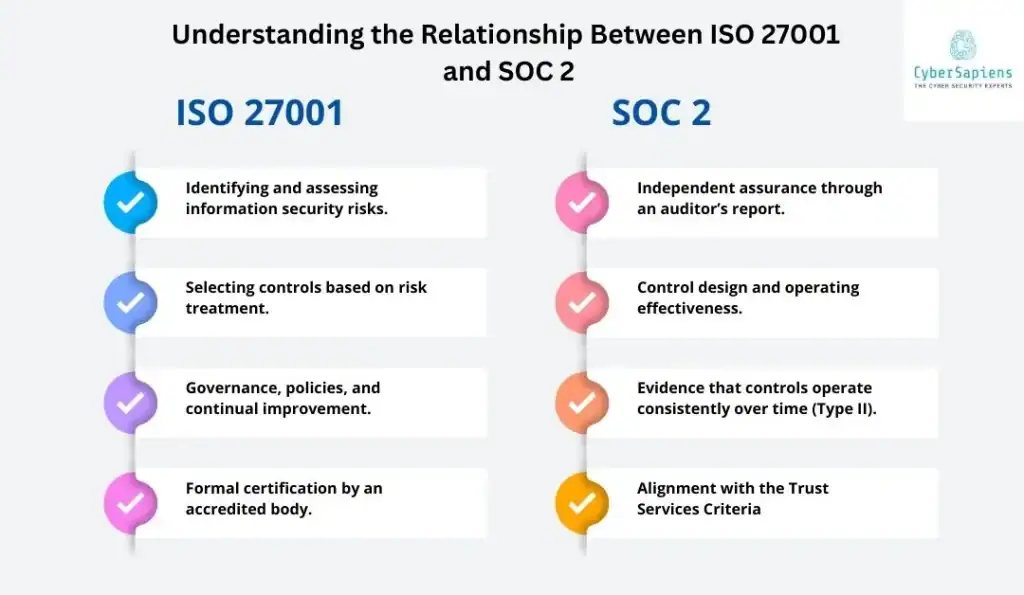
- Identifying and assessing information security risks.
- Selecting controls based on risk treatment.
- Governance, policies, and continual improvement.
- Formal certification by an accredited body.
ISO 27001 is prescriptive about process and governance, but flexible in how controls are implemented.
SOC 2: An Assurance Framework Based on Trust Criteria
SOC 2 is an audit framework developed by the AICPA that evaluates whether controls meet the Trust Services Criteria (TSC). It focuses on:
- Independent assurance through an auditor’s report.
- Control design and operating effectiveness.
- Evidence that controls operate consistently over time (Type II).
- Alignment with trust services criteria.
SOC 2 is less about formal certification and more about proving that controls work in practice.
Why ISO 27001 and SOC 2 Overlap?
Although structured differently, both frameworks address the same core security objectives:
- Access control and identity management.
- Risk management and governance.
- Incident response and monitoring.
- Change management and secure development.
- Vendor and cloud security.
This overlap makes ISO 27001 an ideal foundational framework, with SOC 2 layered on top for assurance, when controls are mapped correctly.
Why Mapping ISO 27001 to SOC 2 Makes Sense?
Organizations that pursue ISO 27001 and SOC 2 separately often discover they are doing the same work twice, maintaining duplicate controls, collecting similar evidence, and answering overlapping audit questions. Mapping ISO 27001 controls to SOC 2 criteria eliminates this inefficiency and creates a more sustainable compliance program.
Key Reasons Mapping Delivers Real Value
- Significant Control Overlap: Both ISO 27001 and SOC 2 address core security areas such as access control, risk management, incident response, change management, logging, and vendor security. Mapping allows a single control to satisfy requirements in both frameworks.
- Reduced Audit Workload: With mapped controls, teams can reuse policies, procedures, and evidence instead of recreating them for each audit. This reduces preparation time and internal disruption.
- Faster and Cleaner Audits: Clear traceability between ISO 27001 controls and SOC 2 criteria helps auditors quickly understand control coverage, leading to fewer follow-up questions and smoother audits.
- Lower Compliance Costs: Less duplication means fewer internal hours spent on compliance activities and lower consulting and audit support costs over time.
- Consistency Across Security Programs: A unified control framework ensures security practices are applied consistently across the organization, rather than fragmented across multiple standards.
- Stronger SOC 2 Type II Readiness: ISO 27001’s risk-based approach provides a solid foundation, while mapped controls can be operationalized and tested for SOC 2 Type II operating effectiveness.
Key ISO 27001 Control Areas That Map to SOC 2
One of the biggest advantages of aligning ISO 27001 with SOC 2 is the strong overlap across core security domains. When these areas are mapped correctly, a single set of controls and evidence can satisfy both ISO 27001 requirements and SOC 2 Trust Services Criteria, significantly reducing audit workload.
Below are the key ISO 27001:2022 control areas that map directly to SOC 2.
1. Governance, Risk Management, and Policies
ISO 27001 focus: ISMS governance, risk assessment, and management oversight
SOC 2 mapping: Security (Common Criteria)
- Information security policies and objectives.
- Risk assessment and risk treatment processes.
- Defined roles, responsibilities, and management reviews
These controls form the foundation of SOC 2’s expectation that security is formally governed and risk-driven.
2. Access Control and Identity Management
ISO 27001 focus: Logical access controls and user lifecycle management
SOC 2 mapping: Security
- User provisioning and deprovisioning.
- Role-based access control (RBAC).
- Privileged access management.
- Periodic access reviews.
Access control is one of the most heavily tested areas in SOC 2 audits, and ISO 27001 provides a strong baseline coverage when controls are properly operationalized.
3. Incident Response and Security Monitoring
ISO 27001 focus: Incident management and operational security
SOC 2 mapping: Security, Availability
- Incident detection and response procedures.
- Security logging and monitoring.
- Incident escalation and resolution.
- Post-incident reviews.
ISO 27001 controls map well here, but SOC 2 often requires clear evidence of testing and execution over time.
4. Change Management and Secure Development (SDLC)
ISO 27001 focus: System acquisition, development, and change control
SOC 2 mapping: Security, Processing Integrity
- Change approvals and testing.
- CI/CD controls.
- Secure development practices.
- Separation of environments
These controls demonstrate that systems change in a controlled, traceable, and secure manner, a key SOC 2 expectation.
5. Vulnerability Management and VAPT
ISO 27001 focus: Technical security and risk treatment
SOC 2 mapping: Security
- Vulnerability scanning
- Penetration testing
- Remediation tracking
- Re-testing evidence
While ISO 27001 is risk-based, SOC 2 auditors expect ongoing, repeatable testing with evidence, making proper mapping essential.
6. Third-Party and Cloud Security
ISO 27001 focus: Supplier relationships and external dependencies
SOC 2 mapping: Security, Availability, Confidentiality
- Vendor risk assessments.
- Cloud shared responsibility controls.
- Contractual security requirements.
- Ongoing vendor monitoring.
This area is increasingly important in SOC 2 audits due to supply-chain risk concerns.
7. Business Continuity and Availability Controls
ISO 27001 focus: Information security aspects of business continuity
SOC 2 mapping: Availability
- Backup and recovery procedures.
- Disaster recovery testing.
- Capacity and performance management.
These controls are critical when Availability is included in the SOC 2 scope.
How CyberSapiens Helps Reduce Audit Workload Through Mapping?
Managing ISO 27001 and SOC 2 separately often results in duplicated controls, repeated evidence requests, and increased audit fatigue. CyberSapiens helps organizations streamline both frameworks into a single, efficient compliance program by strategically mapping ISO 27001 controls to SOC 2 criteria.
How CyberSapiens Simplifies Dual Compliance?
1. ISO 27001–SOC 2 Control Mapping & Gap Analysis
CyberSapiens maps your ISO 27001:2022 controls directly to the relevant SOC 2 Trust Services Criteria, identifying overlaps and highlighting SOC 2-specific gaps that need additional controls or evidence.
2. Unified Control & Evidence Strategy
Instead of maintaining separate control sets, CyberSapiens helps design shared controls and reusable evidence that satisfy both ISO 27001 and SOC 2 audit requirements.
3. SOC 2 Type II Operating Effectiveness Alignment
ISO 27001 controls are operationalized to meet SOC 2 Type II expectations, ensuring controls not only exist but operate consistently over time.
4. Evidence Traceability & Audit Readiness
CyberSapiens structures evidence repositories with clear ownership, timestamps, and traceability—making it easier to respond to auditor requests without last-minute effort.
5. Technical Control Validation & VAPT
Shared technical controls such as access management, logging, vulnerability management, and incident response are validated through testing and VAPT, strengthening audit confidence.
6. Reduced Audit Questions & Faster Reviews
Clear mapping documentation helps auditors quickly understand how controls meet both standards, reducing follow-up questions and audit delays.
7. Ongoing Compliance & Change Management Support
As systems and processes change, CyberSapiens ensures mappings stay current, preventing drift and future audit surprises.
Clients Served by CyberSapiens




One Control Framework, Multiple Compliance Wins
Mapping ISO 27001 controls to SOC 2 criteria is not just a technical exercise; it’s a strategic way to reduce audit workload, eliminate duplication, and build a sustainable compliance program. By leveraging the natural overlap between the two frameworks, organizations can reuse controls and evidence, shorten audit cycles, and respond to auditor requests with clarity and confidence.
A unified approach also strengthens security outcomes. Instead of maintaining parallel programs, teams focus on consistent control execution and operating effectiveness, which is exactly what SOC 2 Type II auditors expect, while retaining the governance and risk-based strengths of ISO 27001.
With its expertise in control mapping, evidence strategy, and audit readiness, CyberSapiens helps organizations simplify audits without compromising rigor. The result is fewer audit headaches, lower compliance costs, and a single security framework that supports both ISO 27001 certification and SOC 2 assurance, efficiently and at scale.
FAQs
1. Can ISO 27001 replace SOC 2?
Answer: No. ISO 27001 is a certification-based ISMS standard, while SOC 2 is an assurance report. However, ISO 27001 can serve as a strong foundation for SOC 2 when controls are properly mapped.
2. Does ISO 27001:2022 align well with SOC 2?
Answer: Yes. ISO 27001:2022’s 93 controls and risk-based structure align closely with SOC 2 Trust Services Criteria, making mapping more practical than earlier versions.
3. Will mapping reduce SOC 2 audit effort?
Answer: Yes. Proper mapping allows organizations to reuse controls, policies, and evidence, significantly reducing duplicate work and audit preparation time.
4. Which SOC 2 criteria benefit most from ISO 27001 mapping?
Answer: The Security criteria benefit the most, followed by Availability and Confidentiality, depending on the scope.
