
How to Review a Vendor SOC 2 Report in 15 Minutes
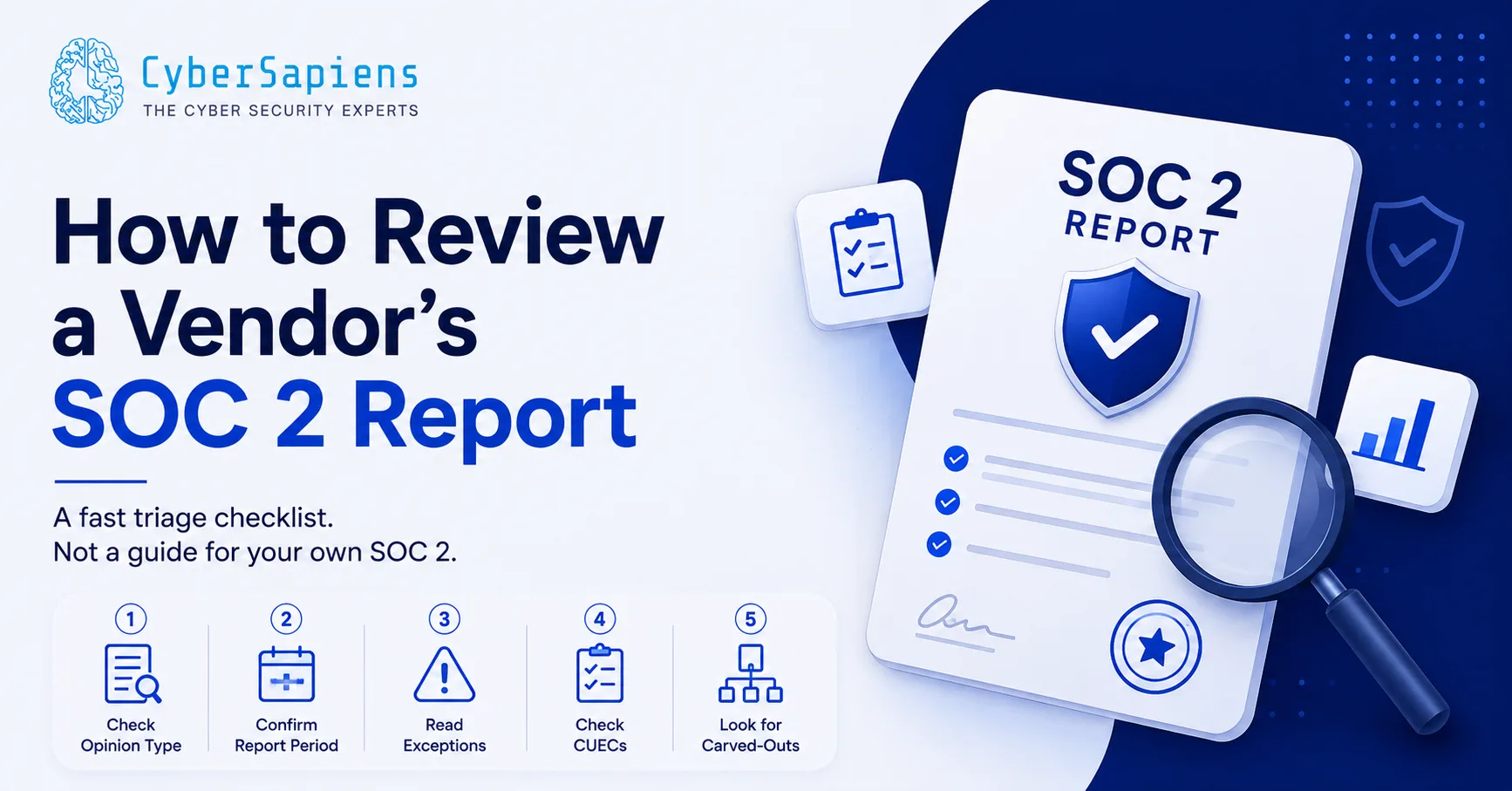
A SOC 2 report can run to 60 or more pages, and most of it is not what you actually need to check. Five things matter most: the auditor’s opinion type, the report period, any exceptions listed, the complementary user entity controls, and whether any subservice organisations are carved out of scope.
Check those five in order and you will know within about 15 minutes whether the vendor in front of you is actually as secure as their sales team claims. Here is how to do that triage, plus a red-flags table and guidance on when a report is thin enough that you should ask for more before signing anything.
The 15-Minute Triage
Check the opinion type first
Go straight to the auditor’s opinion, usually in Section I of the report, part of AICPA’s SOC 2 framework. There are four possible opinions: unqualified (clean), qualified, adverse, or disclaimer. An unqualified opinion means the auditor found the vendor’s controls were designed and operating effectively for everything in scope. Anything else needs a closer look before you go any further.
While you are in this section, also check which SOC 2 Trust Services Criteria the report actually covers. Every report includes Security, but not every vendor includes Availability, Confidentiality, or Privacy, and you need to know which apply to what you are relying on them for.
Confirm the report period actually covers what you need
Check two things: is this the current report, not one 18 months old that the vendor is still handing out, and does the period covered, particularly for a Type 2 report, actually overlap with your evaluation window. If there is a gap, ask whether the vendor can provide a bridge letter to cover it.
Read the exceptions, do not just count them
Most SOC 2 reports have at least a few exceptions listed, and that is normal. What matters is what the exception actually was, how significant it is to the services you are relying on, and whether it was remediated. A single, well-explained access control exception that was fixed within the audit period is very different from a pattern of repeated, unresolved findings.
Check the CUECs, and whether you are actually meeting them
Complementary User Entity Controls, defined in the AICPA Trust Services Criteria, are the controls the vendor expects you to have in place on your side. This is the single most overlooked part of a SOC 2 review. A vendor’s clean report only protects you if you are also doing your half. Read the CUEC list and honestly check whether your organisation is meeting each one.
Look for subservice organisations and how they are handled
If the vendor relies on another company to deliver part of the service, a cloud host, a payment processor, check whether that subservice organisation is included in the report (inclusive method) or excluded (carve-out method). If it is carved out and material to what you are relying on, you may need to request a separate report from that subservice organisation too.
Red Flags Table
What you see, and what it likely means.
| What you see | What it likely means |
|---|---|
| Report is more than 12 months old with no bridge letter | The vendor’s controls have not been independently verified recently, ask for a current report or a bridge letter covering the gap |
| Opinion is qualified, adverse, or disclaimer | Something material did not meet the criteria, ask the vendor to explain specifically what and how it affects the service you use |
| No CUEC section at all | Either genuinely no user-entity responsibilities, which is rare, or an incomplete report, ask the vendor to clarify |
| Repeated exceptions on the same control across multiple report periods | A pattern, not a one-off, worth a direct conversation before proceeding |
| Vendor is reluctant to share the full report, only a summary letter | A summary letter is not a substitute for the actual report, the full report is what you need to review |
| Subservice organisations are carved out with no separate reports available | You have a visibility gap on part of the service you depend on |
When to Reject a Report and Ask for More
Not every imperfect report is a reason to walk away, but a few situations genuinely warrant pushing back before you rely on it: the opinion is adverse or disclaimer, exceptions directly affect the service you are using and show no sign of remediation, or the vendor cannot or will not provide the full report, only marketing summaries.
In any of these cases, it is reasonable to ask the vendor directly how they are addressing the gap, and to factor the answer into your decision rather than accepting the report at face value.
What Good Vendor Risk Management Looks Like Ongoing
A one-time report review is a good start, but vendor risk is not a one-time task. Reports should be re-reviewed at renewal, CUECs should be checked against your actual practices at least annually, and any vendor whose report shows a pattern of exceptions is worth tracking more closely than one with a clean history. If you are managing more than a handful of vendors this way, it is worth setting up an actual SOC 2 vendor management process rather than tracking reviews ad hoc.
If working through this exercise made you realise your own company does not have a great answer if a customer asked to see your own SOC 2 report, that is worth a separate conversation. Our SOC 2 compliance services focus specifically on helping companies get their own report ready, from readiness through to audit.
FAQs
How long should reviewing a SOC 2 report take?
A full first read can take longer, but a focused triage using the 5 checks above, opinion, period, exceptions, CUECs, subservice organisations, can realistically be done in about 15 minutes once you know what to look for.
Is a SOC 2 Type 1 report as good as a Type 2?
They answer different questions. Type 1 confirms controls were designed appropriately at a single point in time. Type 2 confirms those controls actually operated effectively over a period, usually 3 to 12 months. For ongoing vendor relationships, a Type 2 report gives you more assurance.
What if a vendor refuses to share their SOC 2 report at all?
Treat this as a red flag in itself. A vendor confident in their compliance posture should be willing to share the report, often under an NDA if it contains sensitive detail. Reluctance to share anything is worth questioning directly.
Do I need to review every vendor’s SOC 2 report the same way?
No, prioritise by risk. A vendor handling sensitive customer data or critical infrastructure deserves a closer review than one providing a low-risk, non-critical service.
What is the difference between a SOC 1 and a SOC 2 report?
A SOC 1 report focuses on controls relevant to a client’s financial reporting, typically used by payroll or financial services vendors. A SOC 2 report focuses on the Trust Services Criteria, security, availability, processing integrity, confidentiality, privacy, and is the one most relevant for SaaS and technology vendors.

Content Reviewed By
Ketki Tidke
Cyber Security and GRC Lead Auditor
ISO 27001 Lead Auditor
Ketki is a certified ISO 27001 Lead Auditor specialised in Governance, Risk and Compliance, with experience consulting public, private, and government clients. She evaluates threats, risk impacts, and regulatory requirements across multiple industry frameworks.
Realise your own SOC 2 needs work?
If working through this exercise made you think about your own company’s SOC 2 report, we can help you get one ready, from readiness through to audit. Our SOC 2 compliance services start with a straightforward scoping conversation.
Get Your SOC 2 ReadyCall Us
1300 507 668Email Us
[email protected]Our Office
Lvl 1, 206 Lorimer St, Port Melbourne, Australia
