
How VAPT Helps Protect Customer Data for Businesses in New Zealand?
Data protection has emerged as an essential concern for businesses in New Zealand as organizations are increasingly using digital channels to provide services to their customers. Whether it is an e-commerce site, financial services, healthcare services, or software as a service applications, businesses are using digital channels to collect and store large amounts of sensitive customer data, including personal data, financial data, and login credentials. Although digital transformation is helping businesses provide better services to their customers, it has also opened new avenues for cyber criminals to steal sensitive data from businesses.
Data breaches can have significant consequences for businesses, including financial losses, business disruptions, legal issues, and erosion of trust among customers. A single security flaw in a web application can allow cyber criminals to access unauthorized data. As cyber threats are changing rapidly, businesses need to proactively identify and fix security vulnerabilities before they are exploited by cyber criminals.
However, this is where Vulnerability Assessment and Penetration Testing (VAPT) comes into action. VAPT assists businesses in identifying vulnerabilities in their applications, networks, and systems using automated security scanning and simulated cyber attacks. This way, businesses are able to implement measures to safeguard customer information against potential security gaps and reduce the possibility of a data breach. For businesses in New Zealand’s growing digital economy, it is vital to incorporate VAPT into their cybersecurity framework to ensure customer information is secured and to build trust with their clients.
Why Customer Data Protection Matters for Businesses in New Zealand?
Customer data is one of the most important assets for today’s businesses. Organizations, regardless of their industries, deal with different types of data regarding their customers to deliver services, enhance user experience, and process transactions. Nevertheless, this rising trend of relying on digital data has brought about the need to safeguard this data from unauthorized use, misuse, or cyber attacks.
There are several types of data regarding customers that New Zealand-based businesses deal with, including:
- Personal identification data, such as names, addresses, and phone numbers.
- Financial data, including payment card data and other financial information.
- User credentials, such as usernames and passwords.
- Health records and other personal data for healthcare services.
- Transaction data, including data regarding customer activities.
If this data somehow reaches the wrong hands, the consequences can be devastating for both the business and its customers. A data breach can cause financial fraud, identity theft, and loss of customer trust. This can cause severe damage to the business, including financial, legal, and reputational consequences.
Aside from financial and operational risks, it is also important to consider data protection as it relates to building trust with customers. Generally, customers expect organizations to look after their personal data and treat it responsibly. If there is a security breach, it is easy to lose customer trust and switch to another business.
Organizations are also required to comply with data protection laws and regulations. Good cybersecurity practices, security assessments, and risk management are necessary to ensure that customer data is being handled securely.
By focusing on customer data protection and implementing effective security measures such as Vulnerability Assessment and Penetration Testing (VAPT), businesses can effectively protect themselves from cyber attacks while maintaining customer trust and satisfaction.
What is VAPT?
VAPT is an integrated approach to security testing and comprises two essential security practices:
Vulnerability Assessment: The core concept of this approach is to identify and analyze security vulnerabilities in systems and applications. Security tools and automated scanning are employed to identify security vulnerabilities, which include outdated software, configuration issues, weak encryption practices, and exposed services. The ultimate aim of this approach is to develop a list of identified security vulnerabilities that have the potential to cause harm to an organization.
Penetration Testing: Penetration testing is more than just scanning and vulnerability assessment. This approach is intended to analyze and understand real-time cyber attacks on an organization’s systems and applications. Security experts attempt to exploit identified security vulnerabilities in a virtual environment and analyze them to understand the impact of those vulnerabilities on an organization.
How VAPT Helps Protect Customer Data?
However, more than just security measures are required to ensure the security and protection of the customer data. For instance, businesses need to ensure that their systems, applications, and infrastructure are regularly tested to ensure that any security loopholes are recognized and addressed before they are exploited by attackers. Vulnerability Assessment and Penetration Testing (VAPT) has been recognized as one of the key contributors to the security and protection of data against any security threats.
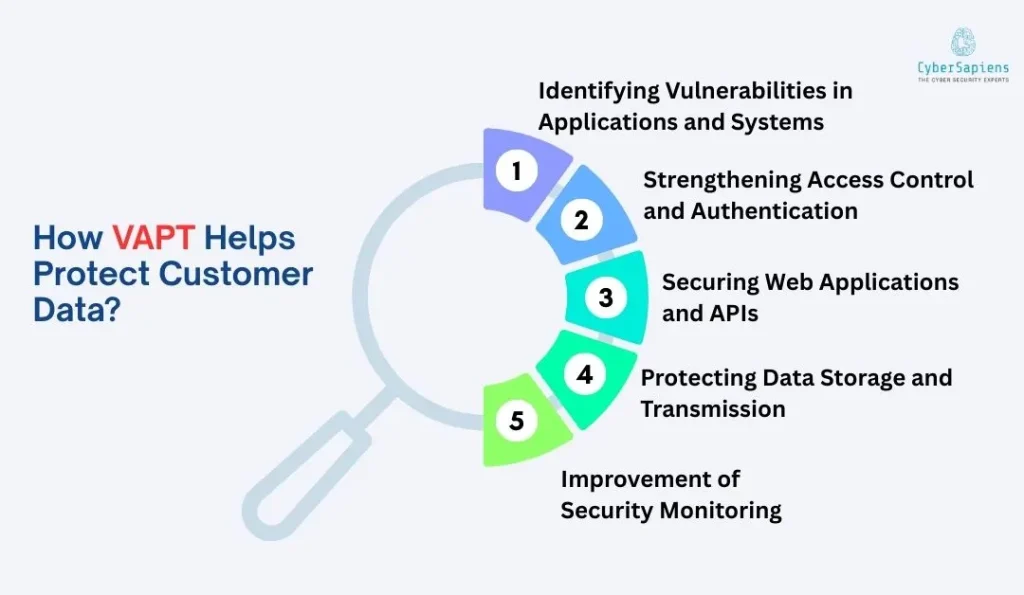
The following are some of the key roles that VAPT contributes to the security and protection of customer data.
1. Identifying Vulnerabilities in Applications and Systems
VAPT helps organizations identify security loopholes in web applications, databases, and cloud infrastructure. These security loopholes could be exploited by attackers to gain unauthorized access to the customer data. For instance, security loopholes could be created in the web applications, databases, and cloud infrastructure, which could be exploited by attackers to gain unauthorized access to the customer data.
2. Strengthening Access Control and Authentication
Inadequate authentication and access controls enable unauthorized users to access customer data. VAPT tests examine login systems, user permissions, and authentication procedures to ensure that only approved individuals have access to sensitive data.
3. Securing Web Applications and APIs
Web applications and APIs are vulnerable to cyber attacks as they often interact directly with customer data. VAPT tests identify web application vulnerabilities such as SQL injection attacks, XSS attacks, and API-related attacks that may enable attackers to manipulate or access sensitive data.
4. Protecting Data Storage and Transmission
Customer data must be protected during storage and when it is being transmitted from one system to another. VAPT tests examine data storage and communication procedures to ensure that sensitive data is not compromised during storage or communication.
5. Improvement of Security Monitoring and Detection of Incidents
A logging and monitoring system is critical for detecting suspicious activities and responding to security incidents. VAPT helps identify gaps in security monitoring and logging, allowing organizations to improve their ability to detect and respond to security incidents.
By conducting VAPT assessments, businesses can minimize the risk of data breaches and ensure their customers’ data is secure against emerging cyber threats.
How Cybersapiens Helps Businesses in New Zealand Protect Customer Data?
Ensuring that customer information is properly safeguarded necessitates a proactive and systematic cybersecurity strategy. CyberSapiens assists businesses in New Zealand in bolstering their cybersecurity posture by providing end-to-end Vulnerability Assessment and Penetration Testing (VAPT) solutions that assist businesses in mitigating security vulnerabilities prior to a potential data breach incident.
With the assistance of cutting-edge security technology and tested security testing methodologies, businesses can successfully identify vulnerabilities in their digital ecosystem and implement a robust security strategy to protect customer information.
Some of the key ways in which CyberSapiens helps businesses include:
1. Comprehensive VAPT Assessments
CyberSapiens provides comprehensive vulnerability assessments and penetration tests for web applications, APIs, networks, and cloud environments to identify potential vulnerabilities that may expose customer data.
2. Application and API Security Testing
Security experts at CyberSapiens test web applications and APIs for various vulnerabilities like injection attacks, broken authentication, access control vulnerabilities, and more that may give attackers unauthorized access to sensitive data.
3. Real-World Attack Simulations
Ethical hackers at CyberSapiens simulate various types of cyberattacks in order to understand how vulnerabilities may be exploited and assess the potential impact of cyberattacks on business systems and customer data.
4. Detailed Vulnerability Reports
Business organizations receive detailed security reports that include vulnerability severity levels and technical details of vulnerabilities with recommendations for resolving vulnerabilities in order to address security issues in an effective manner.
5. Remediation Guidance and Support
Identifying vulnerabilities is only the first step in improving an organization’s security posture. What truly strengthens security is the ability to effectively remediate those vulnerabilities and implement long-term security improvements. Cybersapiens goes beyond simply reporting security issues by working closely with developers, DevOps teams, and IT security teams to ensure that identified vulnerabilities are properly addressed.
6. Continuous Security Testing
Cybersecurity is not a one-time activity. As businesses grow, deploy new applications, update systems, and adopt new technologies, new vulnerabilities can emerge. Continuous security testing ensures that organizations remain protected even as their digital environments evolve.
CyberSapiens supports organizations by conducting regular VAPT assessments to monitor the security of applications, networks, and infrastructure over time. These periodic tests help detect newly introduced vulnerabilities that may arise due to software updates, infrastructure changes, or newly discovered security threats.
By taking advantage of these services, organizations in New Zealand can improve their cybersecurity posture, protect against data breaches, and ensure that customer data is safe from cyber attacks in an increasingly complex threat environment.
Strengthening Customer Data Security for New Zealand Businesses
As businesses in New Zealand are growing and expanding their online presence, securing customer data is now considered a fundamental responsibility. With cyber attacks and threats becoming even more sophisticated, it is important that businesses are able to protect their applications, networks, and systems from potential attacks that may compromise customer data.
Vulnerability Assessment and Penetration Testing (VAPT) is considered a vital component in assisting businesses in identifying potential security risks before they are exploited by cybercriminals. With regular testing of systems and applications to identify vulnerabilities, businesses are able to strengthen their defenses and implement efficient security measures to prevent data breaches and cyber attacks.
For businesses that require and handle critical customer data, it is not only important to implement efficient security measures to prevent cyber attacks and data breaches, but also to ensure that businesses are able to build and sustain customer trust to ensure business success in the long run.
FAQs
1. Why is protecting customer data important for businesses in New Zealand?
Answer: Customer data often includes personal, financial, and sensitive information. If this data is compromised, it can lead to identity theft, financial fraud, legal consequences, and loss of customer trust. Strong cybersecurity practices help businesses safeguard this information and maintain their reputation.
2. What types of systems should be tested with VAPT?
Answer: VAPT can be performed on web applications, mobile applications, APIs, internal networks, cloud infrastructure, and databases to identify vulnerabilities that could expose customer data.
3. How often should businesses perform VAPT testing?
Answer: Organizations should conduct VAPT assessments at least once a year or whenever major system changes occur. Many businesses also perform quarterly or biannual testing to maintain continuous security.
4. Can VAPT help prevent data breaches?
Answer: Yes. By identifying and fixing vulnerabilities before attackers exploit them, VAPT significantly reduces the likelihood of data breaches and unauthorized access to sensitive customer information.
