
ISO 27001:2013 vs 2022: From 14 Domains to 4 Control Categories Explained
ISO 27001 has long been the global benchmark for information security management, but as technology and cyber threats evolved, the standard needed to evolve as well. Organizations implementing ISO 27001:2013 often struggled with its 14 control domains and 114 controls, which, while comprehensive, were sometimes complex, overlapping, and difficult to map to modern cloud and digital environments.
To address these challenges, the standard was updated to ISO 27001:2022, introducing a simpler and more intuitive structure. The controls were reduced from 114 to 93, and the traditional 14 domains were reorganized into four clear control categories: Organizational, People, Physical, and Technological. This change was designed to improve clarity, reduce duplication, and make implementation more practical, without compromising security.
For organizations already certified to ISO 27001:2013, this update requires more than a simple renumbering of controls. Risk assessments, Statements of Applicability (SoA), documentation, and technical controls must be reviewed and aligned with the new structure. For new adopters, the 2022 version offers a clearer, more manageable starting point.
ISO 27001:2013 Overview: The 14 Control Domains Explained
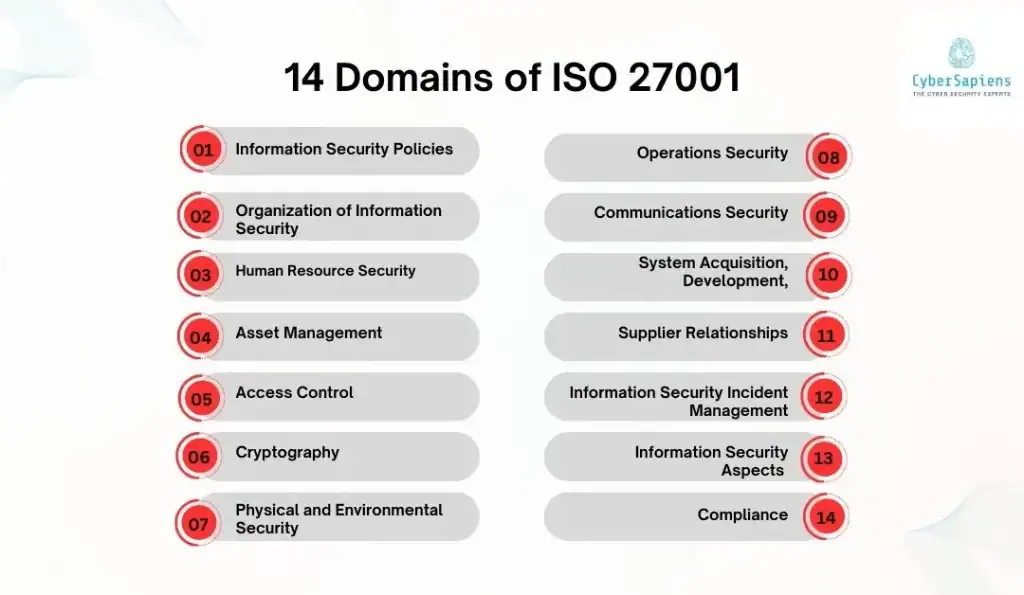
In ISO 27001:2013, Annex A was structured around 14 distinct control domains, covering a total of 114 controls. This model aimed to provide comprehensive coverage of information security but often resulted in complexity, overlap, and implementation challenges, especially as organizations moved toward cloud and digital-first environments.
The 14 Control Domains in ISO 27001:2013
- Information Security Policies: Focused on defining and maintaining information security policies approved by management.
- Organization of Information Security: Covered roles, responsibilities, and governance for managing information security internally and externally.
- Human Resource Security: Addressed security responsibilities before, during, and after employment.
- Asset Management: Focused on identifying assets and defining appropriate protection responsibilities.
- Access Control: Defined requirements for user access management, authentication, and authorization.
- Cryptography: Covered the use and management of cryptographic controls to protect information.
- Physical and Environmental Security: Focused on preventing unauthorized physical access, damage, or interference.
- Operations Security: Addressed secure system operations, logging, malware protection, and backup.
- Communications Security: Covered network security management and protection of information in transit.
- System Acquisition, Development, and Maintenance: Focused on security requirements in application development and system changes.
- Supplier Relationships: Addressed risks related to third-party access and outsourced services.
- Information Security Incident Management: Defined how incidents should be reported, managed, and learned from.
- Information Security Aspects of Business Continuity Management: Ensured information security continuity during disruptive events.
- Compliance: Focused on legal, regulatory, and contractual compliance requirements.
Challenges with the 14-Domain Structure
While comprehensive, this structure often caused:
- Overlapping controls across multiple domains.
- Confusion during control selection and audits.
- Heavy documentation and maintenance effort.
- Difficulty aligning controls with modern cloud and SaaS environments.
These challenges were a key reason ISO restructured Annex A in the 2022 update.
Why ISO 27001 Was Updated in 2022?
The update from ISO 27001:2013 to ISO 27001:2022 was driven by major shifts in technology, business operations, and the global threat landscape. While the 2013 version provided strong security coverage, it no longer fully reflected how modern organizations operate and manage information security.
Key Reasons Behind the ISO 27001:2022 Update
- Rapid Growth of Cloud and SaaS Technologies: Organizations increasingly rely on cloud platforms, APIs, and remote infrastructure. The 2013 controls were not clearly aligned with these environments, leading to interpretation gaps.
- Evolving Cyber Threat Landscape: Threats such as ransomware, supply-chain attacks, and advanced persistent threats demanded clearer and more adaptive security controls.
- Shift to Remote and Hybrid Work Models: Changes in how employees access systems and data required modernized access control, endpoint security, and identity management practices.
- Overlapping and Redundant Controls: Many of the 114 controls in the 2013 version addressed similar objectives across different domains, creating confusion and unnecessary complexity.
- Need for a Clearer, Risk-Based Structure: Organizations needed a framework that was easier to understand, implement, and audit, while still allowing flexibility based on risk.
ISO 27001:2022 Overview: The 4 Control Categories Explained
With the release of ISO 27001:2022, Annex A was restructured to make control selection and implementation more intuitive. Instead of 14 domains, the standard now organizes its 93 controls into four clear control categories, each aligned with how organizations actually manage security today.
This shift improves clarity, reduces overlap, and makes audits and ongoing maintenance easier.
1. Organizational Controls (Annex A.5)
Focus: Governance, policies, and overall management of information security. These controls define how information security is planned, governed, and continuously improved across the organization.
Key areas include:
- Information security policies and objectives.
- Roles, responsibilities, and segregation of duties.
- Risk management and governance.
- Asset management and information classification.
- Supplier and third-party security.
- Incident management and business continuity.
2. People Controls (Annex A.6)
Focus: Reducing human-related security risks. People controls address how employees, contractors, and third parties interact with information and systems, ensuring security responsibilities are clearly understood and followed.
Key areas include:
- Background verification and onboarding.
- Security awareness, training, and education.
- Defined security responsibilities.
- Disciplinary processes.
- Responsibilities after termination or role change.
3. Physical Controls (Annex A.7)
Focus: Protecting physical environments and assets that support information processing. These controls ensure that physical access to facilities, equipment, and devices is properly restricted and monitored.
Key areas include:
- Secure areas and physical access controls.
- Protection of equipment and devices.
- Secure disposal or reuse of assets.
- Protection against environmental threats.
4. Technological Controls (Annex A.8)
Focus: Technical safeguards for systems, networks, applications, and data. This category reflects the biggest modernization in ISO 27001:2022, aligning controls with cloud computing, digital services, and modern cyber threats.
Key areas include:
- Identity and access management.
- Authentication and authorization.
- Encryption and key management.
- Logging and monitoring.
- Vulnerability management and patching.
- Secure development lifecycle.
- Network, application, API, and cloud security.
14 Domains vs 4 Control Categories: Key Differences at a Glance
The transition from ISO 27001:2013 to ISO 27001:2022 is not just a cosmetic change; it reflects a fundamental shift in how information security controls are organized, understood, and implemented. Moving from 14 domains to 4 control categories was designed to reduce complexity while improving real-world usability.
1. Structural Comparison
- ISO 27001:2013
- 14 control domains
- 114 individual controls
- Domain-based structure (e.g., Access Control, Operations Security, Communications Security)
- Higher overlap between domains and controls
- More documentation-heavy and harder to maintain
- ISO 27001:2022
- 4 control categories
- 93 consolidated controls
- Category-based structure (Organizational, People, Physical, Technological)
- Reduced duplication and clearer control intent
- Easier mapping to modern security practices
2. Control Simplification and Consolidation
In the 2013 version, similar controls appeared across multiple domains, for example, access control, operational security, and system development. In the 2022 version, these overlapping controls were merged into broader, outcome-focused controls, reducing redundancy without weakening security.
3. Better Alignment with Modern Environments
The 4-category model aligns more naturally with:
- Cloud and SaaS architectures
- Remote and hybrid work environments
- DevOps and secure development practices
- Continuous monitoring and risk management
4. Impact on Implementation and Audits
- Clearer control of ownership across teams
- Simpler Statements of Applicability (SoA)
- Faster audit preparation and evidence mapping
- Easier long-term maintenance and scalability
For organizations migrating from ISO 27001:2013, this change requires thoughtful control and risk mapping, not just renumbering.
How CyberSapiens Supports ISO 27001:2013 to 2022 Migration?
Migrating from ISO 27001:2013 to ISO 27001:2022 requires more than updating control numbers. The transition from 14 domains and 114 controls to 4 control categories and 93 controls changes how risks are assessed, controls are justified, and evidence is presented to auditors. Cybersecurity expert at CyberSapiens provides end-to-end migration support to ensure organizations remain compliant, audit-ready, and aligned with modern security practices throughout the transition.
End-to-End Migration Support from CyberSapiens
1. Comprehensive ISO 27001:2022 Gap Assessment
CyberSapiens starts by evaluating your existing ISMS against ISO 27001:2022 requirements. This assessment identifies which 2013 controls already align, which require modification, and where new controls or evidence are needed, creating a clear, prioritized migration roadmap.
2. Detailed Control Mapping (14 Domains → 4 Categories)
Controls from the 2013 domain-based structure are systematically mapped into the 2022 categories: Organizational, People, Physical, and Technological. This ensures continuity of security intent while eliminating duplication and confusion during audits.
3. Risk Assessment and Risk Treatment Realignment
Migration is used as an opportunity to modernize risk management. CyberSapiens reviews threats, vulnerabilities, and impacts in light of cloud adoption, remote work, and evolving attack vectors, then updates risk treatment plans to match the new control framework.
4. Statement of Applicability (SoA) Redesign
The SoA is reworked to reflect the 93-control model, with clear justification for inclusion or exclusion of each control. This is critical for transition and surveillance audits, where auditors closely examine control applicability and traceability.
5. Policy, Procedure, and Documentation Updates
Existing ISMS documentation is updated to align with ISO 27001:2022 terminology and structure. Policies and procedures are refined to ensure they reflect actual operations and support the new control categories.
6. Technical Control Validation and VAPT
CyberSapiens validates Technological controls through vulnerability assessments and penetration testing. This provides objective evidence that controls, such as access management, secure configuration, and vulnerability management, are effective in real-world conditions.
7. Independent Internal Audits and Transition Readiness
An independent internal audit is conducted to confirm that the migrated ISMS meets ISO 27001:2022 requirements. Gaps are identified early, corrective actions are tracked, and readiness is confirmed before the transition audit.
8. Surveillance and Post-Migration Compliance Support
After a successful transition, CyberSapiens supports ongoing compliance with periodic reviews, risk updates, internal audits, and surveillance audit preparation, ensuring certification is maintained under the 2022 standard.
By combining migration expertise, practical ISMS implementation, and technical security validation, CyberSapiens helps organizations move from ISO 27001:2013 to ISO 27001:2022 smoothly, protecting certification status while strengthening security maturity for the future.
Clients Served by CyberSapiens





Simplifying the Transition Without Compromising Security
The move from ISO 27001:2013 to ISO 27001:2022 represents a meaningful evolution in how organizations manage information security. By shifting from 14 domains to 4 clear control categories and reducing controls from 114 to 93, the updated standard offers greater clarity, flexibility, and alignment with modern technologies and threats.
However, a successful transition requires more than understanding the new structure. Organizations must reassess risks, realign controls, update documentation, and validate implementation to meet audit expectations. When approached correctly, the migration becomes an opportunity to strengthen security maturity rather than just a compliance exercise.
With its structured migration methodology, technical validation, and audit-focused execution, CyberSapiens helps organizations transition to ISO 27001:2022 smoothly and confidently. By simplifying complexity while maintaining rigor, CyberSapiens ensures the updated framework delivers both compliance assurance and long-term security value.
FAQs: ISO 27001:2013 vs 2022: From 14 Domains to 4 Control Categories Explained
1. Does ISO 27001:2022 reduce security requirements?
Answer: No. Security has not been reduced. Controls were merged and modernized to remove duplication while maintaining the same security intent.
2. Is migration from ISO 27001:2013 to 2022 mandatory?
Answer: Yes. Organizations certified under ISO 27001:2013 must transition to ISO 27001:2022 within the transition period defined by certification bodies to maintain certification.
3. What happens if organizations do not migrate in time?
Answer: Failure to migrate within the allowed transition period can result in suspension or withdrawal of ISO 27001 certification.
4. How long does ISO 27001:2022 migration usually take?
Answer: Migration typically takes 2–4 months, depending on ISMS maturity, organizational size, and existing compliance levels.
