
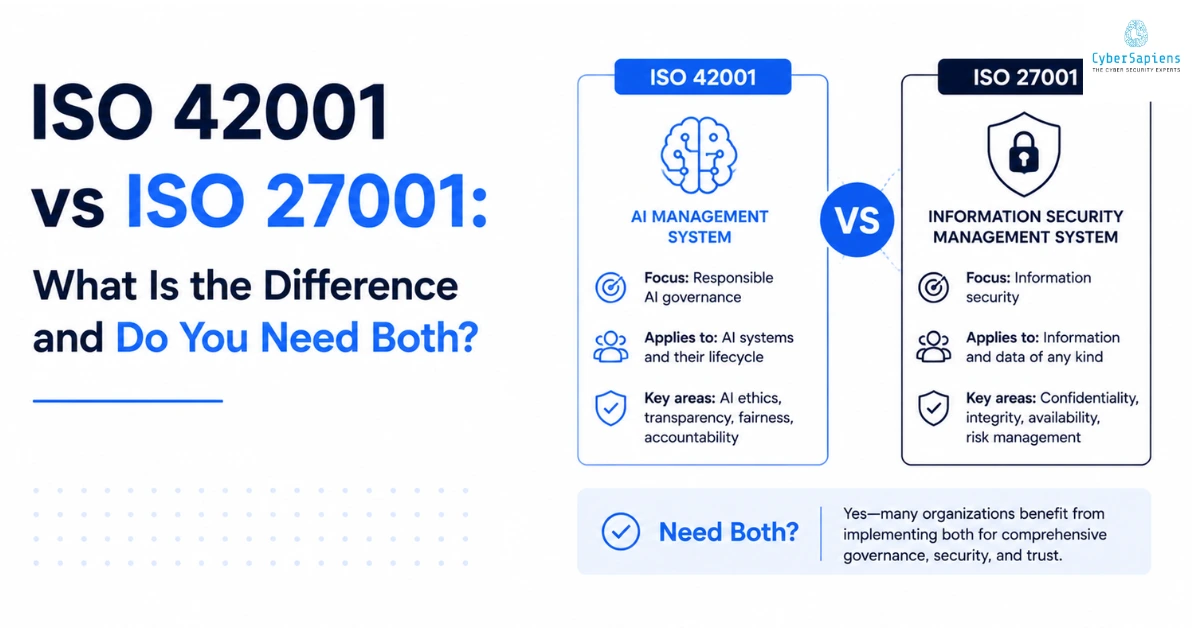
ISO 42001 vs ISO 27001: What Is the Difference and Do You Need Both?
ISO 42001 and ISO 27001 are both management system standards, but they address different business risks. ISO 27001 focuses on protecting information through an Information Security Management System (ISMS), while ISO 42001 focuses on governing artificial intelligence through an Artificial Intelligence Management System (AIMS).
As Australian organisations increasingly deploy AI technologies, many are discovering that information security alone is not enough. Businesses looking to strengthen AI governance are working with specialists such as CyberSapiens to understand how ISO 42001 and ISO 27001 complement each other and whether implementing both standards makes sense.
What Is ISO 27001?
ISO/IEC 27001 is the world’s leading standard for Information Security Management Systems (ISMS). The standard helps organisations protect information assets by establishing a structured framework for identifying, assessing, and managing security risks.
Information Protection
Protects sensitive information and business-critical data from unauthorised access, loss, theft, or disclosure.
Risk Management
Provides a systematic approach for identifying, assessing, treating, and monitoring information security risks.
Governance Framework
Establishes policies, procedures, controls, and accountability mechanisms to strengthen information security governance.
ISO 27001 Focus Areas
- Confidentiality
- Integrity
- Availability
- Information security governance
- Security risk management
- Incident response
- Access control
- Security monitoring
What Is ISO 42001?
ISO/IEC 42001 is the world’s first certifiable Artificial Intelligence Management System standard. Published in December 2023, the standard helps organisations govern AI systems responsibly throughout their lifecycle.
Rather than focusing primarily on information security, ISO 42001 addresses broader AI governance concerns, helping organisations establish accountability, transparency, risk management processes, and responsible AI practices.
AI Accountability
Defines governance structures and ownership responsibilities for the development, deployment, and monitoring of AI systems.
Risk & Impact Management
Introduces structured methods for assessing AI-related risks, impacts, and unintended consequences.
Responsible AI
Promotes ethical, transparent, explainable, and trustworthy AI systems across the entire AI lifecycle.
ISO 42001 Addresses
- AI accountability
- Bias management
- Transparency
- Explainability
- Ethical considerations
- AI risk management
- AI impact assessments
- Responsible AI use
Australia has adopted the standard as AS ISO/IEC 42001:2023, making it directly relevant to Australian organisations implementing, developing, or managing AI systems.
ISO 42001 vs ISO 27001: Key Differences
The biggest difference between ISO 42001 and ISO 27001 is the type of risk each standard addresses. ISO 27001 focuses on information security risks, while ISO 42001 focuses on AI-specific risks, governance challenges, and responsible AI practices.
| Area | ISO 27001 | ISO 42001 |
|---|---|---|
| Primary Focus | Information Security | Artificial Intelligence Governance |
| Management System | ISMS | AIMS |
| Main Objective | Protect information assets | Govern AI responsibly |
| Core Risk Area | Cybersecurity and information security | AI risks and impacts |
| Certification Standard | Yes | Yes |
| AI Governance | Limited | Core Focus |
| Bias Management | Not Specifically Addressed | Key Requirement |
| Explainability | Not Specifically Addressed | Key Requirement |
| AI Impact Assessments | Not Required | Required |
| Transparency Requirements | Limited | Significant Focus |
| Ethical Considerations | Indirect | Direct Focus |
Why ISO 27001 Alone Is No Longer Enough for Many Organisations
ISO 27001 remains essential for protecting information and managing cybersecurity risks. However, it was not designed specifically for artificial intelligence.
An AI system can be secure from a cybersecurity perspective while still creating significant governance risks. Organisations increasingly need frameworks that address not only security controls but also how AI systems make decisions, impact individuals, and align with ethical and regulatory expectations.
Examples of AI Risks Beyond Traditional Information Security
Biased Outcomes
An AI model may generate unfair or biased outcomes that negatively impact customers, employees, or stakeholders.
Lack of Explainability
Automated decisions may be difficult to understand or justify, creating transparency and accountability concerns.
Compliance Challenges
AI-generated outputs may introduce legal, privacy, intellectual property, or regulatory compliance risks.
Unintended Consequences
AI systems may affect individuals and business processes in ways that traditional security frameworks were never designed to evaluate.
These challenges fall outside the traditional scope of information security and are addressed more directly through ISO 42001’s AI governance framework.
What Risks Does ISO 42001 Address That ISO 27001 Does Not?
While ISO 27001 provides a strong foundation for information security, it does not specifically address many of the governance challenges introduced by artificial intelligence. ISO 42001 fills this gap by introducing controls and governance mechanisms designed specifically for AI systems.
Bias and Fairness
ISO 42001 encourages organisations to identify, assess, and manage bias within AI systems. This is particularly important where AI influences hiring, lending, healthcare, education, or customer decision-making.
Explainability
Organisations should understand and communicate how AI-driven decisions are made. Explainability becomes increasingly important when AI outputs affect customers, employees, or stakeholders.
AI Accountability
The standard requires organisations to establish clear ownership, accountability, and governance responsibilities for AI-related activities.
AI Impact Assessments
ISO 42001 introduces structured assessments designed to evaluate the potential consequences, risks, and impacts of AI systems before and during deployment.
Transparency Requirements
The framework promotes transparency around AI system capabilities, limitations, decision-making processes, and intended use cases.
Responsible AI Governance
The standard encourages policies, controls, and governance frameworks that support ethical, trustworthy, and responsible AI adoption across the organisation.
Where Do ISO 42001 and ISO 27001 Overlap?
Although the standards focus on different risks, they share several common principles. Organisations that already maintain ISO 27001 often find ISO 42001 implementation more straightforward because both frameworks follow a similar management system approach.
Risk Management
Both standards require organisations to identify, assess, treat, and monitor risks using a structured and repeatable methodology.
Leadership Involvement
Senior management must actively support, oversee, and review the effectiveness of the management system.
Internal Audits
Regular audits are required to verify compliance, assess effectiveness, and identify opportunities for improvement.
Continual Improvement
Both frameworks follow the Plan-Do-Check-Act (PDCA) model to drive ongoing improvement and governance maturity.
Documentation & Governance
Each standard requires documented policies, procedures, governance controls, and management oversight mechanisms.
Why This Matters
Because of these shared principles, organisations that have already implemented ISO 27001 can often leverage existing governance structures, audit programmes, management reviews, documentation processes, and risk management frameworks when pursuing ISO 42001 certification.
Can ISO 42001 and ISO 27001 Be Implemented Together?
Yes. In fact, many organisations are choosing to implement both standards as part of a broader governance, compliance, and risk management strategy.
Since both standards follow ISO’s High-Level Structure (HLS), organisations can integrate many management system activities rather than maintaining completely separate frameworks. This reduces duplication, improves efficiency, and simplifies governance across the business.
Shared Components That Can Be Integrated
Governance frameworks
Internal audit programmes
Risk management processes
Corrective action procedures
Management review activities
Training programmes
Documentation controls
Benefits of an Integrated Approach
By aligning ISO 42001 and ISO 27001, organisations can strengthen information security, improve AI governance, streamline compliance activities, reduce operational overhead, and build greater trust with customers, regulators, and stakeholders.
Which Organisations Need ISO 42001?
ISO 42001 is particularly valuable for organisations that develop, deploy, manage, or rely heavily on artificial intelligence. As AI adoption increases across industries, organisations are under growing pressure to demonstrate responsible AI governance, transparency, and accountability.
AI Product Developers
Companies developing AI applications, machine learning models, large language model solutions, or AI-powered platforms can benefit from structured AI governance.
SaaS Providers
Software companies integrating AI capabilities into their products can use ISO 42001 to demonstrate responsible AI practices to customers and partners.
Generative AI Users
Organisations using generative AI extensively for content creation, automation, customer support, analytics, or business operations can strengthen governance and risk management.
Decision-Making Systems
Businesses using AI to support decisions related to hiring, lending, healthcare, insurance, education, or customer outcomes face increased governance responsibilities.
Third-Party AI Adopters
Even organisations that do not build AI internally but rely on third-party AI platforms can benefit from governance frameworks that assess risks and accountability.
Regulated Industries
Healthcare, finance, government, education, and critical infrastructure sectors can use ISO 42001 to demonstrate mature AI governance practices.
The more AI influences business operations, customer interactions, or decision-making processes, the stronger the case for implementing ISO 42001.
Which Organisations Need Both Standards?
Many organisations benefit from maintaining both ISO 27001 and ISO 42001 certifications. While ISO 27001 provides a foundation for information security, ISO 42001 extends governance into the rapidly evolving field of artificial intelligence.
Technology & SaaS Companies
Technology providers increasingly require strong information security controls alongside mature AI governance frameworks to meet customer expectations and contractual requirements.
Financial Services
Banks, fintech companies, insurers, and lenders face both cybersecurity threats and AI governance challenges that require comprehensive risk management.
Healthcare Organisations
Healthcare providers must safeguard sensitive patient information while managing risks associated with AI-assisted diagnostics, treatment planning, and clinical decision-making.
Government Contractors
Government projects increasingly demand both robust security controls and responsible AI governance practices from suppliers and contractors.
Large Enterprises
Enterprises adopting AI at scale often require both standards to support governance, regulatory compliance, stakeholder confidence, and operational resilience.
A Complementary Approach
Rather than choosing one standard over the other, many organisations view ISO 27001 and ISO 42001 as complementary frameworks that together provide comprehensive coverage for modern digital, cybersecurity, and AI-related risks.
Frequently Asked Questions
Is ISO 42001 better than ISO 27001?
Neither standard is better. They serve different purposes. ISO 27001 focuses on information security, while ISO 42001 focuses on AI governance and responsible AI management.
Can I have ISO 42001 without ISO 27001?
Yes. Organisations can pursue ISO 42001 independently. However, organisations handling sensitive information often benefit from implementing both standards together.
Do organisations using AI need both standards?
Not always. However, organisations handling sensitive information and using AI extensively often benefit from implementing both ISO 27001 and ISO 42001.
Which standard came first?
ISO 27001 was published long before ISO 42001. ISO/IEC 42001 was introduced in December 2023 as the world’s first certifiable AI management system standard.
Is ISO 42001 mandatory?
No. ISO 42001 is currently a voluntary certification standard. Organisations adopt it to demonstrate responsible AI governance, risk management, and stakeholder trust.
Choosing the Right Approach for Your Organisation
The decision is not usually ISO 42001 versus ISO 27001. For many organisations, the question is whether they need both.
ISO 27001 remains the foundation for information security. ISO 42001 extends governance into the rapidly growing area of artificial intelligence. Together, they provide a comprehensive framework for managing modern digital risks.
CyberSapiens helps Australian organisations assess AI governance maturity, align existing ISO programmes, and prepare for ISO 42001 and ISO 27001 certification initiatives.
Speak with CyberSapiens About ISO 42001
If your organisation is evaluating ISO 42001, ISO 27001, or an integrated certification approach, contact CyberSapiens to discuss your requirements.
Contact CyberSapiens
Shabari Shankar
Senior Content Writer
Shabari Shankar is a Senior Content Writer with 10+ years of experience creating impactful cybersecurity content. Specializing in cyber threats, compliance, cloud security, and emerging technologies, Shabari delivers informative and engaging content tailored for modern digital audiences.
View LinkedIn Profile