

Path Confusion in Nginx/Apache Leads to Critical Auth Bypass in PAN-OS
Palo Alto Networks has recently disclosed a critical authentication bypass vulnerability in its PAN-OS network security operating system, tracked as CVE-2025-0108. This flaw, with a CVSSv3.1 score of 7.8, allows attackers to bypass authentication on the PAN-OS management web interface, exposing affected systems to significant risks.
The vulnerability exploits architectural weaknesses in how Nginx and Apache handle authentication headers and URL paths, allowing unauthenticated attackers to invoke certain PHP scripts without proper authorization. This flaw can lead to unauthorized access to administrative functionalities, raising severe security concerns for organizations using PAN-OS.
Here in this article, we are going to discuss Path Confusion in Nginx/Apache Leads to Critical Auth Bypass in PAN-OS
Understanding Path Confusion in Nginx/Apache
The root cause of CVE-2025-0108 lies in path confusion and header smuggling between Nginx and Apache within the PAN-OS management interface. Here’s how it happens:
- When a request is sent to the PAN-OS management interface, it is first processed by Nginx, which uses specific headers to enforce authentication.
- The X-pan-AuthCheck: on header ensures that authentication is required.
- However, Nginx’s conditional rules may disable this authentication check for certain paths, such as those matching /unauth/.
For example, the following Nginx configuration rule disables authentication for unauthenticated paths:
if ($uri ~ ^\/unauth\/.+$) {

    set $panAuthCheck 'off';

}- After processing by Nginx, the request is forwarded to Apache, which applies additional rewrite rules for handling static assets and PHP scripts.
- Attackers exploit this double URL decoding behavior in Apache’s internal redirection process to bypass authentication mechanisms.
Exploiting Authentication Bypass in PAN-OS
According to Assetnote researchers, this vulnerability is triggered through double URL decoding during Apache’s redirection process. A crafted request such as:
/unauth/%252e%252e/php/ztp_gate.php/PAN_help/x.cssexploits this behaviour by using double-encoded directory traversal sequences:
- Initially, Nginx decodes %252e%252e into %2e%2e, failing to recognize it as a directory traversal attempt.
- Apache then decodes the URL again, translating %2e%2e into ../, which effectively bypasses authentication controls.
- Since Nginx has already disabled authentication for this path (X-pan-AuthCheck: off), the attacker gains unauthorized access to PHP scripts like ztp_gate.php.
Potential Impact of CVE-2025-0108
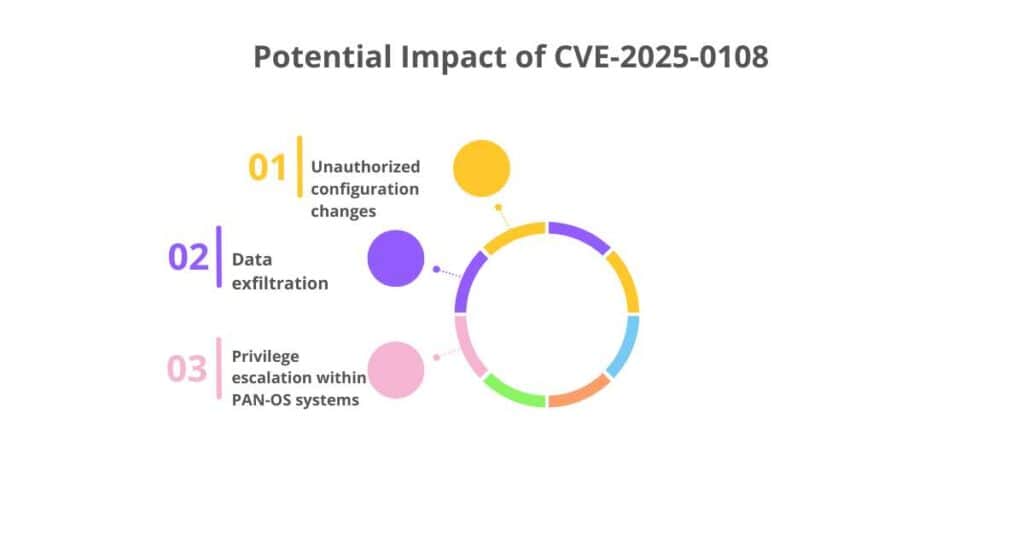
By exploiting this vulnerability, attackers can completely bypass authentication on the PAN-OS management interface and execute PHP scripts. While this does not directly allow remote code execution (RCE), it exposes sensitive administrative functionalities, potentially leading to:
- Unauthorized configuration changes
- Data exfiltration
- Privilege escalation within PAN-OS systems
A proof-of-concept (PoC) exploit has been demonstrated, where a specially crafted request returns a 200 OK status, granting unauthorized access to restricted resources.
Mitigation and Security Recommendations
Palo Alto Networks has responded to CVE-2025-0108 by releasing security patches in the following PAN-OS versions:
- PAN-OS 11.2: Fixed in 11.2.4-h4 and later.
- PAN-OS 11.1: Fixed in 11.1.6-h1 and later.
- PAN-OS 10.2: Fixed in 10.2.13-h3 and later.
- PAN-OS 10.1: Fixed in 10.1.14-h9 and later.
Recommended Actions for Organizations
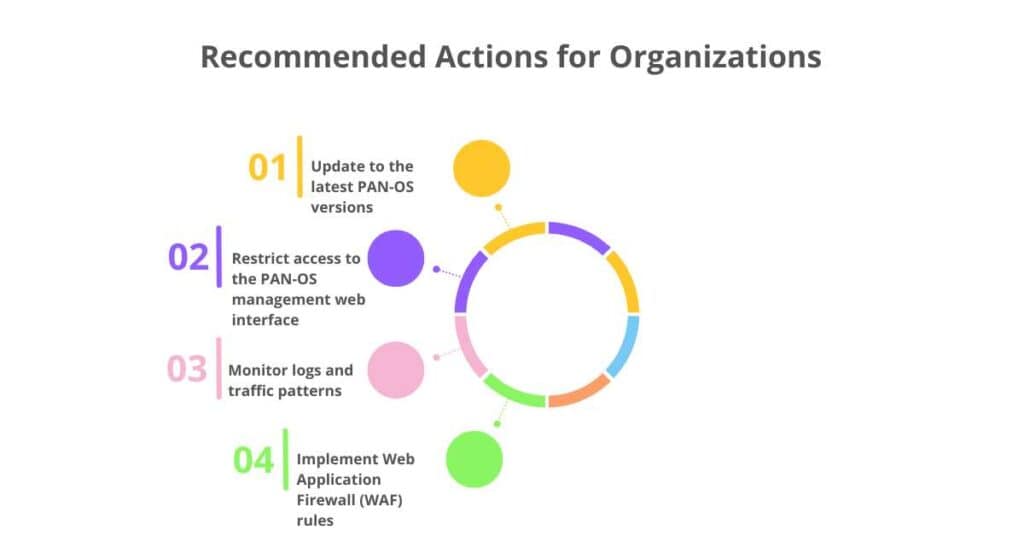
To mitigate potential exploitation, organizations using PAN-OS should take immediate action:
1. Update to the latest PAN-OS versions
Containing security patches.
2. Restrict access to the PAN-OS management web interface
By allowing only trusted internal IP addresses.
3. Monitor logs and traffic patterns
For suspicious unauthenticated access attempts.
4. Implement Web Application Firewall (WAF) rules
To detect and block malicious requests targeting authentication bypass exploits.
Final Thoughts
The CVE-2025-0108 vulnerability in PAN-OS demonstrates the critical security risks associated with path confusion and improper authentication enforcement. Organizations relying on PAN-OS must act swiftly to apply patches and strengthen security controls to mitigate potential threats.
For businesses seeking expert cybersecurity services, CyberSapiens United LLP provides comprehensive penetration testing to identify and remediate such vulnerabilities. Contact us today at CyberSapiens to secure your digital infrastructure.
Why Choose CyberSapiens?
1. Expert Penetration Testing
Web, Mobile, API & Cloud Security
2. Tailored Cybersecurity Solutions
Custom assessments for your business needs
3. Proactive Security Approach
Identify and fix vulnerabilities before attackers do
4. Industry-Recognized Team
Trusted by over 60+ clients worldwide
📩 Get a FREE Consultation at CyberSapiens and fortify your business against cyber threats today!
