
PCI DSS Compliance and Audit Service Providers in Chennai
Chennai has become a leading hub for enterprise IT services, global delivery centers, manufacturing industries, retail businesses, and digital commerce platforms. With increasing adoption of card payments, online transactions, and mobile banking, securing cardholder data has become a critical priority for organizations across the city. PCI DSS (Payment Card Industry Data Security Standard) provides a globally recognized framework that helps businesses strengthen payment security, reduce fraud risks, and maintain compliance with industry expectations.
For Chennai-based companies that store, process, or transmit cardholder data, PCI DSS compliance is not just a regulatory need; it is a strategic step for safeguarding sensitive payment information and ensuring operational credibility. Choosing the right PCI DSS Compliance and Audit Service Provider in Chennai enables businesses to identify security gaps, establish strong controls, and achieve certification efficiently while building long-term security resilience.
What is PCI DSS Compliance?
PCI DSS Compliance refers to meeting the Payment Card Industry Data Security Standard, a global security benchmark designed to protect cardholder information and minimize payment fraud. Any organization in Chennai handling credit or debit card data—whether through online transactions, retail swipes, POS terminals, or digital wallets—must comply with PCI DSS to ensure safe and secure payment processing.
In simple terms, PCI DSS compliance means implementing necessary measures such as encryption, access control, secure configurations, vulnerability management, and continuous monitoring. These controls help organizations maintain secure payment operations, avoid financial penalties, and enhance customer trust across digital channels.
Understanding PCI DSS Requirements
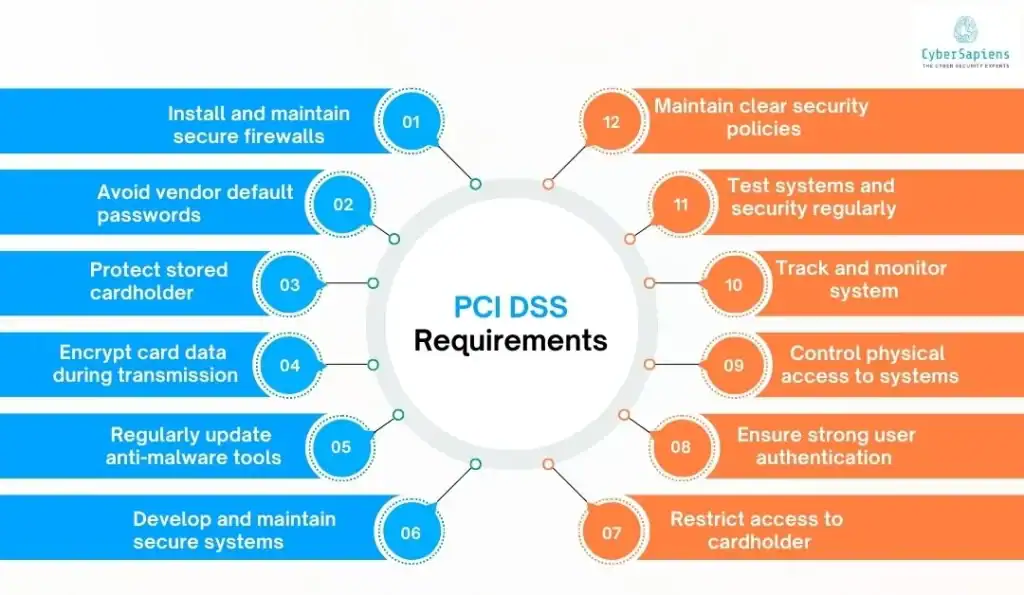
The PCI DSS framework is built around 12 core requirements that help organizations secure cardholder data throughout its lifecycle during storage, processing, and transmission.
The 12 PCI DSS Requirements
- Install and maintain secure firewalls to protect cardholder environments: Firewalls must be configured to control access and isolate the Cardholder Data Environment (CDE) from untrusted networks.
- Avoid vendor default passwords and security settings: Replacing default configurations reduces exposure to predictable attack methods.
- Protect stored cardholder data using strong cryptography: Sensitive data must be encrypted or tokenized to prevent unauthorized access if systems are compromised.
- Encrypt card data during transmission over open networks: Encrypting data during transfer ensures attackers cannot intercept readable cardholder information.
- Use and regularly update anti-malware protections: Anti-malware tools must be deployed and kept updated to detect evolving threats, including ransomware.
- Develop and maintain secure systems and applications: Applying patches and secure coding practices reduces vulnerability risks in applications and infrastructure.
- Restrict access to cardholder data based on job roles: Access must be granted strictly on a need-to-know basis to reduce insider risk.
- Ensure strong authentication and identity controls: Unique user IDs and MFA help verify user identity and track system-level access.
- Control physical access to systems storing cardholder data: Restricted facility access and physical safeguards prevent unauthorized entry to systems and devices.
- Monitor and log system activity for suspicious actions: Logging and monitoring support the detection of abnormal behavior and rapid response to incidents.
- Test systems regularly through scans and penetration testing: Continuous testing identifies exploitable weaknesses before attackers do.
- Maintain clear security policies and employee training: Policies and training ensure employees understand their roles and follow secure practices consistently.
These requirements provide Chennai organizations with a structured path to enhance payment security and reduce operational risks.
Why Businesses in Chennai Need PCI DSS Compliance?
Chennai’s business landscape spans fintech companies, automotive manufacturing units, large IT parks, and expanding e-commerce networks—all of which rely heavily on digital transactions. PCI DSS compliance helps organizations secure their payment ecosystem and maintain competitive trust.
Key benefits for Chennai organizations:
- Protects cardholder data from theft, fraud, and cyberattacks.
- Strengthens customer and partner confidence in digital payments.
- Reduces operational, financial, and reputational risk after breaches.
- Helps avoid penalties and processing restrictions due to non-compliance.
- Supports requirements from banks, processors, and service providers.
- Strengthens overall cybersecurity posture.
- Essential for industries including IT, BFSI, retail, hospitality, healthcare, and logistics.
With Chennai’s rapid digital expansion, PCI DSS compliance has become integral to secure business growth.
Benefits of Partnering With the Right Audit Service Provider
Collaborating with experienced PCI DSS Compliance and Audit Service Providers in Chennai helps organizations speed up compliance and improve long-term security.
- Expert guidance for faster compliance: simplifies technical requirements and implementation.
- Accurate gap identification: reveals vulnerabilities that affect compliance and security.
- Efficient remediation support: prioritizes corrective actions to align with PCI requirements.
- Reduced operational burden: streamlines documentation, evidence preparation, and audit processes.
- Improved readiness for recurring audits: builds internal maturity and repeatable compliance practices.
- Enhanced security beyond compliance: strengthens resilience against evolving cyber threats.
- Lower risk of penalties and breaches: reduces the likelihood of costly incidents.
- Continuous monitoring & support: maintains compliance as technologies and risks change.
Top PCI DSS Compliance and Audit Service Providers in Chennai
1. Cybersapiens
Offers end-to-end PCI DSS consulting, readiness assessments, remediation support, audit preparation, and continuous compliance services tailored to Chennai’s digital ecosystem.
Cybersapiens PCI DSS Process
1. Initial Scoping & Gap Analysis
This phase begins by identifying all systems, applications, and processes that store, process, or transmit cardholder data to accurately define the Cardholder Data Environment (CDE). Data flows are traced end-to-end from capture points to storage, transmission, and disposal to understand exposure risks.
2. Compliance Roadmap & Planning
Based on the identified gaps, a structured plan is created to guide the compliance journey and ensure activities are sequenced logically. This roadmap outlines which security controls must be implemented or enhanced, which policies and procedures must be updated, and what documentation needs to be prepared.
3. Implementation Support
During implementation, technical and procedural security measures are rolled out to bring systems in line with PCI DSS requirements. This includes segmenting the CDE to reduce exposure, enforcing granular access control based on user roles, applying strong encryption to protect stored and transmitted data, and configuring logging and monitoring to track activity in real time.
4. Internal Testing & Validation
To ensure readiness for the official assessment, organizations undergo internal validation activities that verify control effectiveness and completeness. This includes conducting internal and external vulnerability scans, penetration testing where required, reviewing system configurations, validating access logs, and confirming the presence of supporting evidence.
5. Audit & Reporting
Once controls are validated, the organization prepares required artifacts such as policies, network diagrams, scan results, configuration evidence, and operational records for submission to Qualified Security Assessors (QSAs). Coordination with QSAs ensures that documentation is presented clearly, questions are answered promptly, and the assessment process remains efficient.
6. Post-Assessment Support & Continuous Compliance
Compliance does not end with certification. To maintain PCI DSS alignment year-round, organizations receive continued support through periodic reviews, policy updates, quarterly vulnerability scans, access audits, and monitoring of configuration changes.
Clients Served by CyberSapiens






2. SISA Information Security
Provides PCI DSS audits, digital forensics, remediation support, and advisory services with strong domain expertise.
3. ControlCase
Delivers PCI DSS validation, compliance automation, and managed services for enterprises and service providers.
4. Panacea Infosec
Supports PCI DSS assessments, risk validation, and compliance consulting for organizations within regulated industries.
5. Payatu
Specializes in penetration testing, red-team operations, and vulnerability assessments supporting PCI DSS readiness and remediation.
Strengthening Payment Security Through PCI DSS in Chennai
Achieving and maintaining PCI DSS compliance enables Chennai businesses to secure cardholder data, prevent fraud, and earn customer trust in an increasingly digital economy. With evolving cyber threats and compliance expectations, partnering with the right PCI DSS Compliance and Audit Service Providers in Chennai ensures organizations not only meet certification requirements but also strengthen their overall security resilience.
By following a structured compliance approach from assessment and remediation to validation and continuous upkeep, organizations can confidently move toward certification and sustain security maturity, turning PCI DSS into a long-term advantage rather than a one-time requirement.
FAQs
1. Who needs PCI DSS compliance in Chennai?
Answer: Any organization that stores, processes, or transmits cardholder data—including IT companies, fintech firms, retail businesses, payment service providers, and hospitality brands.
2. How often must PCI DSS assessments be conducted?
Answer: Organizations are required to undergo annual PCI DSS assessments and perform quarterly vulnerability scans to maintain compliance.
3. What happens if an organization is not PCI DSS compliant?
Answer: Non-compliance can lead to penalties, loss of processing privileges, customer distrust, and increased risk of data breaches.
4. How long does it take to achieve PCI DSS certification?
Answer: The timeline varies based on security maturity and remediation needs, typically from several weeks to a few months.
5. Is penetration testing mandatory under PCI DSS?
Answer: Yes—regular penetration testing and vulnerability scanning are required to identify security weaknesses and validate controls.
