
PCI DSS Compliance and Audit Service Providers in Singapore
As Singapore continues to lead Southeast Asia in digital payments, e-commerce expansion, fintech innovation, and cashless adoption, protecting cardholder data has become mission-critical for businesses of every size. PCI DSS (Payment Card Industry Data Security Standard) offers a globally recognized security framework that enables organizations to safeguard payment card information, reduce fraud risks, and maintain customer trust.
For businesses that store, process, or transmit cardholder data in Singapore, achieving and maintaining PCI DSS compliance is more than a regulatory requirement; it’s a strategic commitment to protecting sensitive financial information in an increasingly sophisticated cybersecurity landscape.
Choosing the right PCI DSS compliance and audit service provider in Singapore can simplify this journey, helping businesses identify security gaps, implement the required controls, and prepare for certification efficiently. This blog explores what PCI DSS means for Singaporean organizations and how specialized providers can support compliance, validation, and ongoing security maturity.
What is PCI DSS Compliance?
PCI DSS Compliance refers to meeting the Payment Card Industry Data Security Standard, a global security benchmark defined by major card brands to protect cardholder data and reduce payment fraud. Any Singapore-based organization that handles credit or debit card data must comply with PCI DSS to ensure sensitive payment information is securely managed.
In simple terms, compliance means implementing necessary safeguards such as encryption, access control, vulnerability scanning, monitoring, and regular audits to prevent unauthorized access or data breaches involving cardholder information. PCI DSS compliance helps build customer trust, avoid regulatory penalties, and support secure business growth in a digitally driven marketplace.
Understanding PCI DSS Requirements
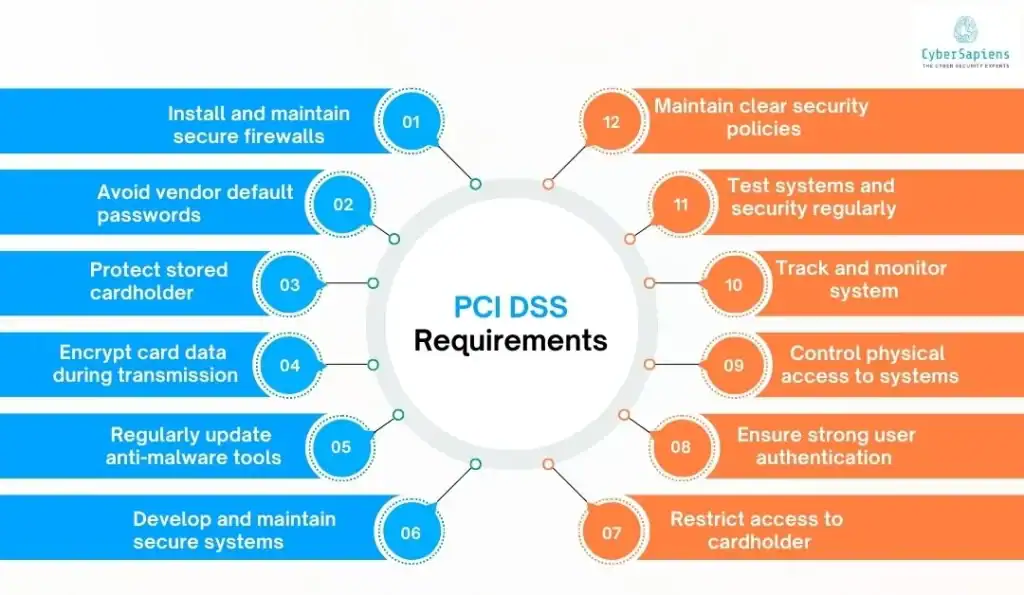
PCI DSS is built around 12 core requirements designed to protect cardholder data throughout its lifecycle. These requirements cover everything from network security and access controls to monitoring and testing, providing a structured approach to risk reduction.
The 12 PCI DSS Requirements
- Install and maintain secure firewalls to protect cardholder environments: Firewalls must be configured to isolate the cardholder data environment (CDE) and prevent unauthorized access from external or untrusted networks.
- Avoid vendor default passwords and security settings: Organizations must remove default credentials and harden configurations to reduce exposure to common, easily exploitable entry points.
- Protect stored cardholder data using cryptographic techniques: When data retention is necessary, sensitive cardholder information must be encrypted, tokenized, or hashed to remain unreadable even if accessed.
- Encrypt card data during transmission over open networks: Payment data transmitted through public or wireless networks must be encrypted with secure protocols like TLS to prevent interception.
- Use and regularly update anti-malware tools: Anti-malware software should be deployed, continuously updated, and monitored to detect and block malicious threats targeting systems handling cardholder data.
- Develop and maintain secure systems and applications: Patch management and secure coding practices are essential to prevent vulnerabilities from being exploited.
- Restrict access to cardholder data based on job roles: Access to sensitive data should be granted only to employees who require it to perform their duties, reducing unnecessary exposure.
- Ensure strong authentication and access controls: Multi-factor authentication (MFA) and unique IDs must be implemented to verify user identities and track system activity.
- Control physical access to systems storing cardholder data: Server rooms, workstations, and storage devices must be protected from unauthorized physical access through secure facilities and monitoring.
- Monitor and log system activity for suspicious actions: Logging and monitoring mechanisms should capture access attempts, configuration changes, and irregular behaviors to support incident detection and response.
- Test systems regularly through vulnerability scans and penetration testing: Routine testing validates control effectiveness and identifies exploitable weaknesses before attackers do.
- Maintain clear security policies and employee training: Policies and training ensure staff understand responsibilities, follow secure practices, and stay updated on emerging risks.
Understanding these requirements allows Singaporean businesses to assess their current security posture, identify gaps, and create a structured roadmap toward compliance.
Why Businesses in Singapore Need PCI DSS Compliance?
With digital transactions driving commerce across Singapore from retail and hospitality to fintech and transport, protecting cardholder information is crucial for maintaining security and customer confidence. PCI DSS provides organizations with the framework needed to safeguard sensitive data and reduce exposure to fraud and breaches.
Key benefits of PCI DSS compliance for Singaporean organizations:
- Protects cardholder data against theft and cybercrime.
- Enhances customer trust in digital payment experiences.
- Reduces financial, legal, and reputational risks associated with breaches.
- Aligns with expectations from banks, processors, and payment service providers.
- Helps avoid penalties, chargebacks, and increased oversight due to non-compliance.
- Strengthens cybersecurity resilience in a rapidly evolving digital market.
- Essential for sectors like retail, fintech, banking, hospitality, logistics, and healthcare.
Benefits of Partnering With the Right Audit Service Provider
Choosing the right PCI DSS Compliance and Audit Service Providers in Singapore can accelerate compliance while improving overall security posture.
- Expert guidance for faster compliance: simplifies technical requirements to avoid delays.
- Accurate gap identification: uncovers vulnerabilities and misconfigurations early.
- Efficient remediation support: ensures issues are resolved in line with PCI DSS expectations.
- Reduced operational burden: streamlines documentation, evidence preparation, and workflow.
- Improved readiness for future audits: builds internal capability and repeatable processes.
- Enhanced security beyond compliance: helps organizations address threats proactively.
- Lower risk of penalties and breaches: reduces exposure to regulatory and financial consequences.
- Continuous monitoring & support: maintains compliance as environments and risks evolve.
Top 5 PCI DSS Compliance and Audit Service Providers in Singapore
1. Cybersapiens
Delivers comprehensive PCI DSS consulting, gap assessments, remediation guidance, audit support, and continuous compliance services tailored for Singapore-based businesses handling cardholder data.
Cybersapiens Process for PCI DSS Compliance and Audit
1. Initial Scoping & Gap Analysis
This phase begins by identifying every system, application, and workflow that stores, processes, or transmits cardholder data to define the Cardholder Data Environment (CDE). Once the flow of data is understood, current controls are assessed against PCI DSS requirements to uncover weaknesses, missing safeguards, and misconfigurations.
2. Compliance Roadmap & Planning
Based on the gaps identified, a structured plan is developed to outline corrective actions, policy updates, and documentation requirements needed to meet PCI DSS standards. Tasks are sequenced by risk and complexity to ensure critical issues are addressed first and implementation is both achievable and efficient.
3. Implementation Support
During implementation, technical and procedural controls are rolled out to secure cardholder data and align systems with PCI DSS expectations. Support may include configuring network segmentation to isolate the CDE, enforcing access restrictions, applying encryption to sensitive data, enabling monitoring and logging, and hardening systems.
4. Internal Testing & Validation
Before moving into the official assessment, internal validation activities confirm that deployed controls function as intended. This includes performing vulnerability scans, reviewing configurations, assessing access policies, and validating logging and monitoring mechanisms.
5. Audit & Reporting
To support a successful audit, organizations prepare evidence such as policies, system configurations, network diagrams, scan reports, and operational records required by Qualified Security Assessors (QSAs). Coordination with QSAs ensures smooth communication, timely submission of documentation, and accurate representation of implemented controls.
6. Post-Assessment Support & Continuous Compliance
After certification, continuous compliance activities help maintain alignment with PCI DSS throughout the year, not just during audit season. This includes ongoing monitoring, quarterly vulnerability scans, policy updates, periodic access reviews, and readiness checks before future audits.
Clients Served by CyberSapiens






2. VantagePoint Security
Singapore-based cybersecurity consultancy providing PCI DSS assessments, penetration testing, and remediation guidance tailored for enterprises and financial institutions.
3. Pragma
Offers compliance and audit support, PCI DSS advisory services, and incident readiness planning for regulated businesses across Singapore.
4. KPMG Singapore
Provides PCI DSS assessments, advisory support, and readiness services for large organizations requiring structured compliance programs.
5. SISA Information Security
A global PCI DSS assessor with a strong presence in APAC, offering compliance validation, forensic investigation, and monitoring services to Singapore businesses.
Strengthening Security Through PCI DSS in Singapore
Achieving and maintaining PCI DSS compliance is essential for Singaporean businesses that handle cardholder data. It reinforces secure payment operations, reduces breach risks, and builds long-term customer confidence in an increasingly cashless economy.
With rising digital adoption and sophisticated cyber threats, partnering with the right PCI DSS Compliance and Audit Service Providers in Singapore ensures that organizations meet industry expectations while strengthening their overall security posture.
By following a structured compliance approach from scoping and planning to implementation and continuous monitoring, businesses can move confidently from assessment to certification and ongoing resilience, transforming PCI DSS into a sustainable security advantage.
FAQs
1. Who needs PCI DSS compliance in Singapore?
Answer: Any organization that stores, processes, or transmits cardholder data, including retailers, online platforms, hospitality providers, fintech companies, and payment service providers.
2. How often should PCI DSS assessments be conducted?
Answer: Annual assessments and quarterly vulnerability scans are required to maintain compliance.
3. What happens if a business is not PCI DSS compliant?
Answer: Non-compliance can lead to penalties, loss of processing privileges, regulatory scrutiny, and reputational damage after a breach.
4. How long does PCI DSS compliance take?
Answer: Timelines vary based on system complexity and security maturity, ranging from weeks to several months when remediation is required.
5. Is penetration testing required for PCI DSS compliance?
Answer: Yes, penetration testing and vulnerability scanning are mandatory to identify and resolve exploitable weaknesses.
