
PCI DSS Compliance and Audit Service Providers in the United States
As digital payments continue to dominate the United States’ retail, e-commerce, hospitality, and financial sectors, protecting cardholder data has never been more important. PCI DSS (Payment Card Industry Data Security Standard) provides a structured, globally recognized framework to help organizations secure payment environments, reduce fraud risk, and maintain customer trust. For organizations that store, process, or transmit cardholder data, achieving and maintaining PCI DSS compliance isn’t just a regulatory expectation; it’s a commitment to safeguarding sensitive financial information in today’s increasingly targeted threat landscape.
Choosing the right PCI DSS compliance and audit service provider in the United States can make this journey smoother, ensuring businesses understand their security gaps, implement required controls, and achieve certification efficiently. This blog explores what PCI DSS means for U.S. organizations and how specialized providers support them through compliance, assessment, and continuous security improvement.
What is PCI DSS Compliance?
PCI DSS Compliance refers to meeting the Payment Card Industry Data Security Standard, a set of global security requirements designed to protect cardholder data and reduce payment fraud. Any U.S. business that stores, processes, or transmits credit or debit card information must comply with these standards to ensure that sensitive payment data is handled securely.
In simple terms, PCI DSS Compliance means implementing security controls—such as encryption, access restrictions, network monitoring, vulnerability management, and regular audits to prevent unauthorized access or data breaches involving cardholder information. This helps organizations build customer trust, avoid financial penalties, and maintain secure payment operations.
Understanding PCI DSS Requirements
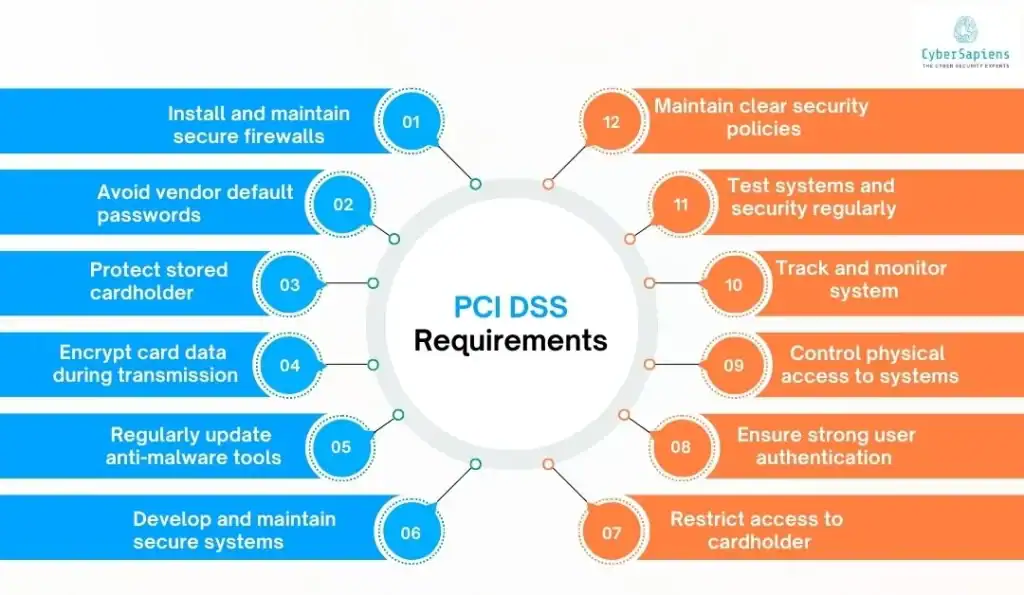
PCI DSS is built around 12 core security requirements that help organizations protect cardholder data throughout its lifecycle. These requirements cover a wide range of controls—from securing networks and systems to monitoring access and responding to potential threats. Together, they create a structured approach to reducing the risk of data breaches and payment fraud.
The 12 PCI DSS Requirements
- Install and maintain secure firewalls to protect cardholder environments: Firewalls act as the first line of defense by filtering incoming and outgoing traffic based on approved security rules. U.S. organizations must design, configure, and maintain firewalls that isolate the cardholder data environment (CDE) from external networks to prevent unauthorized access.
- Avoid vendor default passwords and security settings: Default system settings like usernames, passwords, and configurations are often exploited in attacks. PCI DSS requires organizations to replace defaults with strong, unique credentials and hardened configurations.
- Protect stored cardholder data using encryption, hashing, and truncation: If cardholder data must be stored, strong cryptography is required to ensure the data is unreadable in the event of unauthorized access.
- Encrypt card data during transmission over open or public networks: Any cardholder data transmitted over the internet or other public channels must be encrypted using industry-accepted protocols like TLS to prevent interception.
- Use and regularly update anti-malware tools: Anti-malware systems must be deployed, continuously monitored, and updated to detect and block viruses, ransomware, and other malicious software.
- Develop and maintain secure systems and applications: U.S. organizations must apply security patches promptly and follow secure coding practices to protect against vulnerabilities like SQL injection and cross-site scripting.
- Restrict access to cardholder data based on job roles: Only employees with a legitimate business need should access cardholder data, reducing the risk of accidental exposure or misuse.
- Ensure strong user authentication and secure access controls: Each user accessing sensitive systems should have a unique ID, and multi-factor authentication (MFA) should be used to prevent unauthorized logins.
- Control physical access to systems storing cardholder data: Physical safeguards such as locked server rooms, badge access, and surveillance ensure that only authorized individuals can access systems or devices that handle sensitive data.
- Track and monitor system activity for suspicious behavior: Logging and monitoring tools must capture access and changes to critical systems to detect and respond to unauthorized actions quickly.
- Test systems and security regularly: Routine vulnerability scans and penetration testing help ensure security controls are working and identify weaknesses before attackers exploit them.
- Maintain security policies and staff training: Comprehensive security policies and ongoing training ensure employees understand their roles and responsibilities in protecting cardholder data.
Understanding these requirements helps U.S. businesses evaluate their security posture, identify gaps, and plan their journey toward full PCI DSS compliance.
Why Businesses in the United States Need PCI DSS Compliance?
With digital payments becoming the norm across the U.S., protecting cardholder information is essential for maintaining trust and avoiding costly breaches. PCI DSS provides the security framework businesses need to safeguard payment data and operate with confidence.
Key benefits of PCI DSS Compliance for U.S. businesses:
- Protects cardholder data from theft, fraud, and unauthorized access.
- Strengthens customer trust by demonstrating commitment to secure payment handling.
- Reduces financial and reputational risks associated with data breaches.
- Supports regulatory and industry expectations for data protection.
- Helps avoid penalties and fines from payment processors and card brands.
- Ensures smoother relationships with banks and payment service providers.
- Promotes resilience against evolving cyber threats.
- Important for industries such as retail, e-commerce, fintech, hospitality, and banking, where payment processing is core to operations.
Benefits of Partnering With the Right Audit Service Provider
Choosing the right PCI DSS Compliance and Audit Service Providers in the United States can make the compliance journey faster, smoother, and more effective. A strong partner not only validates compliance but also helps strengthen your overall security posture, ensuring your organization meets industry expectations while maintaining customer trust.
Here’s how the right provider adds value:
- Expert guidance for faster compliance: Simplifies interpretation of technical requirements and accelerates implementation.
- Accurate gap identification: Highlights vulnerabilities and risky areas needing remediation.
- Efficient remediation support: Helps prioritize and resolve issues to meet PCI DSS controls.
- Reduced operational burden: Streamlines documentation, evidence collection, and audit preparation.
- Improved readiness for future audits: Builds internal compliance maturity and repeatable practices.
- Enhanced security beyond minimum standards: Strengthens resilience against modern threats.
- Lower risk of penalties and breaches: Reduces the potential for costly data exposures.
- Continuous monitoring & support: Helps maintain compliance as systems and environments evolve.
Top 5 PCI DSS Compliance and Audit Service Providers in the United States
1. Cybersapiens
Offers end-to-end PCI DSS consulting, readiness assessments, remediation support, compliance validation, and continuous support tailored to U.S. businesses handling cardholder data.
Cybersapiens Process for PCI DSS Compliance and Audit
1. Initial Scoping & Gap Analysis
This stage begins with mapping every system, application, and workflow that stores, processes, or transmits cardholder data to precisely define the cardholder data environment (CDE). Once the scope is clear, a detailed gap analysis is performed to compare your current security controls against PCI DSS requirements.
2. Compliance Roadmap & Planning
Based on the findings from the scoping and gap assessment, a structured and prioritized roadmap is developed to outline the steps required to reach compliance. This roadmap identifies necessary technical changes, policy updates, process adjustments, and documentation needs, ensuring activities are sequenced logically, resourced appropriately, and aligned with business timelines.
3. Implementation Support
During implementation, experts work alongside internal teams to deploy and configure required PCI DSS controls across systems and networks. This includes segmenting the CDE from other networks, enforcing strict access controls, applying encryption to sensitive data, enabling centralized logging and monitoring, and securing configurations to harden environments.
4. Internal Testing & Validation
Before undergoing a formal PCI DSS audit, internal validation activities verify that deployed controls are operating effectively. This testing involves conducting internal and external vulnerability scans, reviewing configurations, validating access controls, and confirming logging and monitoring are functioning as required.
5. Audit & Reporting
In this stage, your organization prepares for assessment by gathering required documentation, including evidence of configurations, policies, procedures, network diagrams, scan results, and system logs. Support is provided to organize, standardize, and present evidence to Qualified Security Assessors (QSAs), helping ensure clarity and completeness during the audit.
6. Post-Assessment Support & Continuous Compliance
After achieving certification, ongoing compliance activities ensure that controls remain effective throughout the year, not just during the audit period. This includes continuous monitoring, regular reviews of access and configurations, quarterly vulnerability scans, policy updates, and readiness checks before future assessments.
Clients Served by CyberSapiens






2. Trustwave
A globally recognized PCI DSS assessor and managed security services provider with a strong presence in the U.S., offering comprehensive assessment and remediation services.
3. ControlCase
Delivers PCI DSS compliance validation, gap analysis, audit support, and risk management services suited to U.S. organisations of all sizes.
4. Coalfire
A leading cybersecurity and compliance provider specializing in PCI DSS assessments, advisory services, penetration testing, and readiness planning.
5. NCC Group
Offers PCI DSS consulting, compliance validation, penetration testing, and risk assessment services for enterprises and payment service providers.
Strengthening Security Through PCI DSS
Achieving and maintaining PCI DSS compliance is essential for U.S. businesses that handle cardholder data, helping them safeguard payment transactions, reduce the risk of cyberattacks, and build lasting customer trust. With the continued growth of digital payments and increasingly sophisticated threats, partnering with the right PCI DSS Compliance and Audit Service Providers in the United States ensures organisations not only meet regulatory expectations but also strengthen their overall security posture.
By following structured compliance processes, businesses can confidently move from assessment to certification to ongoing compliance—turning what may feel like a complex process into a strategic security advantage.
FAQs
1. Who needs PCI DSS compliance in the United States?
Answer: Any business that stores, processes, or transmits credit or debit card information, including retailers, e-commerce platforms, fintech companies, hospitality businesses, and payment processors.
2. How often should PCI DSS assessments be conducted?
Answer: PCI DSS requires annual assessments and quarterly vulnerability scans to ensure ongoing compliance and security.
3. What happens if a business is not PCI DSS compliant?
Answer: Non-compliance can lead to financial penalties, loss of payment processing privileges, legal liabilities, and reputational damage following a breach.
4. How long does it take to become PCI DSS compliant?
Answer: The timeline varies depending on the environment’s complexity and security maturity, but can range from a few weeks to several months, especially when remediation is needed.
5. Is penetration testing required for PCI DSS compliance?
Answer: Yes—penetration testing and vulnerability scanning are mandatory components to identify exploitable weaknesses.
