Black Box Testing
Testing the system like a hacker would — no prior knowledge of the internal networks and systems. Simulates a real-world external attacker perspective.
CyberSapiens is a Melbourne-based penetration testing company. Our OSCP and CEH-certified testers find and safely exploit vulnerabilities in your web apps, APIs, cloud, mobile apps and networks, then show you exactly how to fix them. Every engagement includes a CVSS-rated report and a free re-test.

Businesses across Australia, India, USA & Canada secured by our cybersecurity experts


















CyberSapiens is a Melbourne-based penetration testing company. Our OSCP and CEH-certified testers find and safely exploit vulnerabilities in your web apps, APIs, cloud, mobile apps and networks, then show you exactly how to fix them. Every engagement includes a CVSS-rated report and a free re-test.
Australian Requirements
If you hold customer data, sell to enterprises or fall under an Australian regulator, a penetration test is how you prove your controls actually work.
APP 11 requires reasonable steps to protect personal information, and the Notifiable Data Breaches scheme applies when it fails. Testing shows you took those steps.
APRA-regulated entities must systematically test the effectiveness of their information security controls, including those run by third parties.
Testing validates that patching, application control, MFA and the other Essential Eight strategies work in practice, not just on paper.
Responsible entities need a risk management program that covers cyber hazards. Penetration testing provides evidence for it.
Auditors expect evidence of technical vulnerability management and security testing. PCI DSS requires penetration testing at least annually.
Enterprise security questionnaires and cyber insurance renewals increasingly ask for a recent third-party penetration test report.
Know the Difference
A scan lists possible weaknesses. A penetration test proves which ones an attacker can actually use, and what they would reach.
| Vulnerability scan | Penetration test (VAPT) | |
|---|---|---|
| How it works | Automated tool checks for known issues | Certified testers manually exploit weaknesses, supported by tools |
| Finds | Known CVEs and misconfigurations | Business-logic flaws, chained attacks, access-control gaps scanners miss |
| False positives | Common | Each finding verified with proof-of-concept evidence |
| Shows real impact | No | Yes: what data or systems an attacker could reach |
| Accepted for compliance | Partly, as supporting evidence | Yes: ISO 27001, SOC 2, PCI DSS, APRA CPS 234 evidence |
| Best used | Continuously, between tests | At least yearly and after major changes |
About Our VAPT Service
VAPT identifies vulnerabilities across systems, applications, networks, and cloud environments — then analyses real-world risk by safely exploiting them exactly as a motivated attacker would.
We go beyond identification and reporting. CyberSapiens assists with remediation and re-validates every fix, so you close the loop instead of inheriting a checklist. Our manual-first approach catches business-logic flaws and chained attacks that automated scanners miss entirely.
Teams across Australia, India, Canada & USA deliver audit-ready reports mapped to OWASP, PTES, and NIST SP 800-115.
Platforms We Test
Comprehensive penetration testing across every layer of your technology stack.
OWASP Top 10 testing — injection, auth flaws, access control, business-logic vulnerabilities.
Learn moreStatic and dynamic analysis of Android & iOS apps, APIs, insecure local storage.
Learn moreInternal and external network testing — segmentation, lateral movement, service exploitation.
Learn moreBOLA/BFLA authorisation flaws, broken auth, injection across REST & GraphQL endpoints.
Learn moreIAM misconfigurations, S3 bucket exposure, Lambda, EC2, and VPC security testing.
Learn moreAzure AD, Blob Storage, VM, PostgreSQL, and role-based access control testing.
Learn moreGCP IAM, Cloud Storage, Compute Engine, and Kubernetes cluster security testing.
Learn moreServers, firewalls, endpoints assessed for misconfigurations and outdated software.
Learn moreFirmware analysis, hardware interfaces, communication-protocol security testing.
Learn moreDesktop app testing — insecure storage, traffic interception, privilege escalation.
Learn moreCase Study
A practical way to assess VAPT companies is to look at how they support real businesses under time, budget, and product-delivery pressure.
CyberSapiens supported an Australian fintech founder with vulnerability assessment and penetration testing focused on practical risk reduction, clear remediation, and developer-friendly reporting — helping the client move from assessment to action without slowing product delivery.
Needed a VAPT partner who could work within practical business constraints, understand fintech priorities, assess platform security risks, and provide guidance the development team could use without slowing delivery.
Delivered vulnerability assessment and penetration testing focused on priority risks, practical advice, clear remediation steps, and direct support for the client's technical implementation team.
The engagement helped the client move from assessment to action — findings translated into clear solutions that supported faster remediation and stronger long-term security confidence.
"I am a FinTech founder. I engaged Claude Pinto and his team from CyberSapiens to help me with Vulnerability and Penetration Testing for my FinWhiz Platform. They were not only extremely professional but very accommodating. They worked within our budget and timeframes. They understood our priorities and delivered to them. They provided practical advice for our situation. They also provided development teams with clear solutions which sped implementation. We are proud to partner with CyberSapiens as long-term partners and have no hesitation in recommending them to other founders and businesses."
Read the full technical breakdown — Android, iOS, API & runtime testing.
Download Full Case StudyOur Process
Aligned with OWASP, PTES, and NIST SP 800-115 — combining automated breadth with manual depth.
Build a detailed understanding of the design, architecture, functionality, and security posture of the target environment.
Manual-first approach supported by industry tools (Burp Suite, Nmap, Metasploit) to surface weaknesses across the in-scope attack surface.
Each finding is validated to eliminate false positives. Attack vectors are explored through multiple methods to understand exploitability.
Controlled exploits and simulated attacks evaluate the true impact and risk. Advanced tools and open-source scripts achieve a high degree of penetration.
An evaluation report categorises findings as Critical, High, Medium, or Low — with CVSS severity ratings, proof-of-concept evidence, and compliance mapping.
Our experts guide fixes, confirm patches are effective, and issue a CyberSapiens Secured safe-to-host certificate once all vulnerabilities are resolved.
Testing Approaches
Scope is defined based on the assets to be tested and the level of access provided to our testers.
Testing the system like a hacker would — no prior knowledge of the internal networks and systems. Simulates a real-world external attacker perspective.
Testing with partial knowledge of internal networks. A combination of black-box and white-box — the most common approach for Australian engagements.
Full-access VAPT performed from within the network — complete knowledge of architecture and systems. Delivers the deepest possible coverage.
What You Get
More than a report — a complete path from finding to fix.
Clear summary of every vulnerability — its nature, impact, exploitability, CVSS rating, and proactive remediation steps. Executive summary plus full technical detail.
The CyberSapiens Secured certificate validates your infrastructure is secured — compliant with ISO 27001, HIPAA, and GDPR continuous monitoring requirements.
OSCP and CEH certified experts with 15–20 years' experience. Manual testing finds what automated tools miss — there's no substitute for the human mind.
Why CyberSapiens
CyberSapiens is an ISO 27001:2022 certified security partner delivering 10 VAPT service lines under one roof for businesses across Australia, India, Canada & USA.
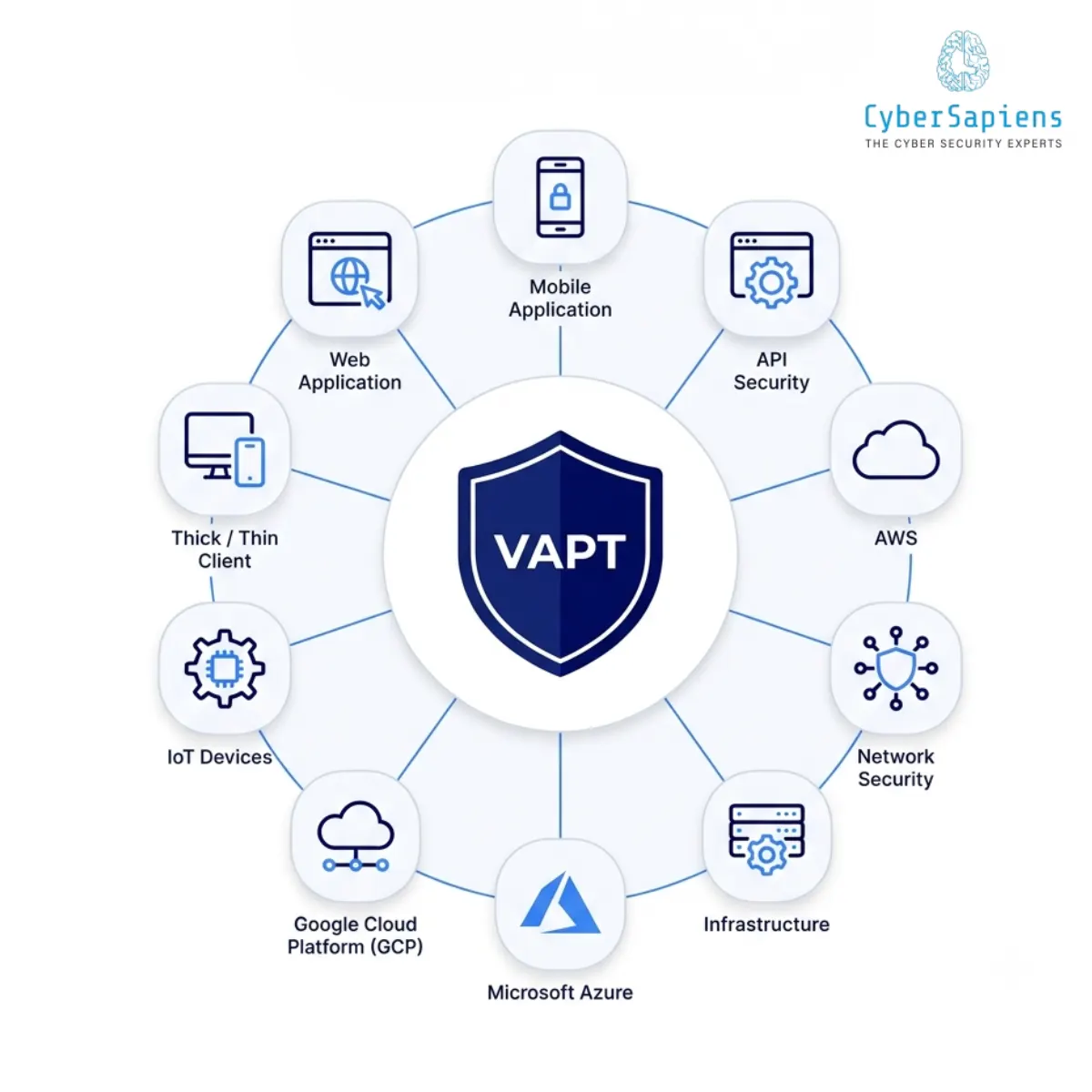
10 VAPT service lines under one trusted partner
Manual-first testing — find what scanners miss
Flat pricing — save time and money, zero hidden charges
Ensure you meet control requirements and pass certification audits
Free remediation re-test included on every engagement
Teams across Australia, India, Canada & USA
We are an ISO 27001:2022
Certified Company!

Industries
From regulated finance to fast-moving SaaS, our testing adapts to your industry's specific risk profile and compliance needs.
Payment systems, trading platforms, and regulatory-compliant security testing for financial applications.
Patient data protection, HIPAA compliance, and EHR system security testing.
Multi-tenant app security, API testing, and CI/CD pipeline integration for growing tech companies.
Payment gateway, customer data, and PCI DSS-aligned security testing for online retailers.
Critical infrastructure testing aligned to ACSC Essential Eight and SOCI Act compliance.
Student data protection, LMS platform, and university network security testing.
Frequently Asked Questions
Common questions about penetration testing in Australia — answered by our security team.
VAPT are two integrated security services. Vulnerability Assessment focuses on identifying and categorising weaknesses in systems. Penetration Testing simulates real-world attacks to exploit those weaknesses and assess actual impact. Together they provide a comprehensive picture of your security posture.
Yes. Vulnerability Assessment focuses on the core security of your systems — patching and configuration best practices. Penetration Testing focuses on real-world attack simulation from an external perspective. We recommend combining both for complete coverage.
Cost depends on scope: the number of applications, APIs, IP addresses and cloud accounts in the test. We give a fixed quote after a free scoping call, with no hidden charges.
Information Security experts from CyberSapiens — OSCP and CEH certified with 15–20 years' experience. All undergo extensive background checks with confidentiality and non-disclosure agreements.
Testing typically begins within 3 to 5 business days after the work order is signed. Expedited testing is available and can be scheduled per your convenience.
Yes. A CyberSapiens Secured certificate is provided for each VAPT audit upon successful completion and remediation.
Risks are significantly reduced with proper planning — test environments, agreed testing windows, live monitoring and recovery procedures. We plan thoroughly, but if a tester can crash a system, an attacker can too. Better to find out in a controlled engagement.
A detailed report covering scope, methodology, vulnerability findings with proof-of-concept, CVSS severity ratings, compliance mapping and prioritised remediation steps. A free re-test confirms your fixes.
At least once a year and after major changes such as a new release or cloud migration. Frameworks such as APRA CPS 234 and ISO 27001 expect regular security testing. Some organisations test quarterly, depending on risk appetite and how fast their environment changes.
Yes. Our report maps findings to frameworks such as ISO 27001, SOC 2, PCI DSS and APRA CPS 234, and supports the evidence you need for ASD Essential Eight assessments. Compliance itself depends on your whole security programme.
Networks are more exposed than ever with mobile apps, IoT and cloud adoption. A penetration test validates your security against real-world attacks and shows the actual impact of each weakness, so you can fix it before an attacker finds it or a data breach has to be notified.
Duration depends on scope. A single web application or API usually takes one to three weeks, and larger environments take longer. A free scoping call gives you a firm timeline for your environment.
Three scopes: Black Box (no prior knowledge, external attacker simulation), Grey Box (partial knowledge, combination approach), and White Box (full access, deepest coverage from within the network).
Primarily manual testing — there's no substitute for the human mind. Supported by Metasploit, Burp Suite, Nmap and other tools as required. Tool selection varies based on environment assessment.
Yes. We check web applications and networking devices for DoS & DDoS attacks — showing how many concurrent connections an application or device can maintain before failure.
Protect your assets before an attack happens. Get a free consultation to scope your requirements and receive a VAPT quote — flat pricing, zero hidden charges.