
Red Teaming vs VAPT: Which Does Your Business Need?
Quick Answer
Most Australian businesses need VAPT (vulnerability assessment and penetration testing), not red teaming. VAPT finds and lists vulnerabilities across your systems on a fixed scope and timeline. Red teaming tests whether your people, processes, and detection capability can catch a realistic, multi-stage attack, and only delivers value once you already have basic security controls in place. If you are unsure which applies to you, the maturity check below will tell you in under a minute.
The debate between red teaming vs penetration testing comes up constantly with Australian businesses preparing for a compliance deadline, a board request, or a cyber insurance renewal. The two are often quoted interchangeably by vendors, which leads companies to either overpay for a red team engagement they are not ready for, or underinvest in a VAPT program when they actually need deeper, adversary-style testing.
In our engagements with Australian SMEs and mid-market businesses, the deciding factor is rarely budget. It is security maturity. Below is the verdict we give clients based on where their organisation actually sits, before any comparison table or technical detail.
The Verdict, By Company Maturity
Early Stage or First Audit
You need VAPT. If this is your first formal security test, or you cannot say with confidence what is currently exposed to the internet, start here.
Growing, Compliance Driven
You need scheduled VAPT, typically annual or biannual. This is the stage most ISO 27001 and SOC 2 programs sit at.
Mature, Established Controls
You are ready to consider red teaming, alongside continued VAPT, not instead of it. This is where red teaming adds real signal.
Red Teaming vs VAPT: Side By Side Comparison
Both approaches use similar techniques, but they answer different questions. Penetration testing is a specialised type of assessment used to identify vulnerabilities that adversaries could exploit, typically under NIST SP 800-115, while red team exercises extend into social engineering and technology-focused attacks to assess an organisation’s security maturity under real world conditions. The table below breaks down how they differ in practice.
| Factor | VAPT | Red Teaming |
|---|---|---|
| Goal | Find and list as many exploitable vulnerabilities as possible | Test whether an attack is detected and stopped in practice |
| Scope | Defined systems, networks, or applications, agreed in advance | Open-ended, goal-based, often unknown to internal defenders |
| Duration | Typically 3 to 10 working days | Typically 2 to 6 weeks, sometimes longer |
| Cost (AU) | Lower, scoped per asset or application | Significantly higher, reflects time and skill required |
| Output | Vulnerability list ranked by severity, with remediation steps | Narrative of attack path, detection gaps, and response effectiveness |
What Each Approach Actually Reveals
In our client work, the confusion between VAPT and red teaming usually comes down to what the report is meant to prove. They answer different questions, and both are useful, but only when applied at the right stage.
VAPT Reveals
Where your technical vulnerabilities actually are, right now, ranked by severity and exploitability. It tells you what to patch first and gives auditors concrete, dated evidence that controls were tested.
Red Teaming Reveals
Whether your security team actually notices a real attack while it is happening, how far an attacker can move before being stopped, and whether your incident response holds up under pressure.
This is also why red teaming builds on VAPT rather than replacing it. Under the Australian Signals Directorate’s Essential Eight maturity model, detection and response capability is only meaningful to test once baseline technical controls are already in place. Running a red team engagement before that point mostly proves the same unpatched issues VAPT would have found faster and cheaper.
You Are Not Ready For Red Teaming If…
We would rather turn away a red teaming engagement than deliver one that just confirms problems a VAPT would have caught for a fraction of the cost. Here is our honest checklist. If any of these apply to you, start with VAPT instead.
You have never had a formal penetration test on your core systems. Red teaming will just rediscover the basics at ten times the price.
You have known vulnerabilities from a previous scan or test that have not been remediated yet.
You do not have a security team, internal or outsourced, actively monitoring alerts. Red teaming tests whether someone notices. If no one is watching, there is nothing to test.
Your compliance requirement (ISO 27001, SOC 2, an insurer, or a client questionnaire) specifically asks for VAPT evidence, not a red team report.
Budget is the main driver, not maturity. Red teaming is a significant investment that only pays off once basic controls are already solid.
The Progression Path: VAPT to Red Team
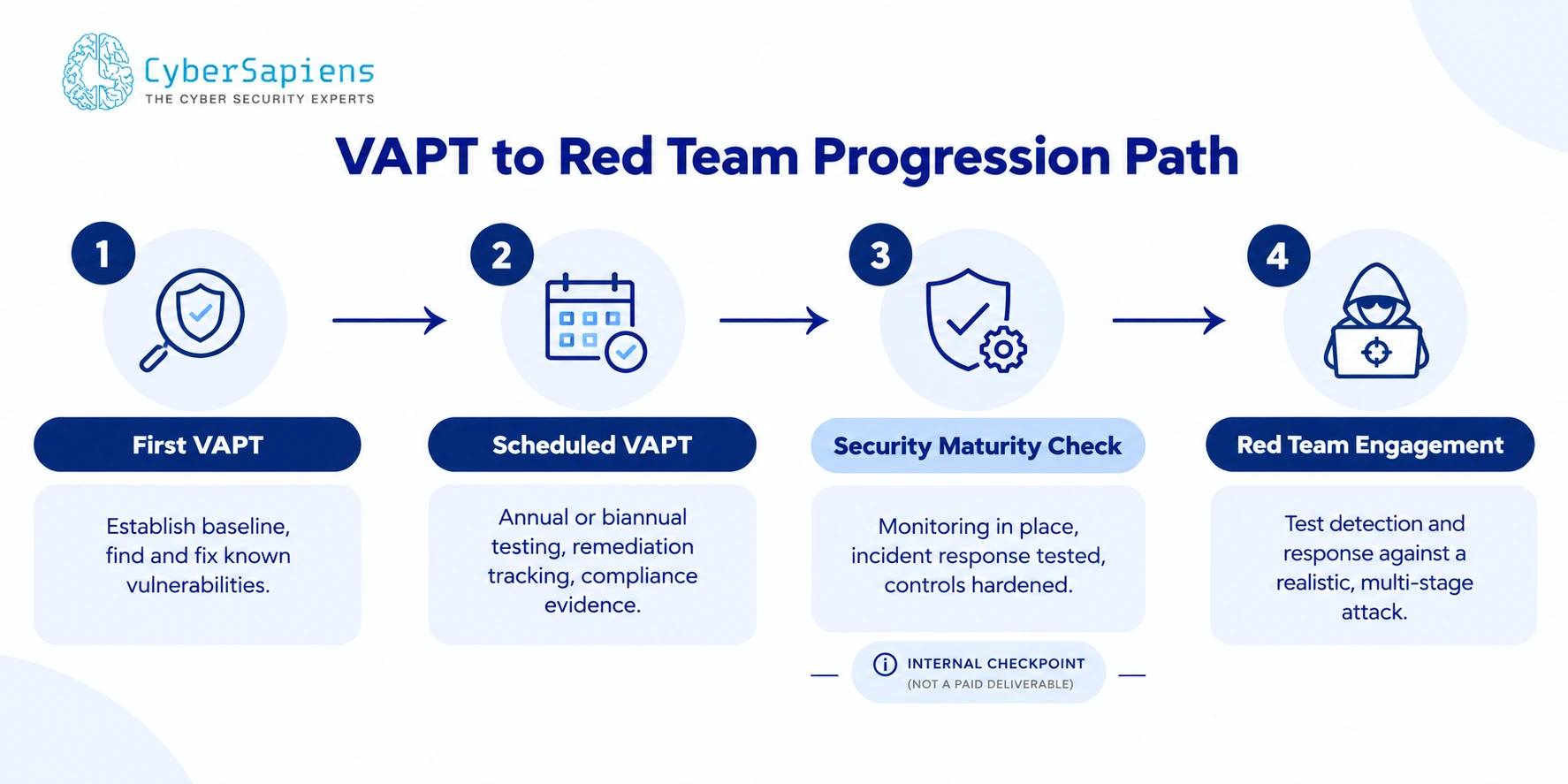
We treat red teaming as the next stage after VAPT, not a separate product. Here is the progression we walk Australian clients through.
First VAPT
Establish a baseline. Find and fix known vulnerabilities across your priority systems.
Scheduled VAPT
Move to annual or biannual testing with remediation tracking, building a record of evidence for auditors and insurers.
Security Maturity Check (Internal Checkpoint)
Confirm monitoring is in place, incident response has been tested, and prior VAPT findings are remediated. This is not a paid deliverable, it is the readiness gate before red teaming.
Red Team Engagement
Test detection and response against a realistic, multi-stage attack that mirrors how a real adversary would target your business.
Frequently Asked Questions
Is red teaming just a more expensive penetration test?
No. VAPT finds and lists vulnerabilities across a defined scope. Red teaming tests whether your people and detection systems notice and respond to a real, multi-stage attack. The cost difference reflects a different objective, not just more hours on the same task.
How much does VAPT cost compared to red teaming in Australia?
VAPT is typically scoped per application or network segment and priced per engagement over days, not weeks. Red teaming runs over several weeks and involves specialist skills across technical and social engineering attack paths, which is reflected in a significantly higher cost. Exact pricing depends on scope, so we recommend a maturity discussion before quoting either.
Which one do I need for ISO 27001 or SOC 2 compliance?
Most compliance frameworks, including ISO 27001 and SOC 2, ask for evidence of regular VAPT, not red teaming. Under NIST’s penetration testing definition, this type of assessment directly validates technical controls in a way auditors expect to see documented. Red teaming can support a mature program but rarely replaces the VAPT evidence auditors request.
How long does each engagement take?
VAPT typically takes 3 to 10 working days depending on scope. Red teaming usually runs 2 to 6 weeks, sometimes longer, since it involves reconnaissance, staged attack simulation, and detailed reporting on detection and response.
Which companies should consider red teaming?
Organisations that already run scheduled VAPT, have monitoring and incident response in place, and want to validate how their team performs against a realistic attack. It is best suited to businesses with existing security maturity, not those starting their security program.

Ketki Tidke
Cyber Security and GRC Lead Auditor
ISO 27001 Lead Auditor
Ketki is a certified ISO 27001 Lead Auditor specialised in Governance, Risk and Compliance, with experience consulting public, private, and government clients. She evaluates threats, risk impacts, and regulatory requirements across multiple industry frameworks.
Not Sure Where Your Business Sits?
Talk to our team about your current security maturity. We will give you a straight answer on whether VAPT, scheduled VAPT, or red teaming is the right next step, no upsell if you are not ready.
Discuss Your Maturity