



Blogs

SOC 2 and HIPAA Compliance Companies in Australia

SOC 2 AND HIPAA COMPLIANCE — AUSTRALIA 2026

If your Australian business handles US patient data, works with US healthcare organisations, or sells software to health systems, you are operating under two distinct compliance obligations: SOC 2 and HIPAA. Both frameworks are now standard gatekeeping requirements in US enterprise and healthcare procurement — and failing to satisfy either will stall or kill deals regardless of how strong your product is.

This guide covers the leading SOC 2 and HIPAA compliance companies in Australia in 2026 — what each framework requires, how they compare, which Australian businesses need both, and how to choose the right compliance partner for your specific situation.

Table of Contents

What is SOC 2 and HIPAA Compliance?

SOC 2 and HIPAA are two separate compliance frameworks that Australian businesses selling into the US healthcare market must understand and satisfy. SOC 2 is a security audit standard. HIPAA is a federal law. Both are required — and both serve a different purpose in the US procurement and regulatory landscape.

AUDIT FRAMEWORK

SOC 2 Compliance Explained

SOC 2 (System and Organisation Controls 2) is a framework developed by the American Institute of Certified Public Accountants (AICPA) that evaluates whether a technology company’s security controls meet the Trust Services Criteria. Security is the mandatory criterion; the remaining four — Availability, Processing Integrity, Confidentiality, and Privacy — are selected based on your service commitments to clients.

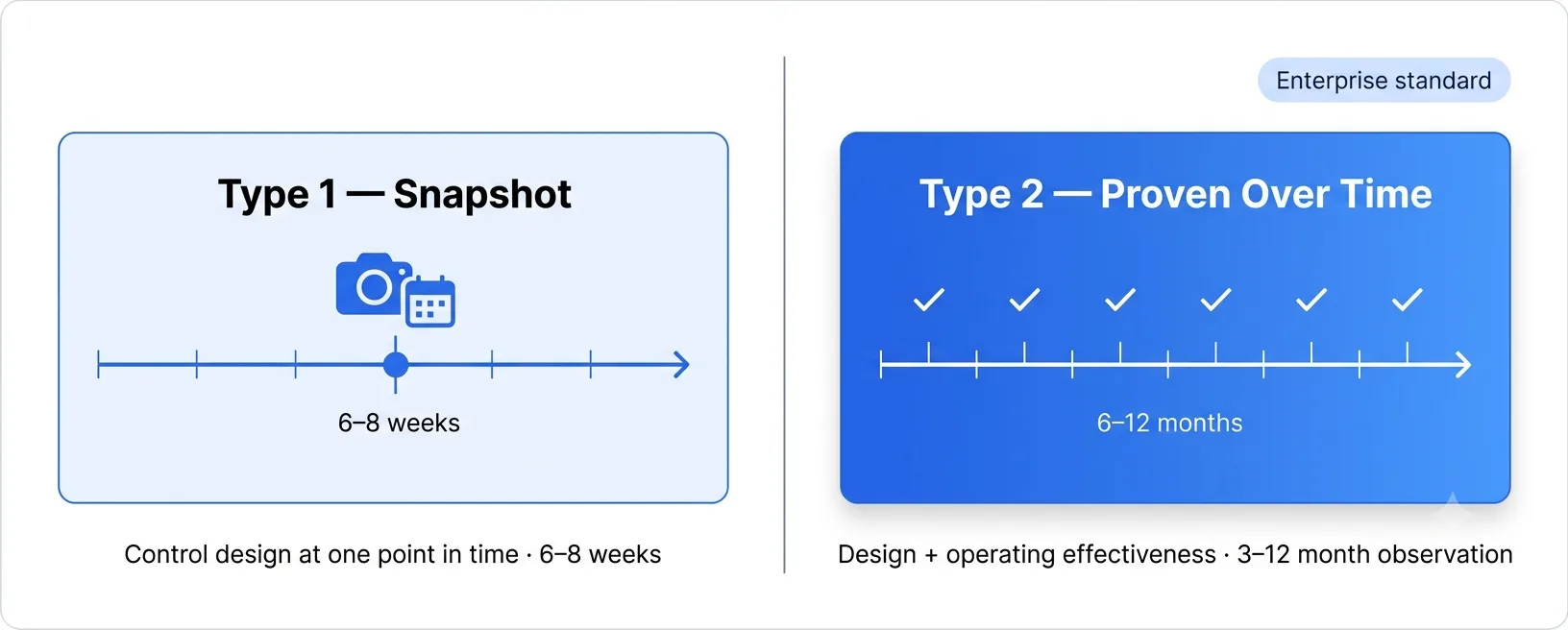
SOC 2 produces an independent audit report prepared by an accredited CPA firm that US enterprise buyers, investors, and procurement teams accept as evidence of your security posture. It comes in two forms:

SOC 2 Type I

Confirms that your controls are properly designed at a specific point in time. Typically completed in 6 to 8 weeks with an experienced compliance partner.

SOC 2 Type II

Confirms that your controls operated effectively over a minimum 6-month observation period. The gold standard accepted by the most demanding US enterprise buyers.

US FEDERAL LAW

HIPAA Compliance Explained

HIPAA — the Health Insurance Portability and Accountability Act — is a US federal law that governs the protection of Protected Health Information (PHI). It applies to two categories of organisation: Covered Entities and Business Associates.

Who HIPAA Applies To:

Covered Entities

Healthcare providers, health plans, and healthcare clearinghouses that create or handle PHI directly.

Business Associates

Any vendor, technology provider, or service partner that accesses, processes, stores, or transmits PHI on behalf of a Covered Entity.

Three Core HIPAA Rules:

Privacy Rule — governs how PHI may be used and disclosed.

Security Rule — mandates administrative, physical, and technical safeguards for electronic PHI (ePHI).

Breach Notification Rule — requires prompt notification to affected individuals, HHS, and in some cases the media when a PHI breach occurs.

According to the US Department of Health and Human Services, HIPAA civil penalties can reach up to USD 1.9 million per violation category per year — making compliance a material risk management priority for any Australian business touching US healthcare data.

SOC 2 vs HIPAA — Key Differences for Australian Businesses

Both SOC 2 and HIPAA address data security — but they serve different purposes, apply to different organisations, and satisfy different buyer requirements. Understanding the distinction is important before selecting a compliance partner.

Criteria SOC 2 HIPAA
Issued by AICPA (American Institute of CPAs) US Federal Government (HHS)
Type Voluntary audit framework Mandatory federal law
Who it applies to Technology and SaaS companies handling client data Healthcare organisations and their business associates
What it covers General security controls across Trust Services Criteria Protection of Protected Health Information (PHI) specifically
Output Independent CPA audit report (Type I or Type II) Ongoing compliance program — no single certificate issued
Enforced by Market demand from enterprise buyers US Department of Health and Human Services (HHS)
Penalty for non-compliance Loss of deals, reputational damage Civil and criminal penalties up to USD 1.9M per category
Renewal Annual re-assessment for Type II Ongoing — annual risk analysis mandatory
Australian applicability Required by US enterprise procurement Required if you handle PHI from US patients or clients

When Australian Businesses Need Both

If your platform handles health data from US clients, you will almost certainly need both. SOC 2 satisfies the IT security due diligence gate. HIPAA satisfies the healthcare data protection legal obligation. US healthcare procurement teams check for both — independently.

Why Australian Businesses Need SOC 2 and HIPAA Compliance

Australian digital health companies and SaaS platforms entering the US market face two compliance gates that must be cleared before contracts can be signed. Here is why both frameworks are now non-negotiable for Australian businesses operating in the US healthcare sector.

US Market Entry Requirements

The single most common reason Australian digital health companies stall at the US market entry stage is failing one or both of these checks. Enterprise healthcare buyers — hospital systems, health insurers, pharmacy networks, and telehealth platforms — require vendors to provide a current SOC 2 report and confirm HIPAA compliance before a contract is signed. This is not a negotiable requirement.

Digital Health and SaaS Platforms Handling PHI

Any Australian SaaS or digital health platform that stores appointment records, clinical notes, lab results, prescription data, telehealth session recordings, or any other identifiable patient information from US users is handling PHI under HIPAA — regardless of where the data is stored. If your servers are in Sydney but your patients are in Boston, HIPAA applies.

Business Associates Operating Under a BAA

When a US healthcare organisation engages an Australian technology provider as a vendor, they are required by law to execute a Business Associate Agreement (BAA) with that vendor. The BAA contractually obligates the Australian business to comply with HIPAA’s Security, Privacy, and Breach Notification Rules. Operating without a BAA — or with a BAA but without the controls to back it up — exposes both parties to regulatory penalties and contract liability.

Investor and Insurance Requirements

US investors conducting due diligence on Australian health tech companies increasingly require SOC 2 reports and evidence of HIPAA compliance as part of their pre-investment security review. Cyber insurers providing coverage for businesses handling PHI also typically require HIPAA compliance documentation as a condition of policy issuance.

Top SOC 2 and HIPAA Compliance Companies in Australia

For a full ranked comparison of providers with detailed strengths, best-for profiles, and how to choose between them, see our dedicated guide to the top 10 SOC 2 and HIPAA compliance service providers in Australia. Below is a focused overview of the leading companies operating in this space.

The AICPA’s SOC 2 framework requires that audits be conducted by accredited CPA firms — making the choice of compliance partner critical, as not all firms have the accreditations or audit partnerships needed to issue a valid SOC 2 report.

1. CyberSapiens

RECOMMENDED

Leading SOC 2 and HIPAA Compliance Company in Australia

CyberSapiens is an Australian cybersecurity and compliance firm offering end-to-end SOC 2 and HIPAA compliance programs for startups, SaaS businesses, digital health platforms, and health tech companies. Unlike generalist accounting firms that treat compliance as one of many services, CyberSapiens is built around cybersecurity and compliance as its core practice — giving clients deeper technical expertise and faster delivery.

CyberSapiens works with accredited CPA audit partners including Accorp Partners and Gabriel Registrar to issue the official AICPA SOC 2 certificate accepted by US enterprise buyers. For HIPAA, their program covers PHI risk assessments, Security Rule control implementation, Privacy Rule policy development, Business Associate Agreement review, and Breach Notification procedure setup.

What makes CyberSapiens the right choice for Australian businesses:

End-to-end support from gap assessment through to certified SOC 2 report

Combined SOC 2 and HIPAA compliance programs that share evidence and reduce total timeline

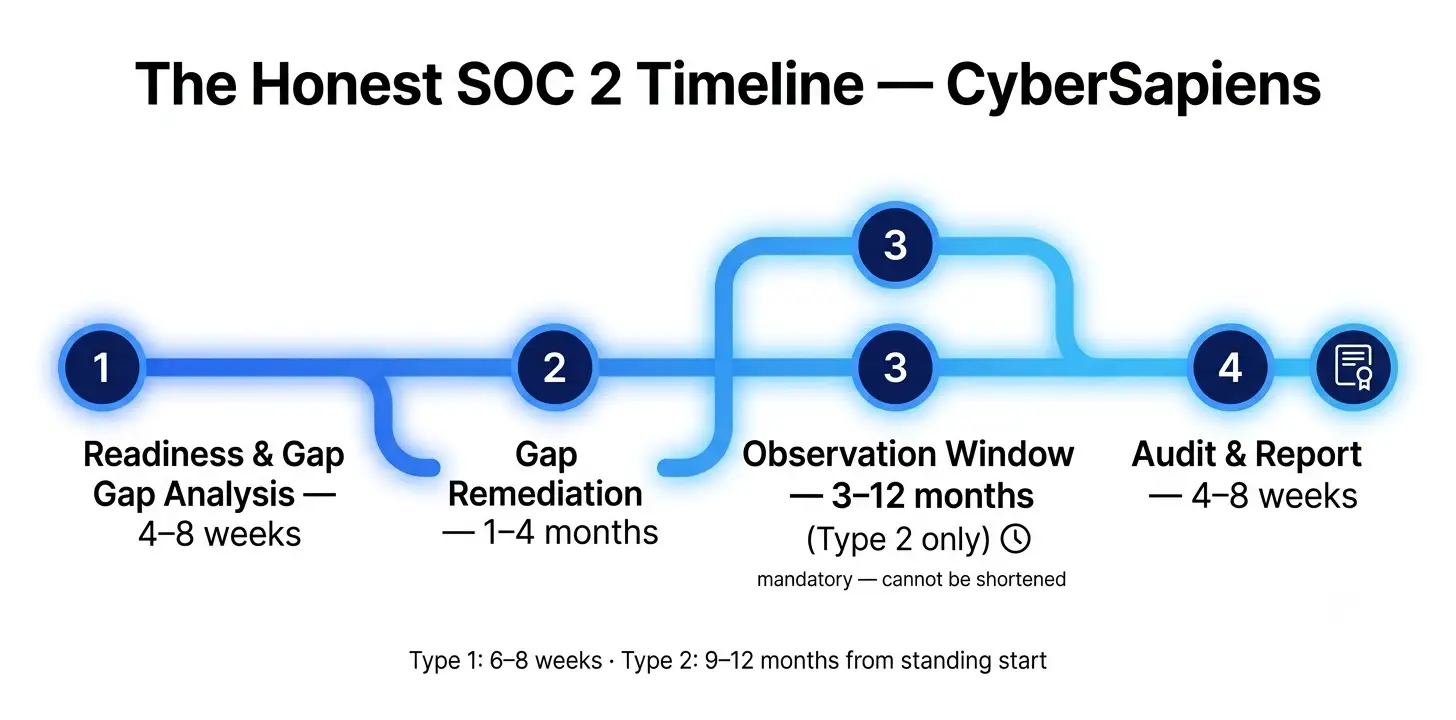
SOC 2 Type I achievable in as little as 6 to 8 weeks

HIPAA compliance program with full PHI risk assessment and Security Rule implementation

CISSP, CISM, CEH, and ISO 27001 certified expert team

Transparent fixed pricing with a clear scope agreed before work begins

Free gap assessment with compliance roadmap and fixed quote within 24 hours

Ongoing post-certification and annual renewal support

Get Your Free Gap Assessment

2. Deloitte Australia

Deloitte delivers SOC 2 and HIPAA compliance through their Risk Advisory division, with particular strength in large enterprise environments with complex multi-cloud infrastructure. Best suited for ASX-listed organisations where a Big Four name is required by procurement or board-level stakeholders.

3. PwC Australia

PwC Australia provides SOC 2 and HIPAA compliance with a strong focus on regulated industries including healthcare, financial services, and government. Their approach combines compliance with broader enterprise risk advisory, making them well suited for organisations aligning SOC 2 and HIPAA with an existing enterprise risk management program.

4. Ernst and Young (EY) Australia

EY Australia brings strong expertise in cloud environments, emerging technology, and data privacy. Their experience across the Australian Privacy Act, GDPR, and APRA CPS 234 makes them a strong choice for organisations managing multiple regulatory frameworks simultaneously.

5. KPMG Australia

KPMG Australia focuses on practical, outcome-driven compliance — with particular strength where healthcare data handling intersects with financial services or insurance. Their HIPAA practice is built around understanding operational risk rather than a pure checkbox approach.

6. RSM Australia

RSM Australia offers quality SOC 2 and HIPAA compliance services with a strong mid-market focus. Senior practitioner involvement throughout the engagement makes them a solid choice for growing healthcare businesses that want hands-on expert attention without Big Four pricing.

How CyberSapiens Delivers SOC 2 and HIPAA Compliance for Australian Businesses

CyberSapiens does not use a one-size-fits-all compliance checklist. Every engagement begins with a structured gap assessment that maps the client’s current security environment against both the SOC 2 Trust Services Criteria and HIPAA’s Security Rule requirements simultaneously — identifying overlaps, gaps, and the most efficient path to satisfying both frameworks.

1

Step 1 — Free Combined Gap Assessment

CyberSapiens conducts a free, comprehensive gap assessment that evaluates your current controls against both SOC 2 and HIPAA requirements in a single exercise. The output is a detailed gap report, a compliance roadmap, and a fixed project quote — delivered within 24 hours of the assessment.

2

Step 2 — Scope Definition and Program Design

Based on the gap assessment findings, CyberSapiens defines the audit scope — which systems, processes, and data flows are in scope for SOC 2 and HIPAA — and designs the compliance program. For businesses pursuing both frameworks simultaneously, the program is designed to share evidence and documentation across both, reducing duplication and total program cost.

3

Step 3 — Control Implementation and Policy Development

CyberSapiens’ certified team implements the security controls and develops the policies and procedures required to satisfy both frameworks. This includes access control policies, incident response plans, encryption standards, vendor management programs, workforce training, and HIPAA-specific PHI handling procedures.

4

Step 4 — Evidence Collection and Audit Readiness

CyberSapiens manages the evidence collection process — gathering and organising the documentation required by the CPA audit firm for the SOC 2 audit and by the HIPAA risk analysis. Clients are prepared for auditor interviews and walkthroughs before the formal audit begins.

5

Step 5 — CPA Audit Coordination and AICPA Certificate Issuance

CyberSapiens coordinates directly with accredited CPA audit partners — Accorp Partners and Gabriel Registrar — to conduct the independent SOC 2 audit and issue the official AICPA SOC 2 certificate. The certificate is accepted by US enterprise buyers, investors, and healthcare procurement teams as evidence of a verified, independent security audit.

6

Step 6 — Ongoing Compliance and Annual Renewal

SOC 2 and HIPAA compliance require ongoing maintenance. CyberSapiens provides annual renewal support — including updated risk analyses, evidence refresh, control re-assessment, and coordination with the audit firm for the annual SOC 2 Type II re-assessment cycle. For more information, visit the CyberSapiens HIPAA compliance service page.

FAQs — SOC 2 and HIPAA Compliance Companies in Australia

Common questions from Australian businesses navigating SOC 2 and HIPAA compliance requirements for the US market.

What is the difference between a SOC 2 compliance company and a HIPAA compliance company?

A SOC 2 compliance company helps technology and SaaS businesses design, implement, and audit security controls against the AICPA Trust Services Criteria — producing an independent SOC 2 audit report. A HIPAA compliance company helps healthcare organisations and business associates implement the administrative, physical, and technical safeguards required by the HIPAA Security, Privacy, and Breach Notification Rules. Some Australian firms — including CyberSapiens — offer both as an integrated service.

Can an Australian company be fined for HIPAA non-compliance?

Yes. HIPAA applies to any organisation that handles PHI from US patients or operates as a Business Associate to a US Covered Entity — regardless of where the company is based. The US Department of Health and Human Services has authority to investigate and impose civil penalties on foreign entities that violate HIPAA. Additionally, non-compliance typically constitutes a breach of the Business Associate Agreement, exposing the Australian company to civil liability from the US client.

What is the fastest way for an Australian business to achieve SOC 2 and HIPAA compliance?

The fastest path is to engage a compliance partner that offers an integrated SOC 2 and HIPAA program — running both frameworks simultaneously with shared evidence collection, a single gap assessment, and coordinated audit preparation. CyberSapiens delivers SOC 2 Type I in as little as 6 to 8 weeks and designs HIPAA programs that run in parallel, compressing the total timeline significantly compared to pursuing each framework sequentially.

Do I need a Business Associate Agreement if my company is based in Australia?

Yes. If you are providing software, cloud services, or data processing to a US healthcare organisation and your service involves accessing, storing, or transmitting PHI, you are a Business Associate under HIPAA and the Covered Entity is legally required to execute a BAA with you. Operating without one exposes both parties to regulatory penalties.

What Australian industries most commonly need both SOC 2 and HIPAA compliance?

The industries most commonly requiring both in Australia are: digital health and telehealth platforms, clinical software providers, health data analytics companies, SaaS businesses with US healthcare clients, medical device software companies, health insurance technology providers, and any technology company acting as a Business Associate to a US Covered Entity.

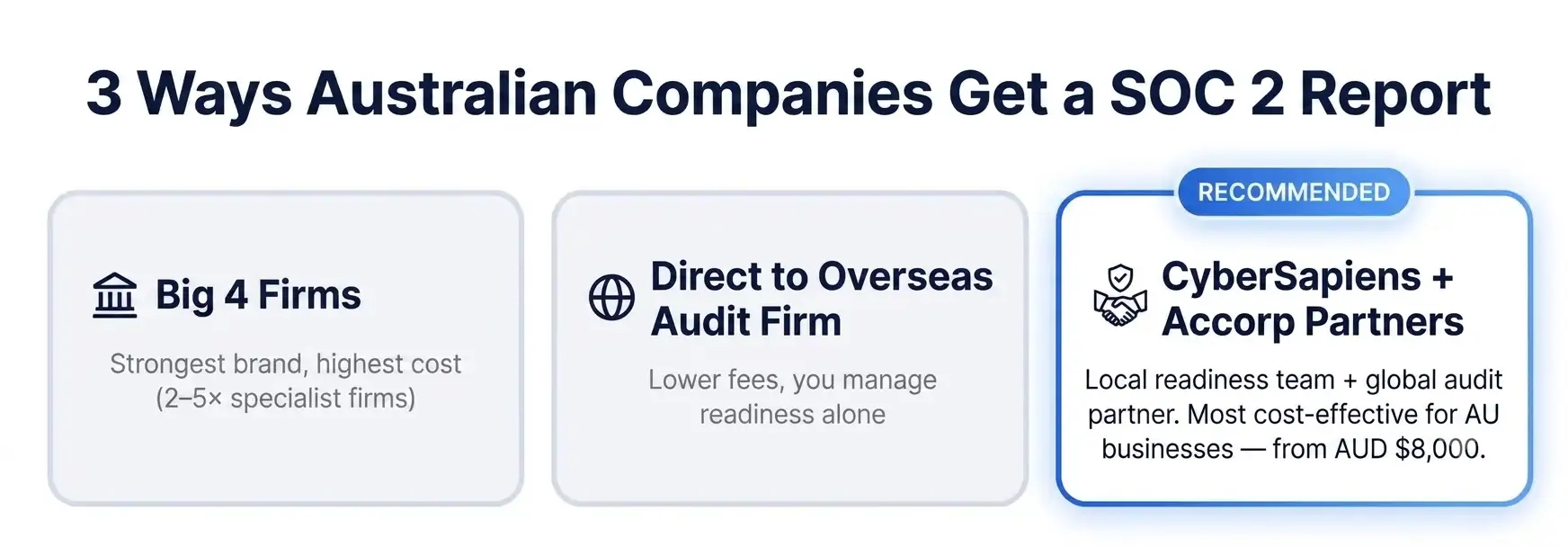
How does CyberSapiens differ from Big Four firms for SOC 2 and HIPAA compliance?

CyberSapiens offers deeper cybersecurity expertise, faster delivery timelines, and more direct senior practitioner involvement than generalist Big Four firms where compliance is one of many service lines. Their integrated SOC 2 and HIPAA programs are specifically designed for Australian startups, SaaS companies, and digital health platforms — with fixed pricing, a free gap assessment, and end-to-end support from the same team throughout the engagement.

Ready to Achieve SOC 2 and HIPAA Compliance?

CyberSapiens helps Australian businesses satisfy both SOC 2 and HIPAA requirements in a single integrated compliance program. Start with a free gap assessment and get a clear compliance roadmap and fixed project quote within 24 hours.

Want to compare your options first? See our full guide to the top SOC 2 and HIPAA compliance service providers in Australia before you decide.

Call Us

1300 507 668

Office

Lvl 1, 206 Lorimer St,
Port Melbourne, Australia

Content Reviewed By

Robin Dsouza, Founder CyberSapiens
Robin Dsouza CISA Certified

Founder and Lead Cyber Security Expert

Cyber Forensic Advisor, Karnataka State Police

CISA CPISI v3.2 ISO 27001 Lead Implementer 10+ Years Experience

200K+

Trained

200+

Clients

500+

Seminars

10+ Yrs

Exp

Robin is the founder of CyberSapiens and one of Australia’s leading cybersecurity experts. With over 10 years of experience, he has trained more than 200,000 individuals, consulted over 200 organisations, and conducted 500+ seminars. Previously at Infosys, KPMG Global Services, and iPRIMED Education Solutions.

GRC and SOC 2 ISO 27001 HIPAA IT Risk Management Security Auditing Network Security Data Privacy
Table of Contents