



SOC 2 Compliance in Australia: Expert Support for SaaS, Fintech & Tech Companies

why to choose cybersapiens for soc2 certification in australia

SOC 2 Compliance in Australia Made Easy & Effortless!

Our team of experts is dedicated to providing comprehensive SOC 2 Compliance solutions tailored to your organization’s unique needs.

We guide you through the entire compliance journey, from assessment to implementation and ongoing maintenance, helping you navigate the complex requirements of SOC 2 compliance with confidence and ease.

Our SOC 2 Compliance Service Process

CyberSapiens SOC 2 compliance process in Australia
SOC 2 compliance process in Australia

Our Clients

The five SOC 2 trust principles cybersapiens follows

What is SOC 2 Compliance Service?

Ensuring SOC 2 compliance is crucial when aiming to establish credibility and foster trust in the contemporary digital landscape.

RephraseThe American Institute of CPAs (AICPA)’s stringent Trust Services Criteria must be met by an organization’s controls. Businesses can prove their dedication to upholding high standards of security, availability, processing integrity, confidentiality, and privacy by adhering to SOC 2 standards. Insights into an organization’s control environment are gained from SOC 2 compliance audits, which reassure clients and stakeholders that their data and systems are secure.

Developing a robust cybersecurity framework is an essential process that helps to mitigate risks and provides a competitive edge in an increasingly security-aware market.

Hence, it is essential to prioritize investing in SOC 2 compliance to safeguard your business and cultivate trust and loyalty among your valued clients.

Why your Organisation needs SOC 2 Compliance Service?

In the digital age, consideration and credibility must be established through SOC 2 compliance service. Customers and other stakeholders are reassured that a business has put strong controls in place to safeguard sensitive data and guarantee the security, accessibility, processing integrity, confidentiality, and privacy of their information.

Companies can demonstrate their commitment to industry-recognized requirements and acceptable practices through the current SOC 2 audit process. SOC 2 compliance allows for risk mitigation, data breach prevention, and meeting the growing demand for data privacy and security. It gives organizations a competitive edge because customers prioritize working with dependable partners who prioritize the security and integrity of their data.

why your organisation needs soc-2 compliance in Australia

Types of SOC 2 Compliance Service

There are 2 types of SOC 2 Compliance! We are offering SOC 2 audit services in Australia.

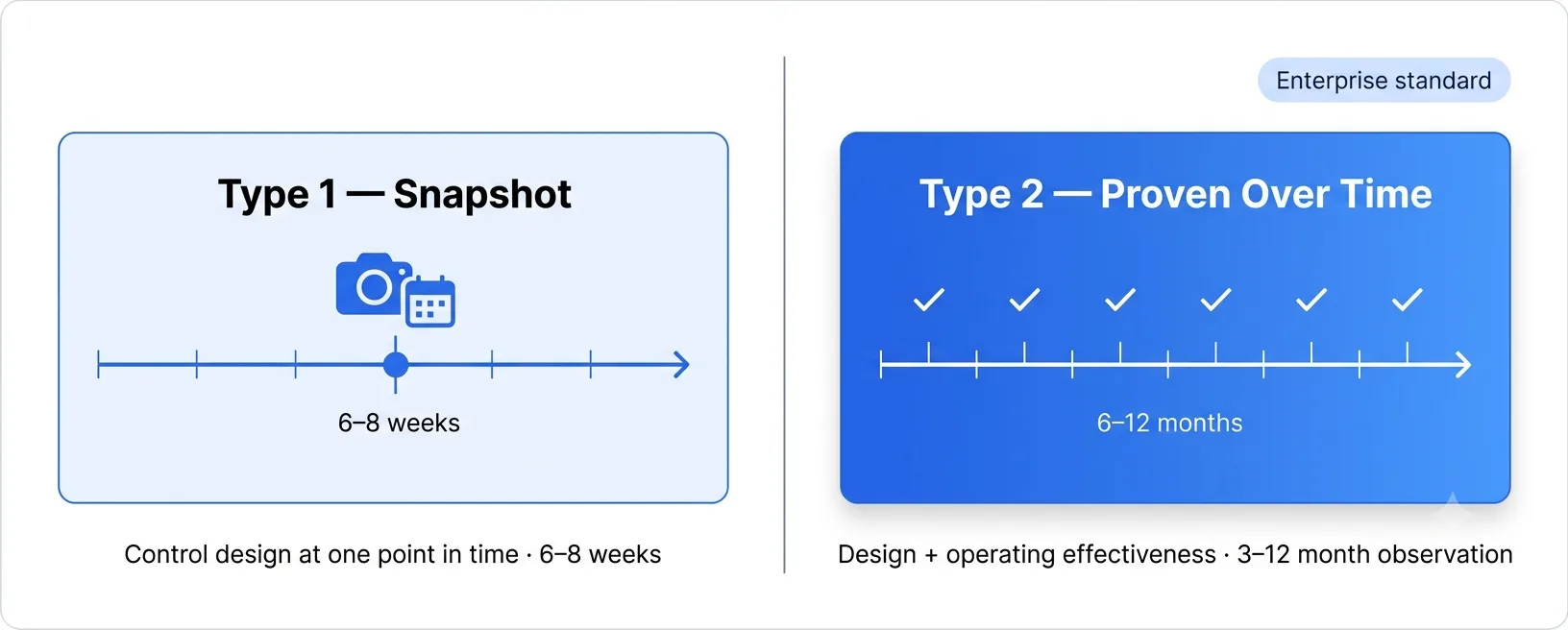
SOC 2 Type 1

The SOC 2 Type 1 report evaluates the effectiveness of a company's controls over a predetermined time frame. It gives a summary of the branding that has been used and evaluates whether it is appropriate for achieving dependable service standards. This report gives stakeholders information about the controls' designs and how they compare to accepted standards, reassuring them that the organization has put in place the proper procedures to manage security and address issues with availability, functional integrity, privacy, and confidentiality.

SOC 2 Type 2

A SOC 2 Type 2 report assesses the design and functionality of an organization's controls over a defined period of time, typically six to twelve months, and the effectiveness of those controls over time. As a result, stakeholders are provided with a comprehensive view of how well the controls have been established and operated over time, as well as how well they have been used. It is important to note that SOC 2 Type 2 provides significant insights into the continued adherence to the Trust Services Criteria, providing a greater level of confidence regarding the effectiveness of security controls.

Benefits of SOC 2 Compliance Services!

Enhanced Security

Compliance with SOC 2 regulations requires the implementation of strong security controls, ensuring the protection of sensitive data against unauthorized access and breaches.

Regulatory Compliance

SOC 2 compliance adheres to industry-specific regulations, helping your organization meet compliance requirements and avoid fines or legal issues.

Increased Client Trust

SOC 2 compliance demonstrates your commitment to data security and privacy, building trust with customers and stakeholders who value the security of their information.

Competitive Advantage

SOC 2 compliance sets you apart from competitors by demonstrating your commitment to data security and privacy, giving you a competitive edge in the marketplace.

Operational Efficiency

SOC 2 compliance encourages the implementation of standardized processes and systems, leading to improved performance and efficiency.

Risk Mitigation

SOC 2 compliance involves identifying and mitigating risks, allowing you to address vulnerabilities and strengthen your risk management processes.

Vendor Due Diligence

SOC 2 compliance helps facilitate a vendor's due diligence process as potential customers can trust that they have implemented effective controls to protect their data.

Improved Internal Processes

A SOC 2 compliance process often highlights areas of improvement within your organization, allowing you to improve your internal processes and security measures.

why choose CyberSapiens for SOC compliance in Australia

We are an ISO 27001:2022 
Certified Company!

cybersapiens is ISO 27001 certified

Why Choose Us for your SOC 2 Compliance Audit Service?

Reach Compliance at your own pace

Establish Roadmap & Stay on Target

Save time & money

Ensure you meet the control requirements

Ensure you pass your certification audit

Ensure you maintain certification every year

We are an ISO 27001:2022 
Certified Company!

cybersapiens is ISO 27001 certified
contact cybersapiens for soc2 report and auditing

Get In Touch
By filling this form ↓

SOC 2 Compliance Organic Form

FAQ's

Yes. We specialize in helping Australian SaaS, fintech, and technology companies achieve SOC 2 certification. Our services include readiness assessment with comprehensive gap analysis, hands-on implementation support, cloud security configuration for AWS/Azure/GCP, policy and procedure development, evidence automation using compliance platforms, auditor selection and coordination, real-time audit support, and ongoing maintenance. We've certified 200+ Australian companies with a 95% first-time pass rate. Our team includes AWS, Azure, and GCP certified security professionals with deep expertise in cloud-native architectures and DevOps security.

Partially, yes. SOC 2 with Privacy criteria overlaps significantly with Australian Privacy Principles (APPs) under the Privacy Act 1988, particularly around security controls, data protection measures, and privacy safeguards. However, SOC 2 alone doesn't guarantee full Privacy Act compliance. You still need APP-specific consent mechanisms, Notifiable Data Breaches (NDB) scheme procedures, and cross-border disclosure agreements. We help align SOC 2 controls with APPs to maximize compliance efficiency and reduce duplication. Many controls satisfy both frameworks, but legal review is recommended to ensure complete Australian regulatory compliance.

SOC 2 (Service Organization Control 2) is a security audit framework developed by the American Institute of CPAs (AICPA) that evaluates how service providers manage and protect customer data. It's essential for Australian businesses because: (1) 80% of US enterprise RFPs require SOC 2 from vendors, (2) it demonstrates commitment to security beyond basic compliance, (3) it provides independent third-party validation of security controls, (4) it helps identify and address security gaps before breaches occur, and (5) it's often required in enterprise procurement processes. While SOC 2 originated in the US, it has become the global standard for SaaS, cloud service providers, and technology companies handling sensitive data. Australian companies serving international markets need SOC 2 to compete effectively and access enterprise clients.

Business benefits include: revenue growth through access to US enterprise markets with average deal sizes of $150K-$500K, faster sales cycles with pre-answered security questionnaires, premium pricing power (15-25% higher than uncertified competitors), and reduced customer churn. Security benefits include risk mitigation through identifying vulnerabilities before breaches, 60-70% reduction in security incidents, structured security program development, and formal third-party risk management. Operational benefits include standardized processes, efficiency gains through automation, security-conscious culture, and 15-30% lower cyber insurance premiums. Strategic benefits include investor confidence for funding rounds, M&A readiness with streamlined due diligence, market expansion opportunities, and enhanced brand reputation. Real ROI: Our average client sees SOC 2 pay for itself within 6-9 months through 1-2 large enterprise deals that wouldn't have closed without certification.

SOC 2 is not legally mandated, but the commercial consequences are severe. Revenue impact includes: lost enterprise deals (80% of US enterprise RFPs require SOC 2, disqualifying uncertified vendors), 3-6 month sales cycle delays, lower deal values by targeting smaller less security-conscious buyers, price pressure competing on cost rather than trust, and market access restrictions to healthcare, financial services, and government sectors. Competitive disadvantage includes certified competitors winning your deals and market perception of "not serious about security." Operational risks include higher security incident likelihood without structured controls and potential data breaches averaging $3.35M AUD cost in Australia (IBM 2025 data). Legal consequences of data breaches that SOC 2 helps prevent include Privacy Act penalties up to $2.5M AUD, mandatory Notifiable Data Breach reporting costs, civil litigation and class actions, and OAIC regulatory investigations. Strategic impacts include difficulty raising capital without demonstrating security maturity, M&A blockers where acquisition targets require certification, and partnership limitations with strategic partners requiring vendor attestation.

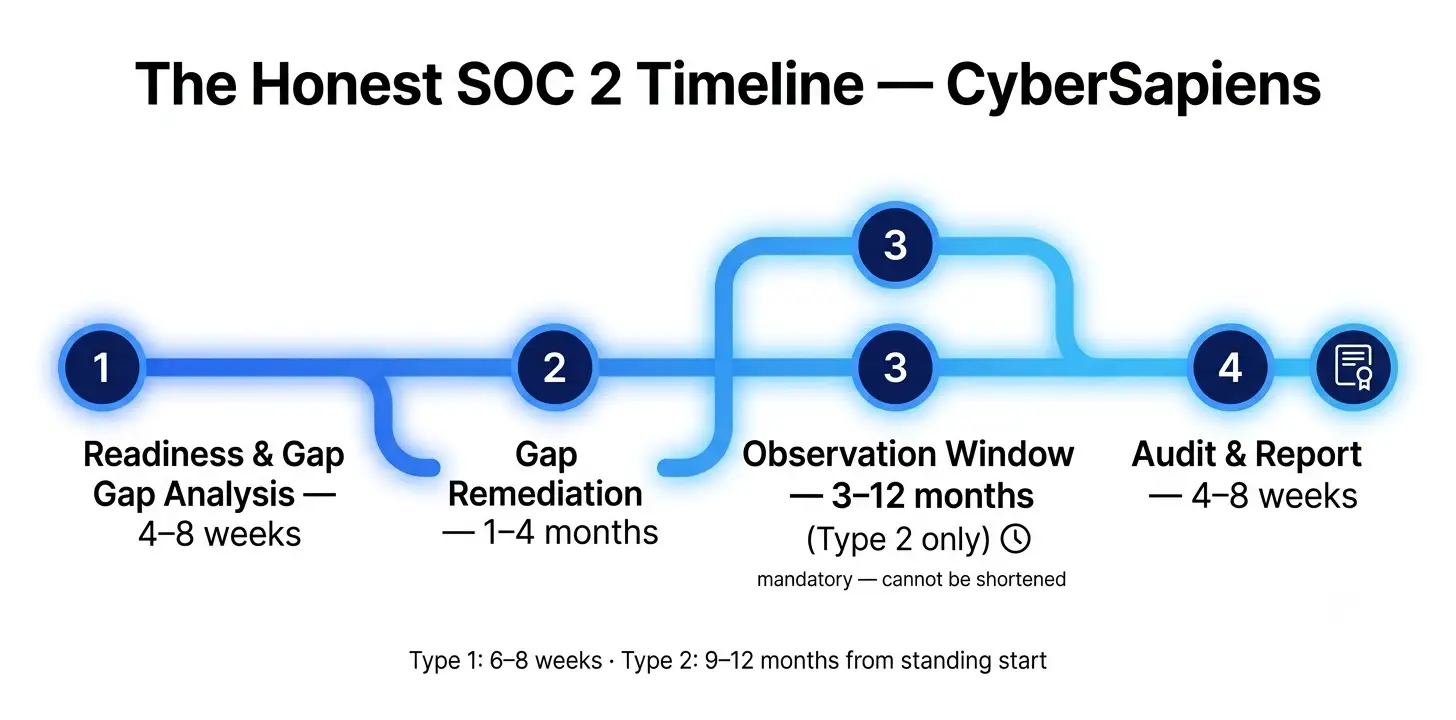
SOC 2 Type 1 typically takes 6-10 weeks if you have existing security controls. SOC 2 Type 2 takes 6-18 months depending on starting point. Minimum timeline (6-7 months) requires: all controls already implemented, 3+ months historical evidence exists, minimal remediation needed, and 3-month observation period (shortest possible). Average timeline (9-12 months) for typical Australian companies includes: some security controls exist, 2-3 months remediation needed, 6-month observation period (most common), and standard audit process. Extended timeline (12-18 months) for companies starting from scratch includes: no formal security program, significant remediation required, 12-month observation period (preferred by enterprise clients), and complex infrastructure. Important: The observation period for Type 2 is mandatory and cannot be shortened. This is an AICPA requirement where auditors must observe your controls operating effectively over 3-12 months. Providers claiming "45-day Type 2 certification" are misleading - this timeline is physically impossible due to mandatory observation requirements.

Yes. We help you define the optimal scope to balance compliance requirements, cost, and timeline. Scope decisions include: which Trust Services Criteria to include (Security is mandatory; Availability, Processing Integrity, Confidentiality, and Privacy are optional), which products or services to include (start narrow, expand later), which infrastructure to include (single cloud region vs multi-region), which locations to include (single office vs multiple), and which third-party services to include (critical vendors only vs all). Our recommendation: start with Security criteria only, single primary product, primary cloud environment, and critical vendors. This minimizes first-year cost and timeline while meeting most enterprise buyer requirements. You can expand scope in subsequent annual audits. We conduct scope workshops to map your business requirements, client expectations, and resource constraints to the right certification scope.

Most Australian companies (90%) should go directly to SOC 2 Type 2 and skip Type 1 entirely. Choose Type 2 if: you're selling to US enterprises (they require Type 2), your deals are in the enterprise range, you want competitive differentiation, you're building a long-term compliance program, or you can commit 6-12 months to the process. Choose Type 1 only if: a specific smaller client explicitly accepts Type 1 in writing, you need interim certification while working toward Type 2, or resource constraints require staged approach. Time comparison: Getting Type 1 then Type 2 takes longer overall and requires more total investment than going directly to Type 2. You save several months and reduce total investment by skipping Type 1. Enterprise acceptance: Only 10-15% of enterprise buyers accept Type 1, while 85-90% require Type 2.

SOC 2 compliance forces implementation of fundamental security controls that many companies lack. Key security improvements include: access management with multi-factor authentication enforcement, role-based access controls, quarterly access reviews, and privileged access monitoring. Encryption implementation including data at rest encryption for databases and backups, TLS 1.2+ for data in transit, and proper key management. Monitoring and logging with centralized SIEM or log aggregation, real-time security alerting, 12+ month log retention, and continuous threat detection. Incident response with documented incident response plan, tested response procedures, incident tracking and root cause analysis, and post-incident improvement processes. Vulnerability management including monthly vulnerability scanning, annual penetration testing, patch management processes, and configuration hardening. These aren't just compliance checkboxes - they're operational security controls that reduce breach likelihood significantly and minimize impact when incidents occur.

No, this is impossible. SOC 2 Type 2 requires a mandatory observation period of 3-12 months where auditors monitor your controls operating effectively over time. This is an AICPA requirement that cannot be shortened, bypassed, or accelerated regardless of readiness level. Minimum possible timeline is 6-7 months if you have: all security controls already fully implemented and operating, 3+ months of historical evidence already collected, zero remediation gaps, and auditor agreement to minimum 3-month observation (rare). Typical timeline is 9-12 months for companies with some existing controls. Claims of "45-day SOC 2 certification" refer to SOC 2 Type 1 (point-in-time assessment with no observation period) or are misleading marketing. Any provider promising 45-day Type 2 is either inexperienced or dishonest. The observation period exists to prove your controls work consistently over time, not just at a single moment. Enterprise buyers prefer 6-12 month observation periods for stronger assurance.

SOC 2 and ISO 27001 serve different markets and purposes. SOC 2 is: US-focused framework, conducted by CPA firms, common in North American procurement, emphasizes operational controls and trust services criteria, produces audit report (not certificate), required for US enterprise sales, and report-based assurance. ISO 27001 is: international standard, certified by accredited bodies, common in European and Asia-Pacific procurement, emphasizes information security management system (ISMS), produces certificate, required for European and government contracts, and certification-based assurance. Geographic preference: SOC 2 for US market, ISO 27001 for Europe/Asia/Australia government. Many Australian companies pursuing both for maximum market coverage. Control overlap is 60-70% (access management, encryption, incident response are similar). Investment efficiency: implement controls once, get dual certification with less duplication. Our recommendation: SOC 2 if selling primarily to US enterprises, ISO 27001 if selling to European enterprises or Australian government, both if serving global markets.

No, you can and should go directly to SOC 2 Type 2 in most cases. Getting Type 1 first adds unnecessary time and investment. Comparison: Type 1 first approach takes 8 weeks for Type 1 plus 10 months for Type 2 equals 12+ months total. Direct to Type 2 approach takes 9-12 months. You save 2-3 months by skipping Type 1. Enterprise buyer perspective: 85-90% require Type 2 specifically and won't accept Type 1. Type 1 provides minimal value if you need Type 2 eventually. Only get Type 1 if: a specific client explicitly accepts Type 1 in writing (rare), you need something immediately while working toward Type 2, or resource constraints require staged approach (still not recommended). Technical reason: Type 1 and Type 2 cover the same controls - Type 2 just adds observation period. You're not "practicing" with Type 1 before Type 2. Market reality: Type 1 is becoming obsolete as enterprise buyers universally expect Type 2. Our recommendation to 95% of clients: go straight to Type 2.

Our team includes certified security specialists across all major cloud platforms. AWS expertise: AWS Certified Security Specialty certified consultants, experience with IAM policies and roles, CloudTrail logging and GuardDuty configuration, VPC security groups and network architecture, S3 bucket encryption and access controls, RDS database security, and CloudWatch monitoring and alerting. Azure expertise: Azure Security Engineer Associate certified staff, experience with Azure AD and Conditional Access, Azure Security Center configuration, Log Analytics and monitoring, Network Security Groups, Azure Policy enforcement, and Key Vault encryption. GCP expertise: GCP Professional Cloud Security Engineer certified team, experience with Cloud IAM, Cloud Logging and monitoring, Cloud Security Command Center, VPC firewall rules, and Cloud KMS encryption. Multi-cloud architecture experience including hybrid environments, cloud migration security, Infrastructure as Code (Terraform, CloudFormation) security, Kubernetes and container security, serverless architecture (Lambda, Cloud Functions), and microservices security patterns.

The observation period is a mandatory timeframe during which auditors monitor your security controls operating effectively over time. This is specific to SOC 2 Type 2 only (Type 1 has no observation period). Duration: minimum 3 months (rare, requires experienced startup-friendly auditor), standard 6 months (most common for commercial audits), and enterprise-preferred 12 months (stronger certification, better client perception). Why it exists: proves controls work consistently over time, not just at a single point, demonstrates operational effectiveness not just design, provides sufficient evidence sample size across quarters or seasons, and assures clients of sustained security practices. Can it be shortened? No bypassing - observation period is AICPA requirement, no acceleration - you cannot compress time, but early start possible - begin collecting evidence as soon as controls are implemented. During observation you continuously collect: access review logs, security training completion records, incident response documentation, vulnerability scan reports, change management tickets, backup test results, vendor assessment documentation, and penetration test reports.

Employee security awareness training is mandatory for SOC 2 compliance and critical for control effectiveness. Required training includes: initial security awareness training for all new employees within 30 days of hire, annual refresher training for all existing employees, role-specific training for IT, development, and security teams, incident response training for relevant personnel, and documented acknowledgment of security policies. Training topics must cover: password security and MFA usage, phishing recognition and reporting, data classification and handling, acceptable use of systems, incident reporting procedures, physical security, remote work security, and vendor data sharing. Evidence requirements: attendance records, completion certificates, quiz/test results, and policy acknowledgment signatures. Ongoing compliance: annual training cycles, tracking and remediation of incomplete training, and updated training materials reflecting control changes. Without effective training, technical controls fail because employees bypass them or don't understand their importance.

SOC 2 Type 2 reports are valid for one year from the observation period end date, requiring annual re-audits. However, your observation period is continuous - you're always "in audit" collecting evidence year-round. Annual re-audit timeline: Month 1-11 of Year 2 is continuous observation and evidence collection. Month 12 is re-audit execution (2-4 weeks). Month 12.5 is report finalization (1-2 weeks). New report issued covering past 12 months. Annual re-audit differences from initial audit: faster (2-4 weeks vs 8-12 weeks), less expensive, less disruptive (auditor familiar with your environment), and focused on changes and exceptions from prior year. Continuous compliance activities: quarterly internal reviews, ongoing evidence collection automation, policy updates as business changes, regular employee training, vendor assessments, and control monitoring. Best practice: schedule re-audits to complete 30 days before current report expires to avoid gaps.

Common challenges include: underestimating internal effort required (10-20 hours/week from multiple team members for 6-12 months), resource constraints with small IT/security teams already overloaded, executive buy-in difficulties justifying investment without immediate revenue, documentation gaps with lack of formal policies and procedures, technical implementation complexity especially for legacy systems or technical debt, evidence collection burden without automation (manual spreadsheets and screenshots), observation period patience waiting 6-12 months for Type 2 completion, scope creep adding criteria or systems mid-process and restarting timeline, auditor selection confusion choosing between Big 4, mid-market, and specialist firms, and maintaining ongoing compliance after certification (not treating as one-time project). Solutions: hire experienced consultant to reduce timeline significantly, use compliance automation platform to cut evidence collection time, dedicate full-time internal compliance lead, start 12 months before you need certification, implement controls immediately to begin observation period, and keep initial scope minimal.

SOC 2 provides independent third-party validation of your security claims, replacing "trust us" with "verified by auditors." Trust-building mechanisms include: objective evidence through CPA firm attestation (not self-certification), detailed control documentation showing exactly how you protect data, transparency with ability to share actual SOC 2 report (not just certificate), competitive parity matching security standards of enterprise competitors, procurement facilitation pre-answering security questionnaires with report, risk transfer assuring clients their data is protected to defined standards, and regulatory alignment helping clients meet their own compliance obligations. Practical trust benefits: enterprise procurement teams can check SOC 2 requirement box immediately, security teams can review detailed control descriptions, legal teams can assess contract risk, and board members can demonstrate due diligence. Customer perspective: SOC 2 is table stakes for enterprise SaaS, expected rather than differentiator, but absence is a deal-killer.

Yes, we provide hands-on remediation support, not just recommendations. Our gap remediation services include: technical implementation where we configure AWS/Azure/GCP security controls, implement SIEM or log aggregation, set up MFA across all systems, configure encryption at rest and in transit, establish backup and recovery processes, and deploy vulnerability scanning. Policy development where we write information security policies, create access control procedures, develop incident response plans, establish change management processes, create vendor management programs, and document business continuity plans. Process establishment where we design quarterly access review workflows, implement security training programs, create risk assessment methodologies, establish evidence collection automation, and set up compliance calendars. Tool deployment where we implement and configure Vanta, Drata, or Scrut platforms, integrate with cloud providers and identity systems, set up automated evidence collection, and train your team on platform usage. Unlike consultants who only advise, we implement alongside your team.

Yes. We develop SOC 2-compliant security policies aligned with Australian regulatory requirements including Privacy Act and Australian Privacy Principles (APPs), Notifiable Data Breaches (NDB) scheme, Essential Eight (for government contracts), and industry-specific regulations (APRA for financial services, HIPAA for healthcare). Our policy development approach: we start with SOC 2 Trust Services Criteria requirements, overlay Australian Privacy Principles and data protection obligations, incorporate Essential Eight maturity model (if applicable), add industry-specific requirements (fintech, healthcare), and customize for your business operations and technology stack. Policies we develop: Information Security Policy, Access Control Policy, Data Classification and Handling Policy, Incident Response Plan, Business Continuity and Disaster Recovery Plan, Change Management Procedures, Vendor Risk Management Policy, Acceptable Use Policy, Data Retention and Disposal Policy, and Privacy Policy (APP-compliant). All policies include Australian spelling, references to Australian law, and alignment with local business practices.

Extremely relevant. SOC 2 is specifically designed for technology service providers and is mandatory for Australian companies in these sectors: SaaS platforms (project management, CRM, marketing automation), cloud infrastructure providers (hosting, storage, CDN, PaaS), fintech applications (payment processing, lending, banking software), healthcare technology (EHR, telehealth, patient data platforms), data platforms (analytics, business intelligence, data warehousing), API and integration platforms (iPaaS, data integration), security and compliance tools (identity management, GRC platforms), and HR/payroll systems (employee data, benefits). Why especially relevant for cloud providers: SOC 2 was designed for evaluating cloud and hosted service security, it assesses Availability criteria critical for infrastructure uptime, it covers multi-tenant architecture security, it evaluates data center controls and redundancy, and it addresses shared responsibility model concerns. Market reality: 90% of enterprise cloud service procurement requires SOC 2.

Best practices for continuous compliance include: automate evidence collection using Vanta, Drata, or Scrut to eliminate manual work, conduct quarterly internal reviews to identify control gaps before annual audit, maintain compliance calendar tracking all required activities (access reviews, training, vendor assessments), implement continuous monitoring with real-time alerting for control failures, document everything including all changes, incidents, and control execution, treat compliance as ongoing program not annual project, assign dedicated compliance owner (even part-time), integrate compliance into business processes (change management, vendor onboarding), conduct regular employee training with annual refreshers and new hire onboarding, perform quarterly access reviews with documented evidence, maintain vendor management with annual security assessments, test incident response and disaster recovery plans annually, keep policies updated as business changes, track all exceptions and remediation, schedule annual re-audit 6 months in advance. Common mistake: treating SOC 2 as one-time project, then scrambling at re-audit time.

We differentiate through: Australian market expertise having certified 200+ Australian technology companies with deep understanding of local SaaS, fintech, and healthcare tech sectors, honest transparent timelines with no false "45-day Type 2" claims and conservative estimates we consistently meet, cloud-native security expertise with AWS, Azure, and GCP certified consultants experienced in modern architectures, end-to-end implementation where we don't just advise but implement alongside your team, proven track record with 95% first-time audit pass rate (industry average 70-75%), transparent fixed-fee pricing with no hourly billing surprises, ISO 27001:2022 certification proving we practice what we preach, compliance platform partnerships as Vanta Gold Partner and Drata Certified Partner with preferential client pricing, industry specialization focusing exclusively on technology companies, strong auditor relationships with all major Australian audit firms enabling negotiated pricing and expedited scheduling, and local timezone support with Sydney and Melbourne based teams.

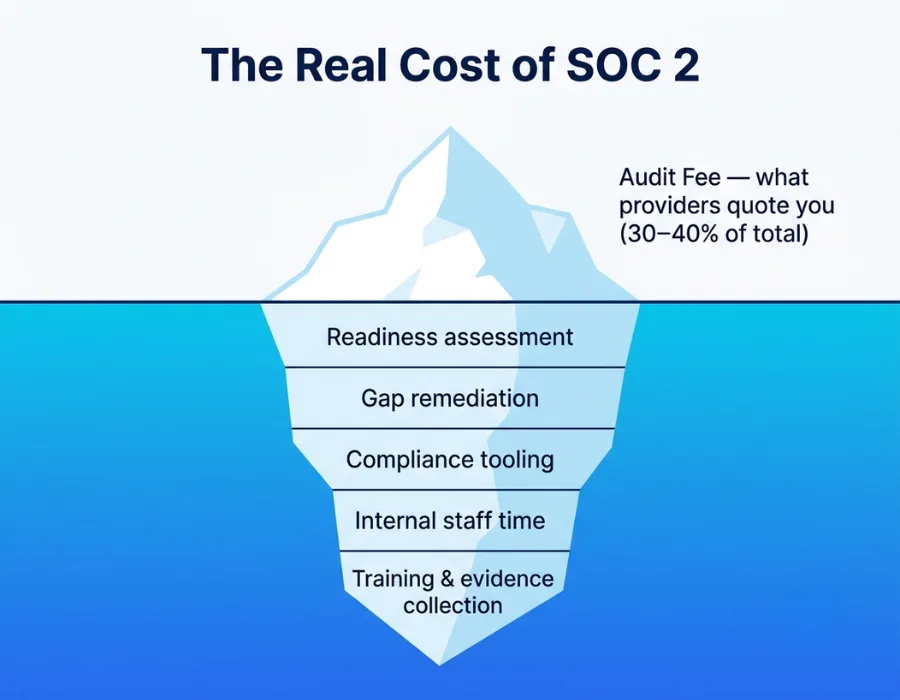
SOC 2 investment varies significantly based on company size, technical complexity, and current security maturity. Factors affecting investment include: company size (number of employees, organizational complexity), technical infrastructure (single cloud vs multi-cloud, number of integrations), current security controls (existing ISO 27001 or starting from scratch), scope decisions (Security only vs multiple Trust Services Criteria), number of products or services in scope, geographic footprint (single region vs global operations), timeline requirements (standard vs accelerated), and remediation complexity. Smaller companies with simple infrastructure typically invest less than mid-size companies with moderate complexity, which invest less than larger enterprises with complex multi-cloud environments. Investment includes: readiness assessment, gap remediation support, policy and procedure development, audit fees, compliance platform tools, implementation support, and evidence automation setup. Annual ongoing investment is required for re-audits, compliance tools, quarterly reviews, and maintenance. Schedule a free assessment to receive a detailed, customized quote based on your specific situation.

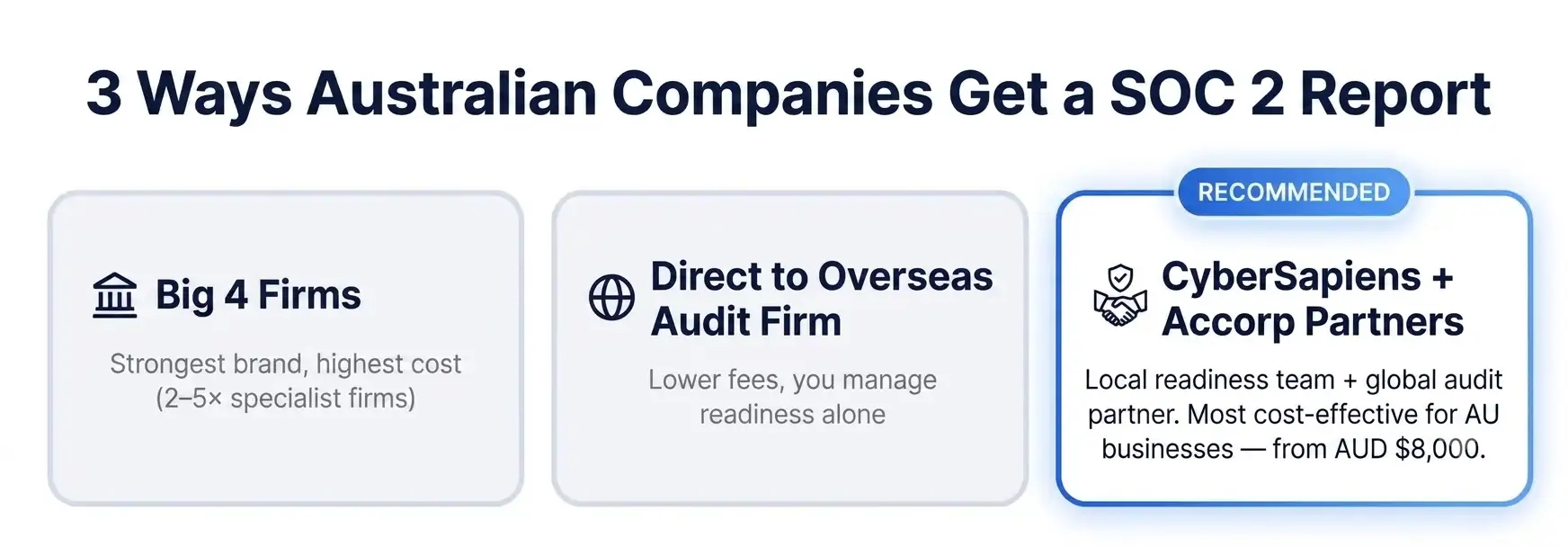
Yes, auditor selection is a critical part of our service. We help you navigate: auditor types including Big 4 firms (Deloitte, PwC, EY, KPMG) for enterprise companies, mid-market firms (RSM, Grant Thornton, BDO) for growth-stage companies, and specialist SOC 2 auditors for startups and focused scope. Our process: create RFP with detailed scope and requirements, distribute to 3-4 qualified auditors from our network, coordinate auditor interviews and technical discussions, evaluate proposals on experience, timeline, and service quality, negotiate favorable terms through our volume relationships, review and negotiate contract terms, and make recommendation based on your needs and budget. Selection criteria we evaluate: industry experience (SaaS, fintech, healthcare), cloud platform expertise (AWS, Azure, GCP), firm size matching your company size, timeline and availability, responsiveness and communication quality, and references from similar companies. Value: we know which auditors are strong in which areas, we have relationships enabling expedited scheduling, we understand fair market rates, and we facilitate smooth audit process.

SOC 2 with Privacy criteria provides substantial but not complete overlap with Australian Privacy Principles (APPs). Overlapping controls include: security safeguards (APP 11) where SOC 2 security controls directly satisfy APP security requirements, data quality (APP 10) where processing integrity criteria address data accuracy, use and disclosure (APP 6) where confidentiality criteria address data protection, access and correction (APP 12) where access management controls support individual rights, and data breach response (NDB scheme) where incident response controls provide foundation. Non-overlapping requirements: consent mechanisms (APPs 3, 7) requiring Australian-specific consent practices, cross-border disclosure (APP 8) requiring specific agreements and notifications, complaint handling (APP 1) requiring formal complaint procedures, and privacy policy (APP 1) requiring Australian law-specific disclosures. Our approach: implement SOC 2 controls as foundation, overlay APP-specific requirements for complete compliance, document control mappings showing APP satisfaction, coordinate with legal counsel for Australian law compliance, and maintain evidence for both SOC 2 audits and OAIC inspections.

You don't technically "pass" or "fail" a SOC 2 audit - auditors issue findings or exceptions. Possible outcomes: clean report with no exceptions (ideal, 70-75% of first-time audits), qualified opinion with minor exceptions (acceptable, 20-25% of audits, issues noted but not material), or significant exceptions requiring remediation (5% of audits, usually preventable with proper preparation). If exceptions occur: auditors document the gap in report, you provide management response explaining remediation plan, clients see both the exception and your response, some exceptions are acceptable depending on client risk tolerance, or you can remediate and request re-audit (additional investment and time). Our approach prevents this: comprehensive readiness assessment identifies all gaps upfront, internal mock audit before formal audit catches issues, continuous auditor communication during observation period, and real-time remediation of any emerging issues. Our track record: 95% first-time clean reports (well above industry average) because we ensure readiness before audit begins. Impact of exceptions: re-audit fees, timeline delay (1-3 months), client confidence impact (exceptions weaken certification value), and potentially lost deals.

Yes, but it requires embedding compliance into change processes. Growth challenges: adding new employees (onboarding, training, access provisioning), launching new products (expanding scope, new security reviews), adopting new technologies (cloud services, SaaS tools, integrations), opening new offices or regions (geographic scope expansion), and scaling infrastructure (more complex architecture). Compliance approach for growth: implement change management process where all changes are documented and security-reviewed, use compliance automation platforms that scale automatically with infrastructure, maintain flexible scope that can expand incrementally, conduct quarterly compliance reviews to catch drift, update policies and procedures as business evolves, plan scope expansions for annual re-audit cycles, and allocate compliance resources proportional to growth. Pro tip: it's easier to maintain compliance while growing than to let it lapse and recertify. Common mistake: achieving certification then neglecting compliance during rapid growth, resulting in major gaps at re-audit. Our ongoing support: quarterly reviews, change management guidance, scope expansion planning, and continuous evidence collection automation ensure your compliance scales with your business.