
SOCI Act Explained: What Australian Critical Infrastructure Operators Must Do
The SOCI Act is Australia’s law for securing critical infrastructure across 11 sectors. Covered operators must register their assets, report cyber incidents within 12 or 72 hours and, for specified asset classes, run a written risk management program (CIRMP).
The SOCI Act is the Security of Critical Infrastructure Act 2018, and it applies to assets across 11 sectors. According to the Cyber and Infrastructure Security Centre, its main duties are to register assets, report cyber incidents, adopt a written critical infrastructure risk management program (CIRMP), and, for systems of national significance, meet enhanced cyber security obligations.
From 10 June 2026 the Enhanced CIRMP Rules apply to nine asset classes, and the grace periods run to 10 June 2027 and 10 June 2028. This guide explains who is covered, what you must do, what has changed and what is still only proposed, then ends with a 90-day checklist.
Where a duty overlaps with common security controls, we point to our Essential Eight guide and our ISO 27001 certification guide. This page is general information and not legal advice, so check the current legislation and CISC guidance for your asset.
Which Sectors and Assets Does the SOCI Act Cover?
The SOCI Act covers 11 sectors, and duties attach to the entities that own or run particular assets within them. Whether a given asset counts as a critical infrastructure asset depends on the Act and its rules, so check the definition for your asset class with the Cyber and Infrastructure Security Centre (CISC).
The 11 sectors
Who holds duties: responsible entities and direct interest holders
The CISC guidance on the Register of Critical Infrastructure Assets separates two roles. Each has its own reporting duties and its own timeframes.
| Role | Who it is | What it reports |
|---|---|---|
| Responsible entity | Typically the entity licensed to own and operate the asset. | Operational information, such as the asset’s location, the area it serves, the entity and its chief executive officer, and how the asset is operated. |
| Direct interest holder | An entity that, with associates, holds at least 10% of the asset, or holds an interest that lets it directly or indirectly influence or control the asset. Moneylenders and custodial or depository providers are excluded. | Interest and control information about the entity and the asset, including any higher entities that can influence or control it. |
A new responsible entity or direct interest holder for an existing critical asset has 30 days to register, and a newly critical asset has a 6-month grace period. Changes must be notified within 30 days.
The nine asset classes under the Enhanced CIRMP Rules
Home Affairs says the amended CIRMP Rules apply to nine asset classes and are now in effect, as set out on its consultation page. These are the classes that need to plan against the 2026 changes in Section 4.
- Critical broadcasting assets
- Critical domain name systems
- Critical electricity assets
- Critical energy market operator assets
- Critical freight infrastructure assets
- Critical freight services assets
- Critical gas assets
- Critical liquid fuel assets
- Critical water assets
A four-question scoping check
Use these questions to decide where to start before you read the obligations in the next section.
Which sector are we in?
Match your business and assets against the 11 sectors above.
What is our role?
Decide whether you are the responsible entity, a direct interest holder, or both, for each asset.
Is the asset in one of the nine Enhanced CIRMP classes?
If so, the 2026 rules and their grace periods apply to it.
Could an asset be a system of national significance?
Assets deemed systems of national significance carry four enhanced cyber security obligations.
What Are the Core SOCI Act Obligations?
The Act places six main duties on covered entities, and not every duty applies to every asset. Use the table to see which apply to you, then check the detail for your asset class with CISC.
| Obligation | What it means | Who and when |
|---|---|---|
| Register assets | Responsible entities give operational information, and direct interest holders give interest and control information, to the Register of Critical Infrastructure Assets. | New responsible entity or direct interest holder: 30 days. Newly critical asset: 6-month grace period. Changes: 30 days. Failure can attract a civil penalty. |
| Report cyber incidents | Report incidents to the Australian Cyber Security Centre (ACSC), by phone then in writing, or through the online form on cyber.gov.au. | Critical incident: 12 hours from becoming aware. Other reportable incident: 72 hours. |
| Adopt a CIRMP | Adopt, maintain and comply with a written critical infrastructure risk management program. | Applies to specified asset classes. The Enhanced CIRMP Rules for nine classes are covered in Section 4. |
| Meet enhanced cyber security obligations | Systems of national significance have four extra duties: incident response plans, cyber security exercises, vulnerability assessments, and providing system information so government can keep a near real-time threat picture. | Applies to assets deemed systems of national significance. |
| Government assistance | The Act includes measures for responding to cyber security incidents that would seriously harm Australia’s prosperity, national security or defence. | Applies where those measures are used. Check the Act for the conditions. |
| Data service provider notification | CISC describes a notification obligation relating to data service providers. | CISC says it applies to all critical infrastructure assets. |
Cyber incident reporting in detail
The CISC incident reporting guidance says a responsible entity must report a critical cyber incident within 12 hours of becoming aware, and an other reportable cyber incident within 72 hours. A phone report to 1300 292 371 must be followed by a written report. The written report is due 84 hours after a verbal report of a critical incident and 48 hours after a verbal report of another incident.
The guidance says space, defence industry and certain aviation assets are excluded from this obligation. It can also extend to data storage systems used with a critical asset, where the entity is responsible for the asset or operates the storage system.
12 hours
Critical cyber incident. Report within 12 hours of becoming aware.
72 hours
Other reportable cyber incident. Report within 72 hours of becoming aware.
Five questions to settle before an incident happens
These are practical checks we suggest for your incident response plan. They are not requirements in the Act.
Who decides?
Name the person who decides whether an event is a reportable cyber incident, and a deputy.
Who calls?
Keep the ACSC reporting number and online form with the incident response plan, and name who makes the call out of hours.
When did we become aware?
Record the time of awareness, because both the 12-hour and 72-hour clocks start from it.
Who writes?
Assign the written report, which is due 84 hours after a verbal critical report and 48 hours after a verbal report of another incident.
What evidence?
Make sure logs and notes are kept so the report can be written accurately.
What Changed in 2026: The Enhanced CIRMP Rules
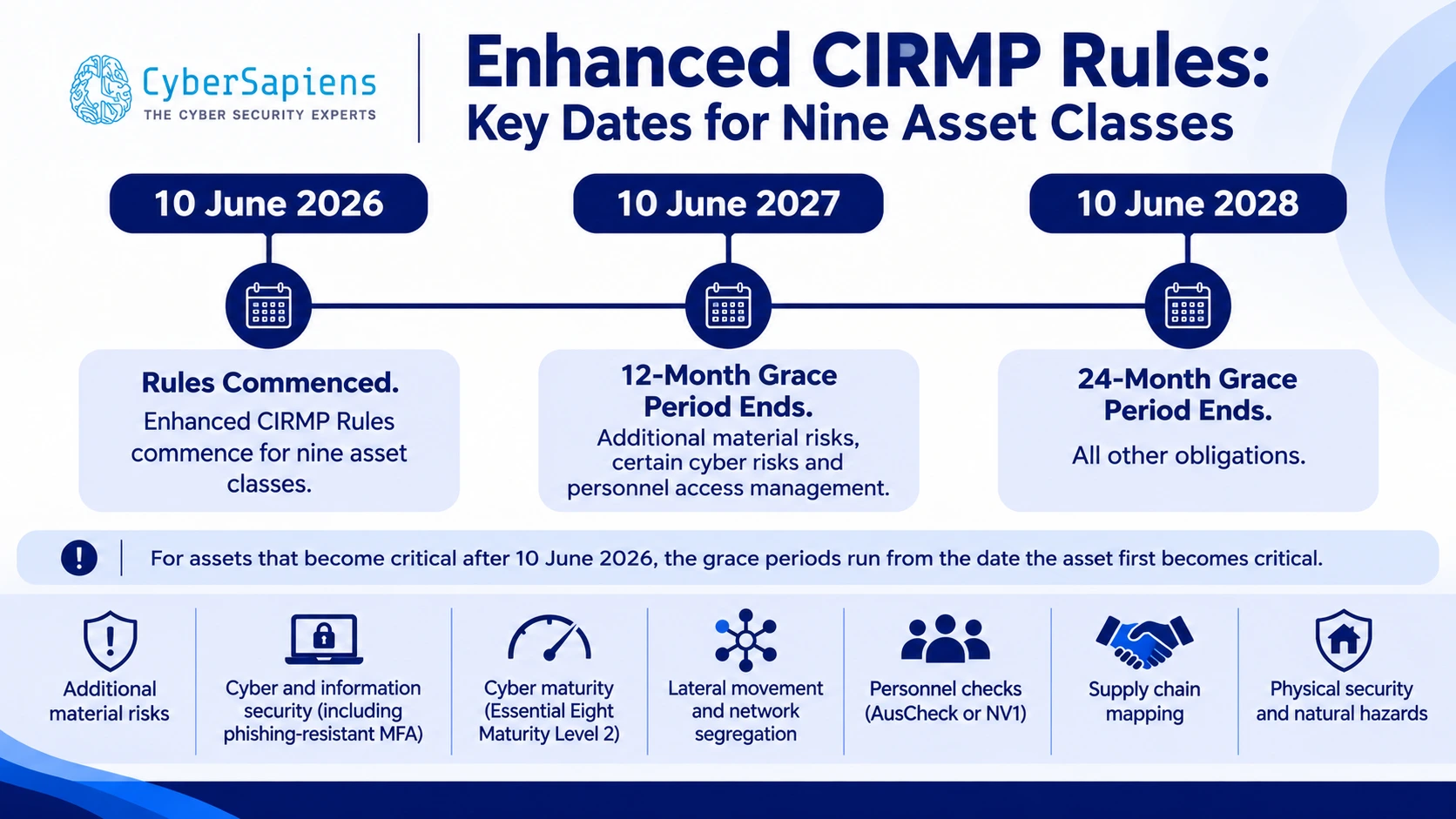
The Enhanced CIRMP Rules commenced on 10 June 2026 and apply to the nine asset classes listed in Section 2. This summary follows the analysis by Landers & Rogers, so check the Rules themselves for the exact wording.
What the rules add
Additional material risks
Minimise or eliminate, as far as reasonably practicable, risks to social and economic stability, national security or defence, foreign ownership, control or influence (FOCI), and offshore or remote access to critical components and business-critical data.
Cyber and information security
Address risks such as unpatched systems, legacy systems and risky use of emerging technology. Use phishing-resistant multi-factor authentication for certain systems, with logging and monitoring of authentication attempts.
Cyber maturity
Comply with a prescribed cyber maturity framework or an equivalent. The list now requires higher levels, such as ASD Essential Eight at Maturity Level 2 where Level 1 applied before.
Lateral movement
Keep an inventory of critical systems and their connections, support recovery, and segregate networks so critical systems can operate independently.
Personnel
Critical workers must pass an AusCheck background check, repeated at least every five years, or hold a Negative Vetting 1 or higher clearance. Entities must also manage unauthorised access and credential misuse.
Supply chain
Map major suppliers and critical components, identify maximum acceptable outages, and assess supplier risks, including FOCI and supplier control over the asset.
Physical security and natural hazards
Centrally manage physical security and natural hazards, considering the physical security consequences of all hazards as far as reasonably practicable.
Deadlines and grace periods
| Date | What happens |
|---|---|
| 10 June 2026 | The Enhanced CIRMP Rules commence. |
| 10 June 2027 | The 12-month grace period ends for additional material risks, certain cyber risks and personnel access management. |
| 10 June 2028 | The 24-month grace period ends for the other obligations. |
For assets that become critical after 10 June 2026, the grace periods run from the date the asset first becomes critical. The source we reviewed does not say which individual requirement falls in which period beyond the groupings above, so confirm the detail in the Rules.
A sensible order of work
This is the order we suggest, and it is not part of the Rules. Because many controls overlap, our Essential Eight guide is a useful companion for the maturity step.
1. Gap check
Compare your current program with the seven areas above, asset class by asset class.
2. Start with 2027
Prioritise the areas due on 10 June 2027: additional material risks, certain cyber risks and personnel access management.
3. Check maturity
Assess your Essential Eight maturity against Level 2, and plan the remaining work for 10 June 2028.
Which Cyber Framework Satisfies the CIRMP Rules?
The Enhanced CIRMP Rules ask an entity to include a process in its CIRMP to comply with one prescribed cyber security framework, or an equivalent. MinterEllison lists five frameworks and says the framework uplift is due by 10 June 2028. You need one of them, not all five.
| Framework | Published by | Level the rules require | Notes |
|---|---|---|---|
| AS ISO/IEC 27001:2023 | ISO/IEC, adopted in Australia | No level stated | An information security management system standard. Useful if you already hold or plan certification. |
| Essential Eight Maturity Model | Australian Signals Directorate (ASD) | Maturity Level 2 | Prioritised technical mitigations. Raised from Level 1 under the 2026 rules. |
| NIST CSF 2.0 | NIST, United States | No level stated | A flexible framework for managing cyber risk. Newer edition required. |
| C2M2 v2.1 | US Department of Energy | Maturity Indicator Level 2 | A maturity model for cybersecurity capability. Raised from Level 1. |
| 2023 AESCSF Framework Core | Australian Energy Market Operator (AEMO) | Security Profile 2 | Built around the energy sector. Raised from Security Profile 1. |
Cliffside says an equivalent framework is accepted only if it is equivalent to the Essential Eight, C2M2 or AESCSF entries and the maturity condition is also included. Both summaries are secondary, so check section 8A of the Rules before you rely on them.
Even where the chosen framework does not require phishing-resistant MFA, MinterEllison says entities must implement MFA on identified systems and centrally log and review authentication attempts.
How to choose
These starting points are our suggestions and not part of the Rules. Our guide on how vCISO services help Australian businesses meet regulatory compliance standards explains one way to coordinate the work.
You already hold ISO 27001
Map your existing controls to the CIRMP areas first. This may be the shortest path, but confirm with your adviser that your scope covers the critical assets.
Your IT estate is the main gap
The Essential Eight at Maturity Level 2 gives a concrete, testable target for patching, MFA, backups and application control.
You operate in energy
The AESCSF at Security Profile 2 may already be part of your reporting. Check how it lines up with your CIRMP.
You work with US partners
C2M2 or NIST CSF 2.0 may fit shared reporting, but they must still meet the conditions in the Rules.
SOCI Act Compliance Checklist: Your First 90 Days
This plan is our suggested order of work. It is built from the duties and dates in the sections above and is not part of the Act or the Rules. Ninety days will not finish everything, but it gives you a baseline, a prioritised gap list and evidence to build on before the 2027 and 2028 dates.
Days 1 to 30: scope and baseline
- Confirm the sector, your role (responsible entity, direct interest holder or both) and the asset class for each asset.
- Check that your register entries are current, and note that changes must be notified within 30 days.
- Identify any asset in the nine Enhanced CIRMP classes, and record the 10 June 2027 and 10 June 2028 dates against it.
- Pick the prescribed framework you will work to, and record your current maturity against it.
- Name who decides that an incident is reportable, and keep the ACSC reporting details in your incident response plan.
Days 31 to 60: close the gaps
- Compare your CIRMP with the seven areas in Section 4, and list what is due first on 10 June 2027.
- List unpatched and legacy systems, and set a patching or replacement date for each.
- Put multi-factor authentication on identified systems, with central logging and review of authentication attempts.
- Start an inventory of critical systems and their connections, and review how networks are segregated.
- Map major suppliers and critical components, and record the maximum acceptable outage for each.
- Identify critical workers and check their AusCheck or Negative Vetting 1 status.
Days 61 to 90: test and evidence
- Run a vulnerability assessment and penetration test of critical systems, with written authorisation and agreed test windows.
- Rehearse the 12-hour and 72-hour reporting steps in a tabletop exercise.
- Keep a remediation tracker, test results and decisions in one place as evidence.
- Brief leadership on the findings, the plan and any risks you are accepting.
- Add the 2027 and 2028 dates, and a check on the proposed reforms, to your calendar.
Adjust the plan for your asset class, because the Enhanced CIRMP Rules apply to nine asset classes and duties for other classes may differ. Take legal advice on how the Act applies to your organisation.
Content Reviewed By

Ketki Tidke
Cyber Security and GRC Lead Auditor
ISO 27001 Lead Auditor
Ketki is a certified ISO 27001 Lead Auditor specialised in Governance, Risk and Compliance, with experience consulting public, private, and government clients. She evaluates threats, risk impacts, and regulatory requirements across multiple industry frameworks.
SOCI Act FAQs
What does SOCI mean?
SOCI stands for the Security of Critical Infrastructure Act 2018, the federal law that sets security duties for owners and operators of critical infrastructure assets in Australia. The Cyber and Infrastructure Security Centre (CISC) administers it. Its main duties are to register assets, report cyber incidents, adopt a critical infrastructure risk management program (CIRMP) and, for systems of national significance, meet enhanced cyber security obligations.
Who does the SOCI Act apply to?
The SOCI Act applies to responsible entities and direct interest holders of critical infrastructure assets across 11 sectors. These are communications, financial services and markets, data storage or processing, defence industry, higher education and research, energy, food and grocery, healthcare and medical, space technology, transport, and water and sewerage. Whether a particular asset counts as critical depends on the Act and its rules, so check the definition for your asset class with CISC.
How quickly must a cyber incident be reported under the SOCI Act?
A critical cyber incident must be reported within 12 hours of becoming aware, and another reportable cyber incident within 72 hours. A phone report must be followed by a written report, due 84 hours after a verbal report of a critical incident and 48 hours after a verbal report of another incident. Reports go to the Australian Cyber Security Centre.
What is a CIRMP under the SOCI Act?
A CIRMP is a written critical infrastructure risk management program that a responsible entity must adopt, maintain and comply with. The Enhanced CIRMP Rules commenced on 10 June 2026 for nine asset classes, with grace periods ending on 10 June 2027 and 10 June 2028. They add requirements on additional material risks, cyber security, cyber maturity, lateral movement, personnel, supply chain, and physical security and natural hazards.
Are the SOCI Tranche 2 reforms law yet?
No, the Tranche 2 reforms are proposals only. The Government consulted on them and submissions closed on 31 July 2026, and as at 17 November 2026 we did not find evidence that a bill has been introduced. Check the Department of Home Affairs website for the latest status.
Book a Free SOCI and CIRMP Gap Assessment
Get a free gap assessment of your SOCI Act and CIRMP position, mapped to the Essential Eight and ISO 27001. You receive a clear view of what to fix first before the 2027 and 2028 dates.
Book a Free Assessment