
Top 10 ISO 27001 Implementation Mistakes That Could Cost You Your Certification
Achieving ISO 27001 certification is a significant milestone for any organization, demonstrating a strong commitment to information security and risk management. However, many organizations underestimate how easy it is to lose certification—or fail an audit, due to common implementation mistakes. In most cases, certification failures are not caused by a lack of effort, but by gaps in execution, misunderstood requirements, or poor alignment between documentation and real-world practices.
ISO 27001 requires more than well-written policies. Auditors look for evidence that security controls are effectively implemented, risks are properly assessed, and the Information Security Management System (ISMS) is actively maintained and improved. When organizations treat ISO 27001 as a one-time compliance exercise, small oversights can quickly turn into major non-conformities.
This blog explores the top 10 ISO 27001 implementation mistakes that can cost you your certification and how to avoid them.
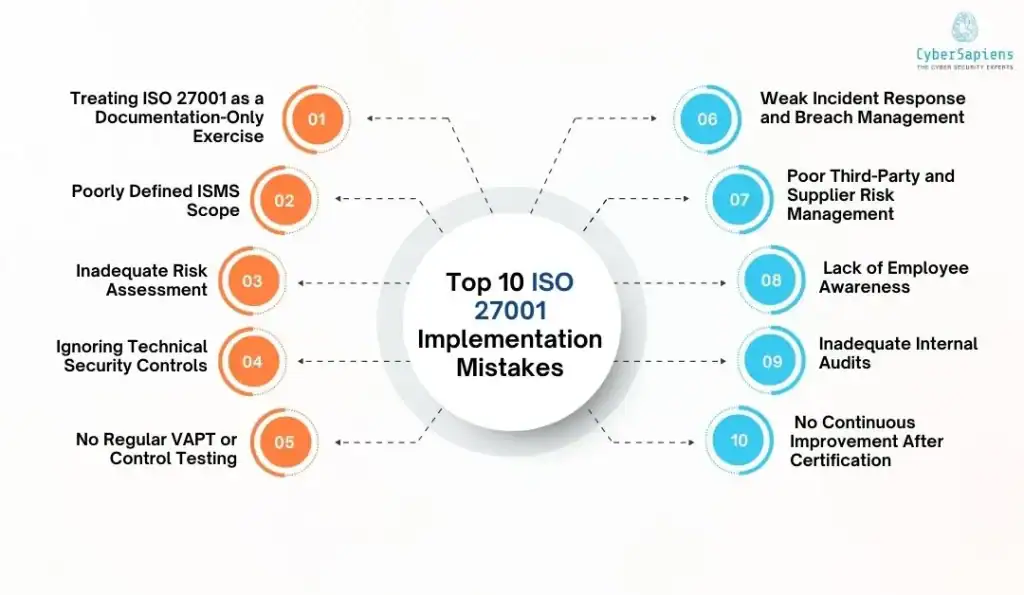
Mistake #1: Treating ISO 27001 as a Documentation-Only Exercise
Many organizations assume that having policies and procedures in place is enough to pass an ISO 27001 audit. In reality, auditors look for evidence that security controls are actively implemented and operating effectively.
Why This Mistake Causes Audit Failures?
- Overemphasis on Policies and Templates: Organizations focus heavily on documentation while neglecting real security controls and operational practices.
- Lack of Evidence for Control Implementation: Missing logs, access reviews, incident records, or change management evidence raises immediate audit concerns.
- Disconnect Between Documentation and Operations: Policies exist, but employees and technical teams do not follow or even understand them.
- Assuming Certification Is a One-Time Activity: Treating ISO 27001 as a checkbox exercise leads to weak controls and poor audit outcomes.
Mistake #2: Poorly Defined ISMS Scope
A poorly defined ISMS scope is one of the fastest ways to trigger audit non-conformities. When the scope is unclear, overly broad, or disconnected from actual operations, auditors struggle to determine what is protected, and gaps quickly surface.
Why an Incorrect ISMS Scope Causes Certification Issues?
- Scope Is Too Broad or Unrealistic: Including systems, locations, or processes that are not properly controlled increases audit risk and complexity.
- Critical Assets Are Excluded: Key applications, cloud environments, or third-party services may be left out, creating security blind spots.
- Mismatch Between Scope and Risk Assessment: Risks are assessed for assets that are not clearly defined within the ISMS scope, leading to inconsistencies.
- Lack of Justification for Inclusions or Exclusions: Auditors expect a clear, documented rationale for what is inside and outside the ISMS scope.
- Business and Technical Teams Are Not Aligned: Different interpretations of scope across teams result in gaps in control implementation and evidence.
Mistake #3: Inadequate Risk Assessment and Risk Treatment
Risk assessment is the backbone of ISO 27001, yet many organizations approach it as a formality rather than a decision-making tool. Generic or incomplete risk assessments often lead to ineffective controls and major audit non-conformities.
Why Poor Risk Management Leads to Audit Failures?
- Using Generic or Copy-Paste Risk Registers: Risks are not tailored to the organization’s actual assets, threats, or business context.
- Lack of Business Impact Analysis: Risks are assessed without considering real operational, financial, or regulatory impact.
- Unclear Risk Acceptance Criteria: There is no defined methodology for evaluating likelihood, impact, or acceptable risk levels.
- Weak or Incomplete Risk Treatment Plans: Controls are selected without justification, ownership, or clear timelines.
- Risk Assessments Are Not Updated Regularly: Changes in infrastructure, applications, or threats are not reflected in the risk register.
Mistake #4: Ignoring Technical Security Controls
Many organizations focus heavily on governance and documentation while underestimating the importance of technical security controls. ISO 27001 requires not only policies but also effective technical measures to protect systems and data.
Why Weak Technical Controls Lead to Audit Non-Conformities?
- Insufficient Access Control Implementation: User access is not reviewed regularly, privileged accounts are poorly managed, or access rights are excessive.
- Lack of Logging and Monitoring: Security events are not logged, monitored, or reviewed, making it difficult to detect incidents or demonstrate control effectiveness.
- Unsecured Applications and APIs: Application-level security controls such as input validation, authentication, and secure configurations are missing or inconsistently applied.
- Poor Vulnerability and Patch Management: Known vulnerabilities remain unaddressed due to a lack of regular scanning, testing, or patching.
- Controls Are Not Tested in Real-World Scenarios: Technical controls exist, but have never been validated through testing such as VAPT.
Mistake #5: No Regular VAPT or Control Testing
Many organizations perform vulnerability assessments or penetration tests only once, often just before an audit. This approach fails to meet ISO 27001’s requirement for continuous risk management and control validation.
Why Lack of Regular VAPT Causes Certification Issues?
- Security Testing Is Treated as a One-Time Activity: Controls are not re-tested after changes to applications, infrastructure, or configurations.
- No Evidence of Continuous Improvement: Auditors expect ongoing testing and improvement, not point-in-time assessments.
- Unidentified New or Emerging Vulnerabilities: Changes in the threat landscape or system updates introduce risks that remain untested.
- VAPT Findings Are Not Tracked or Closed: Vulnerabilities are identified but not documented, remediated, or re-tested.
- Limited Audit Evidence: Without regular VAPT reports, organizations struggle to demonstrate control effectiveness.
Mistake #6: Weak Incident Response and Breach Management
An ineffective or untested incident response process is a serious ISO 27001 gap. Auditors expect organizations to not only document incident response procedures but also demonstrate readiness to detect, respond to, and learn from security incidents.
Why Poor Incident Response Leads to Audit Failures?
- Incident Response Plans Exist Only on Paper: Procedures are documented but never tested or communicated to relevant teams.
- Lack of Defined Roles and Responsibilities: Employees are unclear about who handles incidents, escalation paths, or decision-making authority.
- Delayed Detection and Response: Weak monitoring and unclear workflows result in slow containment and increased impact.
- No Evidence of Incident Testing or Drills: Tabletop exercises or simulations are missing, raising concerns about real-world readiness.
- Incidents Are Not Reviewed or Documented: Lessons learned are not captured, and corrective actions are not implemented.
Mistake #7: Poor Third-Party and Supplier Risk Management
Third-party vendors, cloud providers, and service partners often have access to sensitive systems and data. Failing to manage these risks effectively is a common reason for ISO 27001 audit findings.
Why Weak Supplier Risk Management Causes Certification Issues?
- No Formal Vendor Risk Assessment Process: Suppliers are onboarded without evaluating their security posture or compliance.
- Missing or Inadequate Security Clauses in Contracts: Contracts lack clear security, confidentiality, and incident reporting requirements.
- Lack of Ongoing Supplier Monitoring: Vendor risks are assessed once and never reviewed, even when services or data access change.
- Unclear Ownership of Third-Party Risks: Responsibility for managing supplier risks is not clearly assigned.
- Cloud and SaaS Providers Are Overlooked: Critical cloud services fall outside formal risk assessments and ISMS scope.
Mistake #8: Lack of Employee Awareness and Training
Employees play a critical role in information security, yet many organizations underestimate the importance of regular, role-based security awareness training. Auditors often view weak training programs as a major risk to the effectiveness of the ISMS.
Why Poor Security Awareness Leads to Audit Non-Conformities?
- Employees Are Unaware of Security Policies: Staff do not understand information security requirements, acceptable use, or data handling procedures.
- No Role-Based or Ongoing Training: Training is generic, infrequent, or not tailored to specific job roles.
- Low Awareness of Phishing and Social Engineering Risks: Employees are unable to recognize or report common attack techniques.
- Lack of Training Records and Evidence: Organizations cannot demonstrate that training has been completed or reviewed.
- Security Responsibilities Are Not Reinforced: Awareness efforts are not supported by leadership or integrated into daily operations.
Mistake #9: Inadequate Internal Audits and Management Reviews
Internal audits and management reviews are mandatory requirements under ISO 27001, yet many organizations treat them as formalities. When these activities are weak or skipped, auditors often raise major non-conformities.
Why Weak Internal Audits Cause Certification Issues?
- Internal Audits Are Skipped or Delayed: Audits are not conducted at planned intervals or before certification and surveillance audits.
- Audits Lack Independence or Depth: Audits are performed by untrained staff or focus only on documentation, not on control effectiveness.
- Findings Are Not Tracked or Closed: Non-conformities and observations are identified but not remediated or verified.
- Management Reviews Are Superficial: Reviews do not address risks, incidents, audit results, or improvement actions.
- No Evidence of Leadership Involvement: Lack of top management participation weakens ISMS governance.
Mistake #10: No Continuous Improvement After Certification
Many organizations view ISO 27001 certification as the end of the journey rather than the beginning. Failing to continuously improve the ISMS after certification is a common reason for losing certification during surveillance audits.
Why Lack of Continuous Improvement Leads to Certification Loss?
- ISMS Is Not Updated for Business or Technology Changes: New systems, applications, or processes are introduced without updating risks and controls.
- Risks and Controls Are Not Reviewed Regularly: Risk assessments, control effectiveness, and treatment plans become outdated.
- No Follow-Up on Audit Findings or Incidents: Lessons learned from audits and security incidents are not incorporated into the ISMS.
- Surveillance Audits Are Underestimated: Ongoing audits are treated casually, leading to repeated non-conformities.
- Security Becomes a Compliance Checkbox Again: Without improvement, security maturity stagnates and audit risk increases.
How CyberSapiens Helps You Avoid ISO 27001 Implementation Failures?
ISO 27001 failures often occur due to gaps between documentation, technical controls, and real operational practices. CyberSapiens helps organizations avoid these pitfalls by delivering a risk-driven, audit-ready, and practical approach to ISO 27001 implementation.
Ways CyberSapiens Ensures Successful ISO 27001 Implementation
1. Practical ISMS Design, Not Just Documentation
CyberSapiens focuses on building an Information Security Management System (ISMS) that works in practice, not just on paper. Policies and procedures are mapped directly to implemented security controls, ensuring that documentation accurately reflects day-to-day operations. This alignment helps organizations demonstrate real security maturity during audits rather than relying on theoretical or copy-paste documents.
2. Clear and Auditable ISMS Scoping
Defining the ISMS scope is one of the most critical and commonly misunderstood steps in ISO 27001. CyberSapiens guides organizations to establish a clear, realistic, and defensible scope that includes critical assets, systems, third-party dependencies, and data flows. This clarity minimizes auditor confusion and significantly reduces the risk of scope-related non-conformities.
3. Risk-Based Assessment and Treatment
Instead of generic risk registers, CyberSapiens conducts tailored risk assessments that reflect actual business processes, technical architecture, and regulatory obligations. Risks are evaluated based on real-world likelihood and impact, and treatment plans are aligned with business priorities, ensuring that risk management is both compliant and meaningful.
4. Strong Technical Control Implementation
CyberSapiens supports the implementation of robust technical controls aligned with ISO 27001 Annex A. This includes access control management, centralized logging and monitoring, vulnerability management, secure configuration, and secure application development practices. The focus is on measurable, auditable controls that strengthen security posture while meeting compliance requirements.
5. Integrated VAPT for Control Validation
Vulnerability Assessment and Penetration Testing (VAPT) is integrated into the ISMS to validate whether implemented controls are effective in real-world attack scenarios. Regular testing provides tangible evidence that security measures are functioning as intended, strengthening audit outcomes and reducing security blind spots.
6. Audit-Ready Evidence and Reporting
CyberSapiens ensures organizations are fully prepared with structured, traceable, and auditor-ready evidence. This includes risk assessments, control implementation records, monitoring reports, corrective actions, and management reviews. Having well-organized evidence significantly reduces last-minute audit pressure and improves audit efficiency.
7. Independent Internal Audits and Readiness Reviews
Independent internal audits and readiness assessments are conducted to identify gaps well before certification or surveillance audits. CyberSapiens provides clear findings, root cause analysis, and corrective action guidance, enabling organizations to address issues proactively rather than reacting during external audits.
8. Incident Response and Compliance Readiness
Incident response plans are designed, documented, tested, and periodically reviewed to meet ISO 27001 and regulatory expectations. CyberSapiens helps organizations establish clear escalation paths, response roles, and reporting mechanisms, ensuring preparedness for both security incidents and compliance scrutiny.
9. Continuous Compliance and Improvement Support
ISO 27001 is not a one-time activity. Post-certification, CyberSapiens supports continuous improvement through ongoing risk reviews, periodic VAPT, control monitoring, and surveillance audit preparation. This approach helps organizations maintain certification, adapt to evolving threats, and demonstrate continual improvement as required by the standard.
By partnering with Cybersecurity experts at CyberSapiens, organizations can avoid common ISO 27001 implementation failures and build a resilient, continuously improving ISMS that stands up to audits and real-world threats.
Clients Served by CyberSapiens






Turning ISO 27001 Compliance into a Competitive Advantage
ISO 27001 certification is not just about meeting a standard; it’s about building a security program that actually works. As the common implementation mistakes show, organizations often fail not because they lack intent, but because of gaps in execution, testing, and continuous improvement. Treating ISO 27001 as a one-time or documentation-only exercise can quickly lead to audit non-conformities and loss of certification.
A successful ISO 27001 implementation requires a balanced approach that combines strong governance, effective technical controls, regular VAPT, and clear audit evidence. When these elements work together, the ISMS becomes a living framework that adapts to changing risks, technologies, and business needs.
With its end-to-end ISO 27001 consulting, VAPT, internal audit, and continuous compliance services, CyberSapiens helps organizations avoid costly implementation failures and maintain long-term compliance. By focusing on practical, risk-driven security, CyberSapiens enables organizations to turn ISO 27001 certification into a lasting competitive advantage rather than a recurring audit challenge.
FAQs: Top 10 ISO 27001 Implementation Mistakes That Could Cost You Your Certification.
1. Can ISO 27001 certification be revoked after approval?
Answer: Yes. Certification can be suspended or revoked if major non-conformities are found during surveillance audits or if the ISMS is not properly maintained.
2. Why is the ISMS scope so important in ISO 27001?
Answer: The ISMS scope defines what systems, data, and processes are protected. An unclear or incorrect scope often leads to audit findings and unmanaged risks.
3. How often should risk assessments be updated under ISO 27001?
Answer: Risk assessments should be reviewed at planned intervals and whenever significant changes occur, such as new systems, applications, or regulatory requirements.
4. Is VAPT required for ISO 27001 certification?
Answer: ISO 27001 does not explicitly mandate VAPT, but auditors strongly expect evidence that technical controls are tested. Regular VAPT is considered best practice for compliance.
