

Top 10 Phishing Simulation Tools to Train Banking Staff Against Phishing Email Attacks
In today’s digital banking landscape, phishing email attacks are among the most prevalent and damaging threats. Cybercriminals craft deceptive emails to harvest credentials, trigger unauthorised transactions or steal sensitive data. For banks, the human element—staff clicking malicious links—remains the weakest link.
That’s where phishing simulation tools come in: they recreate realistic phishing campaigns in a controlled environment, helping staff recognise and defuse threats before they cause harm. This article dives deep into the Top 10 Phishing Simulation Tools to Train Banking Staff Against Phishing Email Attacks, equipping security teams with actionable insights to choose and implement the right solution.
What Is a Phishing Simulation Tool?
Defining Phishing Simulation for Banking Institutions
A phishing simulation tool is specialised software that sends mock phishing emails to employees, tracking who falls for the lure and providing follow-up training. Unlike generic security awareness content, these platforms offer:
- Customisable email templates that mimic real-world banking scams
- Automated scheduling for regular campaigns
- Detailed analytics capturing open rates, click-throughs and credential submissions
How Simulations Replicate Real-World Phishing Email Attacks
To build “muscle memory” among staff, simulations employ:
- Brand spoofing
- Social-engineering pretexts (e.g. urgent account freeze notices)
- Cloned landing pages that harvest dummy credentials
Case Study: A mid-sized Australian bank reduced click-through rates from 35% to 8% within six months by running monthly simulations that adapted to emerging scam trends.
Why Phishing Simulation Matters for Banking Staff
The Cost of a Successful Phishing Attack in Banks
- Financial losses averaging AU$1.2 million per incident¹
- Regulatory fines under APRA’s CPS 234 for poor cyber-risk management
- Reputational damage eroding customer trust
Human Factor—The Weakest Link
“Even the most advanced email filters can’t stop a well-crafted phishing email when an employee clicks without thinking.” – CISO, Leading Retail Bank
- Industry studies show up to 30% of staff click on phishing links during unannounced tests.
- Regular simulations reduce click-rates by reinforcing vigilance and embedding best practices.
List of Top 10 Phishing Simulation Tools for Banking Staff
Each of the following platforms excels at phishing email attack simulations tailored for financial institutions.
1. PhishCare: Best Phishing Simulation Tool
PhishCare offers real-time analytics, custom templates and interactive awareness modules. Its strengths include:
- Custom domain integration for authentic simulations
- Automated follow-up training triggered by user clicks
- Dashboard drill-downs by branch, department and role
- Cyber security awareness Training for banking staff
Quote: “PhishCare’s banking-specific templates reduced staff click rates by 60% in under three months.”
2. BankGuard Sim
BankGuard Sim focuses on dynamic link rewriting and attachment-based attacks. Highlights:
- Malware-style attachments to mimic real trojans
- Behavioural scoring for risk-profiled follow-ups
3. SentinelPhish
Ideal for large retail banks, SentinelPhish provides:
- Bulk campaign scheduling across global branches
- User segmentation by risk level and job function
4. CloudPhish Pro
CloudPhish Pro is fully hosted with minimal IT overhead:
- GDPR- and APRA-compliant data handling
- Multi-tenant dashboards for banks with subsidiaries
5. AI-PhishGen
By leveraging machine learning, AI-PhishGen auto-generates new scam templates:
- Natural-language phishing copy adaptation
- Continuous threat-feed updates
6. ThreatLens
ThreatLens connects to global phishing feeds to ensure simulations mirror current campaigns:
- Zero-day phishing lures included
- Weekly template refreshes
7. RiskScore Simulator
RiskScore Simulator assigns each user a phishing risk score based on performance:
- Automated micro-learning for high-risk staff
- Leaderboard dashboards to gamify awareness
8. MobilePhish Tester
Recognising the mobile-first workforce, MobilePhish Tester offers:
- SMS-based phishing simulations
- In-app training modules for smartphone users
9. CompliancePhish Suite
Built for regulatory alignment, CompliancePhish Suite features:
- RBI & PCI-DSS template libraries
- Audit-ready reports for examiners
10. OpenPhishFramework
For banks with in-house expertise, OpenPhishFramework provides:
- Fully customisable codebase
- Community-driven template marketplace
Best Practices for Implementing Phishing Simulations in Banks
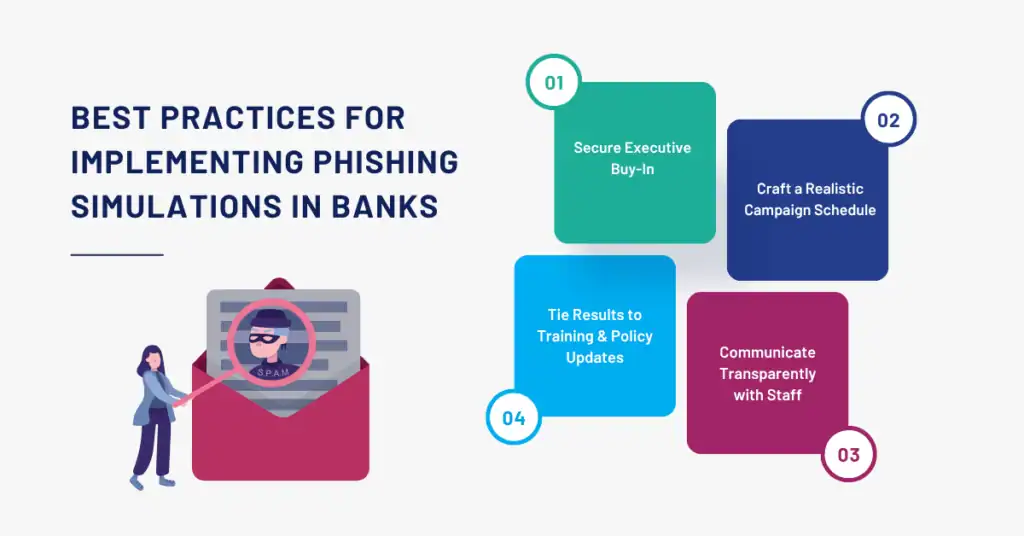
- Secure Executive Buy-In
- Present cost-benefit analyses and case studies.
- Craft a Realistic Campaign Schedule
- Start quarterly, then increase frequency to monthly.
- Communicate Transparently with Staff
- Explain purpose, not punishment.
- Tie Results to Training & Policy Updates
- Use analytics to refine security policies.
Conclusion
Effective defence against phishing email attacks hinges on regular, realistic simulations and targeted training. The 10 top phishing simulation tools reviewed here—ranging from PhishCare to OpenPhishFramework—offer diverse features suited to banks of all sizes. By selecting the right platform, following best practices and measuring key metrics, banking institutions can transform their weakest link into their greatest line of defence.
FAQs
1. How often should banking staff undergo phishing simulation campaigns?
Ans: Aim for monthly simulations after an initial quarterly pilot, to maintain vigilance.
2. Can simulation tools integrate with existing email systems?
Ans: Yes—most support SMTP relay, Office 365 and G Suite integration for seamless delivery.
3. Are mobile-based phishing tests necessary?
Ans: Absolutely; SMS and in-app lures reflect real threats faced on smartphones.
4. What training is provided when a staff member fails a simulation?
Ans: Platforms automate bite-sized learning modules and quizzes immediately after a click.
5. Do phishing simulation tools help with compliance audits?
Ans: Many include audit-ready reporting aligned to APRA, PCI-DSS and other regulations.
