
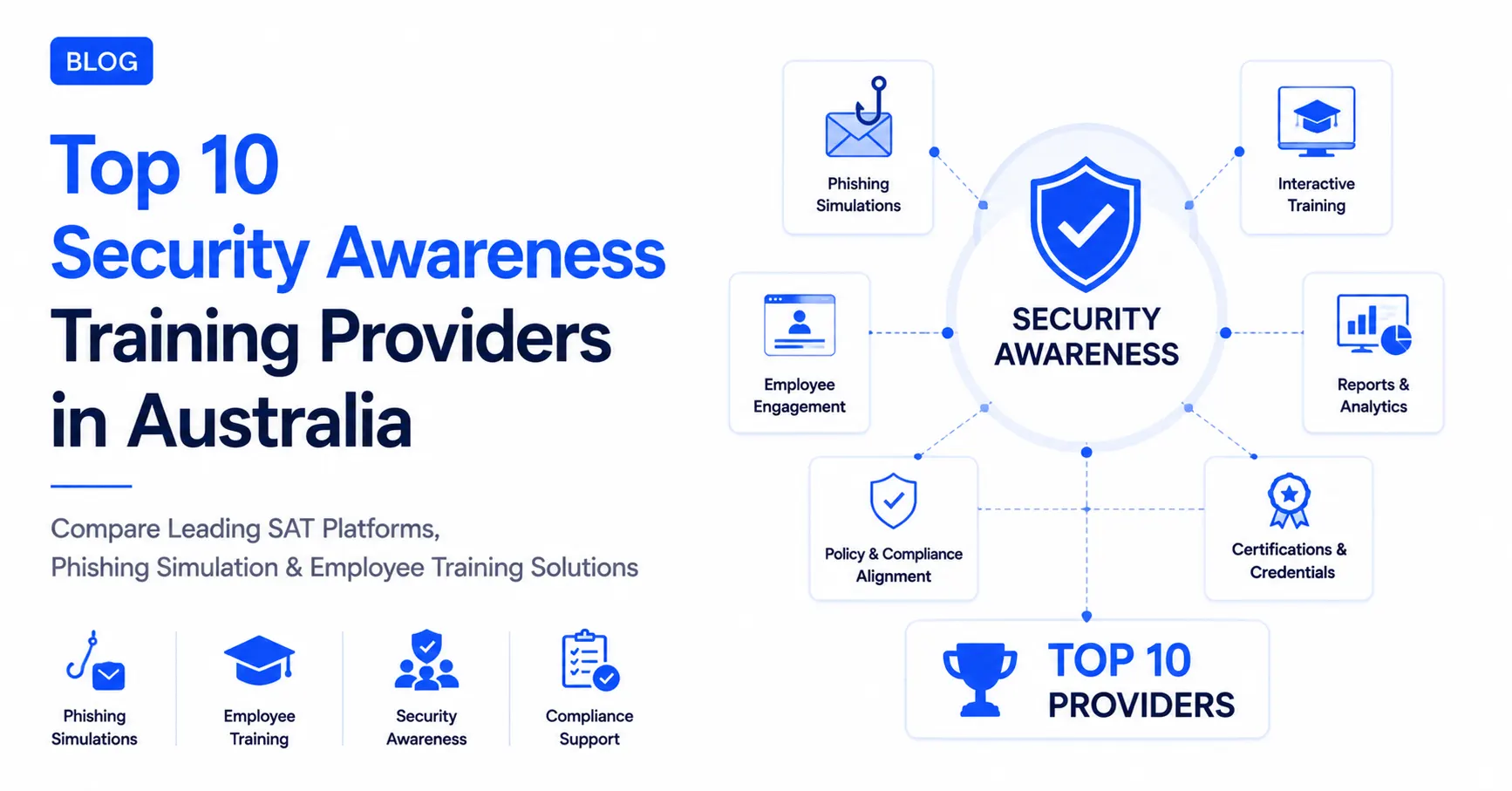
Top 10 Security Awareness Training Providers in Australia
Why Security Awareness Training is Essential for Australian Businesses in 2026
Cyber attacks targeting Australian businesses have shifted significantly. Attackers no longer rely primarily on exploiting software vulnerabilities — they increasingly target employees through phishing emails, AI-generated scams, business email compromise, and social engineering campaigns that are becoming harder to detect every month.
Human error is attributed to nearly two thirds of reported phishing incidents in Australia. The majority of data breaches begin with a successful phishing attempt that an untrained employee failed to recognise. According to the Australian Signals Directorate’s Cyber Threat Report, social engineering and phishing remain the leading initial access methods used against Australian organisations across all industry sectors — with a cybercrime reported every six minutes.
For Australian businesses pursuing Essential Eight compliance, ISO 27001 certification, or SOC 2 attestation, formal security awareness training and phishing simulation programs are not optional extras — they are control requirements auditors will assess. This guide covers the top 10 security awareness training providers in Australia for 2026, what to look for when choosing one, and what a structured program should cover.
Every 6 min
Cybercrime reported in Australia
~66%
Of phishing incidents caused by human error
3,000+
Phishing simulations delivered by PhishCare
90%
PhishCare campaign effectiveness rate
Want to reduce your human cyber risk with phishing simulations?
CyberSapiens and PhishCare deliver end-to-end security awareness training for Australian businesses — baseline assessment, ongoing campaigns, and compliance reporting.
What to Look For in a Security Awareness Training Provider in Australia
Before shortlisting providers, evaluate firms against these five criteria specific to the Australian threat environment and regulatory context.
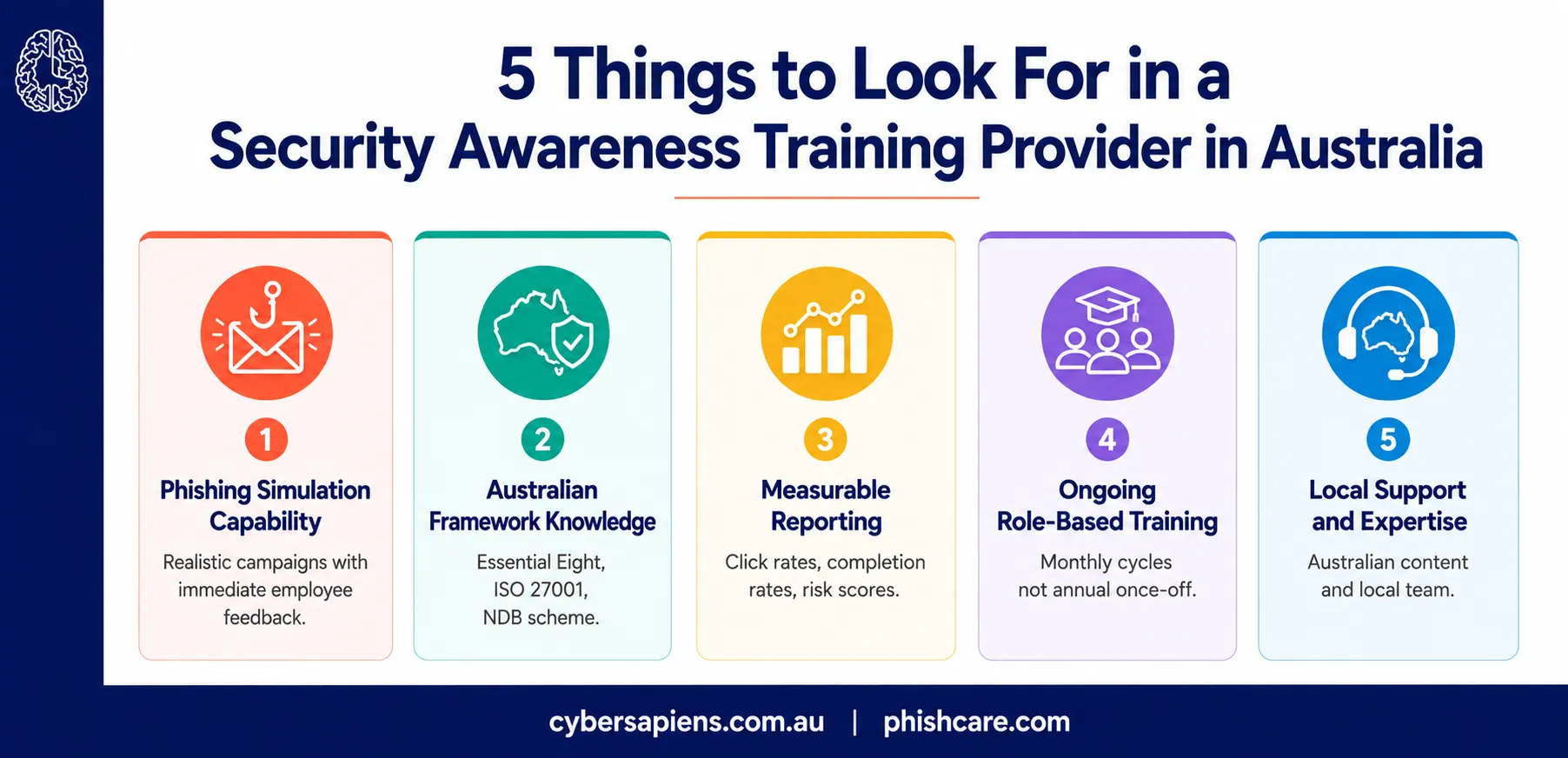
Phishing Simulation Capability
A training program without phishing simulation is incomplete. Employees need to experience realistic simulated attacks, see how they respond, and receive immediate targeted feedback. Providers that combine awareness modules with ongoing phishing campaigns produce measurably better outcomes than those delivering training content alone.
Australian Regulatory Alignment
The provider should understand Australian-specific compliance requirements — the Essential Eight Maturity Model, the Notifiable Data Breaches scheme, ISO 27001, CPS 234, and SOC 2 where applicable. Generic global platforms often miss the local regulatory context that Australian auditors expect to see documented.
Measurable Reporting and Outcomes
Look for providers that track click rates, completion rates, repeat offenders, department-level performance, and improvement over time. Boards and security teams need to demonstrate the program is reducing human risk — not just that training was delivered. Compliance-ready reporting is a must for Essential Eight and ISO 27001 audits.
Role-Based and Ongoing Training
Annual once-off training modules do not change behaviour. Effective providers deliver ongoing microlearning sessions, role-based content tailored to specific risks faced by different departments, and continuous phishing simulation cycles that keep employees sharp throughout the entire year — not just in the week after the compliance training date.
Local Support and Sector Experience
Australian businesses benefit from providers with local support teams, content developed for the Australian threat landscape, and demonstrated experience across industries such as financial services, healthcare, professional services, government, and SMEs. Local providers understand the ATO impersonation scams and myGov credential harvesting campaigns targeting Australian employees specifically.
Top 10 Security Awareness Training Providers in Australia (2026)
Selected based on phishing simulation capability, Australian regulatory alignment, measurable outcomes, training depth, and local sector experience.
KnowBe4
The largest security awareness training platform globally by content volume, with over 1,000 modules and a significant Australian presence. Their AI orchestration agent automates training assignments, phishing campaign cadence, and reporting. Smart Groups enable role-based content routing across distributed workforces. Best suited for large Australian enterprises needing a standardised, compliance-documentation-focused awareness program.
Phriendly Phishing
An Australian-built security awareness training platform with content developed specifically for the Australian threat landscape by Australian-certified professionals. Their “Train, Not Trick” methodology focuses on behaviour change through positive reinforcement. Delivers automated phishing simulations, microlearning modules, role-based training, and real-time dashboards. Strong for organisations that want locally developed content with onshore data sovereignty.
Proofpoint Security Awareness
Integrates tightly with the Proofpoint email security ecosystem, making it a natural choice for Australian organisations already using Proofpoint for email defence. Their AI ThreatFlip feature converts real threats detected in the wild into phishing simulation templates. Positioned around human risk management — identifying high-risk employees and applying targeted training based on actual threat intelligence. Best for large enterprise clients.
Hoxhunt
A behaviour-change-focused platform built on the principle that sustained participation drives lasting change. Adaptive phishing simulations increase in difficulty as users improve, keeping employees engaged without overwhelming them. The platform makes phishing reporting a habit — employees who report simulated attacks receive positive feedback. Strong choice for Australian organisations seeking to move beyond compliance-checkbox training toward measurable long-term risk reduction.
CyberCX
One of Australia’s largest independent cyber security firms, offering tailored security awareness training programs delivered by in-house practitioners. Their training includes in-person workshops, online modules, executive briefings, and phishing simulation exercises. CyberCX stands out for blending technical cybersecurity expertise with practical human risk reduction — trainers are active security practitioners, not third-party content vendors.
Infosec IQ
An established security awareness training platform with a significant Australian client base. Training programs include phishing simulations, role-based learning paths, compliance-focused modules, and gamified content to improve engagement. Well regarded for breadth of content across multiple compliance frameworks including ISO 27001, SOC 2, PCI DSS, and HIPAA — suitable for Australian organisations with multiple regulatory obligations simultaneously.
Cofense
Specialises in phishing defence — combining phishing simulation with real-time threat intelligence from their global network of reporting employees. Australian organisations benefit from simulation templates built from real phishing attacks detected across their customer base, ensuring employees train on current and relevant threat tactics. Best suited to organisations where phishing simulation is the primary focus rather than a broad awareness training platform.
NINJIO
Delivers security awareness training through short narrative-driven video episodes built around emotional susceptibility and the psychology behind human decision-making. Personalised security coaching tied to each employee’s emotional risk profile targets the specific triggers that make individuals vulnerable. A strong choice for Australian organisations that have tried traditional awareness training with poor engagement and are looking for a different approach to behaviour change.
Huntress
Takes a fully managed approach to security awareness training — experts handle campaign design, training management, phishing simulations, and content updates on behalf of the client. Training content is built directly from current threat intelligence drawn from protecting more than five million endpoints globally, meaning employees train on the tactics attackers are using right now. A practical choice for Australian SMEs and mid-market businesses wanting a managed program without internal overhead.
How CyberSapiens and PhishCare Deliver Security Awareness Training
CyberSapiens delivers security awareness training through a structured five-step program that combines the PhishCare platform with hands-on practitioner engagement — producing measurably better outcomes than automated platforms operating without human oversight.
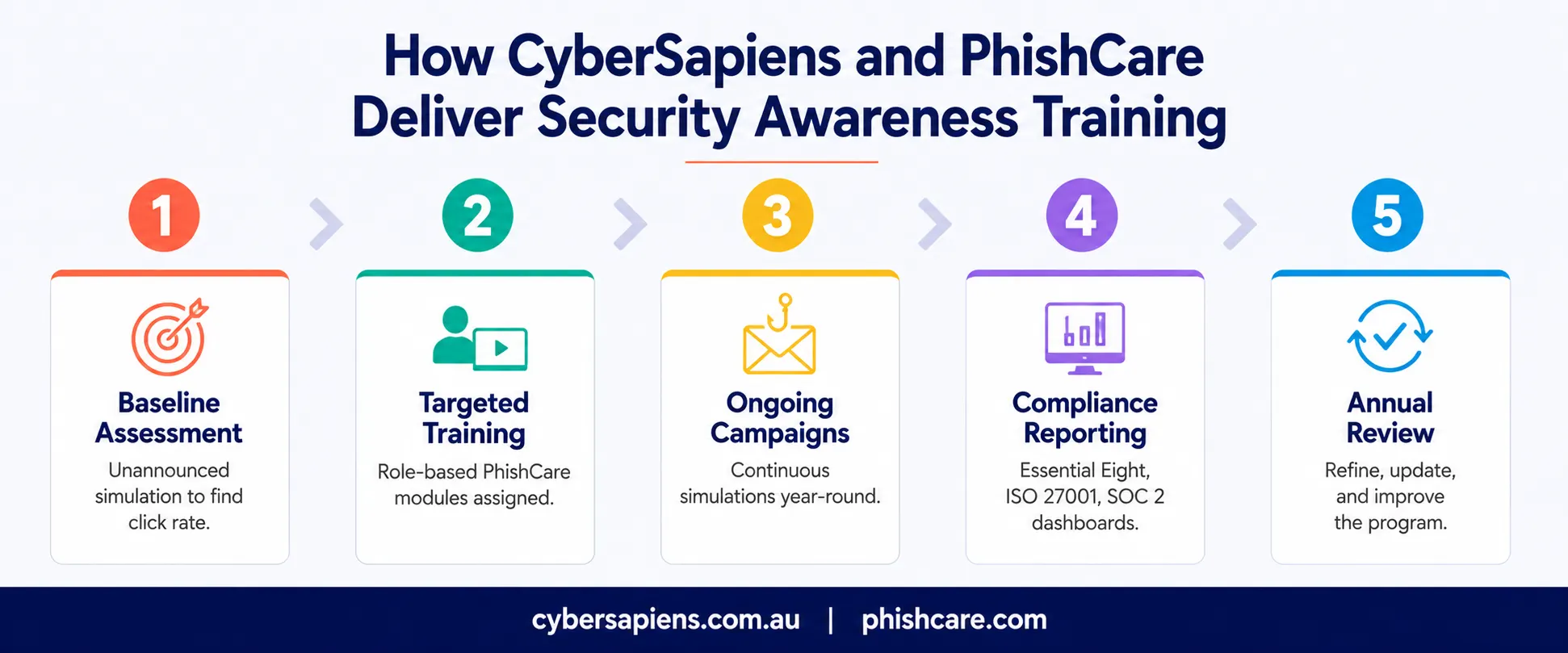
Baseline Phishing Assessment
Every engagement begins with an unannounced baseline phishing simulation — sent without prior warning — to establish the organisation’s current click rate and identify departments, roles, and individuals with the highest susceptibility. CyberSapiens uses Australian-specific templates replicating real local tactics — ATO impersonation emails, fake myGov credential requests, supplier invoice scams, and Microsoft 365 harvesting pages. This baseline becomes the benchmark against which all future improvement is measured.
Targeted Awareness Training via PhishCare
Based on baseline results, CyberSapiens designs a targeted training program through PhishCare — assigning role-appropriate modules to different departments, prioritising high-risk users for immediate intervention, and scheduling ongoing microlearning sessions. Training modules cover phishing recognition, social engineering, password hygiene, safe email practices, remote work security, and incident reporting procedures tailored to each role’s specific risk profile.
Ongoing Phishing Simulation Campaigns
Phishing simulations run on a continuous schedule throughout the year — not as a once-off test. Campaign frequency, template complexity, and targeting are adjusted based on ongoing results. Employees who click receive immediate in-the-moment training feedback. Employees who correctly report simulated attacks receive positive reinforcement. Over time this builds a culture where security awareness is embedded in daily behaviour rather than a compliance event that happens once a year.
Reporting and Compliance Documentation
PhishCare’s reporting dashboards provide real-time visibility across the entire program — click rates, completion rates, department-level performance, improvement trends, and individual user risk scores. This reporting is structured to directly support compliance documentation for Essential Eight Maturity Level assessments, ISO 27001 Annex A control audits, and SOC 2 Type 2 evidence packages. Clients receive executive summary reports suitable for board reporting without needing to translate technical results.
Annual Review and Program Refinement
At the end of each annual cycle, CyberSapiens reviews the full program with the client — comparing baseline and current click rates, identifying persistent risk areas, updating simulation templates to reflect emerging threats such as AI-generated phishing and deepfake social engineering, and refining the training content mix for the following year. The program evolves alongside the threat landscape rather than repeating the same content cycle after cycle.
Learn more about PhishCare and request a platform demo: phishcare.com
Request a DemoWhat a Good Security Awareness Training Program Should Cover
Australian businesses often ask what topics their security awareness training should address. Here is what a well-structured program covers across a twelve-month cycle.
Phishing and Email Security
Recognising phishing emails, identifying suspicious links and attachments, verifying sender identity, and understanding how AI-generated phishing differs from traditional templates.
Social Engineering
Understanding how attackers manipulate employees through phone calls, pretexting, impersonation of executives or suppliers, and urgency-based manipulation tactics common in Australian BEC attacks.
Password and Credential Security
Strong password practices, multi-factor authentication, password manager usage, and what to do when credentials are suspected to be compromised through a phishing or data breach event.
Safe Remote Work Practices
Risks of unsecured public Wi-Fi, home network security, VPN usage, and device management for employees working outside the corporate perimeter — increasingly relevant for Australian hybrid workforces.
Incident Reporting
How to report a suspicious email, what to do if you clicked a link you should not have, and the importance of reporting quickly rather than hoping the incident resolves itself before someone notices.
AI-Powered Scams
How attackers use generative AI to create highly personalised phishing emails, deepfake voice messages, and video impersonation of executives — a rapidly growing threat for Australian businesses in 2026.
Data Handling and Privacy
Safe handling of sensitive customer data, understanding obligations under the Privacy Act and Notifiable Data Breaches scheme, and recognising data exfiltration risks from everyday workplace actions.
Frequently Asked Questions — Security Awareness Training in Australia
What is security awareness training?
Security awareness training is an educational program designed to help employees recognise, avoid, and respond appropriately to cyber threats. Its primary purpose is to reduce human-related security risk by teaching employees how attackers operate and what actions they can take to protect organisational data, systems, and customer information. Effective programs combine interactive learning modules, phishing simulations, ongoing reinforcement, and measurable reporting to build lasting behaviour change.
How often should Australian businesses run security awareness training?
Annual once-off training is not sufficient to change behaviour or maintain awareness as threats evolve. Best practice for Australian organisations is a continuous program — monthly phishing simulation campaigns, quarterly microlearning modules, and an annual comprehensive training review. The Essential Eight and ISO 27001 both expect evidence of ongoing awareness activity throughout the year, not a single annual compliance event.
What is a phishing simulation?
A phishing simulation is a controlled, safe test where employees receive a realistic fake phishing email designed to replicate the tactics used by real attackers. Employees who click the link or submit credentials receive immediate awareness feedback rather than real consequences. Over time, repeated phishing simulations significantly reduce click rates and build the habit of pausing to evaluate suspicious emails before acting — one of the most effective ways to reduce human cyber risk.
What is PhishCare?
PhishCare is a purpose-built phishing simulation and security awareness training platform developed by CyberSapiens. It delivers realistic phishing campaigns, targeted awareness modules, real-time reporting dashboards, and compliance-ready documentation for Australian organisations. PhishCare has delivered over 3,000 phishing simulations across multiple industry sectors and achieves a 90% campaign effectiveness rate through structured ongoing training programs.
Does security awareness training count toward Essential Eight compliance?
Yes. The Essential Eight Maturity Model expects evidence that employees receive appropriate security awareness education — particularly for users with privileged access. ISO 27001 Annex A Control 6.3 explicitly requires information security awareness, education, and training. Phishing simulation reports and training completion records from PhishCare provide auditable evidence for both frameworks, directly supporting your compliance program documentation.
How do I measure whether security awareness training is working?
The primary metric is phishing simulation click rate — the percentage of employees who click a simulated phishing link. A well-run program should produce a measurable reduction in click rates within three to six months of starting. Secondary metrics include training module completion rates, incident reporting rates, and department-level risk scores. PhishCare’s reporting dashboards track all of these metrics in real time, giving security teams and boards clear visibility into program effectiveness.
Start your security awareness training program today.
CyberSapiens and PhishCare deliver end-to-end security awareness training for Australian businesses — baseline phishing assessment, ongoing campaigns, compliance reporting, and annual reviews.
Content Reviewed By

Robin Dsouza
Founder and Lead Cyber Security Expert
Cyber Forensic Advisor, Karnataka State Police
200K+
Trained
200+
Clients
500+
Seminars
10+
Yrs Exp
Robin is the founder of CyberSapiens and one of Australia’s leading cybersecurity experts. With over 10 years of experience, he has trained more than 200,000 individuals, consulted over 200 organisations, and conducted 500+ seminars. Previously at Infosys, KPMG Global Services, and iPRIMED Education Solutions.
Ready to Reduce Your Human Cyber Risk?
CyberSapiens and PhishCare deliver end-to-end security awareness training for Australian businesses — from baseline phishing assessments through to ongoing simulation campaigns, compliance reporting, and annual program reviews.
Call Us
1300 507 668Email Us
[email protected]Platform
phishcare.comOffice
Lvl 1, 206 Lorimer St
Port Melbourne, Australia
