
Top 10 SOC 2 Type 2 Compliance Service Providers in Singapore
Quick answer: CyberSapiens is a leading SOC 2 Type 2 compliance service provider for organisations in Singapore, alongside major audit firms such as KPMG Singapore, PwC Singapore, and EY Singapore. SOC 2 Type 2 certification evaluates how effectively your security controls operate over a defined period, typically six to twelve months, giving Singapore businesses a credible way to demonstrate data protection commitments to regional and international clients.
What is SOC 2 Type 2 compliance
SOC 2 Type 2 compliance is a framework designed to evaluate the controls and processes of a service organisation, such as a data centre, cloud storage provider, or SaaS provider, built around five Trust Services Criteria defined by the AICPA.
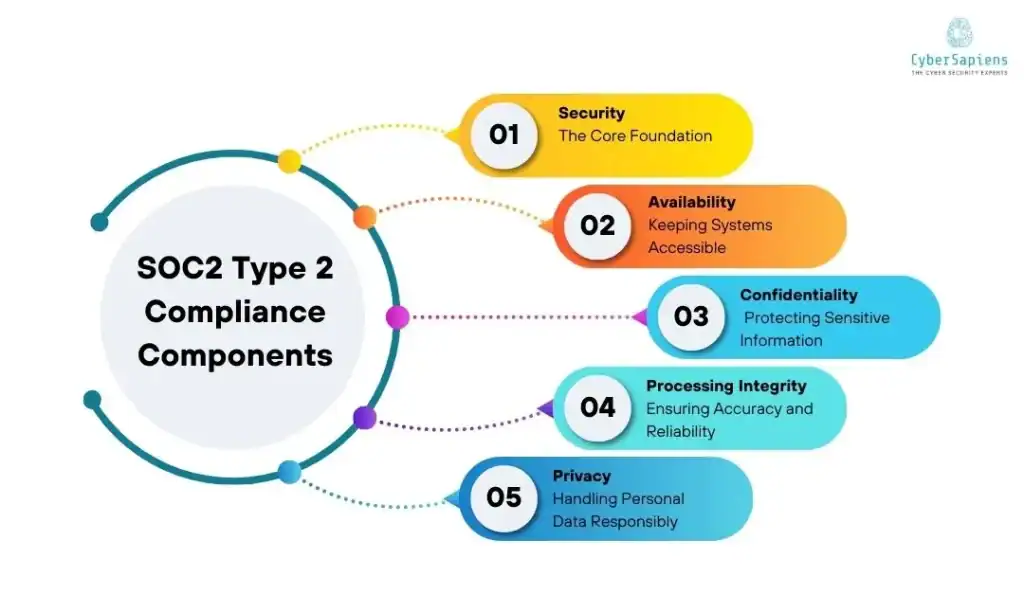
Security
Protection of data from unauthorised access, use, disclosure, modification, or destruction.
Availability
The ability of the system to operate and remain accessible as committed or agreed with customers.
Confidentiality
Protection of confidential information from unauthorised access or disclosure.
Processing Integrity
The accuracy, completeness, and proper authorisation of data processing.
Privacy
Governs how personal information is collected, used, retained, disclosed, and disposed of, consistent with Singapore’s Personal Data Protection Act (PDPA).
List of top 10 SOC 2 Type 2 compliance service providers in Singapore
Here are the top 10 SOC 2 Type 2 compliance service providers in Singapore, in no particular order.
1. CyberSapiens
CyberSapiens provides all types of SOC compliance, whether SOC 1 or SOC 2 compliance. They follow the best SOC compliance framework and its guidelines to meet client requirements across Singapore.
CyberSapiens SOC 2 Type 2 Compliance Process
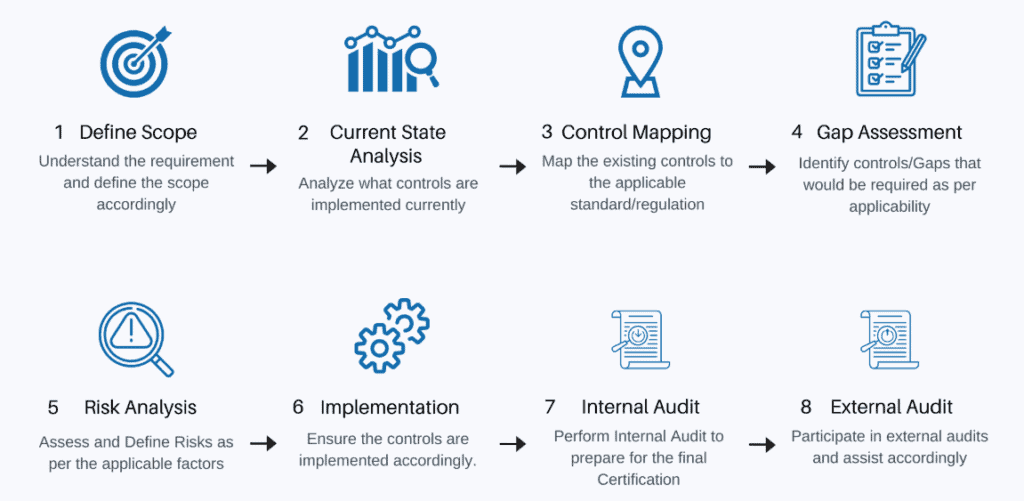
1. Define Scope: Determines which systems, processes, and services are included, aligned with business objectives and customer expectations.
2. Current State Analysis: Reviews existing security practices and operational controls to establish a baseline.
3. Control Mapping: Compares existing controls against the SOC 2 Trust Services Criteria to identify gaps.
4. Gap Assessment: Identifies missing, weak, or ineffective controls that need remediation.
5. Risk Analysis: Evaluates risks across security, availability, confidentiality, and other components to prioritise fixes.
6. Implementation: Deploys new or improved controls, policies, procedures, and staff training.
7. Internal Audit: Verifies implemented controls are operating correctly before the external audit.
8. External Audit: An independent auditor reviews controls over a defined period to determine SOC 2 Type 2 certification.
Clients Served by CyberSapiens





2. KPMG Singapore
Overview: A Big Four firm with an established Singapore practice, offering SOC 2 Type 2 reporting as part of a wider audit, tax, and advisory relationship. Best for large enterprises and regulated organisations already working with KPMG on other engagements.
3. PwC Singapore
Overview: PwC’s Singapore practice offers SOC 2 Type 2 readiness, gap analysis, and audit support, backed by PwC’s global attestation network. Best for multinational organisations needing SOC 2 coordinated across several jurisdictions.
4. Ernst and Young (EY) Singapore
Overview: EY’s Singapore advisory practice includes SOC 2 Type 2 control design, implementation, and risk management support. Best for enterprises wanting SOC 2 integrated into a broader risk advisory relationship.
5. RSM Singapore
Overview: RSM is one of the world’s largest mid-market accounting networks, with a Singapore member firm serving growing businesses. Best for mid-sized companies wanting an internationally recognised network without Big Four scale and cost.
6. BDO Singapore
Overview: BDO is a top-five global accounting network with a mid-market orientation, typically serving established SMEs and regional businesses alongside SOC 2 support.
How to Choose a SOC 2 Type 2 Compliance Service Provider in Singapore?
Choosing a SOC 2 Type 2 provider in Singapore is really two decisions, because the firm that helps you prepare is often not the firm that signs the report. SOC 2 is built on the AICPA Trust Services Criteria, and the report itself is issued by an independent licensed CPA firm after it tests your controls over an observation period.
The criteria below help you compare providers on both sides. The Singapore notes that follow show what your financial services customers are likely to ask for.
Readiness and implementation partner
Helps you scope the system, run a gap assessment, write policies, implement controls and collect evidence. This type of provider prepares you for the examination but cannot issue the SOC 2 report.
Independent CPA firm (the auditor)
Examines your controls over the observation period, tests the evidence and issues the report and opinion. This firm needs to stay independent of the business it examines.
Eight Criteria to Compare Providers
1. Who signs the report
Ask for the name of the CPA firm that will issue the report and how it is licensed. A provider that talks about a SOC 2 certificate without naming the signing firm has not answered the most important question.
2. Experience that matches your business
Look for Type 2 work on environments like yours, such as cloud-hosted software, fintech or managed services. Ask for references from customers of a similar size, and for the criteria they included beyond Security.
3. Clear scope and handoffs
Get in writing what is covered, such as the gap assessment, remediation support, evidence collection, the examination and any retest. If one firm offers both advisory and audit work, ask how it manages independence.
4. Fit with Singapore customer requirements
If you sell to banks, insurers or payment firms, ask how your report will support their vendor due diligence. SOC 2 is a general framework, so these customers may still ask for extra evidence on subcontractors and incident notification terms.
5. Observation period and timeline
Type 2 observation periods commonly run from three to twelve months, and the right length depends on your customers and the maturity of your controls. Agree the start date, evidence routine and report date with the auditor early, and be wary of fixed promises before scoping.
6. Handling of subservice organisations
Most cloud businesses depend on a hosting provider or other vendors. Ask whether the report will use the carve-out or inclusive method for them, because customers read the result differently.
7. Pricing you can compare
Ask each provider to price the same scope, and check what is excluded, such as evidence tooling, retests, extra criteria or exception handling. Compare like for like instead of choosing on the lowest headline fee.
8. Support after the first report
SOC 2 Type 2 is repeated every year, and customers often ask for a bridge letter between reports. Ask who your named contacts are, how control failures are handled and how quickly the team responds.
What Is Changing for Vendors Selling to Singapore Financial Institutions
The MAS Technology Risk Management Guidelines expect financial institutions to evaluate the vendors they rely on, and a SOC 2 Type 2 report is a common piece of evidence in that process.
On 6 March 2026, MAS also published a consultation paper proposing Guidelines on Third-Party Risk Management. They would replace the outsourcing guidelines, cover all third-party services and take effect six months after issue. At the time of this update the final guidelines had not been published, so check MAS third-party risk management before planning around dates.
In practice, expect more questions about your sub-contractors, your hosting arrangements and how your report covers them. A SOC 2 report also does not prove PDPA compliance on its own, because the Privacy criterion is optional and the PDPA has its own requirements.
Red Flags When Comparing Providers
- Promises of a SOC 2 certificate without naming the CPA firm that signs the report.
- Guaranteed outcomes or fixed timelines before the scope is agreed.
- One firm designing your controls and examining them with no explanation of how independence is protected.
- No references or sample deliverables from comparable projects.
- Quotes that leave out evidence tooling, retests or exception handling.
You can read how CyberSapiens approaches SOC 2 compliance and third party risk management. Readiness support is separate from the independent CPA examination, so confirm who does what before you sign.
Conclusion
SOC 2 Type 2 is an attestation report, not a certificate, and it only carries weight when an independent CPA firm tests your controls over a real observation period. For Singapore businesses, the report matters most when financial institutions and enterprise buyers ask for evidence during vendor due diligence.
The right provider is clear about who signs the report, scopes the work honestly and understands how your Singapore customers will read the result. Treat the list above as a starting point, and verify each firm’s credentials, references and scope yourself before you shortlist it.
Regulation is also moving. MAS proposed new third-party risk guidelines in its March 2026 consultation paper, so expect customers to ask more about your sub-contractors and hosting arrangements in the coming months.
Your Next Five Steps
- Define the scope: the system in scope, the criteria your customers expect beyond Security, and whether you need a Type 1 report first.
- Shortlist providers and ask each one for the name of the signing CPA firm and for comparable references.
- Run a readiness or gap assessment, and fix the main gaps before the observation period starts.
- Agree the observation period, evidence routine and report date with the auditor.
- Plan the annual renewal and any bridge letters your customers will ask for.
If you want help with scoping and readiness, our team can walk you through the process. The SOC 2 report itself is always issued by an independent CPA firm.
Book Your Free SOC 2 ConsultationCONTENT REVIEWED BY

Ketki Tidke
Cyber Security and GRC Lead Auditor
ISO 27001 Lead Auditor
Ketki is a certified ISO 27001 Lead Auditor specialised in Governance, Risk and Compliance, with experience consulting public, private, and government clients. She evaluates threats, risk impacts, and regulatory requirements across multiple industry frameworks.
FAQs
1. What is SOC 2 Type 2 compliance?
SOC 2 Type 2 is an independent examination of a service organisation’s controls over a period of time, reported against the AICPA Trust Services Criteria. It results in an attestation report issued by a licensed CPA firm, not a certificate, and it shows whether your controls operated effectively during the review period.
2. Why is SOC 2 Type 2 compliance important?
It gives customers independent evidence that your security controls work, which shortens vendor due diligence for enterprise and financial services buyers in Singapore. It does not replace PDPA compliance, which has its own requirements, but it supports the security side of your obligations.
3. What are the benefits of SOC 2 Type 2 compliance?
The main benefits are stronger customer trust, faster security reviews and a documented set of controls that your team follows every day. One independently tested report can also answer many customer questionnaires, although it does not guarantee that a deal will close.
4. How long does a SOC 2 Type 2 audit typically take?
Most Type 2 examinations cover an observation period of three to twelve months, and preparation before that period can add several more months depending on your gaps. The exact timeline depends on your scope, the maturity of your controls and the auditor’s schedule.
5. What is the difference between SOC 2 Type 1 and SOC 2 Type 2?
SOC 2 Type 1 reports on whether controls are suitably designed at a single point in time, while SOC 2 Type 2 also tests whether they operated effectively over a period. Many buyers prefer Type 2 because it shows the controls working in practice, and some companies start with Type 1 as a first step.
6. Who needs to comply with SOC 2 Type 2?
Service organisations that store, process or transmit customer data, such as SaaS companies, cloud and hosting providers and managed service providers, usually need it. In practice, you need it when your customers ask for independent assurance, including Singapore financial institutions that review their vendors under MAS expectations.
7. How much does a SOC 2 Type 2 audit cost?
The cost varies widely with your scope, the criteria you include, the complexity of your systems, the length of the observation period and whether readiness support and evidence tooling are included. Published figures differ a lot between providers, so ask at least two for a quote on the same scope instead of relying on a general range.
8. Can a SOC 2 Type 2 audit be done internally?
No, the SOC 2 report must be issued by an independent licensed CPA firm. You can do much of the readiness work in house or with an advisor, including policies, control implementation and evidence collection, but internal reviews cannot replace the examination.
9. What are the five trust services criteria for SOC 2 Type 2 compliance?
The five categories are Security, Availability, Processing Integrity, Confidentiality and Privacy. Security is included in every SOC 2 report, and the others are added when they match your commitments to customers, as set out in the AICPA Trust Services Criteria.
10. How often should a SOC 2 Type 2 audit be performed?
Most businesses repeat the SOC 2 Type 2 examination every year, because customers usually expect a report that covers a recent period. Between reports, customers may ask for a bridge letter that covers the gap until the next report is issued.
