
Top 10 Vulnerability Assessment and Penetration Testing Companies in Canada
Vulnerability Assessment and Penetration Testing (VAPT) are essential cybersecurity activities that help organisations identify, evaluate, and validate security weaknesses across IT infrastructure, applications, and networks. Vulnerability assessment focuses on systematically discovering potential flaws, while penetration testing validates those findings by ethically simulating real-world cyberattacks to determine actual risk and business impact.
In Canada’s rapidly evolving digital environment, VAPT has become a necessity rather than a choice. Increased cloud adoption, remote work, digital banking, healthcare digitisation, and stricter privacy and regulatory requirements have significantly expanded the attack surface. From financial services and government to healthcare, education, SaaS, and critical infrastructure, Canadian organisations must regularly assess their security posture to remain compliant, resilient, and trusted.
What is VAPT (Vulnerability Assessment and Penetration Testing)?
VAPT (Vulnerability Assessment and Penetration Testing) is a cybersecurity process used to identify, analyse, and validate security weaknesses in an organisation’s IT environment, including networks, systems, applications, APIs, and cloud infrastructure.
What Does VAPT Include?
1. Vulnerability Assessment (VA)
This involves systematically scanning and reviewing systems to detect known vulnerabilities such as misconfigurations, outdated software, weak credentials, missing patches, and insecure services. The objective is to identify potential security gaps before attackers can exploit them.
2. Penetration Testing (PT)
Penetration testing goes further by ethically exploiting identified vulnerabilities. Security professionals simulate real-world attack techniques to assess exploitability, data exposure, system impact, and overall business risk.
Why is VAPT Important?
- Identifies security weaknesses before attackers do.
- Validates real-world risk, not just theoretical issues.
- Helps meet regulatory and compliance requirements.
- Strengthens overall security posture.
- Reduces the likelihood of data breaches and financial loss.
Types of VAPT
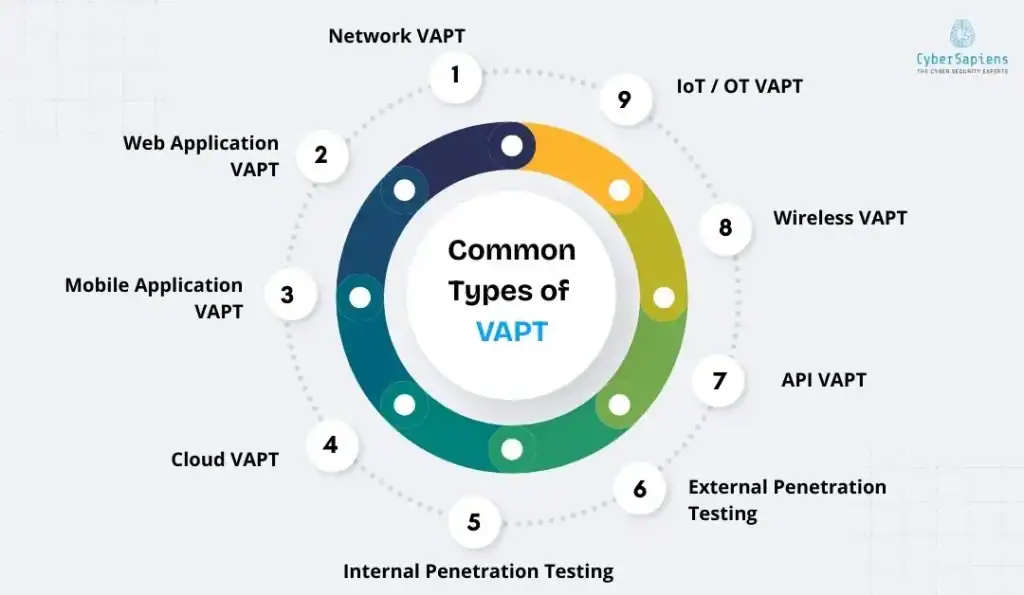
There are several types of Vulnerability Assessment and Penetration Testing (VAPT), each designed to assess different parts of an organisation’s IT environment. Together, they provide a comprehensive view of security risks.
Common Types of VAPT
- Network VAPT: Identifies open ports, insecure services, weak configurations, and network-level vulnerabilities.
- Web Application VAPT: Detects issues such as SQL injection, XSS, authentication flaws, broken access control, and insecure APIs.
- Mobile Application VAPT: Assesses Android and iOS apps for insecure storage, weak encryption, and API vulnerabilities.
- Cloud VAPT: Examines AWS, Azure, and GCP environments for misconfigurations, exposed storage, and IAM risks.
- Internal Penetration Testing: Simulates insider threats or compromised employee accounts.
- External Penetration Testing: Tests internet-facing systems from an external attacker’s perspective.
- API VAPT: Identifies authorisation issues, data exposure, rate-limiting flaws, and logic vulnerabilities.
- Wireless VAPT: Assesses Wi-Fi security, encryption strength, and rogue access points.
- IoT / OT VAPT: Evaluates connected devices and operational systems for firmware and protocol weaknesses.
Why Vulnerability Assessment and Penetration Testing (VAPT) Are Important for Canadian Businesses?
Vulnerability Assessment and Penetration Testing (VAPT) is essential for Canadian businesses as cyber threats continue to grow in scale, sophistication, and regulatory impact. Organisations across Canada increasingly rely on digital platforms, cloud services, and remote work environments, expanding their attack surface and exposure to security risks.
1. Rising Cyber Threats in Canada
Canada faces frequent ransomware, phishing, and supply-chain attacks across both public and private sectors. VAPT helps identify exploitable weaknesses before attackers do.
2. Compliance With Canadian Regulations
Canadian organisations must comply with regulations such as PIPEDA, provincial privacy laws, OSFI cybersecurity guidelines, and sector-specific requirements. Regular VAPT supports compliance and audit readiness.
3. Cloud Adoption and Remote Work
With widespread use of cloud services and hybrid work models, new attack surfaces emerge. VAPT helps secure cloud configurations, APIs, and internet-facing systems.
4. Protection of Sensitive Data
Industries such as BFSI, healthcare, telecom, and government manage highly sensitive personal and financial data. VAPT helps prevent breaches and reputational damage.
5. Business Continuity and Operational Resilience
Cyber incidents can disrupt services and customer trust. VAPT identifies weaknesses that could lead to ransomware or system compromise.
6. Building Customer and Partner Trust
Enterprises and global clients increasingly expect proof of security testing. Regular VAPT reports demonstrate due diligence.
7. Cost-Effective Risk Management
Fixing vulnerabilities early is far more cost-effective than responding to a breach, as remediation usually involves simple patches or configuration changes rather than expensive incident response, downtime, legal costs, and reputational damage.
How VAPT Helps Organisations Meet Compliance Standards?
Vulnerability Assessment and Penetration Testing (VAPT) supports compliance by verifying that security controls work effectively in real-world attack scenarios. It identifies compliance gaps, provides audit-ready evidence, and helps organisations meet standards such as ISO 27001, SOC 2, PCI DSS, HIPAA, and NIST while reducing security and regulatory risks.
1. Identifies compliance gaps early
Vulnerability Assessment and Penetration Testing (VAPT) helps organisations uncover gaps between documented security policies and actual technical implementation. By identifying missing controls, misconfigurations, and weak security practices early, organisations can address compliance issues before audits, regulatory reviews, or real-world attacks expose them.
2. Validates security controls in real-world attack scenarios
Unlike checklist-based compliance reviews, VAPT simulates realistic attacker techniques to test whether security controls actually work under pressure. This validates the effectiveness of firewalls, access controls, authentication mechanisms, monitoring tools, and incident response processes against real-world threats.
3. Provides audit-ready evidence and technical reports
VAPT engagements produce detailed, defensible reports that include vulnerability findings, proof of exploitation, risk ratings, and remediation guidance. These reports serve as strong technical evidence during ISO, SOC, PCI, HIPAA, and regulatory audits, demonstrating that security testing is actively performed and documented.
4. Supports a risk-based compliance approach
By prioritising vulnerabilities based on exploitability, impact, and business risk, VAPT helps organisations focus remediation efforts where it matters most. This aligns security investments with risk-based compliance frameworks rather than treating all findings as equal, improving both efficiency and effectiveness.
5. Helps meet ISO 27001, SOC 2, PCI DSS, HIPAA, NIST, and Canadian regulatory requirements
Regular vulnerability assessments and penetration testing are explicitly required or strongly recommended across major global standards and regulations. VAPT directly supports control requirements related to risk assessment, technical testing, continuous monitoring, and security assurance across these frameworks.
6. Strengthens continuous compliance
Compliance is not a one-time activity. Ongoing VAPT helps organisations maintain compliance throughout the year by continuously identifying new risks introduced by system changes, cloud migrations, application updates, and evolving threat landscapes.
7. Reduces breach and regulatory penalty risk
By proactively identifying and remediating exploitable vulnerabilities, VAPT significantly reduces the likelihood of data breaches, service disruptions, and regulatory violations. This lowers the risk of financial penalties, legal consequences, reputational damage, and loss of customer trust.
Top 10 Vulnerability Assessment and Penetration Testing Companies in Canada
1. CyberSapiens
CyberSapiens delivers end-to-end VAPT services across Canada, combining automated discovery with deep manual penetration testing. Their compliance-ready reporting aligns with ISO 27001, SOC 2, PCI DSS, HIPAA, and Canadian regulatory expectations.
CyberSapiens Vulnerability Assessment & Penetration Testing (VAPT) Services
1. Web Application VAPT
CyberSapiens delivers detailed security assessments of web applications to uncover exploitable weaknesses. Testing covers OWASP Top 10 vulnerabilities such as SQL injection, XSS, authentication and access control flaws, and insecure session handling to ensure resilience against real-world attacks.1.
2. Mobile Application VAPT
This service evaluates Android and iOS applications for security risks, including insecure data storage, weak encryption, unsafe API usage, reverse engineering threats, and authentication issues. Both static and dynamic analysis are used across the application lifecycle.
3. Cloud VAPT
CyberSapiens assesses cloud environments on AWS, Azure, and Google Cloud to identify misconfigurations, exposed assets, weak access controls, insecure storage, and identity-related risks, aligned with cloud security best practices.
4. IoT Device VAPT
IoT Device VAPT focuses on securing connected devices, firmware, and communication protocols by testing for authentication weaknesses, insecure updates, exposed interfaces, embedded credentials, and data interception risks.
5. Infrastructure VAPT
This service examines servers, operating systems, databases, and internal systems to identify unpatched software, insecure configurations, privilege escalation paths, and exposed services across on-premise and hybrid environments.
5. API VAPT
API VAPT secures backend services and integrations by identifying authentication flaws, excessive data exposure, inadequate rate limiting, injection vulnerabilities, and business logic abuse—critical for microservices and third-party integrations.
6. Network VAPT
Network VAPT evaluates internal and external networks for open ports, poor segmentation, insecure protocols, firewall misconfigurations, and lateral movement risks to prevent unauthorised access.
7. Thick Client and Thin Client VAPT
This service assesses desktop and browser-based client applications for insecure communications, client-side logic flaws, weak authentication, and reverse engineering risks, ensuring secure interaction with backend systems.
Clients Served by CyberSapiens





2. eSentire
eSentire provides penetration testing and vulnerability assessment services that integrate closely with its Managed Detection and Response (MDR) offerings. This approach helps enterprise clients not only identify vulnerabilities but also improve real-time detection, response, and threat containment across complex IT environments.
3. Packetlabs
Packetlabs specialises in hands-on penetration testing across networks, applications, APIs, and cloud environments. Their technical-led approach focuses on deep manual testing to uncover real-world exploitable vulnerabilities rather than relying solely on automated scans.
4. Mandiant
Mandiant delivers advanced penetration testing and red team services supported by global threat intelligence. Their testing simulates sophisticated threat actors, helping organisations assess detection capabilities, incident response readiness, and resilience against advanced attacks.
5. KPMG Canada
KPMG Canada offers risk-based VAPT services aligned with audit, regulatory, and compliance requirements. Their approach combines technical testing with governance, risk, and compliance (GRC) expertise, making it well-suited for regulated industries and large enterprises.
6. EY Canada
EY Canada provides penetration testing, vulnerability assessments, and red team services integrated with broader risk advisory. Their services help organisations strengthen security while aligning remediation efforts with regulatory expectations and business risk management.
7. Deloitte Canada
Deloitte Canada delivers large-scale VAPT engagements for complex enterprise and government environments. Their testing spans applications, infrastructure, and cloud platforms, supported by strong reporting, compliance alignment, and risk advisory capabilities.
8. Trustwave
Trustwave offers global penetration testing services with strong expertise in PCI DSS and compliance-driven security testing. Their VAPT services are widely used by organisations handling payment data and operating in highly regulated environments.
9. Herjavec Group
Herjavec Group delivers vulnerability assessment and penetration testing services focused on enterprise risk reduction. Their approach emphasises identifying high-impact vulnerabilities that could lead to operational disruption, data breaches, or reputational damage.
10. Bishop Fox
Bishop Fox specialises in deep technical penetration testing, red teaming, and adversary simulation. Known for its offensive security expertise, the firm focuses on uncovering complex attack paths and testing how organisations respond to real-world threat scenarios.
Enhancing Cybersecurity with VAPT
Vulnerability Assessment and Penetration Testing are no longer optional for organisations operating in today’s threat landscape. Choosing the right VAPT partner helps Canadian businesses identify real risks, strengthen defences, and meet regulatory and compliance expectations with confidence. CyberSapiens enables organisations to move from reactive security to proactive risk management through structured testing and actionable insights.
FAQs
1. How often should organisations perform VAPT?
Answer: At least annually and after major changes such as new applications, cloud migrations, or infrastructure upgrades.
2. What systems can be tested under VAPT?
Answer: Web applications, mobile apps, APIs, cloud environments, networks, infrastructure, IoT devices, and internal systems.
3. Is VAPT mandatory for compliance in Canada?
Answer: Many standards and regulations strongly recommend or require regular VAPT, especially for regulated sectors.
4. Is VAPT only for large enterprises?
Answer: No. Startups and SMBs also require VAPT, particularly when handling sensitive data or operating cloud platforms.
5. Why choose a professional VAPT provider like CyberSapiens?
Answer: Professional providers deliver real-world attack simulation, compliance-ready reporting, and actionable remediation, not just automated scan results.
