

Top 10 vulnerability assessment and penetration testing companies in the UAE
Vulnerability Assessment and Penetration Testing (VAPT) are essential cybersecurity activities that help organisations uncover, evaluate, and confirm security gaps across their IT infrastructure, applications, and networks. Vulnerability assessment concentrates on methodically identifying potential weaknesses, while penetration testing validates those findings by ethically mimicking real-world cyberattacks to understand the actual level of risk and impact.
In the UAE’s fast-evolving digital landscape, VAPT has become a necessity rather than a choice. Accelerated digital transformation, widespread cloud adoption, tightening regulatory requirements, and a surge in targeted cyber threats demand a proactive approach to security testing. Whether in banking, government, healthcare, retail, or emerging startups, organisations must regularly evaluate their security posture to maintain compliance, reduce risk, and ensure long-term cyber resilience.
What is VAPT (Vulnerability Assessment and Penetration Testing)?
VAPT (Vulnerability Assessment and Penetration Testing) is a cybersecurity process used to identify, analyse, and validate security weaknesses in an organisation’s IT environment, including networks, systems, applications, and cloud infrastructure.
What does VAPT include?
1. Vulnerability Assessment (VA)
This focuses on systematically scanning and reviewing systems to detect known vulnerabilities such as misconfigurations, outdated software, weak passwords, and missing security patches. The goal is to create a clear list of potential security gaps before attackers can exploit them.
2. Penetration Testing (PT)
Penetration testing goes a step further by ethically simulating real-world cyberattacks. Security professionals attempt to exploit identified vulnerabilities to determine how serious they are, what data or systems could be compromised, and the real business impact of an attack.
Why is VAPT important?
- Identifies security weaknesses before attackers do.
- Validates actual risk, not just theoretical issues.
- Helps meet compliance and regulatory requirements.
- Strengthens overall security posture.
- Reduces the likelihood of data breaches and financial loss.
Types of VAPT
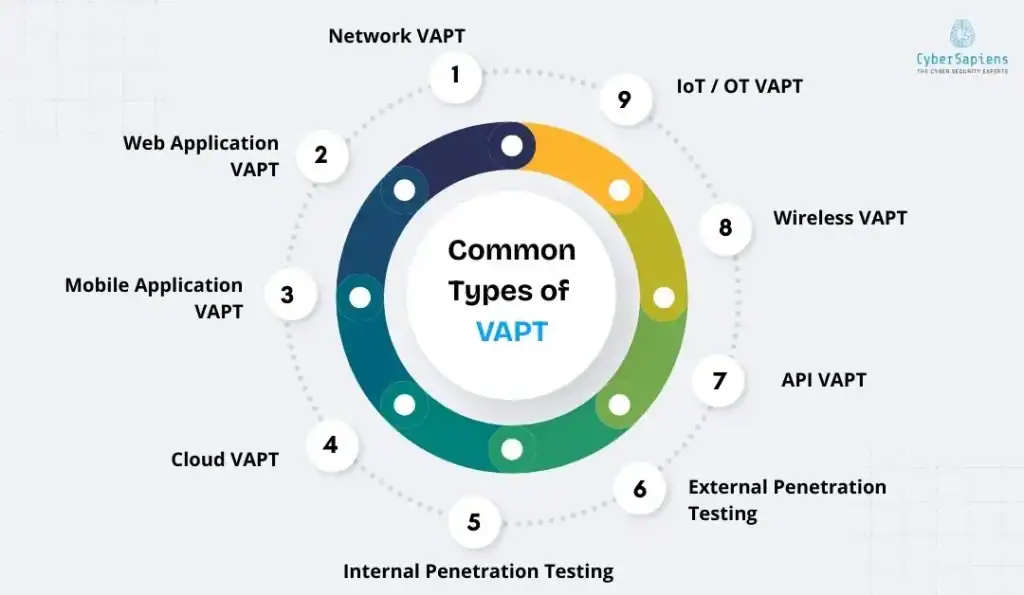
There are several types of Vulnerability Assessment and Penetration Testing (VAPT), each designed to test different parts of an organisation’s IT environment. Together, these provide a complete view of security risks.
Common Types of VAPT
1. Network VAPT: Assesses internal and external networks to identify open ports, insecure services, weak configurations, and exploitable network-level vulnerabilities.
2. Web Application VAPT: Focuses on web applications to detect issues such as SQL injection, cross-site scripting (XSS), authentication flaws, broken access control, and insecure APIs.
3. Mobile Application VAPT: Evaluates Android and iOS applications for insecure data storage, weak encryption, API vulnerabilities, improper authentication, and mobile-specific threats.
4. Cloud VAPT: Examines cloud environments (AWS, Azure, GCP) for misconfigurations, excessive permissions, exposed storage, insecure IAM roles, and shared responsibility gaps.
5. Internal Penetration Testing: Simulates attacks from within the organisation, such as a malicious insider or compromised employee account, to test lateral movement and privilege escalation.
6. External Penetration Testing: Test systems exposed to the internet to understand what an external attacker can access without internal credentials.
7. API VAPT: Targets application programming interfaces to identify authorization issues, data exposure, rate-limiting flaws, and logic vulnerabilities.
8. Wireless VAPT: Assesses Wi-Fi networks for weak encryption, rogue access points, insecure authentication, and unauthorized access risks.
9. IoT / OT VAPT: Evaluates Internet of Things and Operational Technology systems for insecure firmware, default credentials, exposed services, and protocol weaknesses.
Why Vulnerability Assessment and Penetration Testing(VAPT) are Important for UAE Businesses?
Vulnerability Assessment and Penetration Testing (VAPT) play a critical role in protecting UAE businesses against evolving cyber threats. Here’s why vulnerability assessment and penetration testing are important for UAE businesses.
1. Rising Cyber Threats in the Middle East
The UAE is a prime target for cybercriminals due to its strong financial sector, smart city initiatives, and advanced digital infrastructure. VAPT helps identify and fix vulnerabilities before attackers can exploit them.
2. Compliance With UAE Regulations and Standards
UAE organisations must meet requirements from frameworks and regulations such as NESA, UAE Information Assurance Standards, ADHICS, and sector-specific compliance mandates. Regular VAPT supports compliance by demonstrating proactive security testing and risk management.
3. Rapid Digital Transformation and Cloud Adoption
As UAE businesses increasingly adopt cloud services, SaaS platforms, and remote work models, new attack surfaces emerge. VAPT ensures cloud configurations, APIs, and internet-facing systems are securely implemented.
4. Protection of Sensitive and Financial Data
Industries such as banking, healthcare, oil & gas, and government handle highly sensitive data. VAPT helps prevent data breaches, financial losses, and reputational damage by validating real-world security risks.
5. Business Continuity and Operational Resilience
Cyber incidents can disrupt operations, supply chains, and customer services. VAPT identifies weaknesses that could lead to downtime, ransomware, or system compromise, helping organisations maintain continuity.
6. Building Customer and Partner Trust
Clients, regulators, and partners increasingly expect proof of strong cybersecurity practices. Regular VAPT reports demonstrate due diligence, improving trust and competitive positioning in the UAE market.
7. Cost-Effective Risk Management
Fixing vulnerabilities early through VAPT is significantly cheaper than responding to a breach. It helps prioritise remediation efforts based on real risk rather than assumptions.
How Vulnerability Assessment and Penetration Testing(VAPT) Help Organisations Meet Compliance Standards?
Vulnerability Assessment and Penetration Testing (VAPT) play a critical role in helping organisations meet regulatory and industry compliance requirements, such as:
- Identifies Compliance Gaps Early: Most regulations require organisations to identify and manage security risks. VAPT uncovers vulnerabilities, misconfigurations, and weak controls that may lead to non-compliance, allowing teams to address issues before audits or breaches occur.
- Validates Security Controls in Real Conditions: While policies and controls may exist on paper, penetration testing validates whether they actually work. By simulating real-world attacks, VAPT demonstrates that access controls, network security, application security, and monitoring mechanisms are effective.
- Provides Audit-Ready Evidence: Compliance frameworks often require proof of security testing. VAPT reports serve as documented evidence for auditors, showing identified risks, exploitation scenarios, impact analysis, and remediation actions taken.
- Supports Risk-Based Compliance Approach: Standards emphasise risk management rather than checkbox compliance. VAPT helps organisations prioritise remediation based on severity and business impact, aligning security efforts with compliance expectations.
- Helps Meet Multiple Regulatory Requirements: Many standards explicitly recommend or mandate regular vulnerability scanning and penetration testing. VAPT supports requirements across ISO, SOC, PCI DSS, HIPAA, frameworks, and regional regulations by fulfilling testing and continuous monitoring expectations.
- Strengthens Continuous Compliance: Compliance is ongoing, not a one-time activity. Regular VAPT helps organisations monitor changes in infrastructure, cloud environments, and applications, ensuring new vulnerabilities do not introduce compliance gaps over time.
- Reduces Breach and Non-Compliance Risk: By identifying and fixing exploitable weaknesses early, VAPT lowers the likelihood of security incidents that could lead to regulatory penalties, legal exposure, or reputational damage.
Top 10 Vulnerability Assessment and Penetration Testing Companies in the UAE
1. CyberSapiens
CyberSapiens stands out as a leading cybersecurity firm delivering end-to-end Vulnerability Assessment and Penetration Testing services across the UAE. Their approach combines automated vulnerability discovery with deep manual penetration testing to identify real-world exploitable risks across networks, web applications, mobile apps, APIs, cloud environments, and internal infrastructure. What differentiates CyberSapiens is their compliance-ready testing methodology, where VAPT findings are directly mapped to regulatory and security frameworks such as ISO 27001, SOC 2, PCI DSS, HIPAA, and regional cybersecurity requirements.
CyberSapiens Vulnerability Assessment & Penetration Testing (VAPT) Services
1. Web Application VAPT
CyberSapiens conducts in-depth security testing of web applications to identify vulnerabilities that could be exploited by attackers. This includes testing for OWASP Top 10 risks such as SQL injection, cross-site scripting (XSS), broken authentication, access control issues, and insecure session management. The goal is to ensure your web applications are resilient against real-world attacks.
2. Mobile Application VAPT
This service focuses on assessing the security of Android and iOS applications. CyberSapiens evaluates mobile apps for insecure data storage, weak encryption, insecure API usage, reverse engineering risks, and improper authentication. Both static and dynamic testing methods are used to identify vulnerabilities across the mobile application lifecycle.
3. Cloud VAPT
CyberSapiens performs security assessments of cloud environments hosted on platforms such as AWS, Azure, and Google Cloud. This includes identifying misconfigurations, exposed services, weak access controls, insecure storage, and identity-related risks. The testing aligns with cloud security best practices and shared responsibility models.
4. IoT Device VAPT
IoT Device VAPT evaluates the security of connected devices, firmware, and communication protocols. CyberSapiens tests for weak authentication, insecure firmware updates, exposed interfaces, hardcoded credentials, and data interception risks, helping organisations secure their IoT ecosystems from physical and remote attacks.
5. Infrastructure VAPT
Infrastructure VAPT assesses servers, operating systems, databases, and internal environments. CyberSapiens identifies vulnerabilities such as unpatched systems, weak configurations, privilege escalation paths, and exposed services, providing a clear view of risks across on-premise and hybrid infrastructures.
6. API VAPT
API VAPT focuses on securing backend services and integrations. CyberSapiens tests APIs for broken authentication, excessive data exposure, improper rate limiting, injection flaws, and logic abuse. This is critical for organisations using microservices, mobile apps, and third-party integrations.
7. Network VAPT
Network VAPT evaluates both internal and external networks to identify security weaknesses. CyberSapiens performs testing for open ports, weak network segmentation, insecure protocols, misconfigured firewalls, and lateral movement opportunities, helping prevent unauthorised access and internal compromise.
8. Thick Client and Thin Client VAPT
This service assesses desktop-based applications (thick clients) and browser-based client interfaces (thin clients). CyberSapiens tests for insecure communication, client-side logic flaws, weak authentication, and reverse engineering risks, ensuring secure interaction between client applications and backend systems.
Clients Served by CyberSapiens






2. DarkMatter Group
DarkMatter Group is a UAE-based cybersecurity provider known for its strong offensive and defensive security capabilities. Their penetration testing services focus on identifying advanced attack vectors, misconfigurations, and systemic weaknesses across enterprise networks and critical infrastructure.
3. Paramount Computer Systems
Paramount Computer Systems is a well-established cybersecurity company in the UAE offering enterprise-grade vulnerability assessment and penetration testing services. Their VAPT engagements typically cover network security, web and mobile application testing, database security, and cloud environments.
4. DeepStrike
DeepStrike provides modern penetration testing services, including Penetration Testing as a Service (PTaaS), enabling organisations to continuously assess their security posture rather than relying on one-time assessments. Their services cover infrastructure, application, API, and cloud security testing, with results aligned to global standards such as ISO 27001, NIST, and OWASP.
5. Wattlecorp
Wattlecorp is a regional cybersecurity firm offering comprehensive vulnerability assessment and advanced penetration testing services tailored for UAE businesses. Their testing scope includes internal and external network assessments, web and mobile application penetration testing, cloud security reviews, and social engineering simulations.
6. DTS Solution
DTS Solution specialises in network and application penetration testing along with vulnerability management services for organisations across the UAE. Their offerings typically include external and internal network testing, secure configuration reviews, and application security assessments.
7. Microminder Cyber Security
Microminder Cyber Security is known for delivering practical, cost-effective penetration testing and vulnerability assessment services, particularly for small to mid-sized organisations. Their services include infrastructure testing, web and mobile application security assessments, and basic cloud security reviews.
8. Factosecure
Factosecure offers advanced penetration testing services combined with threat intelligence and risk-based security assessments in Dubai and Abu Dhabi. Their VAPT services cover applications, networks, cloud platforms, and APIs, with a strong focus on identifying high-impact vulnerabilities that attackers are most likely to exploit.
9. Help AG (e& Enterprise)
Help AG, part of e& Enterprise, is a prominent regional cybersecurity services provider offering a broad portfolio that includes vulnerability assessment and penetration testing. Their VAPT services are typically integrated with managed security services, security architecture reviews, and SOC capabilities.
10. PenTest ME
PenTest ME is a Dubai-based penetration testing specialist focused on hands-on security testing services. Their offerings include infrastructure penetration testing, web and mobile application testing, internal threat simulations, and privilege escalation testing.
Strengthening Security Through VAPT
Vulnerability Assessment and Penetration Testing are no longer optional for organisations operating in today’s threat landscape, especially in a rapidly digitising region like the UAE. Choosing the right VAPT partner helps businesses identify real risks, strengthen defences, and meet regulatory and compliance expectations with confidence. CyberSapiens offers proven expertise, structured testing approaches, and actionable insights that enable organisations to move from reactive security to proactive risk management. Investing in the right VAPT services today is a critical step toward long-term resilience and trust.
FAQs: Top 10 Vulnerability Assessment and Penetration Testing Companies in the UAE
1. How often should organisations perform VAPT?
Answer: At least annually, and whenever there are major changes such as new applications, infrastructure upgrades, cloud migrations, or compliance requirements.
2. What systems can be tested under VAPT?
Answer: VAPT can cover web applications, mobile apps, APIs, cloud environments, networks, infrastructure, IoT devices, and internal systems.
3. Is VAPT mandatory for compliance?
Answer: Many standards and regulations, such as ISO 27001, SOC 2, PCI DSS, HIPAA, and regional frameworks, strongly recommend or mandate regular vulnerability assessments and penetration testing.
4. Is VAPT only for large enterprises?
Answer: No. Startups and small businesses also require VAPT, especially when dealing with customer data, cloud platforms, or regulatory requirements.
5. Why choose a professional VAPT provider like CyberSapiens?
Answer: Experienced providers deliver accurate testing, actionable remediation, compliance-ready reporting, and real-world attack simulation, not just automated scan results.
